Published on : 29 Sep 2026
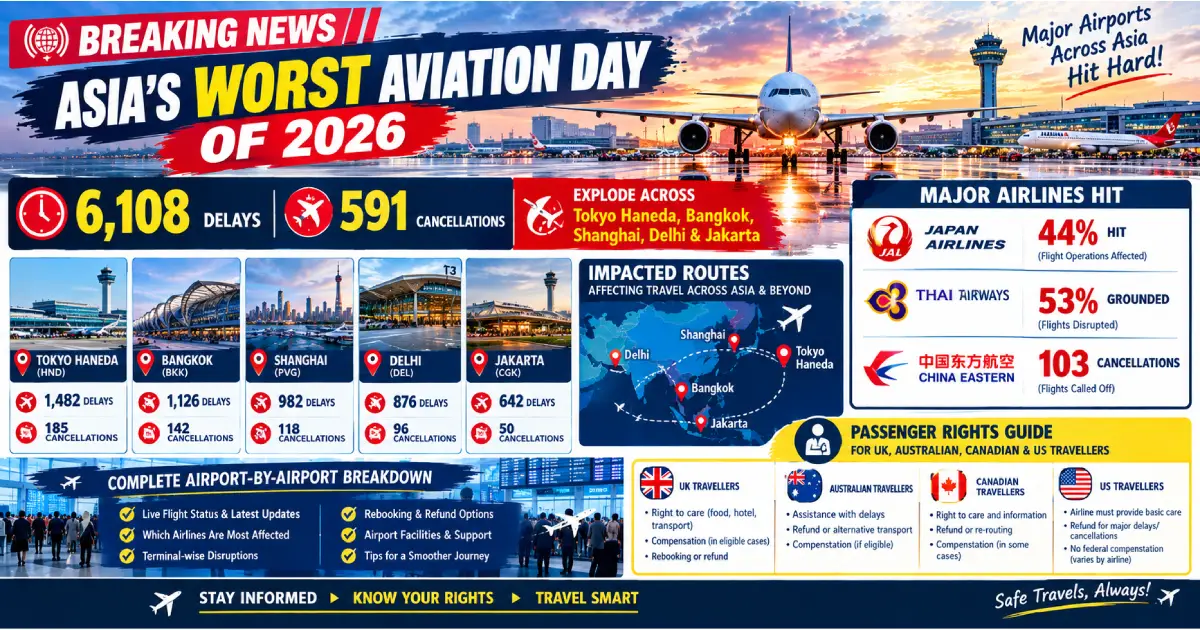
It is the single worst aviation disruption day recorded across the Asia-Pacific region in all of 2026. In one catastrophic 24-hour operational window, 6,108 flights across Asia have suffered delays and 591 have been outright cancelled — a cascade triggered by compounding weather fronts, air traffic control slot restrictions, and crew duty timeout failures rippling simultaneously across Japan, China, Thailand, India, and Southeast Asia. Tokyo Haneda alone has logged 650 delayed departures. Thai Airways has seen 53% of its entire scheduled operation hit. China Eastern has cancelled 103 flights. Every major hub from Shanghai Pudong to Jakarta Soekarno-Hatta is now operating under acute operational strain. If your flight today connects anywhere through Asia, this article is the only thing you need to read before you leave for the airport.
Date of disruption: Tuesday, September 29, 2026 — full 24-hour window Data source: FlightAware real-time airspace monitoring logs Total delays across Asia: 6,108 flights Total cancellations across Asia: 591 flights Worst-hit airport by delays: Tokyo Haneda — 650 delays, 11 cancellations Worst-hit airport by cancellations: Bangkok Suvarnabhumi — 327 delays, 46 cancellations Worst-hit airline by delay rate: Thai Airways — 53% of scheduled flights delayed Worst-hit airline by cancellations: China Eastern — 103 cancelled flights Primary causes: Compounding weather fronts, ATC slot restrictions, cascading crew duty timeouts Countries affected: Japan, China, Thailand, India, Indonesia, Vietnam, UAE Passengers at risk: Hundreds of thousands of connecting travellers across the Asia-Pacific corridor
Asia has experienced several significant disruption events in September 2026 — 4,331 delays on a single day earlier this month, 4,804 on another, 3,314 on a third. Today’s 6,108 delays and 591 cancellations is not simply the next entry in that sequence. It is a step-change in severity that aviation data analysts have not recorded since the post-pandemic recovery peaks of 2022.
The difference today is the breadth and simultaneity of the failure. Previous disruption events in September 2026 were concentrated in either mainland China or Southeast Asia, allowing airlines to reroute connecting traffic through unaffected hubs. Today, the disruption has hit every major Asian aviation corridor at the same time — Japan, China, Thailand, India, Indonesia, and Vietnam are all simultaneously reporting significant operational stress. There is no clean hub to reroute through. Airlines, crew schedulers, and airport operations teams are dealing with an interconnected cascade that has no easy exit.
What makes this particularly severe for UK, Australian, Canadian, and US travellers is the structural role Asia plays in connecting long-haul traffic. The flights that bring passengers from London, Sydney, Toronto, and New York into Asia — whether for onward connections to Southeast Asia, the Indian subcontinent, or domestic Japan and China — are largely arriving intact. It is the connections those passengers are trying to make within Asia that are disintegrating around them in real time.
Tokyo Haneda International Airport led regional disruption with 650 delayed flights and 11 cancellations, heavily impacting Japan Airlines with 346 delays representing 44% of its schedule, and All Nippon Airways with 224 delays representing 38% of operations.
Tokyo Haneda is the domestic hub of Japan’s aviation network — and today’s 650 delays there mean that the ripple effect has spread through every regional Japanese airport simultaneously. New Chitose Airport recorded 200 delays and 7 cancellations; Fukuoka 139 delays and 2 cancellations; and Osaka Itami 123 delays and 4 cancellations.
For UK and Australian travellers arriving into Tokyo on long-haul flights today: Your inbound aircraft is almost certainly arriving from Heathrow, Sydney, or Melbourne into Narita (NRT), not Haneda. However, if your itinerary routes you to Haneda for a domestic connection to Sapporo, Osaka, Fukuoka, or Okinawa — or if you are connecting at Haneda for an onward international departure — the 650 delay figure means your minimum safe buffer today is three hours, not the standard 60-90 minutes.
Critical passenger tip for Japan specifically: If domestic flights between Tokyo Haneda and Osaka Itami or Nagoya are cancelled, JAL and ANA both issue complimentary transfer endorsements onto JR Tokaido Shinkansen bullet trains — the 2h15 Tokyo–Osaka service. If your domestic Japan flight is cancelled today, do not rebook onto the next available flight. Walk to the JAL or ANA service desk and ask for a Shinkansen endorsement. This will get you to your destination faster than waiting for the next available domestic slot.
Bangkok Suvarnabhumi is today’s most severely disrupted airport in Southeast Asia by cancellation volume. Bangkok Suvarnabhumi recorded Southeast Asia’s highest cancellation volume with 327 delays and 46 cancellations, heavily impacting Thai Airways with 147 delays representing 53% of its flights and 44 cancellations.
Thai Airways’ 53% delay rate is the single most alarming airline-level statistic in today’s disruption data. When more than half of a major national carrier’s scheduled departures are delayed at its home hub, the airline’s ability to recover within the 24-hour window is severely compromised. Aircraft that should be positioned at Phuket for morning departures are stuck at Bangkok. Crew that should be resting at Chiang Mai are unable to depart from Bangkok. The cascade effect within the Thai Airways network will extend well into September 30.
For Australian travellers in particular: Bangkok Suvarnabhumi is the single most popular Asian transit hub for Australian passengers. Qantas, Jetstar, and Thai Airways all route significant Australian traffic through Bangkok. Any UK or Australian traveller with a connection at Bangkok today should plan for a minimum 3-hour connection buffer and check their bags go through to final destination before boarding — not at Bangkok.
Phuket International Airport recorded 48 delays and 4 cancellations. Travellers flying direct to Phuket for holidays — one of the most popular Australian and UK leisure destinations — will find check-in and boarding processes slower than normal today as Thai Airways and other carriers divert operational resources to manage the Bangkok crisis.
Jakarta Soekarno-Hatta recorded 193 delays and 19 cancellations, continuing a pattern of elevated disruption that has hit the Indonesian hub repeatedly throughout September 2026. Jakarta’s particular vulnerability is gate congestion and domestic narrowbody fleet displacement — when regional Indonesian routes are disrupted, the knock-on effect cascades through the island-hopping network that connects Bali, Surabaya, Makassar, and Lombok.
For travellers flying into Bali’s Ngurah Rai International Airport today: Bali’s own disruption footprint is smaller than Jakarta’s, but the aircraft serving Bali’s regional connections with Jakarta are increasingly arriving late today, compressing turnaround times at one of Asia’s fastest-growing leisure airports.
Hanoi Noi Bai recorded 125 delays and 11 cancellations, with Da Nang recording 63 delays and 8 cancellations. Vietnam’s aviation disruption today is disproportionately affecting leisure routes popular with UK and Australian travellers — the Hanoi and Da Nang corridors are primary gateways to northern and central Vietnam’s most visited destinations.
China’s contribution to today’s disruption is the largest in absolute volume. Mainland carriers absorbed significant cancellation numbers, led by China Eastern with 311 delays and 103 cancellations, and Air China with 131 delays and 78 cancellations.
China Eastern’s 103 cancellations alone account for 17.4% of all cancellations recorded across Asia today. The scale of China Eastern’s operational collapse today — concentrated across its Shanghai hub — is the primary driver of the Shanghai numbers.
Shanghai Pudong recorded 272 delays and 33 cancellations; Shanghai Hongqiao 93 delays and 44 cancellations; Shenzhen Bao’an 295 delays and 13 cancellations; Guangzhou Baiyun 279 delays and 26 cancellations; Beijing Capital 95 delays and 33 cancellations; and Chengdu Tianfu and Shuangliu airports a combined 178 delays and 45 cancellations.
For UK and Canadian travellers using Shanghai as an Asia gateway — whether for business connections into mainland China or for transit onto Southeast Asian routes — today’s data means both Pudong and Hongqiao are simultaneously stressed. There is no clean Shanghai alternative if your flight is caught in the disruption.
Air traffic control angle: Shanghai Pudong’s disruption today is classified as stemming from air traffic control flow management and airspace restrictions — not weather. This classification matters for passenger rights: ATC restrictions applied by Chinese civil aviation authorities are classified as extraordinary circumstances under most airline conditions of carriage, meaning compensation claims are less straightforward than for purely operational delays.
In India, Delhi Indira Gandhi International registered 228 delays and 13 cancellations, with IndiGo recording 183 delays and SpiceJet 22 delays, while Mumbai reported 75 delays.
Delhi’s disruption today is attributed to evening peak bank departures and runway maintenance throttling — a structural problem at Indira Gandhi International that has recurred throughout the September monsoon season. The airport’s runway maintenance programme, designed to resurface sections of its primary runways before the winter operating season, reduces effective runway capacity at precisely the moment daily departure banks are at their largest.
For UK travellers on Air India, British Airways, or Virgin Atlantic long-haul flights arriving into Delhi today: your inbound aircraft is almost certainly unaffected. It is the onward domestic connection within India — the Air India Express hop to Goa, the IndiGo service to Chennai or Bangalore — that carries the highest disruption risk today.
Transiting Gulf carriers also absorbed network holds, with Dubai International reporting 208 delays and Istanbul logging 210 delays.
Emirates flights delayed into and out of Asian hubs today are arriving late at Dubai, compressing turnaround windows for their onward European and UK connections. This is the mechanism through which today’s Asian disruption reaches UK, Australian, Canadian, and US passengers who are not even travelling to Asia — their Emirates or flydubai connection at Dubai is running late because the Asian inbound sector was delayed.
| Airline | Country | Delays | Delay Rate | Cancellations | Cancellation Rate |
|---|---|---|---|---|---|
| Japan Airlines | Japan | 346 | 44% | 4 | 0% |
| China Eastern | China | 311 | 12% | 103 | 4% |
| China Southern | China | 271 | 11% | 2 | 0% |
| All Nippon Airways | Japan | 224 | 38% | 5 | 0% |
| IndiGo | India | 183 | 9% | 5 | 0% |
| Thai Airways | Thailand | 147 | 53% | 44 | 15% |
| Shenzhen Airlines | China | 134 | 17% | 8 | 1% |
| Air China | China | 131 | 7% | 78 | 4% |
| ANA Wings | Japan | 119 | 32% | 6 | 1% |
| FlyDubai | UAE | 100 | 33% | 4 | 1% |
UK passengers whose flights depart from UK airports — Heathrow, Gatwick, Manchester, Edinburgh, Birmingham — are covered by UK Air Passenger Rights regulations (UK261), which mirrors EU261 in sterling compensation bands:
| Route Distance | Compensation |
|---|---|
| Under 1,500 km | £220 per passenger |
| 1,500 km to 3,500 km | £350 per passenger |
| Over 3,500 km (London to Tokyo, Bangkok, Delhi, Shanghai) | £520 per passenger |
Key condition: Compensation applies only for delays and cancellations caused by factors within the airline’s control. ATC restrictions and extreme weather are classified as extraordinary circumstances — meaning airlines will attempt to avoid compensation. However, crew duty timeout failures and aircraft rotation problems — both of which are driving significant portions of today’s disruption — are within the airline’s control and do not qualify as extraordinary circumstances.
File your claim here:
Australia does not have a blanket statutory compensation scheme equivalent to EU261. However, Australian Consumer Law requires airlines to provide:
For Australian travellers disrupted at Bangkok Suvarnabhumi or Jakarta today: Thai Civil Aviation Authority regulations require airlines to provide complimentary meals, refreshments, and hotel accommodation with ground transport for substantial overnight schedule delays. Do not wait for the airline to offer these proactively — present yourself at the airline service desk and request duty of care in writing.
Passengers departing from any EU airport on any airline are covered by EU Regulation 261/2004:
| Route Distance | Delay 3+ hours | Compensation |
|---|---|---|
| Under 1,500 km | €250 per passenger | |
| 1,500–3,500 km | €400 per passenger | |
| Over 3,500 km | €600 per passenger |
Canadian passengers are covered by APPR, which requires airlines to pay:
Japan Airlines, Thai Airways, China Eastern, and Air China are all classified as large airlines under APPR. File claims at: otc-cta.gc.ca
Action 1 — Open your airline’s app right now. Check your flight status before you leave for the airport. If you are connecting through Tokyo, Bangkok, Shanghai, Delhi, or Jakarta today, your flight is in the disruption zone.
Action 2 — Rebuild your connection buffer. Any Asia connection shorter than 3 hours today should be treated as a missed-connection risk. Contact your airline now and request a rebooking onto a later connecting flight.
Action 3 — Travel carry-on only if possible. Baggage handling at Bangkok, Shanghai, and Jakarta is under maximum pressure today. Checked bags are the highest single risk factor for a disrupted journey today.
Action 4 — Screenshot everything. Screenshot every delay notification, gate change, and cancellation message from your airline’s app. This is your documentary evidence for a compensation claim.
Action 5 — Request duty of care at 2 hours. The moment your delay exceeds 2 hours, go to your airline’s gate or service desk and request meal vouchers. Do not wait for the airline to offer them.
Action 6 — Ask for hotel if you are stranded overnight. If your delay forces an overnight stay at Bangkok, Tokyo, Shanghai, or Delhi, the airline is obligated to provide accommodation and ground transport under Thai, Japanese, Chinese, and Indian civil aviation regulations respectively.
Action 7 — In Japan specifically, ask for Shinkansen. If domestic flights between Tokyo Haneda and Osaka Itami or Nagoya are cancelled, inquire with JAL or ANA regarding complimentary transfer endorsements onto JR Tokaido Shinkansen bullet trains.
Action 8 — In Thailand, request transit hotel access. If delayed overnight at Bangkok Suvarnabhumi, request airline-funded day rooms inside terminal transit zones to avoid clearing immigration and customs lines.
Action 9 — Never accept a voucher in place of cash. For cancelled flights departing EU or UK airports, you are entitled to a full cash refund to your original payment method within 7 days. Airlines routinely offer travel vouchers instead — decline them and state clearly that you are requesting a cash refund under EU261 or UK261.
Action 10 — Save these emergency contacts before you board.
| Airline | Disruption Contact |
|---|---|
| Japan Airlines | jal.com → My Booking | UK: 0344 856 9701 |
| All Nippon Airways | ana.co.jp → My Reservations | UK: 0208 745 1741 |
| Thai Airways | thaiairways.com → Manage Booking | UK: 020 7499 9113 |
| China Eastern | us.ceair.com → Manage Booking | US: 1-800-200-5118 |
| Air China | airchina.com → Manage Booking | UK: 020 7744 0800 |
| IndiGo | goindigo.in → Manage Booking | India: 6360-0-38888 |
| Emirates | emirates.com → Manage | UK: 0344 800 2777 |
| FlightAware live tracker | flightaware.com |
| UK CAA claims | caa.co.uk/passengers |
| No-win-no-fee EU261 | airhelp.com or airadvisor.com |
September 2026 has produced the most sustained wave of Asian aviation disruption since 2022. The data from FlightAware tells a clear story: disruption events that previously peaked at 3,000–4,000 delays earlier in the month have now reached 6,108 in a single day. The trajectory is worsening, not improving, as the month closes.
Three structural factors are driving this acceleration. First, September marks the tail end of Asia’s monsoon season — weather-driven disruptions from Delhi’s runway flooding and Bangkok’s convective storms are occurring simultaneously rather than sequentially. Second, aircraft and crew rotation cycles that were disrupted in early September have not fully recovered, meaning the network is carrying accumulated delays into each new operating day with a deficit already built in. Third, Chinese airspace management has imposed tighter flow controls through September as civil aviation authorities manage the transition between summer and winter slot allocations — a routine annual process that, under normal conditions, causes a short-term disruption, but under this month’s accumulated pressure, has contributed to a much larger cascade.
Asia’s commercial flight corridors represent some of the highest-density airspace routes on earth, linking megalopolises of tens of millions of residents. When regional convective weather patterns or military airspace restrictions force sudden holding patterns, narrow departure corridors quickly reach maximum capacity.
The advice for passengers with Asia travel planned in the coming days is straightforward: book wide connections, carry on if you can, and monitor your airline’s app daily. Today’s 6,108-delay event is not a one-off. It is the product of a system under accumulated stress — and that stress does not resolve overnight.
Monitor this page for updates throughout September 29. FlightAware data refreshes every 15 minutes and we will update the airport tables as the picture evolves.
For More Resources:
Related Articles:
Posted By : Vinay
This article is provided for general informational purposes only and is based on information available at the time of publication. Travel advisories, airline schedules, airport operations, visa requirements, government regulations, and other travel-related information are subject to change without prior notice. While Travel Tourister makes reasonable efforts to verify information using official announcements, government publications, airline and airport communications, and other reliable sources, we cannot guarantee that all information remains complete, accurate, or up to date at all times. Readers should independently verify any information that may affect their travel plans with the relevant airline, airport authority, government agency, embassy, or other official source before making travel, financial, or other decisions. Travel Tourister shall not be liable for any direct or indirect loss, inconvenience, or damages arising from the use of or reliance on the information contained in this article. Nothing in this publication constitutes legal, immigration, financial, or professional travel advice. If you believe any information in this article is inaccurate or outdated, please contact our editorial team. We review all credible correction requests promptly and update our content whenever appropriate.
Lastest News
2nd Floor, 39, Above Kirti Club, DLF Industrial Area, Kirti Nagar, New Delhi, Delhi 110015



Travel Tourister is a leading Travel portal where we introduce travellers to trusted travel agents to make their journey hasselfree, memorable And happy. Travel Tourister is a platform where travellers get Tour packages ,Hotel packages deals through trusted travel companies And hoteliers who are working with us across the world. We always try to find new and more travel agents and hoteliers from every nook and corners across the world so that you could compare the deals with different travel agents and hoteliers and book your tour or hotel with the one you have chosen according to your taste and budget.
Copyright © Travel Tourister, India. All Rights Reserved

 Call
Call Enquiry