Published on : 27 May 2026
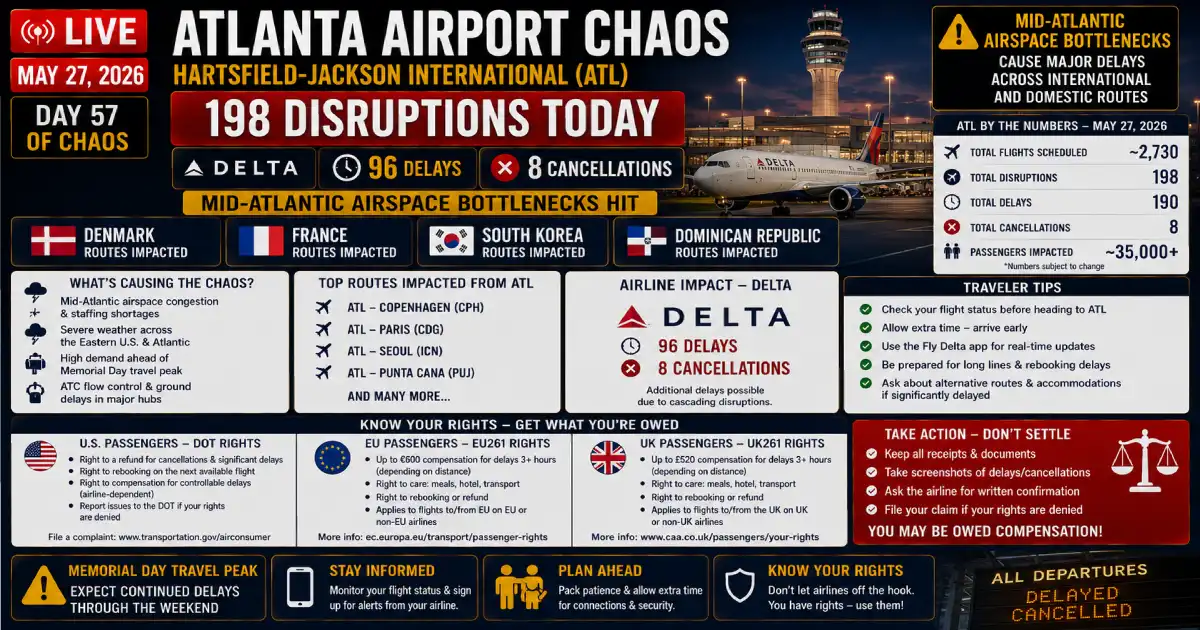
Hartsfield-Jackson Atlanta International Airport enters Day 57 of America’s longest aviation crisis with 198 total disruptions — 190 delays and 8 cancellations — as severe mid-Atlantic airspace bottlenecks create a new disruption mechanism that extends Atlanta’s cascade far beyond the usual domestic US network. Today’s operational challenges were caused by a combination of tightly linked flight schedules at the hub, severe mid-Atlantic airspace bottlenecks and localized hub constraints that sparked sudden travel disruptions, ultimately creating a sweeping ripple effect impacting high-volume routes across the US, Denmark, France, South Korea, and the Dominican Republic. Delta Air Lines — Atlanta’s dominant carrier controlling approximately 60–75% of all ATL movements — is recording 96 delays today: a notable figure that tells two stories simultaneously. The first: Atlanta is still significantly disrupted 57 days into the crisis. The second: Delta’s 96 delays against the airport’s 190 total means the airline is performing proportionally better than on the crisis’s worst days — but the mid-Atlantic airspace bottleneck is introducing a new variable that domestic cascades cannot explain. If you are flying through Atlanta today — on any carrier, to any destination — this is your complete guide.
Published: May 27, 2026 🔴 ACTIVE DISRUPTION — Wednesday (Day 57) Airport: Hartsfield-Jackson Atlanta International Airport (ATL) — Georgia, USA Day in Post-Easter Crisis: Day 57 — 57 consecutive elevated disruption days since Good Friday April 1, 2026 Total Disruptions: 198 (190 delays + 8 cancellations) Primary Cause: Severe mid-Atlantic airspace bottlenecks + localized hub constraints Worst Carrier by Delays: Delta Air Lines — 96 delays (50.5% of all ATL delays) Cancellations: 8 total — Delta, American, and international carriers International Routes Disrupted: Copenhagen/Denmark · Paris CDG (France) · Incheon/Seoul (South Korea) · Santo Domingo (Dominican Republic) · Toronto Pearson (Canada) · Amsterdam (Netherlands) · Zurich (Switzerland) · Mexico City (Mexico) Also Disrupted: Lufthansa · Air France · WestJet · Etihad Airways · United Airlines · JetBlue · American Airlines Cascade Airports: Chicago O’Hare (ORD) · Orlando (MCO) · Denver (DEN) · Dallas-Fort Worth (DFW) · Philadelphia (PHL) · JFK New York · Toronto Pearson (YYZ) · San Francisco (SFO) · Minneapolis-St. Paul (MSP) DOT Cash Refund: ✅ Mandatory — all 8 ATL cancellations entitle passengers to full cash refund EU261 Rights: ✅ Applies at European departure airports — up to €600/person UK261 Rights: ✅ Applies at UK departure airports — up to £520/person APPR Rights: ✅ Applies to Toronto (YYZ) connections — CAD $400–$1,000/person Delta Travel Waiver: Check delta.com/travel-alerts
Every disruption day at Atlanta has a root cause. The pattern through May 2026 has been remarkably consistent: Texas thunderstorms, Chicago cascade, Memorial Day volume surge, crew duty-time violations, or positioning failures from the previous day’s chaos. Today’s cause is different — and more geographically complex.
Severe mid-Atlantic airspace bottlenecks and localized hub constraints sparked today’s travel disruptions. Because severe weather and air traffic control restrictions slowed down incoming flights, planes could not depart on time. The scheduling changes are actively impacting high-volume routes across the US, Denmark, France, South Korea, and the Dominican Republic.
The mid-Atlantic airspace corridor — the stretch of North American and North Atlantic airspace through which transatlantic flights route — has been under elevated pressure since the Strait of Hormuz crisis rerouted significant traffic away from Middle Eastern overflights. Airlines forced to take longer northern Atlantic tracks have been increasing their slot demands in the North Atlantic Organised Track System (NAT-OTS), creating congestion on the most heavily used oceanic corridors.
When mid-Atlantic airspace bottlenecks develop, the cascade mechanism at Atlanta works in reverse compared to normal domestic disruption days:
Normal domestic cascade: Storm at Dallas → aircraft can’t arrive at Atlanta → Atlanta flights delayed → cascade spreads west-to-east.
Today’s mid-Atlantic cascade: Airspace bottleneck slows transatlantic inbounds → Delta’s widebody aircraft operating ATL–CDG, ATL–CPH, and ATL–ICN arrive late at their European or Asian endpoints → those aircraft cannot depart for the return Atlanta leg on time → they arrive late into Atlanta → Delta’s afternoon domestic banks start late → 96 delays build through the day.
This mechanism means Atlanta’s 190 delays today are not primarily the result of anything happening in Georgia, or in Texas, or anywhere in the United States. They are the downstream expression of airspace congestion 4,000 miles away in the North Atlantic.
Delta’s 96 delays today require context to interpret correctly. Here is what 96 means — and what it doesn’t.
What 96 delays means: Delta had 96 flights today that departed or arrived at Atlanta more than 15 minutes behind schedule. At an airport where Delta operates approximately 1,000–1,200 daily movements, 96 delays represents a delay rate of approximately 8–10%. That is significantly above the 2–4% that would constitute a “normal” operating day.
What 96 delays doesn’t mean — compared to Atlanta’s worst days:
| Date | Delta ATL Delays | Delta ATL Cancels | Context |
|---|---|---|---|
| May 4 | 261 | 103 | Crew crisis peak — Spirit collapse |
| May 6 | 628 | 22 | Worst single carrier day of the crisis |
| May 25 (Memorial Day) | 250 (cancellations) | 250 | Memorial Day Sunday peak |
| May 26 | 254 | 13 | Post-Memorial Day recovery |
| May 27 (today) | 96 | ~5 | Mid-Atlantic bottleneck — elevated but not crisis |
Today’s 96 delays represent a system in “sustained elevated disruption” rather than “acute crisis.” The mid-Atlantic airspace bottleneck is creating a new headwind, but Delta’s domestic positioning has partially recovered from the Memorial Day meltdown. The 8 total ATL cancellations today — compared to 250 on May 25 — demonstrates that the airline has significantly rebuilt its crew and aircraft positioning buffers over the past 48 hours.
Delta Air Lines, as the primary hub tenant at ATL, bore the highest raw number of disruptions with 96 delays. However, due to their massive volume, this represented a highly efficient 5% delay rate — demonstrating Delta’s capacity to manage operations even amid systemic airspace constraints.
The nuance matters for passengers: today’s Atlanta disruption is real and ongoing, but it is measurably improving from the Memorial Day crisis levels. The 57-day crisis is not over — but Day 57 is better than Day 55.
Denmark is one of the international routes experiencing disruptions today as mid-Atlantic airspace bottlenecks affect ATL’s transatlantic connectivity.
Delta operates ATL–CPH as part of its Scandinavian network. When mid-Atlantic airspace congestion delays the widebody aircraft operating this route — typically a Boeing 767 or Airbus A330 — the Copenhagen-bound passengers face multi-hour departure delays. EU261 rights apply at Copenhagen for passengers whose ATL–CPH service arrives 3+ hours late due to airline-controllable causes.
Contact Danish Civil Aviation Authority: trafikstyrelsen.dk (EU261 enforcement)
France is among the international destinations experiencing routing disruptions from Atlanta today.
The Air France–Delta joint venture operates the ATL–CDG transatlantic service — one of Atlanta’s highest-yield international routes. Mid-Atlantic airspace restrictions are delaying the Paris-bound departure today.
EU261 rights: €600 per person for controllable delays of 3+ hours on the ATL–CDG transatlantic service. Contact Air France: airfrance.com | 3654 (France) | 1-800-237-2747 (US)
South Korea is among the international routes disrupted by today’s Atlanta airspace and hub constraints.
Delta operates ATL–ICN as a codeshare with Korean Air — one of Atlanta’s longest-haul international services. Disruption on this route means passengers connecting to Korean Air’s extensive Asia-Pacific network (Seoul to Tokyo, Beijing, Hong Kong, Singapore, Bangkok) may miss onward connections.
Contact Korean Air: koreanair.com | 1-800-438-5000 (US)
The Dominican Republic is among the destinations experiencing disruptions from Atlanta’s operational challenges today.
Atlanta is a primary departure point for Caribbean leisure travel — Punta Cana (PUJ) and Santo Domingo (SDQ) are both operated from ATL. Wednesday departures carry a mix of business travellers on short breaks and families beginning mid-week leisure trips. Today’s disruption is directly impacting Dominican Republic-bound passengers.
Toronto Pearson International Airport is among the cascade airports experiencing delays connected to Atlanta’s operational issues today.
Air Canada and Delta both operate ATL–YYZ transborder services. Today’s Atlanta cascade is producing delayed arrivals at Toronto, which then push back outbound YYZ departures.
APPR rights for Canadian passengers on Air Canada ATL–YYZ: ✅ CAD $400 — controllable delay 3–6 hours ✅ CAD $700 — controllable delay 6–9 hours ✅ CAD $1,000 — controllable delay 9+ hours
Contact Air Canada: aircanada.com | 1-888-247-2262 | Air Canada app
Among airports connected to Atlanta, delays were repeatedly reported at Chicago O’Hare, Orlando, Denver, Dallas-Fort Worth, Philadelphia, JFK New York, Toronto Pearson, San Francisco, and Minneapolis-St. Paul International Airport — demonstrating how a disruption at the world’s busiest hub creates nationwide shockwaves.
| Cascade Airport | Connection to ATL | Carriers Affected |
|---|---|---|
| Chicago O’Hare (ORD) | ATL→ORD late inbounds → ORD departure delays | Delta, American, United |
| Orlando (MCO) | ATL–MCO leisure corridor; Delta high-frequency | Delta, Southwest |
| Denver (DEN) | ATL→DEN positioning cascade | Delta, United, Frontier |
| Dallas-Fort Worth (DFW) | ATL→DFW American connection cascade | American, Delta |
| Philadelphia (PHL) | ATL→PHL American connection | American |
| New York JFK | ATL→JFK Delta’s highest-frequency Northeast route | Delta, JetBlue |
| Toronto (YYZ) | ATL→YYZ Air Canada + Delta transborder | Air Canada, Delta |
| San Francisco (SFO) | ATL→SFO United transpacific gateway connection | United, Delta |
| Minneapolis (MSP) | ATL→MSP Delta’s second domestic hub feed | Delta |
ATL primary hub — mid-Atlantic widebody schedule disrupted
Delta’s 96 delays today are concentrated in two distinct sub-networks:
Widebody international services (mid-Atlantic cause): Delta’s Boeing 767, Airbus A330, and A350 aircraft operating transatlantic services (Paris, Copenhagen, Amsterdam) are the primary carriers of today’s mid-Atlantic bottleneck impact. These aircraft arriving late from Europe cannot position in time for their next scheduled ATL domestic rotations.
Narrowbody domestic cascade (positioning cause): The late widebody inbounds create gate conflicts at Atlanta — widebody gates at Concourse E and the International Terminal become occupied past their scheduled vacancy times, delaying narrowbody domestic pushbacks at adjacent Concourses.
Delta’s Fly Delta app is today’s fastest information source. Gate changes at ATL are frequent when widebody-narrowbody scheduling conflicts develop. The app pushes gate change notifications faster than the departure board updates.
Active Delta waiver: Check delta.com/travel-alerts. Post-Memorial Day weather waivers may still be active for certain itinerary windows.
Contact Delta: delta.com | 1-800-221-1212 | Fly Delta app (fastest — push notifications)
Lufthansa is among the international carriers recording disruptions at Atlanta today.
Lufthansa operates ATL–FRA (Frankfurt) transatlantic codeshare service in partnership with Delta. Today’s mid-Atlantic airspace bottleneck is affecting this route specifically. Lufthansa passengers on the ATL–FRA service may face departure delays.
EU261 rights for ATL–FRA passengers: If your Lufthansa or Delta-operated FRA service departs more than 3 hours late and the cause is within airline control — €600 per person applies at the Frankfurt end.
Contact Lufthansa: lufthansa.com | 1-800-645-3880 (US)
American’s smaller Atlanta presence (compared to its DFW fortress hub) means today’s ATL disruption affects primarily its Charlotte (CLT) and Philadelphia (PHL) connections from Atlanta.
Contact American: aa.com | 1-800-433-7300 | American app
Frontier Airlines recorded 26 delays at Atlanta on May 25, and today’s May 27 disruption continues to affect Frontier’s ATL-based leisure routes. Frontier’s no-interline model means cancelled or significantly delayed ATL Frontier flights leave passengers with only two options: rebook within Frontier or take a full cash refund.
Contact Frontier: flyfrontier.com | 801-401-9000 | Frontier app
United Airlines, JetBlue, Air Canada, Air France, WestJet, and Etihad Airways also reported delayed operations at ATL today.
Air Canada (YYZ connections): APPR rights apply — CAD $400–$1,000 for controllable delays Air France (CDG connections): EU261 rights apply — €600 for 3+ hour controllable delays at CDG Etihad Airways (AUH connections through ATL): Contact Etihad at etihad.com for rebooking
To understand today’s 198 disruptions, you need the full May context:
| Day | Date | ATL Total | Key Cause |
|---|---|---|---|
| Day 31 | May 1 | 188 | DFW storm cascade |
| Day 34 | May 4 | 364 | Spirit collapse + Delta crew crisis |
| Day 36 | May 6 | 650+ | Worst ATL day of crisis |
| Day 39 | May 9 | 224 | Sustained elevated disruption |
| Day 44 | May 14 | 160 | Mid-May weather cascade |
| Day 51 | May 21 | 155 | Day 51 thunder complex |
| Day 54 | May 24 | 22 cancels + 128 delays | Pre-Memorial Day |
| Day 55 | May 25 | 250 cancels | Memorial Day meltdown |
| Day 56 | May 26 | 20 cancels + 243 delays | Post-Memorial Day cascade |
| Day 57 | May 27 | 8 cancels + 190 delays | Mid-Atlantic bottleneck |
The data tells a clear story: Atlanta is in its third day of recovery from the Memorial Day Sunday meltdown (250 Delta cancellations, 675,000 passengers, 2+ hour ground stop). Recovery from a 250-cancellation event typically takes 72–96 hours of clean operations. Today’s 8 cancellations and 190 delays represent Day 2 of that recovery window — meaningfully better than Day 55’s catastrophe, but not yet clean.
Atlanta’s sustained May 2026 disruption sequence has exposed the inherent vulnerability of the hub-and-spoke model under compounding external pressures. Unlike point-to-point operations where a single delayed flight affects only that specific route, hub operations mean one aircraft arriving late can affect dozens of subsequent departures as crews, gates, and connecting passengers all experience cascading delays.
Fifty-seven consecutive days of above-normal disruption at the world’s busiest airport is a historically unprecedented situation. The structural reasons why Atlanta cannot achieve a clean operating day are now well-established:
Reason 1 — The 60% concentration problem. When a single carrier (Delta) controls 60–75% of all movements at an airport, that airport’s reliability is synonymous with that carrier’s reliability. Delta’s recovery from the Memorial Day crisis is ATL’s recovery. And Delta’s recovery is being complicated by the new mid-Atlantic airspace bottleneck that is specifically delaying its most important widebody international assets.
Reason 2 — The Hormuz rerouting effect. The Strait of Hormuz crisis (closed February–April) forced transatlantic carriers to take longer northern routes, creating persistent congestion in the NAT-OTS (North Atlantic Organized Track System). Even though the Strait reopened April 17, the rerouted traffic patterns have not fully normalised — some carriers are maintaining their northern Atlantic tracks due to ongoing airspace restrictions in the Gulf region. This is today’s mid-Atlantic bottleneck.
Reason 3 — Zero buffer after 57 days. Delta entered this crisis in April with standard industry spare capacity: approximately 3–5% of aircraft and 5–8% of crews as unscheduled backup. After 57 days of continuous above-normal disruption, those buffers have been consumed. Today’s operations run with essentially zero spare capacity. Any new disruption — mid-Atlantic bottleneck, afternoon Atlanta thunderstorm, crew duty-time violation — immediately produces delays and cancellations because there is no buffer left to absorb it.
US DOT rules — mandatory regardless of cause:
✅ Full cash refund to your original payment method within 7 business days ✅ Not a travel credit. Not SkyMiles. Not miles. Cash. ✅ Rebooking on next available service at no additional cost ✅ Rerouting on partner carrier if Delta’s own next flight is sold out or 24+ hours away
The exact words: “My flight [number] was cancelled. I am requesting a full cash refund under the DOT final rule — not travel credits. Please provide a reference number.”
File if refused: transportation.gov/airconsumer
✅ Meal vouchers — ask explicitly at the Delta gate desk or service counter after 2 hours ✅ Hotel accommodation for overnight controllable delays — demand written confirmation ✅ 2 free communications at airline expense
Today’s disruption cause — mid-Atlantic airspace bottlenecks — sits in legal grey territory. ATC restrictions are generally extraordinary circumstances (outside airline control). However:
If your specific delay resulted from crew duty-time violations caused by the widebody arriving late from the mid-Atlantic bottleneck — that crew scheduling failure may be within Delta’s control (Delta should have positioned backup crews for known airspace constraints).
Document the stated cause precisely. Ask the gate agent: “What is the stated reason for this delay?” Record the answer. If they say “ATC” — note the time. If they say “crew” — that may be controllable.
File your compensation claim regardless. The airline will assess the cause. The worst outcome is rejection. The best is €600 or £520 per person on transatlantic services.
Applies at EU departure airports. If today’s ATL cascade reaches Paris CDG, Frankfurt, Copenhagen, or Amsterdam and your outbound European service is delayed 3+ hours for a controllable reason:
✅ €600 per person — transatlantic routes (over 3,500km) ✅ Meals + 2 communications immediately ✅ Hotel + transport if overnight required
File at: ec.europa.eu/transport/themes/passengers | Direct carrier portals
Applies at UK departure airports. If the ATL cascade delays your UK-departing transatlantic service: ✅ £520 per person — transatlantic distance
File at: aviationadr.org.uk (free, independent — recommended)
✅ CAD $400–$1,000 for controllable delays 3–9+ hours File at: airpassengerprotection.ca
Step 1 — Check your aircraft location on FlightAware before leaving home. Go to flightaware.com and search your specific ATL flight number. If your widebody international inbound (from Paris, Copenhagen, or Amsterdam) has not yet landed at Atlanta — your departure will be late regardless of what the departure board shows. This is today’s key early warning check.
Step 2 — Fly Delta app — enable push notifications. Today’s widebody-narrowbody scheduling conflicts are creating gate changes at Atlanta. The Fly Delta app sends gate change push notifications faster than any other channel — often 15–20 minutes before the departure board updates. Enable push notifications before leaving for the airport.
Step 3 — If you have a transatlantic connection at ATL today — build 90 minutes minimum. Standard 45-minute domestic connection windows at ATL are insufficient when widebody international inbounds are running late. Any ATL connection involving a transatlantic flight (in either direction) needs 90 minutes today.
Step 4 — International passengers — demand rerouting via alternative hub if your service is cancelled. If Delta cancels your ATL–CDG or ATL–CPH service today, Delta is obligated to rebook you on the next available service — including via Newark, New York JFK, Boston, or Detroit on partner/Delta metal. Say: “I need to be rebooked on the earliest available service to [destination], including via alternative US hubs.”
Step 5 — Keep receipts for everything from the moment of disruption. Mid-Atlantic airspace bottleneck = possible extraordinary circumstances = possible rejection of compensation claim. But documentation protects you for every possible claim pathway — DOT refund (certain), duty of care (certain), EU261 compensation (contested but worth filing). Every meal receipt. Every hotel receipt. Every taxi receipt.
Hartsfield-Jackson Atlanta records 198 total disruptions on Wednesday May 27, 2026 — Day 57 of the longest continuous US aviation crisis since COVID-19. 190 delays and 8 cancellations. Delta absorbs 96 delays — its lowest ATL total since Memorial Day week, representing a genuine (if incomplete) recovery from Sunday’s 250-cancellation meltdown. Today’s disruption cause is new: severe mid-Atlantic airspace bottlenecks — not Texas weather, not Chicago cascades — are delaying Delta’s widebody transatlantic aircraft on the Copenhagen, Paris, South Korea, and Dominican Republic routes, then creating downstream narrowbody domestic delays. Lufthansa, Air France, Air Canada, WestJet, and Etihad are all recording disruptions. Cascade airports include Chicago O’Hare, Orlando, Denver, Dallas-Fort Worth, Philadelphia, JFK, Toronto, San Francisco, and Minneapolis. Eight cancellations today mean eight sets of passengers with absolute DOT rights to full cash refunds. EU261 and UK261 apply at European and UK departure airports. APPR applies for Toronto connections. Check FlightAware for your widebody inbound before leaving home. Use the Fly Delta app and enable push notifications. Build 90-minute minimum connections for anything transatlantic.
Day 57. Mid-Atlantic now. The recovery from Memorial Day is real but incomplete. Check your widebody inbound first.
Posted By : Vinay
This article is provided for general informational purposes only and is based on information available at the time of publication. Travel advisories, airline schedules, airport operations, visa requirements, government regulations, and other travel-related information are subject to change without prior notice. While Travel Tourister makes reasonable efforts to verify information using official announcements, government publications, airline and airport communications, and other reliable sources, we cannot guarantee that all information remains complete, accurate, or up to date at all times. Readers should independently verify any information that may affect their travel plans with the relevant airline, airport authority, government agency, embassy, or other official source before making travel, financial, or other decisions. Travel Tourister shall not be liable for any direct or indirect loss, inconvenience, or damages arising from the use of or reliance on the information contained in this article. Nothing in this publication constitutes legal, immigration, financial, or professional travel advice. If you believe any information in this article is inaccurate or outdated, please contact our editorial team. We review all credible correction requests promptly and update our content whenever appropriate.
Lastest News
2nd Floor, 39, Above Kirti Club, DLF Industrial Area, Kirti Nagar, New Delhi, Delhi 110015



Travel Tourister is a leading Travel portal where we introduce travellers to trusted travel agents to make their journey hasselfree, memorable And happy. Travel Tourister is a platform where travellers get Tour packages ,Hotel packages deals through trusted travel companies And hoteliers who are working with us across the world. We always try to find new and more travel agents and hoteliers from every nook and corners across the world so that you could compare the deals with different travel agents and hoteliers and book your tour or hotel with the one you have chosen according to your taste and budget.
Copyright © Travel Tourister, India. All Rights Reserved

 Call
Call Enquiry