Published on : 16 Apr 2026
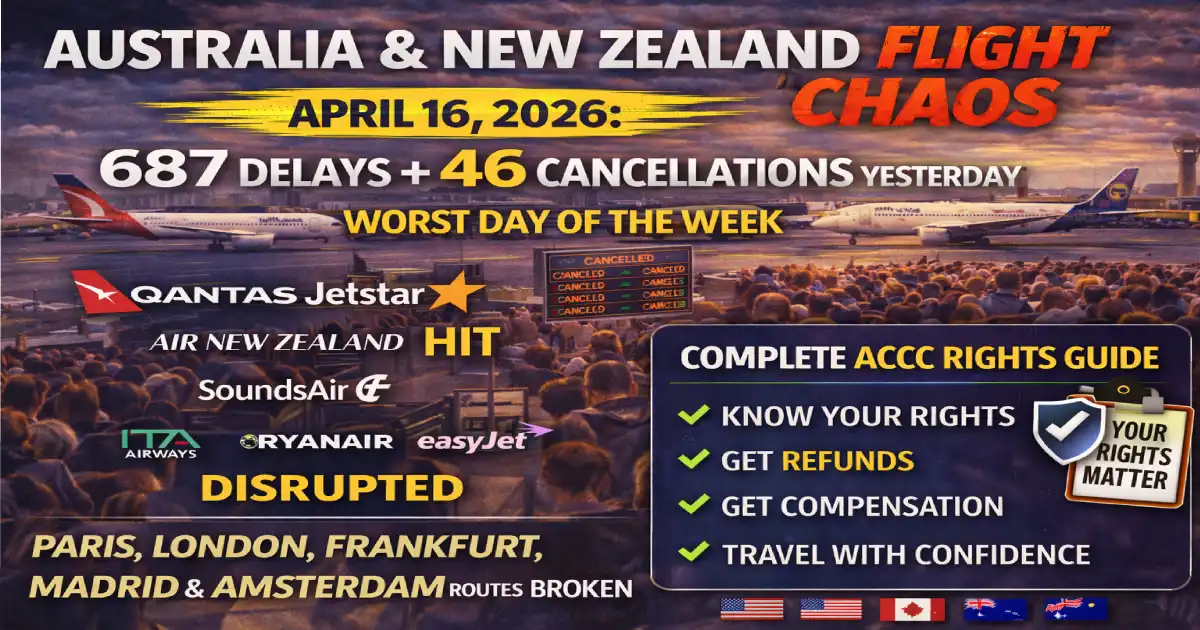
Australia and New Zealand’s aviation networks recorded their worst single day of the week on Tuesday April 15 — and today, Thursday April 16, disruption continues across both countries for the sixteenth consecutive day of elevated chaos in April 2026.
A combined total of 687 flight delays and 46 cancellations were recorded across several key transit hubs including Melbourne, Sydney, Brisbane, Perth, Wellington, Auckland, Christchurch and Blenheim. The disruptions affected major carriers such as Qantas, Jetstar, Sounds Air and Air New Zealand.
That 687-delay count is not just the highest single-day figure this week — it is the continuation of a pattern that has not relented once in April. The Australia–New Zealand network has now recorded more than 4,000 cumulative disruptions across the first sixteen days of the month alone. If you are flying today or this weekend across Australia or New Zealand, here is everything you need to know.
Published: April 16, 2026 — Thursday (Day 16) Yesterday’s total (April 15): 733 disruptions (687 delays + 46 cancellations) — highest single-day count this week Sydney yesterday: 107 delays + 14 cancellations — joint worst airport with Melbourne Melbourne yesterday: 107 delays — joint worst airport Auckland yesterday: 70 delays + 4 cancellations — NZ gateway NZ regional airports hit: Wellington (WLG) · New Plymouth (NPL) · Palmerston North (PMR) · Blenheim (BHE) · Christchurch (CHC) Carriers affected: Qantas · Jetstar · QantasLink · Virgin Australia · Air New Zealand · Sounds Air Root causes: Jet fuel crisis (Strait of Hormuz rerouting doubling costs) + post-Easter aircraft and crew positioning strain + Air New Zealand 1,100-flight cut programme still active Brisbane rail shutdown: Still live — no Airtrain until April 26, taxi and Uber only ACCC status: Enhanced monitoring active — ACCC Airline Monitoring Report tracking Qantas, Jetstar, Virgin Australia Cumulative April disruptions: 4,000+ across Australia and New Zealand
Today marks the sixteenth consecutive day of elevated disruption across Australia and New Zealand since April 1. There has not been a single normal operating day this month. There has not been a single day in April 2026 where the Australia–New Zealand network has operated normally. The aviation landscape across the Oceania region was marked by significant disruption across this period, with the fuel crisis, post-Easter network strain, and the ongoing consequences of Middle East airspace rerouting pushing jet fuel costs to their highest level since 2008. Travel Tourister
The disruption has three distinct causes that are all simultaneously active and all structural — meaning they cannot be fixed by any single operational change:
Cause 1 — The jet fuel crisis. The Iran war and Strait of Hormuz closure that began February 28 has pushed jet fuel prices from $85–$90 per barrel to $150–$200 per barrel. Australia holds only a 30-day national jet fuel reserve — one of the lowest strategic reserves in the developed world. Every flight operating out of Sydney or Melbourne today is burning fuel at more than twice its pre-war cost. Airlines are consolidating flights, cutting off-peak services and raising fares. The aircraft that used to serve the 6am off-peak Melbourne–Sydney sector is no longer operating that rotation — and the passengers who would have taken it are being squeezed onto fewer flights.
Cause 2 — Middle East rerouting adding hours per flight. Australia’s international routes to Europe — via Dubai, Abu Dhabi and the Gulf — have been completely restructured since February 28. Qantas has rerouted its Perth–London service via Singapore. Emirates is operating at reduced capacity from Dubai. The result is that long-haul aircraft are either flying longer routes (burning more fuel) or operating less frequently. When long-haul aircraft are delayed or mispositioned by international rerouting, domestic services that depend on those aircraft get pushed back all day. A Qantas 787 that lands in Sydney an hour late from Singapore is an hour late for its domestic sectors for the rest of the day.
Cause 3 — Air New Zealand’s 1,100-flight cut programme. Air New Zealand has cancelled around 1,100 flights through to early May, affecting around 44,000 passengers. The cuts affect services in and out of several regional centres and mark a significant escalation for an airline grappling with elevated jet fuel prices as a direct result of the Iran war. These are primarily domestic New Zealand routes. The airline plans to cut an average of 2–3 return flights a week to Auckland, rising to as many as 10 after the April peak travel period. It also plans to cut flights to and from Wellington by an average of five a week and Christchurch services by an average of 2–3 a week. When Air New Zealand consolidates its domestic schedule, passengers who would have been on a cancelled service are rebooked onto the next available flight — which increases loads on remaining services, reduces slack in the network, and means any single delay cascades through a tighter schedule.
Sydney Kingsford Smith and Melbourne Tullamarine each recorded 107 delays, making them jointly the worst-hit hubs in the region today. Travel Tourister Sydney also recorded 14 cancellations — the highest cancellation count of any airport in the region on April 15.
Sydney is Australia’s primary international gateway, and the compounding effect of international delays cascading into domestic operations is most acute here. A late Qantas inbound from Los Angeles or Singapore delays the turnaround for domestic sectors. Melbourne feeds the Sydney–Melbourne shuttle — the busiest domestic aviation route in the world — and delays at either end ripple through every subsequent sector.
For passengers today at Sydney or Melbourne: expect longer than normal turnaround times, particularly on the Sydney–Melbourne corridor where aircraft are operating with less buffer than at any point in 2026.
Auckland logged 70 delays and 4 cancellations as New Zealand’s primary international gateway, with disruption cascading through domestic connections to Wellington, New Plymouth, and Palmerston North. Travel Tourister
Auckland is the entry and exit point for nearly all of New Zealand’s international traffic, and every delayed long-haul flight produces domestic misconnections. The cascading effect into Wellington (WLG), New Plymouth (NPL) and Palmerston North (PMR) reflects Air New Zealand’s tight domestic scheduling — with 1,100 flights already cut from the programme, there is less spare capacity to absorb an Auckland delay without it propagating through the whole network.
Brisbane appeared in yesterday’s data as an affected hub, and its disruption comes with a unique compounding factor: the Brisbane Airport Airtrain has been shut since April 3 and does not reopen until April 26.
Every passenger who misses a flight, faces a delayed departure, or needs to make alternative arrangements at Brisbane Airport cannot use the rail link. Taxi, Uber and bus are the only options to and from the city centre. On a day when 400+ flights across the network are delayed, the demand for ground transport at Brisbane Airport significantly exceeds normal capacity — ride-sharing surge pricing, longer waits, and higher stress levels for every passenger.
If you are departing Brisbane today: Allow at minimum 30 additional minutes beyond your normal pre-airport travel time for the Uber/taxi queue at the international and domestic terminals. Do not cut it close.
New Zealand’s regional airports received the cascade of Auckland’s delays through Air New Zealand’s domestic network. Sounds Air — the small regional carrier connecting Wellington to Marlborough, Nelson and Blenheim — was also disrupted, reflecting how even New Zealand’s most lightly-used regional routes are not insulated from the fuel and positioning crisis affecting the main carriers.
Qantas is absorbing the largest absolute volume of disruptions — as Australia’s dominant carrier, it operates the most flights and therefore records the most delays and cancellations numerically. The fuel crisis has hit Qantas through two channels: the direct cost of higher jet fuel for domestic operations, and the secondary effect of long-haul rerouting misposioning aircraft and crew for domestic sectors.
Qantas waiver status: Qantas has been offering fee-free date changes for flights affected by the fuel crisis since late February. Confirmed for travel through April 30 — check qantas.com → Manage Booking → change flight. For cancellations caused by airline operational decisions (including fuel-related consolidation of services), you are entitled to rebooking on the next available Qantas service or a full refund under Australian Consumer Law.
Jetstar recorded among the highest cancellation rates again yesterday. The budget Qantas subsidiary operates on the tightest margins in the network — minimal spare aircraft, no interline agreements, and a lean turnaround model that amplifies any disruption.
The Jetstar no-interline rule — read this: If your Jetstar flight is cancelled, Jetstar cannot rebook you onto Qantas, Virgin Australia, Air New Zealand, or any other carrier. Your only options are: (a) rebook on the next available Jetstar flight on the same route, or (b) request a full refund and buy a new ticket independently. There is no automatic transfer to Qantas even though Jetstar is owned by the Qantas Group. This is the most common source of passenger frustration in Australian aviation disruptions — do not assume the Qantas app or desk can fix a Jetstar cancellation.
Jetstar cancellation hotline: 131 538 (Australia) | +61 3 9645 5999 (international)
Air New Zealand CEO Nikhil Ravishankar acknowledged the unprecedented nature of the situation: “We know that affordability around flying is a real challenge. Even in these unprecedented times, there’s a limit to what we can pass on to our customers.” The airline also suspended its financial guidance for 2026, citing the impossibility of forecasting earnings in an environment where jet fuel prices had more than doubled in weeks. Travel Tourister
Air New Zealand is actively running a 5% schedule reduction through early May. The 1,100 cancelled flights are not accident-related cancellations — they are proactively removed services that the airline has judged uneconomical to fly at current fuel prices. Affected passengers are being rebooked onto adjacent services. If you are on an Air New Zealand service through early May, check airnewzealand.co.nz → Manage My Booking to confirm your service is still operating.
Sounds Air operates small turboprop aircraft connecting Wellington with Marlborough, Nelson, Blenheim, and other South Island regional destinations. With minimal spare aircraft and no codeshare buffers, any delay at Wellington cascades into every subsequent sector. If your Sounds Air flight is disrupted, options for same-day rebooking are limited — call +64 3 520 3080 and ask about the next available service.
Virgin Australia is the second major domestic carrier and is also experiencing disruption driven by the fuel crisis. The network strain is reducing operational flexibility across all carriers simultaneously. Check virginaustralia.com → Manage Booking for your specific flight status. Virgin Australia’s customer service line: 13 67 89 (Australia).
| Date | Total disruptions | Cancelled | Delayed | Notable |
|---|---|---|---|---|
| April 1 | 567 | 46 | 521 | Month opens with fuel crisis + Easter |
| April 3 (Good Friday) | 418+ | 38 | 380+ | Brisbane rail shutdown Day 1 |
| April 6 (Easter Mon) | 851 | — | — | Worst single day of month |
| April 12 (Sunday) | 212 | 29 | 183 | Post-Easter weather + strain |
| April 13 | 418 | 33 | 385 | Fuel shortage explicit cause |
| April 14 | 396 | 38 | 358 | Day 14 consecutive |
| April 15 | 733 | 46 | 687 | Highest count this week |
| April 16 (today) | Day 16 | Ongoing | Ongoing | This article |
April 2026 cumulative total (16 days): over 4,000 disruptions across Australia and New Zealand.
The Brisbane Airport Airtrain has been shut since April 3, 2026 and does not reopen until Thursday April 26, 2026. This is now in its 14th day of closure.
Every passenger travelling to or from Brisbane Airport during this period must use an alternative ground transport option:
Allow at least 30 additional minutes beyond your normal airport travel time for all Brisbane journeys until April 26.
April’s sustained disruption has put Australian Consumer Law (ACL) passenger protections under stress. Here is the practical framework:
What you are entitled to when a flight is cancelled by the airline:
✅ Rebooking onto the next available service to your booked destination at no extra charge — when the cancellation is caused by factors within the airline’s control (including fuel-related schedule consolidation) ✅ Full refund if you choose not to travel following an airline-initiated cancellation ✅ Duty of care for delays of 2+ hours — meals and refreshments. Ask at the gate agent desk. Do not wait to be offered; state directly: “My flight is delayed over two hours. I would like meal vouchers.” ✅ Overnight accommodation and transport if the cancellation requires an overnight stay at the airport and the cause is within airline control
What you are NOT entitled to under Australian law:
❌ Fixed cash compensation (there is no Australian equivalent of EU261’s €250–€600 payment structure) ❌ Automatic rebooking onto a competitor’s aircraft (you must specifically request this and the airline may decline) ❌ Compensation for consequential losses (hotel nights at destination, car hire, missed events) unless the disruption was within airline control and you can establish causation under ACL
The ACCC fuel crisis monitoring context:
The ACCC has activated enhanced airline monitoring in response to the fuel crisis disruptions of April 2026. The quarterly ACCC Airline Monitoring Report tracks Qantas, Jetstar and Virgin Australia on cancellation rates, delay rates, and refund/rebooking policy compliance. If you believe an airline has failed to rebook you or process your refund in a reasonable timeframe, the ACCC complaint form is the appropriate escalation channel — accc.gov.au/contact-us.
Escalation path:
Step 1 — Check your flight status before leaving home. Every major carrier has a live flight status tool. Do not assume your flight is operating because it was on time at midnight.
Step 2 — Rebook digitally first. On high-disruption days, airport queues at customer service desks can be 45–90 minutes. The airline app processes rebookings faster. Use it.
Step 3 — For Brisbane passengers: build in extra ground time. See rail shutdown section above. Do not cut it close on travel to Brisbane Airport.
Step 4 — For Jetstar passengers: understand the no-interline rule. If your Jetstar flight is cancelled, your rebook options are within Jetstar’s network only. Consider whether the next available Jetstar flight meets your needs before accepting it — if it departs the following day, you may prefer to take a refund and buy a Qantas or Virgin ticket independently.
Step 5 — Request meal vouchers at the 2-hour mark. Walk to any gate agent or check-in desk and ask directly. Keep all food receipts regardless of whether vouchers are provided.
Step 6 — Document everything. Screenshot your cancellation notification, original booking confirmation, and any delay notifications the moment they arrive. You have these for ACL claims, travel insurance claims, and any future escalation to the Airline Customer Advocate.
The honest answer is that the fuel crisis driving most of this disruption has no certain end date. The US-Iran ceasefire announced on April 8 has been fragile — Iran accused the US of violations by April 8 itself, and the Strait of Hormuz has only allowed dry cargo vessels through, not oil tankers. The structural fuel chain disruption that IATA warned would take “months not weeks” to normalise is still fully in place.
Ryanair chief executive Michael O’Leary has raised concerns about potential jet fuel supply disruptions affecting European aviation during May and June if the conflict persists. Airlines across parts of Asia have been among the hardest hit, with some implementing outright flight cancellations due to fuel availability constraints.
For Australia and New Zealand specifically, the Air New Zealand 1,100-flight cut programme runs through early May. Qantas has flagged that it will monitor conditions week by week. The Brisbane rail shutdown lifts on April 26. Post-Easter network strain is gradually dissipating as crews and aircraft return to their home bases.
The most realistic outlook: disruption levels should moderate from the April 15 peak of 687 delays as Easter positioning recovers, but the fuel crisis ensures the Australia–New Zealand network will not return to normal until jet fuel prices fall significantly — which requires either a durable ceasefire that fully reopens Hormuz to oil tankers, or airlines successfully finding alternative supply routes.
Related Articles:
Posted By : Vinay
This article is provided for general informational purposes only and is based on information available at the time of publication. Travel advisories, airline schedules, airport operations, visa requirements, government regulations, and other travel-related information are subject to change without prior notice. While Travel Tourister makes reasonable efforts to verify information using official announcements, government publications, airline and airport communications, and other reliable sources, we cannot guarantee that all information remains complete, accurate, or up to date at all times. Readers should independently verify any information that may affect their travel plans with the relevant airline, airport authority, government agency, embassy, or other official source before making travel, financial, or other decisions. Travel Tourister shall not be liable for any direct or indirect loss, inconvenience, or damages arising from the use of or reliance on the information contained in this article. Nothing in this publication constitutes legal, immigration, financial, or professional travel advice. If you believe any information in this article is inaccurate or outdated, please contact our editorial team. We review all credible correction requests promptly and update our content whenever appropriate.
Lastest News
2nd Floor, 39, Above Kirti Club, DLF Industrial Area, Kirti Nagar, New Delhi, Delhi 110015



Travel Tourister is a leading Travel portal where we introduce travellers to trusted travel agents to make their journey hasselfree, memorable And happy. Travel Tourister is a platform where travellers get Tour packages ,Hotel packages deals through trusted travel companies And hoteliers who are working with us across the world. We always try to find new and more travel agents and hoteliers from every nook and corners across the world so that you could compare the deals with different travel agents and hoteliers and book your tour or hotel with the one you have chosen according to your taste and budget.
Copyright © Travel Tourister, India. All Rights Reserved

 Call
Call Enquiry