Published on : 27 Feb 2026
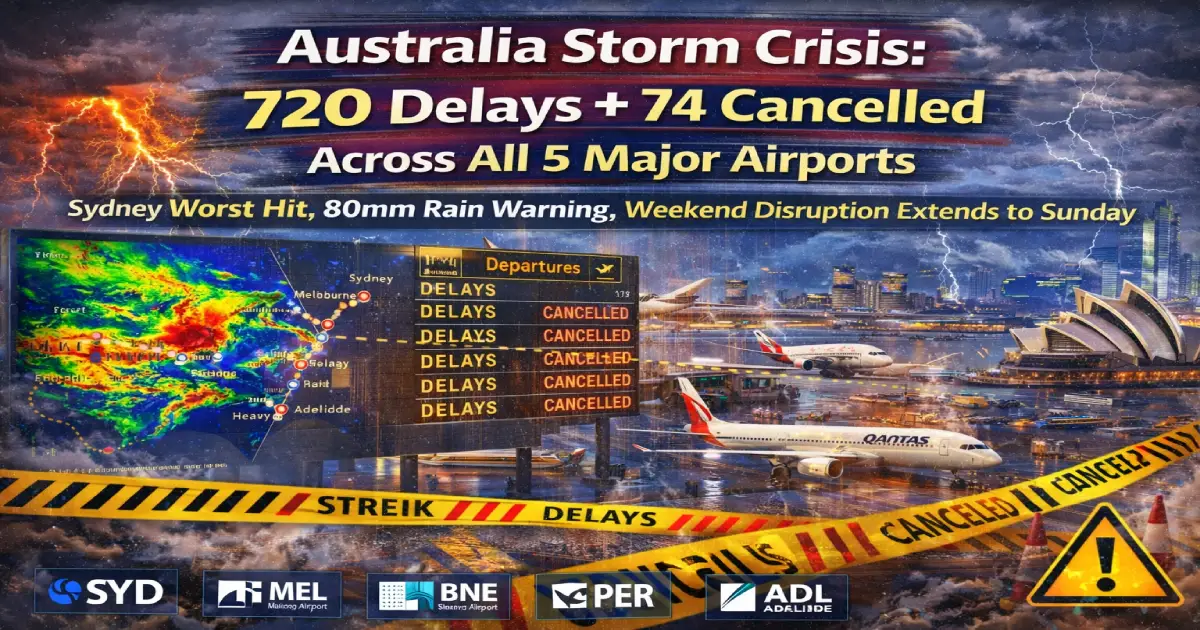
🔴 AUSTRALIA TRAVEL EMERGENCY | Published: February 27, 2026 | Last Updated: February 27, 2026, 8:00 AM AEDT
Disruption Status: ✅ ACTIVE AND WORSENING — storm system tracking south through weekend Last Updated: February 27, 2026 — 8:00 AM AEDT
| Airport | Code | Cancellations | Delays | Status |
|---|---|---|---|---|
| Sydney Kingsford Smith | SYD | 36 | 266 | 🔴 WORST HIT |
| Melbourne Tullamarine | MEL | 15 | 186 | 🔴 SEVERE |
| Melbourne Avalon | AVV | 3 | 3 | 🟠 ELEVATED |
| Brisbane | BNE | Confirmed | Confirmed | 🔴 SEVERE |
| Adelaide | ADL | Confirmed | Confirmed | 🟠 ELEVATED — 80mm by Sunday |
| Perth | PER | Confirmed | Confirmed | 🟠 ELEVATED — geographic lag |
| Canberra | CBR | Confirmed | Confirmed | 🟠 AFFECTED |
| TOTAL AUSTRALIA | — | 74 | 720 | — |
Airline Breakdown:
International Routes Disrupted: Sydney–LAX ✈ | Sydney–DFW ✈ | Melbourne–Dubai (Emirates) ✈ | Brisbane–Dubai (Emirates) ✈ | Sydney/Melbourne–Auckland (Air NZ) ✈ | Sydney/Melbourne–Hong Kong (Cathay) ✈ | Sydney–Abu Dhabi (Etihad) ✈ | SYD–Manila ✈ Storm Cause: Tropical low pressure system + severe thunderstorm bands — tracking south-southeast from Queensland into South Australia Adelaide Warning: Up to 80mm of rain by Sunday — flash flooding risk — emergency authorities urging all residents to avoid flooded roads Bureau of Meteorology Alerts: Flood watches and warnings active for Queensland, South Australia, and Victoria Weekend Forecast: Storm system persists Saturday–Sunday — disruptions extending beyond today Backlog Risk: The 720 delayed flights already in the system will take several days to fully clear UV Warning: Extreme UV index of 11 in some areas despite cloud cover — outdoor terminal transit risk Previous Event: This is a SEPARATE, LARGER event than the February 20 Australia disruption (700 delays, 19 cancellations) — 74 cancellations vs 19 = 4x worse
The numbers are stark. At peak disruption today, at least 720 flights were reported delayed and 74 cancelled nationwide, according to preliminary figures from aviation tracking services and airport operators. That is four times the cancellation count of the February 20 Australia disruption that already hit your site — and this time, all five mainland Australian airports are hit simultaneously, with a storm system forecast to persist through the entire weekend.
For Australian travelers this means a disruption that will not resolve itself overnight. For international passengers booked on Qantas, Emirates, Etihad, Air New Zealand, Cathay Pacific, and Virgin Australia services connecting through Sydney, Melbourne, and Brisbane — routes to Los Angeles, Dallas, Dubai, Abu Dhabi, Hong Kong, Manila, and Auckland are all feeling the downstream effects right now.
This is the complete, verified picture of what is happening, airport by airport, airline by airline, and route by route — plus everything you need to know about your Australian Consumer Law rights, the rebooking process, and the weekend forecast that could extend this disruption well into Monday.
A massive weather system has struck central Australia, severely impacting travel plans for thousands of passengers. Weather warnings have been issued for large areas, including southern Queensland, the Northern Territory, and parts of South Australia. These storms, which are forecasted to continue through the weekend and into next week, have led to flash flooding, road closures, and dangerous driving conditions, all of which have forced significant delays and cancellations at major airports in Australia.
The system is a tropical low that originated in Queensland’s far north and is tracking south-southeast, drawing in moisture from the Coral Sea and Tasman Sea simultaneously. As it moves into South Australia and Victoria this weekend, the moisture convergence is expected to intensify rather than weaken — the opposite of what you’d want to see for a rapid aviation recovery.
Heavy rainfall, combined with severe thunderstorms, has created chaos at Sydney, Melbourne, and Brisbane airports, disrupting flight schedules and causing ripple effects across both domestic and international routes. In some areas, as much as 100mm of rain has fallen in just six hours.
When this type of multi-state weather system moves through Australia’s east coast aviation corridor, five specific operational problems cascade simultaneously:
1. Reduced visibility operations (RVO): Poor visibility forces ATC to increase separation requirements between aircraft, reducing runway throughput from the normal 70–80 movements per hour to 40–50. At Sydney, which already operates at or near its 80-movement/hour cap on normal days, this is catastrophic for on-time performance.
2. Wet tarmac ground holds: Aircraft arriving late from one city trigger knock-on delays in others, snarling what is usually one of the busiest midweek travel periods. With turnarounds slowed by wet tarmac conditions and congestion on taxiways, aircraft arriving late from one city triggered knock-on delays in others.
3. Crew rest cascades: When aircraft are delayed 2+ hours, crew members hit their duty-time limits under CASA Part 121 regulations. Flights that would have been operated by the arriving crew are then held for a standby crew — who may themselves be hours away. A Sydney delay at noon can strand a Perth departure at midnight.
4. The geographic isolation amplifier: Perth’s geographic isolation makes it uniquely vulnerable. A Sydney disruption at 8 AM creates a Perth disruption at 2 PM — a 5-hour flight means aircraft and crew stranded in Sydney cannot reposition to Perth until well into the afternoon. When Perth disruptions hit, there is no adjacent hub to borrow resources from.
5. Avalon Jetstar complete suspension: Melbourne Avalon International Airport, which serves the Geelong region, reported 3 cancellations and 3 delays — all attributed to Jetstar. Jetstar’s total suspension at its Avalon base adds a secondary Melbourne disruption on top of the primary Tullamarine chaos.
The scale of the disruption is most visible at Sydney Kingsford Smith Airport, which has recorded the highest volume of interference. A total of 36 cancellations and 266 delays were reported today, making it the most heavily impacted gateway in Australia.
Sydney’s 36 cancellations and 266 delays represent approximately 40% of the airport’s scheduled movements experiencing disruption — an extraordinary figure for Australia’s busiest airport.
In Sydney alone, Qantas faced 65 delays, illustrating the immense pressure placed on ground handling and gate management during such widespread weather events.
Qantas at SYD: The longest and most complex delays are on Qantas’ international long-haul services. Long-range services to Los Angeles, Dallas, Singapore and London via Perth have experienced extended turnaround times as incoming flights arrive behind schedule. A Qantas aircraft inbound from London Heathrow arriving 90 minutes late requires a full 2-hour turnaround — meaning a departing SYD–JFK or SYD–LAX service will be 3+ hours late before it even boards.
International impact from SYD:
For passengers at SYD right now: Queues have built up at check-in counters and security lanes as rolling delays ripple through domestic and regional networks. The SYD departure board is dominated by pushed-back times. Arrive at the airport 30 minutes earlier than you normally would — not because the queue is long (it is), but because airline staff are under maximum pressure and the information desks need more time than normal to resolve individual issues.
The congestion in Sydney is being mirrored further south in Melbourne, where the Tullamarine hub faced 15 cancellations and 186 delays.
Melbourne’s situation is compounded by its role as the eastern seaboard’s second hub — aircraft and crews not available in Sydney are frequently drawn from Melbourne reserves. When both hubs are simultaneously under weather pressure, the east coast triangle (Sydney–Melbourne–Brisbane) — which accounts for approximately 60% of all Australian domestic flying — effectively collapses.
Emirates at MEL and BNE: Emirates’ services linking Brisbane, Sydney and Melbourne with its Dubai hub have encountered departure delays, complicating connections for passengers bound for Europe, Africa and the Middle East. A passenger booked MEL–DXB–LHR or MEL–DXB–CDG who misses their Dubai connection due to a Melbourne departure delay faces a minimum 12-hour layover in Dubai.
Cathay Pacific at MEL: Cathay Pacific flights through Hong Kong have also felt the strain, particularly for travellers connecting between Australia and secondary destinations in mainland China and North Asia. MEL–HKG–PEK or MEL–HKG–TPE passengers face missed connections if the MEL departure is delayed 2+ hours.
Melbourne Avalon (AVV) — Jetstar Complete Suspension: The secondary terminal at Melbourne Avalon International Airport, which serves the Geelong region, was not spared, reporting 3 cancellations and 3 delays, all attributed to Jetstar. Avalon is a Jetstar-dominated airport — all services have been suspended for the day. If you were booked on a Jetstar Avalon departure today, you have been cancelled and must rebook at Melbourne Tullamarine.
Brisbane Airport has confirmed significant cancellations and delays today. Even the secondary terminal at Melbourne Avalon International Airport was not spared, and regional hubs like Canberra, Perth and the airport serving Geelong are reporting significant backlogs.
Brisbane’s disruption is complicated by its role as the northern gateway for the east coast triangle. When Brisbane is simultaneously disrupted with Sydney and Melbourne, the triangle’s normal resilience — the ability to reroute passengers via a third city — is completely eliminated. There is no “go via Brisbane” option when Brisbane itself is disrupted.
Air New Zealand at BNE: Trans-Tasman services linking Brisbane to Auckland are delayed, creating ripple effects into New Zealand’s domestic network as Air New Zealand aircraft arrive late and cannot depart on their next scheduled Auckland–Wellington or Auckland–Christchurch services.
Adelaide is facing a two-phase disruption: current flight delays from the storm system’s leading edge, and a far more serious threat developing for the weekend. In Adelaide, residents and travellers are being urged by emergency authorities to monitor warnings closely and avoid all flooded roads.
With Adelaide forecasting up to 80mm of rain by Sunday, the city faces potential flash flooding that would complicate both airport operations and ground transportation. Passengers flying into or out of Adelaide this weekend should monitor Bureau of Meteorology alerts at bom.gov.au.
Practical advice for Adelaide travelers: Do not drive to or from Adelaide Airport if flooding is reported. The Botanic Road and Sir Donald Bradman Drive access routes to ADL are vulnerable in extreme rainfall events. Pre-book taxis or ride-shares departing at least 90 minutes before your flight — do not assume normal transit times in a flash flooding event.
Perth’s physical position — 2,700km from Sydney — creates a minimum 5-hour lag in storm disruption arrival. When Sydney and Melbourne entered disruption at 06:00 AEDT, Perth’s cascade arrived around 11:00 AWST as the first wave of repositioning flights failed to arrive on schedule.
Perth saw confirmed significant delay numbers. Network Aviation in Perth is also affected — the specialist WA regional carrier servicing mining and resource sites across the Pilbara and Kimberley was disrupted, affecting the resource sector workers who rely on its scheduled services.
For international passengers connecting Perth–London on Qantas’ Project Sunrise Perth hub: long-range services to Los Angeles, Dallas, Singapore and London via Perth have experienced extended turnaround times. Perth Qantas international departures this evening may be running 2–4 hours late.
Passengers scheduled to fly out of Canberra should check the mobile apps of their respective airlines — Virgin Australia, Jetstar, or Qantas — for real-time updates before departing for the airport. Canberra’s CBR Airport has confirmed disruptions. Canberra is predominantly a domestic hub — SYD–CBR and MEL–CBR services are among the most disrupted routes when Sydney and Melbourne simultaneously face weather.
Virgin Australia appears to be the most affected in terms of cancellations, with a total of 28 flights grounded and 165 delays recorded across the network.
Virgin Australia’s disproportionate cancellation count reflects two factors: its focus on high-frequency east coast triangle flying (SYD–MEL–BNE), and its more limited standby crew reserves compared to Qantas. Virgin operates a tighter crew roster with less slack in the system — meaning when disruptions hit, cancellations come faster than delays.
What to do if you’re on Virgin today:
The national carrier, Qantas, along with its regional subsidiary QantasLink, has also struggled to maintain its schedule. Qantas recorded 15 cancellations and 179 delays.
Qantas has been among the most visible operators affected, with delays and cancellations rippling across its domestic and international network. Heavily trafficked morning and evening departures along the east coast triangle have faced rolling hold-ups as crews and aircraft are shuffled.
In Sydney alone, Qantas faced 65 delays — illustrating just how concentrated Sydney’s weather impact is for Australia’s flag carrier.
QantasLink — 9 cancellations, 46 delays: Qantas’ regional subsidiary is disproportionately impacted. QantasLink serves smaller communities with less alternative transport — when a QantasLink service to Dubbo, Orange, Coffs Harbour, or Port Macquarie is cancelled, there is no competing airline and no viable train alternative.
For Qantas passengers: Check flight status at qantas.com/flightstatus or the Qantas app. Qantas customer service: 13 13 13 (Australia) / 1800 227 4500 (from USA).
Jetstar followed closely, with 20 cancellations and 125 delays, including the total suspension of its services at the airport near Geelong (Melbourne Avalon).
Jetstar’s budget model — minimal crew reserves, high utilisation rates, no interline agreements with full-service carriers — means disruptions disproportionately hit Jetstar passengers. Unlike Qantas passengers who can be endorsed onto competing airlines, Jetstar passengers are typically rebooked on the next available Jetstar service only.
For Jetstar Avalon passengers specifically: You have been cancelled. The Jetstar Avalon terminal is closed for today’s operations. You must get to Melbourne Tullamarine to rebook — check Jetstar’s rebooking policy at jetstar.com for complimentary transfer or accommodation arrangements.
Jetstar customer service: 131 538 (Australia). Allow extended wait times today.
The storm’s impact extends far beyond Australia’s domestic network. Major international routes connecting Australian gateways to global hubs are all facing significant disruption today.
A passenger booked SYD → LAX → JFK on separate tickets faces the most dangerous scenario: a missed LAX connection with no airline liability for the onward JFK ticket. Book through tickets where possible; today’s disruptions make the separate-ticket risk very real.
Air New Zealand services linking Sydney, Melbourne, and Brisbane to Auckland have encountered departure delays, creating knock-on disruption across Air New Zealand’s domestic New Zealand network.
Emirates’ services linking Brisbane, Sydney and Melbourne with its Dubai hub have encountered departure delays, complicating connections for passengers bound for Europe, Africa and the Middle East.
Today’s SYD–DXB or MEL–DXB delays mean the following connecting routes face missed-connection risk: DXB → LHR, DXB → CDG, DXB → FRA, DXB → MXP, DXB → ATH, DXB → JNB, DXB → BOM.
If you miss a Dubai connection due to an Australian departure delay on an Emirates single booking: Emirates’ Customer Affairs team will automatically rebook you on the next available Dubai–onward service with hotel accommodation if an overnight layover is required.
Cathay Pacific flights through Hong Kong have also felt the strain, particularly for travellers connecting between Australia and secondary destinations in mainland China and North Asia. SYD and MEL departures to HKG are delayed today.
Australian passenger protection differs significantly from EU261 and US DOT rules — and understanding the difference is critical to knowing what you can realistically demand today.
Australia has NO equivalent of EU Regulation 261/2004 cash compensation (€250–€600) or US DOT enhanced refund rules. Under Australian Consumer Law, airlines are not legally required to pay fixed cash compensation for cancellations or delays — even when the disruption is within the airline’s control.
What Australian law DOES require — and what today’s airlines are legally obligated to provide:
Under Australian Consumer Law and individual airline contracts of carriage, if your flight is cancelled:
This applies regardless of the reason for the cancellation — including weather. The “weather is outside our control” defence does not extinguish the refund or rebooking right in Australia the way it might affect EU cash compensation.
How to claim: Use the airline app first — it is the fastest rebooking tool during mass disruption events. Then call. The phone queue today will be 45–90 minutes for all carriers.
Unlike the EU, Australia does not have a statutory duty-of-care mandate for meals and accommodation during disruptions. However:
For weather delays specifically: No Australian carrier is contractually required to provide hotel accommodation for weather-caused overnight disruptions. This is where travel insurance becomes critical.
Customers affected by the flight cancellations and delays are encouraged to stay in contact with their airlines. Many airlines are offering rebooking options and will provide accommodation and meals to those stranded due to the cancellations. However, your most robust protection is travel insurance.
A travel insurance policy with trip delay and trip interruption coverage will typically cover:
If you do not have travel insurance for your current Australian trip: file a claim for everything you can under your credit card’s travel protection benefits (Visa Platinum, Mastercard World, Amex Gold and above typically include some coverage). Keep all receipts.
If your flight is cancelled and you choose not to travel: request a refund of any checked bag fees and departure taxes/airport charges. These are always refundable.
The key message from every meteorological source is the same: this storm is not a one-day event.
The forecast predicts that the weather system will persist over the weekend, with heavy rainfall and thunderstorms continuing to affect South Australia, Victoria, and parts of New South Wales. By Saturday and Sunday, Adelaide, Melbourne, and other regions will likely face more intense weather, including widespread thunderstorms and flash floods.
The backlog of 720 delayed flights will likely take several days to clear — even after the weather improves. Here is why:
When 720 flights are delayed today, every aircraft involved in those delays is in the wrong position for tomorrow’s schedule. An aircraft that was supposed to fly SYD → MEL → PER → MEL → SYD today has instead completed SYD → MEL → PER — and is now stuck in Perth overnight instead of Sydney. Tomorrow’s 8:00 AM SYD departure cannot be operated by that aircraft. The ripple extends 24–72 hours beyond the weather event itself.
Practical weekend travel forecast for Australia:
| Date | Expected Conditions | Aviation Risk |
|---|---|---|
| Today Fri Feb 27 | Storm system over QLD–NSW–VIC | 🔴 SEVERE — 720 delays confirmed |
| Sat Feb 28 | System tracking into SA, VIC intensifying | 🔴 HIGH — Adelaide 80mm risk, backlog continues |
| Sun Mar 1 | SA flooding peak, system weakening | 🟠 ELEVATED — clearance begins |
| Mon Mar 2 | Progressive normalisation | 🟡 MODERATE BACKLOG — plan 2–3 hr buffer |
| Tue Mar 3 | Full recovery expected | 🟢 NORMAL |
Step 1: Open your airline’s app and check your specific flight — not the departure board. The app has real-time status 10–15 minutes ahead of the physical boards.
Step 2: If delayed 2+ hours, proactively approach the check-in or transfer desk and ask: (a) What is the latest estimated departure time? (b) Is a later flight available today? (c) What meal vouchers are available?
Step 3: If cancelled, choose between: full refund to original payment, OR rebooking on next available service. Do not accept a travel credit if you prefer cash — state clearly “I prefer a refund.”
Step 4: Check your travel insurance policy on your phone. File a claim for any hotel, food, or transport expenses necessitated by the delay — even before you incur them, many insurers will pre-authorise reasonable costs.
Step 5: Keep all receipts from today — food, transport, hotel, parking extensions. These are claimable under travel insurance and, for full-service carrier passengers, potentially under airline duty-of-care provisions.
Do not book non-refundable domestic Australian connections tight against your international arrival. The standard advice of allowing 2 hours for a domestic connection through Sydney or Melbourne is completely inadequate during this event. The backlog from today’s 720 delays will persist through the weekend — allow a minimum of 4–5 hours for any SYD or MEL domestic connection on Saturday and Sunday.
Aviation experts advise that passengers remain inside the terminals and monitor flight boards closely. Critically: UV levels are expected to reach an extreme index of 11 in some areas despite the cloud cover. If you are required to move between outdoor terminal areas or transfer between terminal buildings — apply sunscreen even in overcast conditions. An index of 11 (Extreme) causes sunburn in as little as 10 minutes in fair-skinned individuals.
This is not a standard travel article warning — it is a genuine safety advisory from Australian health authorities issued specifically because cloud cover creates a false sense of UV protection.
| Airline | Australia Phone | App | Status Page |
|---|---|---|---|
| Qantas | 13 13 13 | Qantas app | qantas.com/flightstatus |
| QantasLink | 13 13 13 | Qantas app | qantas.com/flightstatus |
| Virgin Australia | 13 67 89 | Virgin Australia app | virginaustralia.com/flight-status |
| Jetstar | 131 538 | Jetstar app | jetstar.com/au/flight-status |
| Emirates (AU) | 1300 303 777 | Emirates app | emirates.com/flight-status |
| Air New Zealand | 13 24 76 | Air NZ app | airnewzealand.com.au |
| Cathay Pacific | 1300 556 767 | Cathay app | cathaypacific.com/flight-status |
| United Airlines | 13 17 77 | United app | united.com/flight-status |
| FlightAware SYD | — | — | flightaware.com/live/airport/YSSY |
| FlightAware MEL | — | — | flightaware.com/live/airport/YMML |
| Bureau of Meteorology | — | BOM Weather app | bom.gov.au |
This event is the larger, more serious disruption across every measurable dimension:
| Metric | Feb 20 Event | Today Feb 27 |
|---|---|---|
| Total cancellations | 19 | 74 (4x worse) |
| Total delays | 700+ | 720 |
| Airports hit | 3–4 | All 5 + Avalon |
| International impact | Limited | Full — UAE, NZ, US, HK, Philippines |
| Melbourne Avalon | Partial | 100% suspended |
| Adelaide 80mm rain risk | No | Yes — flash flooding |
| Weekend extension | No | Saturday–Sunday |
| Backlog clearance | 24–48 hours | Several days |
1. Check your specific flight on your airline’s app — not the departure board. Apps are updated in real time 10–15 minutes ahead of physical boards. Know your status before you drive to the airport.
2. If you are traveling this weekend — build in massive buffers. The 720 delays already in the system take several days to clear. Saturday and Sunday conditions are forecast to be WORSE than today for Adelaide and Melbourne. Allow 4–5 hours for any domestic connection through SYD or MEL this weekend.
3. Travel insurance is your primary protection in Australia. Unlike in Europe, there is no EU261 cash compensation here. Your insurance policy is the only financial safety net for accommodation, meals, and missed connections caused by today’s storm. File immediately and keep all receipts.
Australia’s aviation system is one of the most sophisticated in the Southern Hemisphere. By Monday or Tuesday, it will be back to normal. But the next 72 hours are going to be difficult — and the only travelers who will navigate them smoothly are the ones who read this article, checked their apps, filed their insurance claims, and extended their airport arrival buffers before leaving home.
Published: February 27, 2026. Information sourced from TheTraveler.org (published 11 hours ago today), FlightAware Australia airport data, Bureau of Meteorology official flood and storm warnings, Australian Bureau of Meteorology bom.gov.au, and airline official disruption advisory pages. The February 20 Australia comparison data sourced from TravelTourister.com own article. All figures accurate as of 8:00 AM AEDT February 27, 2026.
For More Resources:
Related Articles:
Posted By : Vinay
Lastest News
2nd Floor, 39, Above Kirti Club, DLF Industrial Area, Kirti Nagar, New Delhi, Delhi 110015



Travel Tourister is a leading Travel portal where we introduce travellers to trusted travel agents to make their journey hasselfree, memorable And happy. Travel Tourister is a platform where travellers get Tour packages ,Hotel packages deals through trusted travel companies And hoteliers who are working with us across the world. We always try to find new and more travel agents and hoteliers from every nook and corners across the world so that you could compare the deals with different travel agents and hoteliers and book your tour or hotel with the one you have chosen according to your taste and budget.
Copyright © Travel Tourister, India. All Rights Reserved

 Call
Call Enquiry