Published on : 02 Jan 2026
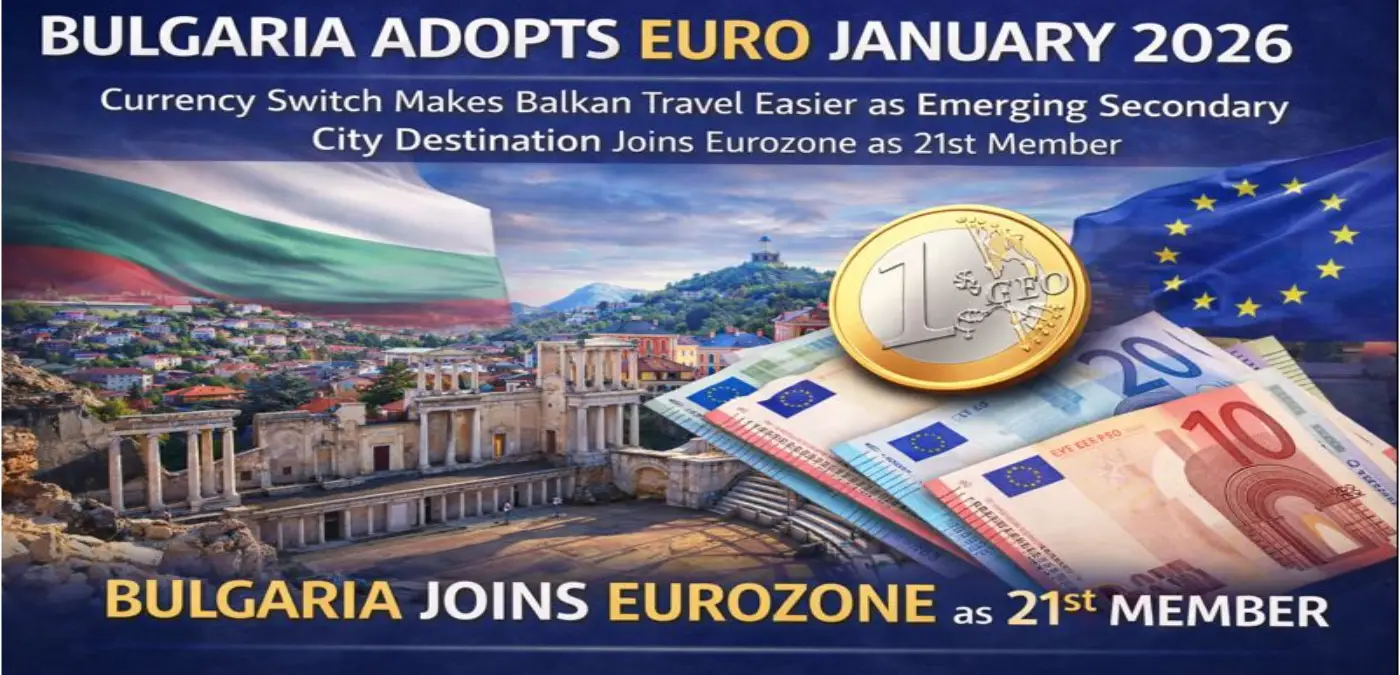
TRENDING: Bulgaria officially adopted euro at midnight January 1, 2026—becoming 21st eurozone member with conversion rate 1.95583 lev = €1, ending 145-year history of lev (“lion”) currency as 358 million Europeans now use single currency extending into Black Sea region for first time, simplifying travel for Australian and New Zealand tourists visiting trending Balkan destination featured in 2026 secondary cities boom alongside Romania, Slovenia
Published: January 2, 2026 Source: European Central Bank, Bulgarian National Bank, European Commission, Multiple Sources Key Finding: Bulgaria becomes 21st eurozone member January 1, 2026 Conversion Rate: 1.95583 Bulgarian lev = €1 (fixed, permanent) Transition Period: Dual currency until January 31, 2026; price displays until August 2026 ANZ Impact: Eliminates currency exchange for Aussie/Kiwi travelers visiting emerging Balkan destination
Bulgaria officially adopted the euro as its currency at midnight January 1, 2026—becoming the 21st member of the eurozone nearly 20 years after joining the European Union in 2007—with euro banknotes and coins beginning circulation immediately while the Bulgarian lev remains legal tender until January 31, allowing consumers and businesses a one-month transition period before the single European currency becomes sole legal tender in the Balkan nation of 6.5 million people where public opinion remains split despite government celebrating the “historic milestone” marking final integration into EU’s economic framework.
“I warmly welcome Bulgaria to the euro family,” declared Christine Lagarde, president of the European Central Bank, as Bulgarian euro coins were projected onto the central bank’s building in Sofia at midnight while crowds gathered in freezing temperatures to witness the historic moment. “The euro is a powerful symbol of what Europe can achieve when we work together, and of the shared values and collective strength that we can leverage to confront the global geopolitical uncertainty that we face at the moment.”
The adoption extends the eurozone geographically into the Black Sea region for the first time, bringing the number of Europeans using the euro to 358 million across 21 member states, while eliminating currency exchange hassles for travelers visiting Bulgaria—an emerging secondary city destination featured prominently in 2026 travel trend forecasts alongside Romania and Slovenia as tourists increasingly seek authentic Balkan experiences away from overcrowded Western European capitals suffering infrastructure strain from overtourism.
“Great! It works!” exclaimed Dimitar, a 43-year-old Sofia resident, after withdrawing €100 from an ATM shortly after midnight—testing the new system that replaces the lev (meaning “lion,” a symbol present in Bulgaria for centuries since the currency’s establishment by the Bulgarian National Bank in 1880) with Europe’s single currency permanently fixed at conversion rate 1.95583 lev per euro, corresponding to the lev’s long-standing peg maintained since 1999 under currency board arrangement that prepared Bulgaria for eventual eurozone membership.
Bulgaria committed to adopting the euro when it joined the European Union on January 1, 2007—a standard obligation for new EU members (though Denmark secured opt-out through 1992 Edinburgh Agreement and Sweden shelved the issue after referendum rejection)—but the path to eurozone membership proved lengthy and politically contentious, with multiple delays pushing the target date from originally anticipated 2014-2015 to 2024, then 2025, and finally January 1, 2026 after the country met all convergence criteria and received formal approval from European institutions in July 2025.
Timeline of Bulgaria’s euro journey:
To adopt the euro, EU member states must demonstrate economic stability and alignment with eurozone standards through five convergence criteria established in the Maastricht Treaty—requirements designed to ensure new members won’t destabilize the currency union or create fiscal burdens for existing members who might be forced to bail out struggling economies, as occurred during the 2010-2015 debt crisis when Greece, Ireland, Portugal, Spain, and Cyprus required emergency financial assistance.
The five convergence criteria Bulgaria met:
“This positive assessment of convergence paves the way for Bulgaria to introduce the euro as of 1 January 2026 and become the 21st EU Member State to join the euro area,” confirmed Philip R. Lane, member of the ECB’s Executive Board, following the June 4, 2025 convergence report. “I wish to congratulate Bulgaria on its tremendous dedication to making the adjustments needed.”
Despite government enthusiasm and official approval from European institutions, Bulgarian public opinion remained deeply divided—with surveys consistently showing roughly half of citizens opposing euro adoption amid fears about inflation, price increases, wage stagnation, and loss of national sovereignty symbolized by abandoning the lev currency that represented Bulgarian independence and national identity for 145 years.
Public opinion polls 2025:
President Rumen Radev proposed in May 2025 that a referendum be held on euro adoption, arguing that such a major decision “must take place with a strong national consensus—through the inner conviction of citizens,” but Bulgaria’s parliament rejected the referendum in June 2023 with 98 votes against, 46 abstentions, and only 68 votes in favor—blocking direct democratic participation in the decision despite 63% of Bulgarians supporting holding a referendum according to polls.
“This refusal was one of the dramatic symptoms of the deep divide between the political class and the people, confirmed by mass demonstrations across the country,” Radev stated in a televised address before midnight December 31, 2025, criticizing the absence of public referendum even as he acknowledged euro adoption as “the final step” in Bulgaria’s EU integration.
Thousands took to the streets of Sofia and other Bulgarian cities throughout 2025 to protest euro adoption, with demonstrations occasionally spilling into violent clashes between protesters and police as minority parties—particularly Vazrazhdane (Revival), which has grown considerably in popularity—campaigned against the single currency, arguing that Bulgaria’s poorest-in-EU status makes the country vulnerable to economic shocks from losing control over monetary policy and being unable to devalue currency during crises.
Throughout January 2026, both the Bulgarian lev and euro remain legal tender, allowing consumers and businesses flexibility during the initial transition month when confusion about conversion rates, payment methods, and pricing could create friction—with the dual currency period designed to ease adaptation while preventing economic disruption that could occur if overnight switch caught businesses or consumers unprepared.
Practical transition mechanics:
“Outgoing prime minister Rosen Zhelyazkov sought to reassure the public ahead of the move, saying he was ‘counting on the tolerance and understanding of citizens and businesses,'” reports Euronews, noting that government officials emphasized the transition infrastructure—dual pricing, conversion calculators, public information campaigns—designed to minimize confusion and prevent merchants from exploiting the changeover to raise prices unjustifiably.
Bulgarians holding lev banknotes and coins can exchange them for euros free of charge during extended grace periods—with the Bulgarian National Bank offering indefinite free exchange, commercial banks providing zero-fee conversion through June 30, 2026, and post offices similarly accepting levs through at least end of 2026, though potentially charging fees after June deadline when free exchange obligation expires for commercial institutions.
Exchange procedures:
Once old lev banknotes and coins are collected back to banks and the central bank, they are typically shredded and recycled—marking the physical end of Bulgaria’s 145-year lev history as the currency that survived Ottoman rule, wars, communist regime, transition to democracy, and EU accession finally gives way to the euro representing Bulgaria’s full integration into European monetary system.
While adopting the shared European currency, Bulgaria retained the right to design the national side of euro coins (the obverse showing Bulgarian symbols while the reverse displays standard EU imagery)—with the Bulgarian National Bank selecting three historic designs that preserve national identity and celebrate the country’s heritage even as Bulgaria joins the euro family.
Bulgarian euro coin designs:
All coins include:
The Madara Rider—Bulgaria’s most famous archaeological monument and UNESCO World Heritage site since 1979—represents particularly significant choice, symbolizing Bulgaria’s early medieval state formation, military prowess, and cultural distinctiveness that persists despite euro adoption eliminating the lev currency that bore similar national symbols for over a century.
For Australian and New Zealand travelers visiting Bulgaria—increasingly popular as secondary city destination offering authentic Balkan culture without Western Europe’s overcrowding and inflated pricing—euro adoption eliminates currency exchange hassles that previously required converting Australian dollars to euros for most of Europe, then to Bulgarian lev specifically for Bulgaria, then back to euros when departing to Greece, Romania, or other EU destinations, creating friction and exchange fee costs that diminished travel budgets.
Travel benefits of Bulgaria’s euro adoption:
“It will make travelling and living abroad easier, boost the transparency and competitiveness of markets, and facilitate trade,” confirmed European Commission President Ursula von der Leyen, describing Bulgaria’s eurozone entry as “an important milestone” for citizens that extends benefits beyond Bulgarians to all travelers visiting the country.
Bulgaria’s euro adoption coincides with the country’s emergence as trending secondary city destination in 2026 travel forecasts—featured alongside Romania, Slovenia, and Adelaide Australia in analyses of travelers increasingly seeking authentic cultural experiences away from overcrowded Western European capitals like Paris, Rome, and Barcelona where overtourism strains infrastructure, drives up prices, and diminishes local character that originally made destinations appealing.
Why Bulgaria trending for 2026 travelers:
“Bulgaria ranks among emerging secondary cities globally as travelers seek alternatives to overtouristed capitals,” confirms destination trend analysis, noting that Sofia and Plovdiv offer medieval architecture, vibrant cafe culture, and affordable luxury accommodations (4-star hotels $60-100 AUD/night) impossible to find at those prices in Vienna, Prague, or Budapest where mass tourism drives costs skyward.
Euro adoption makes Bulgaria seamlessly integrable into broader Balkan itineraries—particularly advantageous for Australian and New Zealand travelers making the long-haul 22-28 hour journey to Europe who want to maximize value by visiting multiple countries during 2-4 week trips rather than limiting exploration to single destinations that don’t justify intercontinental airfare expenses.
Sample Balkan itinerary (14 days):
Note: While Bulgaria and Romania use euros (Romania targets 2027-2028 euro adoption), Serbia and Bosnia maintain separate currencies—though euro widely accepted unofficially at exchange rates, particularly in tourist areas where businesses prefer stable currency over volatile local money.
European Union officials enthusiastically welcomed Bulgaria’s eurozone entry—viewing the expansion as demonstration that European integration continues advancing despite Brexit, euroskeptic political movements, and geopolitical tensions with Russia following Ukraine invasion creating centrifugal pressures on EU unity that could fragment the bloc if smaller, poorer members question whether benefits of membership justify sovereignty costs.
“From today, Bulgaria takes its place as the 21st member of the eurozone,” declared Stephanie Lose, Danish minister for economic affairs. “This marks the culmination of a thorough process towards Bulgaria’s accession, comprising rigorous analysis and intensive preparation. I warmly congratulate Bulgaria and the Bulgarian people on this tremendous achievement.”
Expected economic benefits for Bulgaria:
“The bigger effect is the long-term effect, basically boosting confidence when it comes to the currency, to the purchasing power of the currency, the confidence of foreign investors, people who buy Bulgarian debt, but also people who invest in the country, in different sectors,” Ganev told Euronews, noting that eurozone membership signals economic credibility attracting capital flows that drive development in EU’s poorest member state.
The primary concern driving Bulgarian public opposition to euro adoption centers on inflation fears—with many citizens worried that merchants will exploit the transition to round prices upward, disguise price increases by blaming currency conversion, and generally raise costs while wages stagnate, worsening living standards in a country where average monthly salary approximates €700-800 (compared to €3,000-4,000 in Western European nations).
“Much of that resistance appears to come from fears that inflation will increase as merchants round prices up during the changeover,” confirms analysis of Bulgarian public opinion, noting that historical evidence from previous euro adoptions (Croatia 2023, Slovakia 2009, Slovenia 2007) shows temporary perception of inflation often exceeds actual price increases measured statistically.
Government safeguards against inflation:
“There is no country that has joined the eurozone and seen a decline in living standards,” Finance Minister Temenuzhka Petkova told private broadcaster bTV, seeking to reassure worried citizens that euro adoption historically improves rather than harms economic conditions once transition period concludes and confidence in the new currency stabilizes.
ECB economists Ferdinand Dreher and Nils Hernborg documented in blog post that “after adoption, public opinion shifts in favor of the euro by an average 11 percentage points”—suggesting current 50/50 split among Bulgarians will likely evolve toward 60/40 or 65/35 in favor once citizens experience benefits firsthand and realize inflation fears were largely psychological rather than economic reality.
Bulgaria’s official adoption of the euro at midnight January 1, 2026—becoming the 21st eurozone member with conversion rate 1.95583 lev per euro and extending the single currency into the Black Sea region for first time—eliminates currency exchange hassles for the 358 million Europeans using euros across member states while particularly benefiting Australian and New Zealand travelers visiting Bulgaria as emerging secondary city destination featured prominently in 2026 travel trend forecasts alongside Romania and Slovenia as tourists increasingly seek authentic Balkan experiences away from overcrowded Western European capitals.
For Aussie and Kiwi travelers planning European trips in 2026, Bulgaria’s euro adoption creates seamless monetary integration across the continent—allowing use of single currency from Paris to Sofia, Rome to Plovdiv, Athens to Black Sea beaches without the friction of converting to Bulgarian lev specifically for few days in country that might not justify exchange fees and leftover unspendable currency returning home in wallets forgotten until rediscovered years later in desk drawers.
The timing proves particularly advantageous given Bulgaria’s emergence as trending 2026 destination where affordability ($40-80 AUD daily mid-range budgets), authentic culture (less touristy than Western Europe, genuine local experiences), diverse landscapes (Black Sea beaches, Rila Mountains, medieval cities), and UNESCO heritage sites (seven locations including Rila Monastery, Boyana Church, Thracian tombs) combine to offer exceptional value for travelers seeking alternatives to overtouristed capitals where July-August heatwaves exceed 40°C and crowds diminish experiences that should feel special rather than stressful.
Key takeaways for Australian and New Zealand travelers:
✓ Use euros in Bulgaria starting January 1, 2026 (lev phased out by February 1) ✓ No currency exchange needed (euros work throughout Bulgaria same as Western Europe) ✓ Price transparency (immediately understand costs without conversion calculations) ✓ Budget $40-80 AUD daily (mid-range comfort—accommodation, food, transport, attractions significantly cheaper than Western Europe) ✓ Visit Sofia and Plovdiv (emerging secondary cities offering culture without overcrowding) ✓ Combine with Balkan tour (Bulgaria-Romania-Serbia-Bosnia multi-country itineraries maximizing 14-21 day European trips) ✓ Travel May-June or Sept-Oct (shoulder seasons offering 15-25°C ideal weather vs 40°C+ July-August) ✓ Consider Black Sea coast (beach alternative to overcrowded Greek islands, Croatian coast) ✓ Book early for summer (Bulgaria increasingly popular—accommodation limited in peak season) ✓ Learn basic phrases (English growing in cities but Bulgarian/Russian more useful outside Sofia)
“Bulgaria’s move into the eurozone marked ‘an important milestone’ for the country’s citizens,” confirmed European Commission President Ursula von der Leyen. “It will make travelling and living abroad easier, boost the transparency and competitiveness of markets, and facilitate trade”—benefits extending beyond Bulgarian citizens to all travelers who now explore the Balkans with single currency eliminating the friction of multiple exchange transactions that previously complicated regional exploration.
For the global tourism industry, Bulgaria’s euro adoption represents recognition that emerging secondary cities increasingly compete with established capitals for visitor attention and spending—with trends toward shoulder season travel, climate-conscious timing, and authentic experiences favoring destinations like Sofia and Plovdiv over Paris and Rome where overtourism degrades the very qualities that originally attracted travelers. Bulgaria’s integration into the euro family positions the country to capture growing segments of sophisticated travelers seeking value, culture, and comfort without the crowds—making 2026 ideal year for Australians and New Zealanders to discover the Balkans before wider recognition transforms Bulgaria into tomorrow’s overcrowded destination.
For More Resources:
Related Travel Guides:
Final Reflection: Bulgaria’s euro adoption on January 1, 2026 closes one chapter of national monetary independence while opening another of European integration—a trade-off generating celebration among officials who view eurozone membership as validation of Bulgaria’s democratic transition and economic progress since communism’s 1989 collapse, yet provoking anxiety among citizens who fear losing control over economic destiny to distant Frankfurt bureaucrats unable to understand Bulgarian realities. For travelers, the politics matter less than practicality: Bulgaria now uses euros, making Balkan exploration simpler, budgets clearer, and one of Europe’s most affordable, authentic, and underappreciated destinations more accessible to Australians and New Zealanders seeking alternatives to overtouristed Western European cities where crowds and costs increasingly outweigh cultural benefits. Visit Bulgaria in 2026 before everyone else discovers what savvy travelers already know—the Balkans offer Europe’s best value, richest history, and warmest hospitality for those willing to venture beyond the familiar.
Posted By : Vinay
Lastest News
2nd Floor, 39, Above Kirti Club, DLF Industrial Area, Kirti Nagar, New Delhi, Delhi 110015



Travel Tourister is a leading Travel portal where we introduce travellers to trusted travel agents to make their journey hasselfree, memorable And happy. Travel Tourister is a platform where travellers get Tour packages ,Hotel packages deals through trusted travel companies And hoteliers who are working with us across the world. We always try to find new and more travel agents and hoteliers from every nook and corners across the world so that you could compare the deals with different travel agents and hoteliers and book your tour or hotel with the one you have chosen according to your taste and budget.
Copyright © Travel Tourister, India. All Rights Reserved

 Call
Call Enquiry