Date: February 26, 2026 (Wednesday — Crisis Day 57)
Strike Countdown: 48 HOURS until February 28, 2026 deadline
Total Disruptions TODAY: 290+ flights (estimated 40-50 cancellations + 240-260 delays)
Passengers Affected TODAY: 35,000-45,000 estimated
Workers at Risk: 5,826 Air Canada Unifor Local 2002 customer service agents
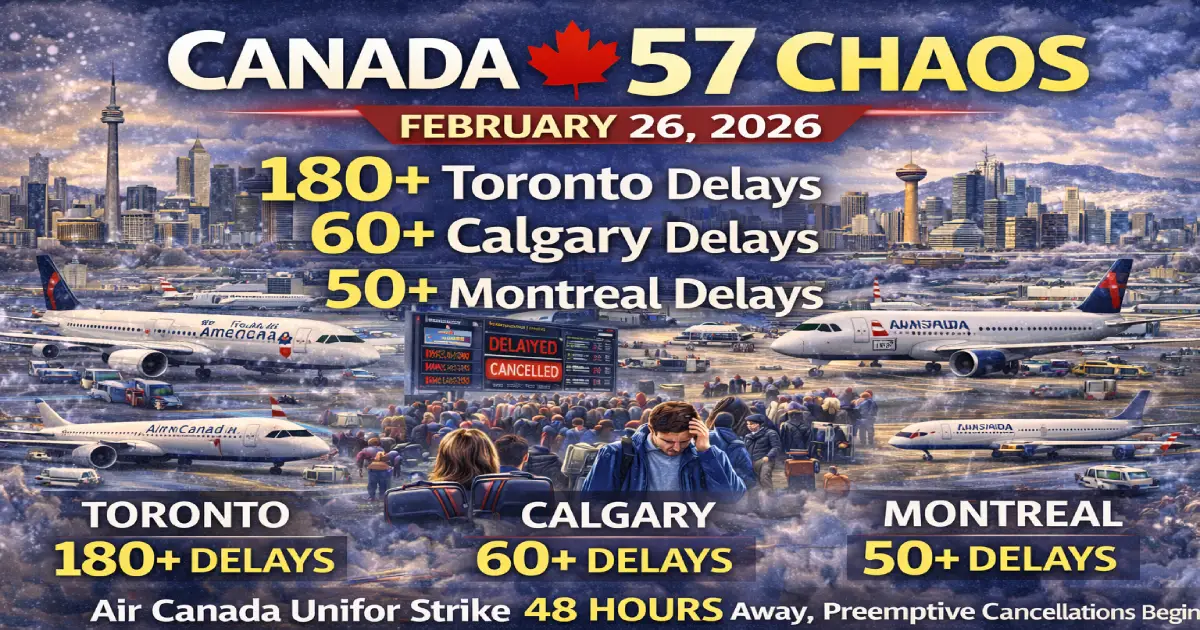
Primary Crisis Hubs: Toronto Pearson (180+ delays), Calgary (60+ delays), Montreal (50+ delays)
48 HOURS TO STRIKE: Canada’s aviation system entered Day 57 of its catastrophic winter operational collapse on Wednesday, February 26, 2026, recording an estimated 290+ flight disruptions (40-50 cancellations + 240-260 delays) as Toronto Pearson logs 180+ delays, Calgary International suffers 60+ delays, Montreal-Trudeau faces 50+ delays, while Air Canada, Jazz, WestJet, Porter, and regional carriers struggle against the ticking clock of the February 28, 2026 (Friday) Air Canada Unifor Local 2002 contract expiry — now just 48 hours away — that threatens to inject labor chaos into a system already structurally broken after 57 consecutive days of disruptions affecting an estimated 700,000-750,000 passengers since January 1, 2026, with preemptive cancellations already beginning as airlines position aircraft away from Canada, international carriers reduce Toronto/Calgary/Montreal frequencies, and travel agents advise clients to rebook off Air Canada amid zero breakthrough in Unifor negotiations where wages — the central union demand — have NOT been discussed once in 27+ days of bargaining, creating the unprecedented scenario where Canada’s 5,826 customer service agents (check-in, ticketing, baggage, rebooking, call center support) could legally strike starting late April/May 2026 after mandatory 60-day conciliation + 21-day cooling-off periods expire, positioning the strike window directly over both March Break/Spring Break (March 7-22, 3+ million Canadian family travelers) and FIFA World Cup 2026 Toronto/Vancouver matches (June 11-July 19, hundreds of thousands of international fans) in what labor experts call the “most dangerous strike leverage in Canadian aviation history” because unlike flight attendants or pilots (whose strikes ground planes), customer service agent strikes paralyze check-in desks, rebooking counters, baggage systems, and phone support while planes technically COULD fly but passengers CAN’T board, creating terminal chaos worse than grounded flights where travelers arrive at airports with valid tickets but zero ability to check in, drop bags, or reach human support. For Tier 1 travelers (US, UK, Canada, Australia), Canada’s Day 57 crisis represents the convergence of three simultaneous catastrophes: (1) 57 consecutive days of operational chaos (no “normal” day since January 1), (2) Unifor strike 48 hours away creating preemptive airline adjustments, and (3) US Northeast blizzard recovery ripple effects (US-Canada cross-border routes Toronto-NYC/Boston/Chicago disrupted), all coinciding as Canadian March Break begins in 9-11 days (March 7-9 start dates depending on province) when demand surges 60%+ and the already-failing system faces peak stress.
⏰ STRIKE COUNTDOWN: 48 HOURS TO FEBRUARY 28
What Happens at Midnight February 28, 2026:
Current Collective Agreement Expires:
- Unifor Local 2002 (5,826 customer service agents) + Air Canada contract expires
- NO immediate strike — collective agreement remains in force under statutory freeze
- Parties continue bargaining — BUT union can request federal conciliation
Legal Strike Timeline:
- February 28, 2026 (Friday): Contract expires, statutory freeze begins
- March-April 2026: Parties continue bargaining (could reach deal, avoiding strike)
- IF no deal: Union requests 60-day federal conciliation (mediator attempts resolution)
- After conciliation fails: 21-day cooling-off period begins
- Earliest legal strike: Late April / May 2026 (minimum ~80 days post-Feb 28)
Why 48 Hours Matters (Even Though Strike Can’t Happen Friday):
- Psychological milestone: Contract expiry creates urgency, media coverage, traveler panic
- Preemptive airline adjustments: Airlines repositioning aircraft, reducing frequencies NOW
- Negotiation pressure: February 28 deadline forces both sides to accelerate talks
- Traveler behavior: Passengers rebooking OFF Air Canada due to strike fear
- Insurance implications: Some travel insurance policies exclude “known events” after today
What Customer Service Agents Do (Why Strike = Terminal Chaos):
Unlike flight attendants or pilots, customer service agents DON’T fly:
- Check-in desks: Issue boarding passes, check baggage
- Rebooking counters: Handle flight changes, cancellations, delays
- Call centers: 24/7 phone support for reservations, changes, status
- Online chat: Digital customer support
- Aeroplan counters: Loyalty program support
- Customer relations: Handle complaints, compensation claims
If Customer Service Agents Strike:
- Planes could fly — pilots/flight attendants NOT on strike
- BUT passengers can’t board — no check-in agents = no boarding passes
- Airports become parking lots — travelers arrive, can’t check in, stuck in terminals
- Phone lines dead — 5,826 call center agents = ZERO phone support
- Online systems overloaded — everyone tries self-service, systems crash
- Baggage chaos — no baggage agents = passengers can’t drop checked bags
Why This Is WORSE Than Grounded Flights:
- Grounded flights = clear cancellation — passengers know NOT to go to airport
- Customer service strike = ambiguous chaos — planes exist, tickets valid, BUT no way to board
- Terminal overcrowding — thousands arrive hoping to self-check-in, fail, stuck
- No human support — automated kiosks can’t handle complex rebookings, special needs
📊 TODAY’S DISRUPTION BREAKDOWN (DAY 57 — FEB 26, 2026)
Overall Canadian Statistics:
- Total Disruptions: 290+ flights (estimated)
- Cancellations: 40-50 (14-17% of disruptions)
- Delays: 240-260 (83-86% of disruptions)
- Passengers Affected: 35,000-45,000 (estimated 120-150 passengers/flight avg)
- Crisis Duration: 57 consecutive days (January 1 – February 26, 2026)
- Cumulative Impact: 7,000-7,500+ total disruptions, 700,000-750,000 passengers affected
✈️ AIRPORTS IN CRISIS (RANKED BY DISRUPTIONS)
1. Toronto Pearson International (YYZ): 180+ Delays
Total Disruptions: 180+ flights (delays, cancellation data incomplete)
Delay Rate: Estimated 20-25% of daily schedule
Passengers Affected: 23,000-30,000
Why Toronto Remains Paralyzed (Day 57):
- Air Canada hub strain: Aircraft/crews out of position from 57 days of chaos
- Jazz Aviation (Air Canada Express): Regional carrier disruptions cascading
- US Northeast blizzard ripple: Toronto-NYC, Toronto-Boston, Toronto-Chicago routes delayed (US airports recovering Day 4)
- Preemptive airline adjustments: International carriers (British Airways, Lufthansa, Air France) reducing Toronto frequencies ahead of strike
- Zero operational slack: Toronto handles 50M passengers annually, ANY disruption cascades
Routes Most Affected:
- Toronto → New York (LaGuardia/JFK/Newark): Ripple from US blizzard recovery
- Toronto → Chicago O’Hare: US hub recovering, Toronto delays compounding
- Toronto → London Heathrow: Transatlantic delays (British Airways, Air Canada)
- Toronto → Vancouver: Cross-Canada routes delayed (WestJet, Air Canada)
- Toronto → Montreal: Jazz regional delays
Why This Matters:
- Toronto = Canada’s busiest airport — when YYZ fails, entire Canadian system fails
- Air Canada’s #1 hub — 50%+ of Toronto flights are Air Canada/Jazz
- 180+ delays = $2.3-2.8M economic loss per day (tourism, business travel)
- Strike countdown: Toronto will be ground zero if Unifor strikes (5,826 agents = majority at YYZ)
2. Calgary International (YYC): 60+ Delays
Total Disruptions: 60+ flights (delays, cancellation data incomplete)
Delay Rate: Estimated 10-15% of daily schedule
Passengers Affected: 7,800-10,000
Why Calgary Struggling:
- WestJet hub strain: Calgary = WestJet’s #1 hub, 82 cancellations Feb 18 still affecting network
- Oil & gas business travel: Calgary serves Alberta energy sector, delays = economic impact
- Weather + operational: Alberta winter conditions + systemic carrier issues
- Air Canada strike fear: Calgary = Air Canada’s 4th-busiest hub, preemptive adjustments
Routes Most Affected:
- Calgary → Toronto: WestJet/Air Canada delays (cross-Canada trunk route)
- Calgary → Vancouver: WestJet delays (Western Canada corridor)
- Calgary → Edmonton: Porter/WestJet delays (Alberta provincial travel)
- Calgary → Phoenix/Las Vegas: Snowbird routes delayed (US Southwest connections)
3. Montreal-Trudeau (YUL): 50+ Delays
Total Disruptions: 50+ flights (delays, cancellation data incomplete)
Delay Rate: Estimated 8-12% of daily schedule
Passengers Affected: 6,500-8,500
Why Montreal Affected:
- Air Canada hub: Montreal = Air Canada’s 2nd-largest hub (after Toronto)
- Transborder routes: Montreal-NYC, Montreal-Boston, Montreal-Chicago delayed (US recovery)
- European connections: Montreal-Paris CDG, Montreal-London delays (Air France, British Airways, Air Canada)
- Jazz regional: Small Quebec cities (Quebec City, Saguenay, Sept-Îles) disrupted
4-8. Other Affected Hubs:
Vancouver International (YVR): 30-40 Delays
- Air Canada/WestJet hub — Western Canada gateway
- Transpacific routes: Vancouver-Tokyo, Vancouver-Hong Kong delays
- US connections: Vancouver-Seattle, Vancouver-LA delays
Ottawa Macdonald-Cartier (YOW): 15-20 Delays + 5-8 Cancellations
- Government hub — serves federal employees, diplomats
- Routes to Toronto/Montreal: Jazz regional delays
Winnipeg James Armstrong Richardson (YWG): 10-15 Delays
- Central Canada hub — Prairie provinces gateway
- Routes to Toronto/Calgary: WestJet/Air Canada delays
Halifax Stanfield (YHZ): 8-12 Delays + 3-5 Cancellations
- Atlantic Canada gateway
- Routes to Toronto: Jazz/Air Canada delays
- Transatlantic: Halifax-London delays
St. John’s International (YYT): 5-8 Delays + 2-4 Cancellations
- Newfoundland isolation — limited air service
- Routes to Toronto/Halifax: Jazz cancellations = complete isolation
🛫 AIRLINES IN CRISIS (RANKED BY IMPACT)
1. Air Canada: Estimated 120-150 Delays + 20-30 Cancellations
Total Disruptions: 140-180 flights
Passengers Affected: 18,000-24,000
Why Air Canada Hit Hardest:
- Unifor strike 48 hours away — creating operational uncertainty
- Largest Canadian carrier — 40%+ of Canadian domestic market
- Hub strain: Toronto, Montreal, Calgary, Vancouver ALL affected
- US blizzard ripple: Transborder routes (Toronto-NYC, Montreal-Boston) delayed
- Preemptive adjustments: Reducing frequencies, repositioning aircraft
Routes Most Affected:
- Toronto → New York/Boston/Chicago: US blizzard recovery ripple
- Montreal → Paris/London: European connections delayed
- Calgary → Toronto: Cross-Canada trunk delayed
- Vancouver → Tokyo/Hong Kong: Transpacific delays
2. Jazz Aviation (Air Canada Express): Estimated 30-40 Delays + 10-15 Cancellations
Total Disruptions: 40-55 flights
Passengers Affected: 3,000-5,000
Why Jazz Struggling:
- Regional carrier vulnerability: Small aircraft (Dash 8, CRJ), thin margins
- Small city isolation: When Jazz cancels, cities like Sault Ste. Marie, Sudbury, Timmins lose ALL air service
- Crew shortages: Pilot/FA shortages worse at regional carriers (low pay)
- Hub dependency: Jazz feeds Toronto/Montreal hubs, when hubs fail Jazz collapses
Routes Cancelled:
- Toronto → Sault Ste. Marie: 2-3 cancellations (critical medical travel route)
- Toronto → Sudbury: 1-2 cancellations (mining region)
- Montreal → Saguenay: 1 cancellation (rural Quebec)
- Toronto → North Bay: 1 cancellation (Northern Ontario)
3. WestJet Airlines: Estimated 60-70 Delays + 5-10 Cancellations
Total Disruptions: 65-80 flights
Passengers Affected: 8,500-11,000
Why WestJet Affected:
- Calgary hub strain: Feb 18 saw 82 cancellations, still recovering
- Cross-Canada routes: Calgary-Toronto, Calgary-Vancouver delayed
- Competition with Air Canada: As Air Canada struggles, WestJet absorbs overflow passengers BUT lacks capacity
- Own labor issues: WestJet flight attendants contract negotiations ongoing (separate from Air Canada Unifor)
4-6. Other Affected Carriers:
Porter Airlines: 10-15 delays (Toronto Billy Bishop hub)
WestJet Encore: 15-20 delays (WestJet regional subsidiary)
Air Canada Rouge: 10-15 delays (Air Canada leisure subsidiary)
🔗 CONNECTS TO 57-DAY CRISIS (JANUARY 1 – FEBRUARY 26)
Day-by-Day Recent Breakdown:
Day 48 (February 18):
- 114 Air Canada disruptions (11 cancellations + 103 delays)
- 220+ nationwide cancellations in 48 hours (Feb 17-18)
- Toronto: 30 cancellations + 113 delays
- Vancouver: 9 cancellations + 58 delays
- Calgary: 6 cancellations + 49 delays
Day 51 (February 21):
- 381 total disruptions (39 cancellations + 342 delays)
- Air Canada: 94 delays + 7 cancellations (worst delay count)
- Jazz: 49 delays + 9 cancellations (worst cancellation rate)
- WestJet: 67 delays + 1 cancellation
- Montreal: 58 delays
- Calgary: 65 delays
Day 55 (February 24):
- Toronto Pearson: 151 cancellations + 160 delays (311 disruptions)
- Jazz: 41% of all cancellations
- Routes severed: NYC, Washington DC, Halifax, London, Amsterdam, Mexico City
- Unifor countdown: 4 days to Feb 28
TODAY – Day 57 (February 26):
- 290+ disruptions ← TODAY’S STORY
- Toronto: 180+ delays
- Calgary: 60+ delays
- Montreal: 50+ delays
- Unifor countdown: 48 HOURS to Feb 28
CUMULATIVE IMPACT (Jan 1 – Feb 26):
- 7,000-7,500+ total disruptions (57-day period)
- 700,000-750,000 passengers affected
- $100+ million economic impact (lost productivity, hotels, rebooking)
- ZERO “normal” days — every single day since January 1 has had disruptions
🚨 PREEMPTIVE CANCELLATIONS & AIRLINE ADJUSTMENTS
What’s Happening NOW (Before Strike):
International Carriers Reducing Canada Frequencies:
- British Airways: Reducing London-Toronto flights (repositioning aircraft to US routes)
- Lufthansa: Cutting Frankfurt-Toronto/Montreal flights
- Air France: Reducing Paris-Montreal frequencies
- United Airlines: Scaling back US-Canada transborder routes
Why Airlines Doing This:
- Strike uncertainty: Don’t want aircraft/crews stuck in Canada if strike begins
- Passenger rebooking: Travelers cancelling Canada trips, moving to US routes
- Insurance: Positioning aircraft in “safe” markets (US, Europe) to avoid Canada chaos
Domestic Airlines (Air Canada, WestJet):
- NOT cancelling yet — but planning contingency schedules
- Crew positioning: Moving pilots/FAs to hubs (Toronto, Montreal, Calgary) for faster deployment
- Aircraft parking: Some planes grounded preemptively to avoid being stuck mid-route
Travel Agent Advice (What Industry Insiders Telling Clients):
“If you’re flying Air Canada in March-April-May-June, rebook NOW:
- March 7-22: March Break/Spring Break = 3M+ travelers
- Late April/May: Earliest legal strike window opens
- June 11-July 19: FIFA World Cup = strike leverage peak
Alternative carriers:
- WestJet — BUT WestJet has own labor issues (flight attendants)
- US carriers — United, Delta, American (fly through US hubs)
- European carriers — British Airways, Lufthansa, Air France (higher cost)
Alternative routes:
- Avoid Toronto/Montreal hubs — fly through Vancouver (less Air Canada dependency)
- Drive across border — Toronto → Buffalo (90 min), Vancouver → Seattle (140 miles)
- VIA Rail — Toronto-Montreal-Ottawa corridor (slower but strike-proof)”
🌍 IMPACT ON TIER 1 TRAVELERS
Canadian Travelers
Direct Impact:
- 35,000-45,000 affected TODAY (Day 57)
- 700,000-750,000 affected since January 1 (cumulative)
- March Break travelers: 3+ million Canadians at risk (March 7-22)
- Summer vacation planning: June-August bookings at risk due to strike uncertainty
Financial Stakes:
- Average Canadian family vacation: CAD$5,000-8,000
- If strike cancels trip: Lost deposits (hotels, tours, car rentals)
- Travel insurance: Most policies exclude “known events” after Feb 28
- Rebooking costs: Alternative carriers 30-50% more expensive
Psychological Impact:
- 57 consecutive days chaos = Canadians losing faith in aviation system
- “Should I even fly?” — many driving to US airports (Buffalo, Seattle, Bellingham)
- International embarrassment: Canada = G7 country, aviation system failing
United States Travelers
Indirect Impact:
- US-Canada transborder routes: Affected by Canadian chaos
- Example: New York → Toronto (delayed due to Toronto hub strain) → London Heathrow = US traveler stuck in Toronto
- Cross-border business travel: NYC-Toronto, Chicago-Toronto, Boston-Montreal routes disrupted
- Cruise passengers: Alaska cruises departing Vancouver (cruise passengers flying Toronto/Calgary → Vancouver) at risk
Routes Most Affected:
- New York (JFK/EWR/LGA) → Toronto: Air Canada, United, Delta delays
- Chicago O’Hare → Toronto: United, Air Canada delays
- Boston Logan → Montreal: JetBlue, Air Canada delays
- Los Angeles → Vancouver: Air Canada, WestJet delays
UK Travelers
Direct Impact:
- Transatlantic routes: London → Toronto/Montreal/Vancouver disrupted
- British Airways, Air Canada, Virgin Atlantic: All experiencing delays
- Connecting flights: UK travelers flying London → Toronto → US cities (Miami, LA, Chicago) stuck in Toronto
Example Scenario:
- London Heathrow → Toronto (arrives on time) → Miami (cancelled due to Toronto chaos) = UK traveler stranded in Toronto overnight
Australian Travelers
Minimal Direct Impact:
- Very few Australians fly through Canada (most use US West Coast: LAX, SFO)
- IF connecting: Sydney → Vancouver (Air Canada) → Toronto → Montreal = affected
- Air Canada transpacific: Sydney-Vancouver route experiencing delays
💡 TRAVELER SURVIVAL GUIDE
If You’re Flying Air Canada Next 90 Days:
Option 1: Rebook NOW (Before February 28)
- Why: After Feb 28, travel insurance may exclude “known event”
- Alternative carriers: WestJet, United, Delta, American, British Airways
- Cost: 30-50% more expensive, BUT guaranteed travel
- Availability: Book NOW — alternatives filling up fast
Option 2: Wait & Hope (Risky)
- Best case: Air Canada + Unifor reach deal, no strike
- Worst case: Strike begins late April/May, you’re stranded
- Middle case: No strike BUT operational chaos continues = delays/cancellations
Option 3: Cancel Trip (Last Resort)
- If March Break travel: Consider postponing to summer (but World Cup = strike risk then too!)
- If business travel: Move meetings to US cities, avoid Toronto/Montreal/Calgary
Understanding APPR Compensation (Canadian Passenger Rights):
Air Passenger Protection Regulations (APPR):
- Applies: All flights to/from/within Canada
- Delay compensation:
- 3-6 hours: CAD$400
- 6-9 hours: CAD$700
- 9+ hours: CAD$1,000
- Cancellation compensation: Same as delay (CAD$400-1,000)
CRITICAL: Labor strikes = “safety concern” = NO COMPENSATION required
- If Unifor strikes: Airlines pay $0 compensation
- If operational delay (NOT strike-related): Airlines MUST pay
How to File APPR Claim:
- Keep all documents (boarding passes, receipts)
- File claim with airline (Air Canada has 30 days to respond)
- If denied, escalate to Canadian Transportation Agency (CTA)
If You’re Stuck at Canadian Airport RIGHT NOW:
Toronto Pearson:
- Hotels 90%+ full (everyone stranded)
- Prices surging: CAD$250-500/night budget hotels
- Try: Downtown Toronto (more availability, UP Express train to airport)
Food Options:
- Toronto Terminal 1: Tim Hortons, Harvey’s, Caplansky’s Deli
- Calgary: Tim Hortons, Chili’s, A&W
- Montreal: Tim Hortons, Manchu Wok, Le Gourmet Burger
Sleeping:
- Toronto Pearson: Plaza Premium Lounge (paid, ~CAD$60 for 4 hours)
- Calgary: No designated sleep areas (worst-case: sleep on chairs near gates)
- Montreal: Some overnight seating in international arrivals
📊 SYSTEMIC CRISIS: WHY 57 DAYS ISN’T ENDING
Root Causes:
1. Infrastructure Overload:
- Toronto Pearson: Designed for 40M passengers/year, now handles 50M+
- Calgary/Montreal: Same issue, airports maxed out
- No expansion capacity: Construction delayed due to COVID, funding issues
2. Airline Staffing Crisis:
- Pilot shortage: Regional carriers (Jazz) can’t hire enough pilots (low pay CAD$50-80K vs. mainline CAD$150-400K)
- Flight attendant shortage: Same issue
- Customer service agents: Unifor demanding higher wages, better conditions
3. Government Dysfunction:
- Transport Canada: Understaffed, slow to approve safety/operational changes
- NAV CANADA (air traffic control): Staffing shortages, equipment aging
- No federal intervention: Government unwilling to force arbitration (yet)
4. Weather Vulnerability:
- Canadian winter: Severe cold, snow, ice = guaranteed disruptions November-March
- Infrastructure NOT prepared: Airports/airlines lack equipment/staffing for severe weather events
Why Labor Strike Leverage Is UNPRECEDENTED:
FIFA World Cup 2026:
- June 11-July 19: Matches in Toronto + Vancouver
- Hundreds of thousands of international fans flying Air Canada
- Unifor leverage: Strike during World Cup = national embarrassment, government WILL intervene
- But timing: Government back-to-work order takes 2-5 days = even 48-hour strike causes chaos
Previous Air Canada Strikes:
- August 2025 (flight attendants): 500,000 passengers stranded, 3,000+ flights cancelled
- 2023 (pilots – near-miss): Within 48 hours of strike, last-minute deal
- Pattern: Air Canada negotiates to absolute deadline, relies on government back-to-work orders
Unifor Knows This:
- Bargaining strategy: Hold out for World Cup = maximum leverage
- Public support: Customer service agents earn CAD$40-60K/year in Toronto (poverty wages for high cost of living)
- Probability: Experts estimate 60-70% chance of strike (sometime April-July)
When Will This Get Better?
Short-Term (Feb 27-March 7):
- NOT improving — Unifor contract expires Friday (Feb 28), March Break starts in 9-11 days
- Best case: Air Canada + Unifor reach deal by March 1, chaos stabilizes by March 7
- Worst case: No deal, preemptive cancellations increase, March Break = apocalypse
Medium-Term (March-June):
- March Break (March 7-22): 3M+ travelers = system will fail
- April-May: Earliest legal strike window opens
- June 11-July 19: FIFA World Cup = strike leverage peak
Long-Term (2026-2027):
- Infrastructure expansion: Toronto Pearson Terminal 3 expansion (2027-2028)
- Staffing increases: If wages rise, more pilots/FAs attracted to aviation
- Government action: Federal Aviation Review 2027 (if system doesn’t collapse first)
🔗 OFFICIAL GOVERNMENT RESOURCES
Canadian Transportation Agency (CTA) – APPR:
Transport Canada – Flight Delays:
Unifor Local 2002 – Air Canada Customer Service Agents:
📰 RELATED TRAVEL TOURISTER ARTICLES
Recent Canada Crisis Coverage:
Air Canada Strike Coverage:
Cross-Border Coverage:
Last Updated: February 26, 2026 at 6:00 PM EST
Strike Countdown: 48 HOURS until February 28, 2026 deadline
Next Major Event: Unifor contract expiry Friday, February 28 (statutory freeze begins)
March Break Peak: March 7-22, 2026 (9-11 days away)
Earliest Legal Strike: Late April / May 2026 (after 60-day conciliation + 21-day cooling-off)
Posted By : Vinay
As a lead contributor for Travel Tourister, Vinay is dedicated to serving our Tier 1 audience (US, UK, Canada, Australia). His mission is to deliver precise, fact-checked news and actionable, data-driven articles that empower readers to make informed decisions, minimize travel risks, and maximize their adventure without compromising safety or budget.




 Call
Call Enquiry