Published on : 17 Feb 2026
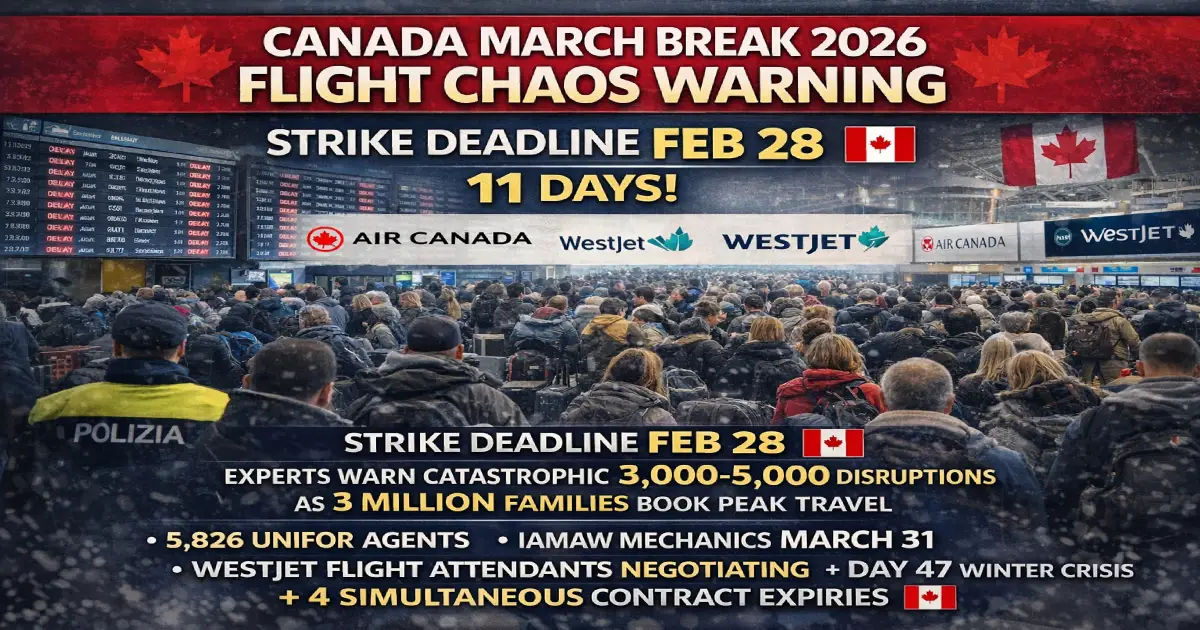
URGENT WARNING: Canadian families booking March Break travel face the single most dangerous aviation disruption window in the country’s modern history, as four simultaneous airline contract expiries, a 47-day ongoing winter crisis, and structural aviation failures converge to create a perfect storm threatening to strand millions of passengers during Canada’s peak family travel period — with Air Canada’s 5,826 Unifor Local 2002 customer service agents reaching contract deadline in just 11 days (February 28), Air Canada mechanics and baggage handlers (IAMAW) expiring March 31 — directly during March Break — WestJet flight attendants in active 2026 negotiations, and Sunwing cabin crew expiring May 31, while McGill University aviation expert John Gradek warns “they all have the potential to shut down the airlines,” former industry observers note that Canada’s aviation system has now experienced 5,500+ disruptions in 47 days since January 1, and the spectre of Air Canada flight attendants’ August 2025 strike defiance of a federal back-to-work order — which stranded 500,000 passengers and cancelled 3,000+ flights — looms as a chilling precedent over what could be the darkest March Break in Canadian aviation history, with the FIFA World Cup 2026 (June 11-July 19) adding yet another catastrophic disruption window if negotiations fail this spring.
Published: February 17, 2026 (Day 47 of Canada’s Winter Aviation Crisis) URGENT: Air Canada Unifor contract expires February 28 — 11 days away Workers at Risk: 5,826 Unifor Local 2002 customer service agents Second Expiry: Air Canada IAMAW mechanics + baggage handlers — March 31 Third Risk: WestJet flight attendants — active 2026 negotiations Fourth Risk: Sunwing cabin crew — May 31 expiry March Break Peak: March 7-21, 2026 (3 million+ family travelers) Winter Crisis: Day 47, ~5,500 disruptions, 500,000+ passengers affected since Jan 1 August 2025 Precedent: Air Canada flight attendants struck, defied back-to-work order, 500,000 stranded FIFA World Cup Risk: June 11-July 19, 2026 — peak travel + potential strikes = catastrophic Expert Warning (McGill): “They all have the potential to shut down the airlines”
Unifor Local 2002 negotiations with Air Canada over wages and conditions could lead to legal strike after Feb. 28 contract expiry.
Air Canada and Unifor Local 2002 have opened bargaining for 5,826 airport and call-centre customer service agents, with the current collective agreement set to expire on February 28, 2026. Unifor says negotiations began January 28, and members are seeking higher wages, more predictable scheduling, and improved working conditions, arguing these roles are central to the passenger experience during disruptions and day-to-day operations.
What these 5,826 agents actually do: Air Canada’s customer service agents are responsible for tasks like check-in, reservations, baggage handling, and customer support — the impact could be felt deeply across Canada’s aviation system.
These customer service agents handle check-in, ticketing, rebooking, and frontline problem-solving at major airports — including Toronto Pearson International Airport — and in contact centres, so any labour action could quickly manifest as longer queues, slower re-accommodation, and increased pressure on airport operations.
Canada’s robust Labour Code sets clear parameters for what happens when a contract between employers and unions ends. Once Air Canada’s contract with Unifor Local 2002 expires, the union and the airline enter a 60-day conciliation period. During this time, federal mediators help the two parties negotiate a new agreement. If the process fails, a 21-day cooling-off period follows, preventing any work stoppages. However, once this cooling-off period ends, federally regulated strikes or lockouts can occur — provided that the appropriate legal steps are followed.
Realistic Strike Timeline:
| Stage | Duration | Earliest Date |
|---|---|---|
| Contract expires | — | February 28, 2026 |
| Conciliation period | Up to 60 days | March 1 – April 28 |
| Conciliator files report | — | By ~April 28 |
| Cooling-off period | 21 days | April 28 – May 19 |
| Legal strike possible | — | ~May 19, 2026 |
| 72-hour strike notice required | — | ~May 16 |
Critical insight: The legal process means a worst-case strike could fall directly during the FIFA World Cup 2026 group stage — the single most travel-intensive period in Canadian aviation history.
But don’t assume March Break is safe: That said, a strike wouldn’t happen immediately after February 28. Federal rules require additional steps first, and any legal job action would also need at least 72 hours’ notice.
However — and this is critical — a strike is only ONE of the risks. The ongoing winter crisis, February 28 contract expiry chaos, and March 31 mechanics expiry combine to make March Break dangerous regardless of whether a strike materialises.
Unifor’s roughly 5,800 customer service agents are essential to passenger processing — from ticketing, check-in, and baggage service to contact center support — and have raised concerns about wages, staffing levels, and working conditions as contract talks intensify.
Unifor National President Lana Payne: “Air Canada’s customer service agents are the backbone of the passenger experience. They manage delays, disruptions, and customer care under immense pressure, yet too often without the staffing and protections that reflect the value of their work. This bargaining round is about respect, safety, and fairness for the workers who keep Canada flying.”
Specific demands include: The union highlights that its members often handle high-pressure customer interactions and logistical challenges. In these moments, customer service agents are often the first point of contact for travellers seeking rebookings or support.
Unifor Local 2002 says it is too early to predict a strike date, the union remains focused on reaching a fair agreement through talks.
Unpaid work issue: Much of the work service agents do happens under intense pressure and “includes unpaid time spent in uniform before and after shifts, as well as ongoing mandatory training to meet strict regulatory requirements.”
Mechanics and workers in Air Canada’s warehouse, finance and administration departments, represented by the International Association of Machinists and Aerospace Workers (IAMAW), have a contract that will expire on March 31.
Why IAMAW is MORE dangerous than Unifor for March Break:
Unlike the customer-service agents’ contract, the IAMAW’s current contract is a 10-year agreement, meaning these workers haven’t negotiated new wages or improvements to working conditions since 2016.
That 10-year gap = enormous pent-up demand for wage increases:
WestJet will start 2026 in negotiations with flight attendants. Air Canada will see many ground crew and baggage workers bargaining a renewed contract.
“They all have the potential to shut down the airlines in each of their respective contract negotiations,” said John Gradek, faculty lecturer in aviation management at McGill University.
WestJet context: Gradek, the industry expert, speculates that contract disputes at a carrier like WestJet might not really take off until the end of May, if not later.
But: WestJet has its own history of disruptions:
Cabin crew at Sunwing Airlines, represented by CUPE Airline Division Local 4055, will also be in bargaining this year, as their current contract expires on May 31.
Additional aviation contracts expiring in 2026: May and June will see other airline industry contracts expire at Sunwing Airlines and Cargojet.
Cargojet: Canada’s dominant air cargo carrier. Strike = disruption to Canadian supply chains, e-commerce deliveries, pharmaceutical shipments.
Last Major Strike: August 16-19, 2025 (flight attendants) — 500,000 passengers stranded, 3,000+ flights cancelled.
A growing reliance on back-to-work directives by the federal government has, ironically, spawned further impasses at the bargaining table, as employers banked on staff members being ordered to return to their posts within hours of launching a job action.
The directives rely on Section 107 of the Canada Labour Code. The provision allows the labour minister to “direct the (industrial relations) board to do such things as the minister deems necessary… to maintain or secure industrial peace” — such as ending a work stoppage via binding arbitration. Used sparingly since its inception in 1984, the government has now triggered Section 107 eight times since 2020.
While ordering union members back to work hasn’t always seen them comply recently, with CUPE members notably defying that order, labour experts and lawyers point out that relying on the government using that power is something employers may be relying on.
The critical point for travelers: Air Canada flight attendants’ defiance of the back-to-work order may make employers think twice about depending on Section 107.
Translation: Even if the government issues a back-to-work order during March Break, unions may defy it — as they did in August 2025. Passengers cannot assume government intervention will save their travel plans.
Canada’s aviation system is already in crisis — before any potential strikes.
47-day crisis summary (January 1 – February 17, 2026):
| Date | Event | Disruptions |
|---|---|---|
| January 1-4 | New Year chaos | 2,448 total |
| January 5-31 | Ongoing winter disruptions | ~2,000 est. |
| February 9 | Day 40 crisis | 383 total |
| February 12 | Pearson operational failure | 152 at YYZ alone |
| February 14 | Valentine’s Day | 366 total Canada |
| February 16 | Day 47 | 344 total Canada |
| Total Jan 1 – Feb 17 | 47 days | ~5,500 flights |
Structural problems causing ongoing disruptions:
1. Hub concentration:
2. De-icing bottlenecks:
3. Regional carrier fragility:
4. Labor strife (ongoing):
March Break 2026 provincial dates:
| Province | March Break Dates |
|---|---|
| Ontario | March 14-22, 2026 |
| British Columbia | March 14-22, 2026 |
| Quebec | March 7-14, 2026 |
| Alberta | March 21-29, 2026 |
| Nova Scotia | March 14-22, 2026 |
| New Brunswick | March 14-22, 2026 |
| Manitoba | March 21-29, 2026 |
Peak travel demand:
What makes 2026 uniquely dangerous:
| Risk Factor | Previous Years | 2026 |
|---|---|---|
| Winter crisis ongoing | Occasionally | ✅ Day 47 entering March Break |
| Customer service contract | Not expired | ✅ Expires Feb 28 (during March Break) |
| Mechanics contract | Not expired | ✅ Expires March 31 (DURING March Break) |
| WestJet negotiations | Settled | ✅ Active negotiations |
| Back-to-work reliability | Reliable | ✅ Defied August 2025 |
| Hub capacity | Strained | ✅ At maximum |
| Risk level | Moderate | 🚨 EXTREME |
Scenario A: Unifor deal reached before Feb 28 (BEST CASE)
Scenario B: Unifor conciliation period, no strike (MODERATE)
Scenario C: IAMAW mechanics strike March 31 (SEVERE)
Scenario D: Multiple strikes + back-to-work defiance (CATASTROPHIC)
High-Risk Travel Periods: Spring Break (Feb 28–March 22), FIFA World Cup 2026 (June 11-July 19).
Why FIFA World Cup amplifies strike risk:
World Cup Canada venues:
Air Canada’s dilemma:
If traveling February 28 – March 6 (immediate risk window):
If traveling March 7-21 (March Break peak):
Alternative airlines (less exposed):
Documentation checklist:
If flight cancelled due to strike:
Critical APPR tip: Air Canada gate agents may claim “we can only book Air Canada” but this violates regulations. Politely insist: “Canadian Air Passenger Protection Regulations require you to check ALL airlines, not just Air Canada.”
Travel insurance: Read the fine print
Q: Is March Break 2026 definitely going to be chaos? A: Not definitely — deals can be reached. But the combination of Day 47 ongoing crisis + 4 contract expiries + August 2025 precedent = highest disruption risk of any March Break in recent memory. Plan accordingly.
Q: Can the government stop a strike during March Break? A: While ordering union members back to work hasn’t always seen them comply recently, with CUPE members notably defying that order, labour experts and lawyers point out that relying on the government using that power is something employers may be relying on. Do not assume government intervention will save your March Break.
Q: Should I cancel my March Break booking? A: Don’t cancel yet — monitor negotiations. If Unifor reaches a deal before February 28, risk drops significantly. Make sure you have refundable bookings and/or travel insurance before the deadline.
Q: Which airline is safest for March Break? A: Porter (lowest labour risk this period) → Air Transat (charter, different contracts) → WestJet (has own risks but different timeline) → Air Canada (highest risk).
Q: What about travel to the US during this period? A: US transborder flights on American, United, Delta = much safer bet. Consider flying US carriers directly from Canadian cities.
Q: Does Air Canada have to pay me if they cancel due to a strike? A: No cash compensation — strikes are “extraordinary circumstances.” But free rebooking or full refund is guaranteed. Keep all receipts for meals/hotels.
Canada’s March Break 2026 faces the most dangerous aviation disruption window in the country’s modern history — with Air Canada’s Unifor contract expiring in just 11 days (February 28), IAMAW mechanics expiring March 31 (directly during spring break), WestJet in active negotiations, and Sunwing expiring May 31 all converging with a 47-day, 5,500-flight winter crisis that has already devastated Canadian aviation since January 1, while the August 2025 flight attendant strike (500,000 stranded, 3,000+ cancelled) and subsequent defiance of the government’s back-to-work order removes the safety net Canadians have relied upon, leaving 3 million March Break family travelers exposed to what McGill University expert John Gradek calls a situation where “they all have the potential to shut down the airlines.”
The bottom line for Canadian travelers:
For More Information:
Related Articles:
Posted By : Vinay
This article is provided for general informational purposes only and is based on information available at the time of publication. Travel advisories, airline schedules, airport operations, visa requirements, government regulations, and other travel-related information are subject to change without prior notice. While Travel Tourister makes reasonable efforts to verify information using official announcements, government publications, airline and airport communications, and other reliable sources, we cannot guarantee that all information remains complete, accurate, or up to date at all times. Readers should independently verify any information that may affect their travel plans with the relevant airline, airport authority, government agency, embassy, or other official source before making travel, financial, or other decisions. Travel Tourister shall not be liable for any direct or indirect loss, inconvenience, or damages arising from the use of or reliance on the information contained in this article. Nothing in this publication constitutes legal, immigration, financial, or professional travel advice. If you believe any information in this article is inaccurate or outdated, please contact our editorial team. We review all credible correction requests promptly and update our content whenever appropriate.
Lastest News
2nd Floor, 39, Above Kirti Club, DLF Industrial Area, Kirti Nagar, New Delhi, Delhi 110015



Travel Tourister is a leading Travel portal where we introduce travellers to trusted travel agents to make their journey hasselfree, memorable And happy. Travel Tourister is a platform where travellers get Tour packages ,Hotel packages deals through trusted travel companies And hoteliers who are working with us across the world. We always try to find new and more travel agents and hoteliers from every nook and corners across the world so that you could compare the deals with different travel agents and hoteliers and book your tour or hotel with the one you have chosen according to your taste and budget.
Copyright © Travel Tourister, India. All Rights Reserved

 Call
Call Enquiry