Published on : 08 Apr 2026
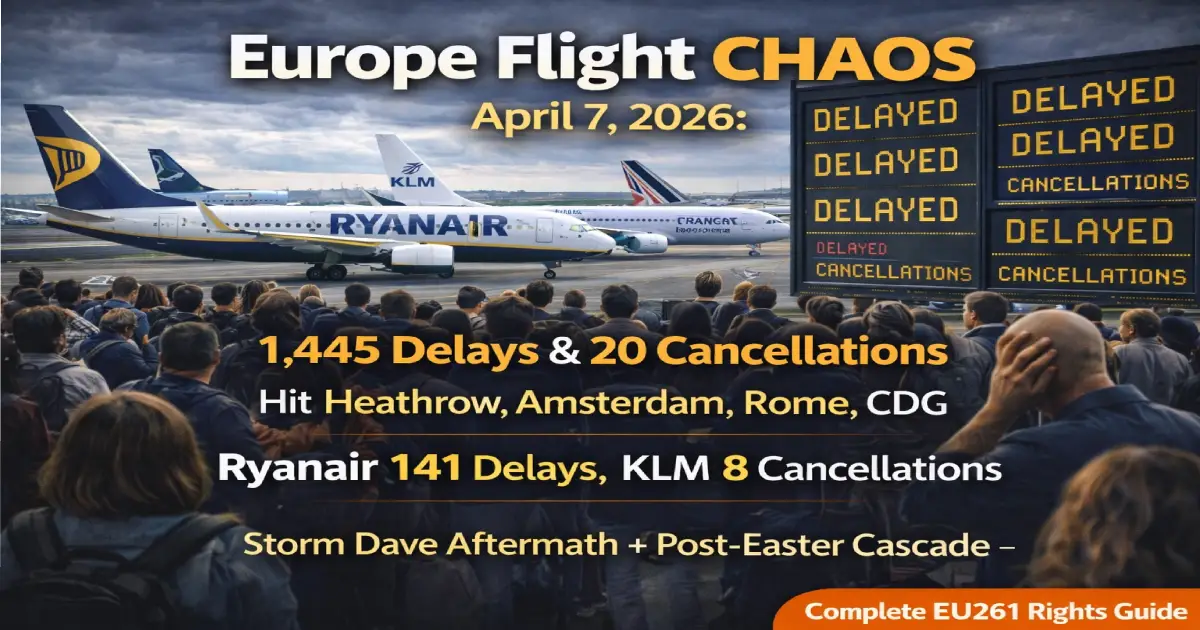
Breaking: A major wave of flight disruption is sweeping across Europe today, Tuesday April 7, 2026 — with 1,445 delays and 20 cancellations hitting England, Denmark, France, Ireland, Italy, the Netherlands, Portugal and Switzerland. Rome Fiumicino is the worst-affected airport by volume. Amsterdam Schiphol leads all airports for cancellations. Ryanair is recording more delays than any other single carrier on the continent. The disruption is the direct product of three forces colliding simultaneously on the first full working day after Easter: Storm Dave’s trailing disruption cascade, post-Easter aircraft and crew misalignment across the network, and the structural strain of a European aviation system already running on empty after the most disrupted Easter period in years.
If you are flying through any European airport today — or have flights in the coming days — this is your complete airport-by-airport breakdown and full EU261 rights guide.
Published: April 7, 2026 Total European Disruptions: 1,465 (1,445 delays + 20 cancellations) Countries Affected: England, Denmark, France, Ireland, Italy, Netherlands, Portugal, Switzerland Worst Airport (Delays): Rome Fiumicino (FCO) — 223 delays, 0 cancellations Worst Airport (Cancellations): Amsterdam Schiphol (AMS) — 8 cancellations, 197 delays Worst Airline (Delays): Ryanair — 141 delays across network Worst Airline (Cancellations): KLM — 8 cancellations + 136 delays Root Causes: Storm Dave aftermath cascade + post-Easter aircraft/crew misalignment + ATC congestion + Middle East long-haul rerouting knock-on What’s Next: Italy nationwide aviation strike April 10 — 3 days away EU261 Cash Compensation: €250–€600 per passenger for qualifying delays/cancellations Apply At: Your airline’s website + national aviation authority if refused
April 7 is the first Tuesday after Easter. For the European aviation network, that is a specific kind of operational stress that builds in layers rather than arriving as a single event.
Layer 1 — Storm Dave aftermath. A fierce Atlantic weather system dubbed Storm Dave barrelled across northern and western Europe on April 7, forcing airlines to cancel at least 238 flights and delay almost 1,500 more. Dublin Airport joined Keflavík, Stockholm Arlanda, London’s main airports and Frankfurt on the list of worst-affected hubs as crosswinds and poor visibility slashed runway capacity during peak morning waves. Storm Dave first struck on Easter Saturday, April 4, before tracking northeast through Easter Sunday, Easter Monday and into today. Storm Dave, the fourth named storm of the year, struck northern and western parts of the UK overnight from Saturday into Easter Sunday, leading to significant travel chaos. Even as the weather system exits, the damage it leaves behind in the form of displaced aircraft and out-of-position crews continues to cascade through Tuesday’s schedule.
Layer 2 — Post-Easter network misalignment. Easter is the busiest four-day flying period in European aviation’s annual calendar. When 15,000+ flights operate across those four days at close to maximum capacity — with Storm Dave disrupting hundreds of them — aircraft end their Easter Monday in the wrong airports, crews hit their duty time limits in unexpected locations, and maintenance windows that were scheduled for off-peak periods have to be compressed or skipped. Figures compiled on April 6 and 7 show more than 2,400 delayed flights and over 150 cancellations in a 24-hour period across Europe, affecting major hubs such as London, Paris, Amsterdam, Frankfurt and Copenhagen.Today’s 1,445 delays are partly today’s operational story and partly yesterday’s unresolved backlog materialising in departure boards across the continent.
Layer 3 — Structural European airspace strain. Analysts point to a combination of air traffic control capacity constraints, unsettled weather linked to the current windstorm season and lingering knock-on effects from diverted long-haul routes as key drivers of the latest disruption. The Middle East conflict has forced dozens of long-haul widebody aircraft onto alternative European routings through London, Amsterdam and Paris. Those extra movements are consuming ATC capacity in airspace sectors that were already running at or near peak volume for the post-Easter working week restart. The result is an invisible but pervasive pressure on departure windows across every major European hub.
Rome is today’s most disrupted airport by raw delay count. Rome Fiumicino recorded 223 delays and notably zero cancellations, indicating operational continuity despite congestion. The absence of cancellations is significant — ITA Airways and the other carriers operating from Fiumicino are choosing to absorb delays rather than cut flights, keeping passengers on board their original services at the cost of significant schedule slippage throughout the day.
ITA Airways, Rome’s dominant carrier, is recording 100 delays today — the highest of any Italian carrier. The combination of post-Easter return traffic, Storm Dave’s northern cascade pushing aircraft off their rotations, and the ongoing structural pressure from the Iran war’s long-haul rerouting through European hubs is producing one of Rome’s most disrupted post-holiday days of 2026.
Critically for travellers: Italy is facing a nationwide aviation strike on April 10 — just 3 days away. Unions representing air traffic controllers and aviation workers have called a strike affecting Rome Fiumicino, Milan and other Italian airports. If you have flights through Italy in the next 72 hours, monitor the situation closely.
If delayed at Rome Fiumicino:
Amsterdam is today’s most disrupted airport for outright cancellations. Amsterdam recorded the highest cancellations (8) alongside 197 delays, making it one of the most severely impacted hubs overall.
KLM is the source of virtually all of Amsterdam’s cancellations today — and KLM is simultaneously the worst airline in Europe for cancellations with 8 confirmed groundings and 136 delays across its full network. KLM’s travel alert page, last updated Tuesday April 7 at 10:10 Amsterdam time, confirmed disruption to, from or via US Eastern airports from April 4–7 due to thunderstorms, offering rebooking and refund options for affected passengers.
The compounding factors at Schiphol are acute. KLM operates Amsterdam as its only hub — meaning every cancelled KLM aircraft is a cancelled aircraft from the heart of the network. There is no secondary hub to absorb the load. When aircraft are positioned in the wrong city after Storm Dave’s disruption of Easter weekend services, Schiphol feels every displacement immediately. In the Netherlands, Amsterdam Schiphol continued to experience elevated disruption levels after a difficult start to the April travel period. Flight data showed Schiphol handling a disproportionately high share of delayed services, magnifying the impact for connecting passengers traveling onward to transatlantic and long-haul destinations.
KLM passenger actions for today:
Lisbon is today’s third-worst airport by delay volume. Rome Fiumicino, Lisbon and the Paris airport system were among the hubs reporting significant knock-on effects, as late-arriving aircraft from earlier legs struggled to recover their schedules.
TAP Air Portugal is the primary driver at Lisbon today with 116 delays — the third-highest carrier delay count in Europe today. TAP’s network touches the UK, France, Germany, Brazil, the US, and Anglophone Africa through Lisbon. When Lisbon’s delays cascade, they cascade far. Porto (Francisco Sá Carneiro) is recording an additional 48 delays in TAP’s regional Portuguese network.
TAP passenger actions:
Paris CDG is absorbing significant disruption today in the form of 137 delays and 2 cancellations. Paris CDG saw 137 delays and 2 cancellations, with Air France accounting for a significant portion of disruptions. Air France recorded 65 delays and 1 cancellation at CDG today — a significant hit for Europe’s second-largest network carrier.
The Paris disruption today is heavily post-Easter in character. CDG processed record Easter volumes across the four-day holiday weekend, and today’s delays reflect the accumulated schedule slippage of aircraft that could not fully recover from Storm Dave’s disruption on Saturday and Sunday. Tight minimum connection times at CDG — which regularly sees connecting times of 60–75 minutes — are producing a specific misconnection risk for passengers flying transatlantic inbound and connecting onward to European destinations.
Air France passenger actions:
Heathrow is recording 126 delays and 2 cancellations today. British Airways, operating from London Heathrow and Gatwick, faced its own set of challenges as earlier system issues and congested airspace translated into rolling delays on European routes. Short-haul sectors to Rome, Madrid, Amsterdam and Paris showed punctuality well below seasonal norms, adding to the number of passengers misconnecting from long-haul arrivals into the carrier’s European network.
British Airways and its subsidiaries are recording 56 delays at Heathrow today. The Heathrow disruption has a specific character on April 7 — it is primarily a connecting problem rather than a departure problem. Long-haul flights from North America, Australia and Southeast Asia are arriving at Heathrow on time or with modest delays. But the European short-haul services that were supposed to be waiting for those connections are themselves running late from Storm Dave’s residual cascade, creating a pinch point in Heathrow’s T5 (British Airways’ primary terminal) and T2 connection banks.
British Airways passenger actions:
Dublin is recording 93 delays and 1 cancellation today, still feeling the direct residual effects of Storm Dave which hit Ireland particularly hard over Easter weekend. Storm Dave critically disrupted Dublin Airport flight operations, causing 53 aborted landings, 17 cancellations, and 13 diverted flights. Aircraft that diverted during the storm are now working their way back to their home bases, producing reactionary delays throughout today’s schedule.
Ryanair’s Irish base is a specific pressure point. As the dominant carrier at Dublin, Ryanair’s 141-delay total across Europe today is heavily weighted toward its Irish and UK departure banks.
| Airport | Code | Delays | Cancellations |
|---|---|---|---|
| Zurich | ZRH | 86 | 4 |
| Milan Malpensa | MXP | 67 | 0 |
| Marseille Provence | MRS | 49 | 0 |
| Porto | OPO | 48 | 0 |
| Copenhagen | CPH | 46 | 2 |
| Milan Linate | LIN | 36 | 0 |
| Lyon Saint-Exupéry | LYS | 34 | 0 |
| Edinburgh | EDI | — | — |
| Airline | Delays | Cancellations | Hub(s) Most Affected |
|---|---|---|---|
| 🔴 Ryanair | 141 | 1 | Dublin, Lisbon, Porto, Marseille |
| 🔴 KLM | 136 | 8 | Amsterdam Schiphol |
| 🟠 TAP Air Portugal | 116 | 0 | Lisbon, Porto |
| 🟠 ITA Airways | 100 | 0 | Rome Fiumicino |
| 🟠 easyJet | 93 | 0 | Gatwick, Lisbon, Milan |
| 🟡 Air France | 65 | 1 | Paris CDG |
| 🟡 British Airways | 56 | 2 | Heathrow, Gatwick |
| 🟡 SAS | 27 | 2 | Copenhagen |
Ryanair operates a point-to-point network with no hub — meaning every aircraft must recover its own rotation individually. There is no slack to borrow from a quieter hub. When Storm Dave displaced Ryanair aircraft across Ireland, the UK and northern France on Saturday and Sunday, each of those individual aircraft had to work its way back to its base route through Tuesday. With 141 delays today, Ryanair’s post-Easter recovery is the most visible individual carrier story of Europe’s April 7 disruption.
Budget carriers rely on rapid aircraft turnarounds and dense daily rotations, leaving little margin when morning flights depart late or air traffic control restrictions tighten. As the day progressed, this translated into a growing backlog of delayed departures from regional airports in England, Ireland, Italy and Portugal feeding into primary hubs such as Rome and Lisbon.
KLM is carrying the compounding weight of three separate pressures: the Storm Dave aftermath, the Middle East route suspensions (KLM suspended flights to Tel Aviv, Dubai, Riyadh and Dammam until May 17), and the structural overcrowding at Amsterdam Schiphol as diverted long-haul traffic from Middle Eastern routings flows through the Netherlands hub. KLM has suspended flights to and from Tel Aviv, Dammam, Riyadh and Dubai up to and including Sunday May 17, 2026. Every suspended route is a widebody aircraft that cannot earn revenue — but whose absence means fewer seats for rerouting displaced passengers, increasing the pressure on existing KLM capacity.
A delay of more than an hour on an initial sector to hubs such as Paris Charles de Gaulle, Amsterdam Schiphol, London Heathrow or Rome Fiumicino was often enough to cause passengers to miss onward flights, especially where minimum connection times were already tight.
Today’s highest-risk connecting itineraries:
🔴 High risk: Any connection through Amsterdam Schiphol with less than 90 minutes — KLM’s 197 delays mean inbounds are arriving late, compressing connection windows across the board.
🔴 High risk: Heathrow long-haul arrivals → European short-haul departures — the pinch point described above is producing a specific misconnection wave in T2 and T5.
🟠 Medium-high risk: Rome Fiumicino connections — no cancellations but 223 delays means domestic Italian feeders and European short-haul services are all running behind.
🟠 Medium-high risk: Paris CDG connections under 75 minutes — CDG’s complex terminal geography adds 15–20 minutes of ground time to any transfer, and delays are compressing that window.
If you are connecting today: Open your airline app RIGHT NOW and check whether your inbound flight is on time. If it is showing a delay of 45+ minutes and your connection is under 90 minutes, call the airline before you land and ask to be proactively rebooked on the next available connection. This is far easier to arrange before you arrive than after.
Italy is bracing for an air traffic control and aviation worker strike on April 10, with national and regional unions planning stoppages that could affect flights at Rome Fiumicino, Milan and other key gateways. Travel advisories warn that even passengers not flying to or from Italy could see their journeys affected, as rerouting and holding patterns spill delay minutes into neighbouring countries.
April 10 is also the date that EES — the EU Entry/Exit System — goes fully mandatory across all 29 Schengen countries. The collision of a major Italian aviation strike with the first full day of EES mandatory biometric processing at European borders is a compounding risk that has not yet received significant coverage.
If you have flights through Rome Fiumicino or Milan on April 10 — check your airline’s travel alert page for disruption warnings. Italy strikes typically affect afternoon and evening departures most severely.
EU Regulation 261/2004 covers: ✅ All flights departing from any EU airport (on any airline) ✅ All flights arriving at an EU airport on an EU-based carrier (Air France, KLM, Ryanair, easyJet, ITA Airways, TAP) ❌ Flights arriving at EU airports on non-EU carriers (British Airways arriving into Paris — covered by UK261 on departure from UK, but not EU261 on arrival into EU)
UK261 (the UK’s retained version of EC261) covers: ✅ All flights departing from any UK airport (Heathrow, Gatwick, Stansted, Manchester etc.) ✅ All flights arriving at UK airports on UK-licensed carriers (British Airways, easyJet UK, Ryanair UK)
If your flight is DELAYED:
After 2 hours (short-haul, flights under 1,500km): ✅ Free meals and refreshments — voucher from airline or keep receipts
After 3 hours (medium-haul, 1,500–3,500km): ✅ Meals and refreshments ✅ Two free phone calls or emails
After 5 hours (any distance): ✅ Full refund of your ticket AND ✅ Return flight to your departure airport if you no longer wish to travel
Overnight delay: ✅ Hotel accommodation + transport to/from hotel — when cause is within airline control (staffing, technical, crew). Weather delays (Storm Dave) typically do not require hotels — though airlines often provide them voluntarily.
Cash compensation for delays arriving 3+ hours late at final destination:
| Route Distance | Compensation |
|---|---|
| Under 1,500 km (e.g. London–Amsterdam, Paris–Rome) | €250 / £220 |
| 1,500–3,500 km (e.g. London–Lisbon, Amsterdam–Marrakech) | €400 / £350 |
| Over 3,500 km (e.g. London–New York connecting through EU) | €600 / £520 |
Important Storm Dave caveat: Weather-caused delays and cancellations are classified as “extraordinary circumstances” under EU261 — meaning airlines can legally avoid paying the cash compensation (€250–€600). However: duty of care (meals, hotel) ALWAYS applies regardless of cause. And if the delay was partly weather AND partly within the airline’s control (staffing mismanagement, aircraft positioning failure), you can still claim. The airline must prove the extraordinary circumstances — not you.
If your flight is CANCELLED: ✅ Full cash refund to original payment method — unconditional legal right ✅ OR free rebooking on next available flight to your destination ✅ AND duty of care (meals, accommodation if overnight) ✅ Cash compensation (€250–€600) IF notice was given less than 14 days before scheduled departure
Step 1: Collect evidence — screenshots of flight board, delay notification from airline, boarding pass, booking confirmation.
Step 2: Request duty of care at the airport. Ask the airline desk explicitly: “I am requesting meals and/or accommodation under EU Regulation 261/2004. Please provide vouchers or written confirmation that my reasonable expenses will be reimbursed.”
Step 3: Submit your compensation claim through the airline’s online claims portal. Most airlines: 8–12 week processing time.
Step 4 — if refused: Escalate to your national aviation authority:
No-win-no-fee claims services: AirHelp (airhelp.com), Flightright (flightright.eu), ClaimCompass (claimcompass.eu) — they take 25–35% of the compensation but handle the entire process including litigation.
Do not rely on the airport board. Open your airline app and enable push notifications. Today’s delays are evolving throughout the day as each bank of departures absorbs or amplifies the morning cascade.
Schiphol: 3 hours for European connections, 3.5 hours for long-haul today. Heathrow: 3 hours minimum for connections — T5 to T2/T3 transfers require the inter-terminal shuttle and significant queue time at security. Rome Fiumicino: 2.5 hours — delays are high but queues at security are manageable.
Under 60 minutes: High risk of misconnect today. Call your airline NOW. 60–90 minutes: Moderate risk. Monitor your inbound flight carefully. Over 90 minutes: Adequate buffer for most connections today.
Every airline has a live rebooking tool in its app. Do not wait until you land to discover your connection has departed. Call the airline, open the app, and request rebooking before you board your inbound flight. Airlines are legally required to rebook you on the next available service at no cost if a delay causes a misconnect.
If you buy food, pay for a taxi, or book a hotel because of a delay or cancellation — keep every receipt. Even if the airline initially refuses to reimburse, you have a right to request reimbursement and escalate to the aviation authority if denied.
Related Articles:
Posted By : Vinay
This article is provided for general informational purposes only and is based on information available at the time of publication. Travel advisories, airline schedules, airport operations, visa requirements, government regulations, and other travel-related information are subject to change without prior notice. While Travel Tourister makes reasonable efforts to verify information using official announcements, government publications, airline and airport communications, and other reliable sources, we cannot guarantee that all information remains complete, accurate, or up to date at all times. Readers should independently verify any information that may affect their travel plans with the relevant airline, airport authority, government agency, embassy, or other official source before making travel, financial, or other decisions. Travel Tourister shall not be liable for any direct or indirect loss, inconvenience, or damages arising from the use of or reliance on the information contained in this article. Nothing in this publication constitutes legal, immigration, financial, or professional travel advice. If you believe any information in this article is inaccurate or outdated, please contact our editorial team. We review all credible correction requests promptly and update our content whenever appropriate.
Lastest News
2nd Floor, 39, Above Kirti Club, DLF Industrial Area, Kirti Nagar, New Delhi, Delhi 110015



Travel Tourister is a leading Travel portal where we introduce travellers to trusted travel agents to make their journey hasselfree, memorable And happy. Travel Tourister is a platform where travellers get Tour packages ,Hotel packages deals through trusted travel companies And hoteliers who are working with us across the world. We always try to find new and more travel agents and hoteliers from every nook and corners across the world so that you could compare the deals with different travel agents and hoteliers and book your tour or hotel with the one you have chosen according to your taste and budget.
Copyright © Travel Tourister, India. All Rights Reserved

 Call
Call Enquiry