Published on : 17 Feb 2026
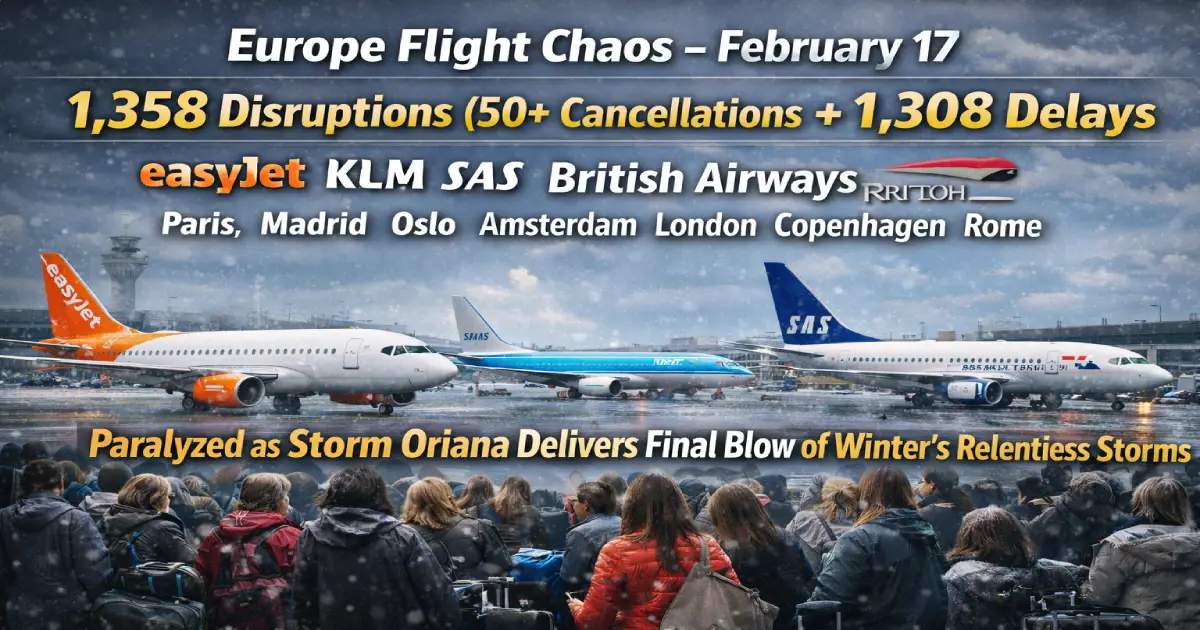
EUROPEAN AVIATION CRISIS: Thousands of passengers traveling around Europe today are facing a difficult start to their journeys, as flight disruption ripples across major hubs in France, Spain, Norway, the Netherlands and the United Kingdom—with more than 50 flights cancelled and at least 1,308 delayed across key airports including Paris, Madrid, Oslo, Amsterdam and multiple London terminals, with knock-on effects spreading to regional airports and connecting routes throughout the continent. From Madrid and Paris to Amsterdam, London, Copenhagen, Rome and Zurich, operations at major airports were severely disrupted as leading European carriers struggled to keep schedules on track—with Lufthansa, British Airways, Air France, KLM, Iberia, SAS, Vueling, ITA Airways and several smaller airlines reporting a combined 1,362 delayed flights and 56 cancellations, snarling air traffic across Spain, France, Germany, the Netherlands, the United Kingdom, Denmark, Italy and Switzerland. EasyJet, KLM, SAS and British Airways are among the hardest-hit carriers, with disrupted schedules causing chaos for travelers—and passengers in these cities should prepare for long waits, rebookings, and potential cancellations. The timing could not be worse: this is Storm Oriana, warned by Spain’s AEMET meteorological agency as the “last storm in this long series that began at end of December”—making today the culmination of Europe’s worst winter aviation season in recent memory, following Storm Goretti (January), Berlin black ice (February 5-6), Storm Nils (February 11-13), and now Oriana delivering the final devastating blow.
Published: February 17, 2026 Total European Disruptions: 1,358+ flights (50+ cancellations + 1,308 delays) Countries Affected: France, Spain, Norway, Netherlands, UK, Germany, Denmark, Italy, Switzerland Airlines Hit: easyJet, KLM, SAS, British Airways, Lufthansa, Air France, Iberia, Vueling, ITA Airways, SAS Link, Braathens Regional, Cityjet Airports Paralyzed: Paris CDG/Orly, Madrid Barajas, Oslo Gardermoen, Amsterdam Schiphol, London (Heathrow/Gatwick/City), Copenhagen, Frankfurt, Munich, Rome Fiumicino, Zurich Weather Cause: Storm Oriana — adverse weather, strong winds, slick surfaces, fog, crosswinds Passengers Affected: Estimated 100,000+ across Europe Storm Context: Final storm of Europe’s relentless December 2025-February 2026 winter series Smaller Carriers Also Hit: Cityjet, Braathens Regional Airways, SAS Link
Pan-European airspace:
Context:
December 2025 – February 17, 2026:
Cumulative winter 2025-26 European disruptions (estimate):
Spain’s national meteorology agency (AEMET) had warned:
“Storm Oriana may be, at least for a few days, the last storm in this long series that began at the end of December.”
What this means:
Airports affected:
Airlines affected:
Why Paris struggled: Airlines such as easyJet, KLM, SAS and British Airways are all reporting operational challenges as adverse weather, tight capacity and lingering staffing strains converge on one of the busiest winter travel weekends of the year. The most immediate impact of today’s disruption is being felt at Europe’s large connecting hubs, where even modest schedule changes cascade rapidly through tightly packed timetables.
Passenger impact:
Airport affected:
Why Madrid hit: In Spain, Madrid Barajas saw banks of departures pushed back by hours, as inbound aircraft from northern Europe arrived late and crews timed out.
Airlines affected:
Routes affected:
Winter Olympics connection:
Airport affected:
Why Oslo struggling: Further north, Oslo Gardermoen has been contending with low temperatures, slick surfaces and fresh snow following recent winter weather systems across Scandinavia. De-icing is a routine part of operations here, but when multiple banks of flights require treatment within a short window, queues develop quickly. This has had a direct impact on SAS, Norwegian and other operators linking Oslo to the rest of Europe, including key routes to London and Amsterdam that are already under pressure elsewhere in the network.
Airlines affected:
De-icing crisis:
Airport affected:
Why Amsterdam hit: Amsterdam Schiphol, often described as a barometer for European aviation health, has once again become a focal point for disruption. Changes in wind direction and strength, coupled with intermittent showers and cloud, have required runway configuration changes and slower-than-usual arrival rates. The effect has rippled through KLM’s extensive hub operation, as well as affecting easyJet, Transavia and numerous other carriers that rely on Schiphol as a gateway between northern and southern Europe.
Airlines affected:
KLM’s specific problems: While the majority of KLM flights are still operating, a noticeable share of intra-European services have been delayed, especially those linked to early-morning banks that were impacted by fog and strong crosswinds. Regional partners and feeder routes into northern Germany, Scandinavia and the UK have been particularly affected.
International ripple effects:
Airports affected:
Why London struggling: To the north, Amsterdam Schiphol and London’s airports, particularly Heathrow and Gatwick, reported wave after wave of late departures as ground handling bottlenecks and air traffic control constraints compounded the initial problems.
Airlines affected:
UK-specific context:
Airports affected:
Why Germany affected: Germany and Italy, home markets for Lufthansa and ITA Airways respectively, were not spared. Frankfurt and Munich logged mounting delays throughout the day as aircraft and crews struggled to stay within regulatory duty limits.
Airlines affected:
Lufthansa’s context:
Airport affected:
Airlines affected:
Why Copenhagen hit:
Airports affected:
Why Italy affected: Rome Fiumicino similarly saw departures banked and then rolled back repeatedly as ITA and partner airlines attempted to recover from the backlog.
Airlines affected:
Winter Olympics complication:
Airport affected:
Why Zurich affected: In Switzerland, Zurich experienced its own share of delayed departures as late-arriving aircraft from the United Kingdom, France and Germany upset carefully choreographed schedules.
Airlines affected:
Pan-European impact:
Why easyJet leads:
Amsterdam impact:
Routes cancelled/delayed:
IAG Group (BA + Iberia + Vueling) combined:
BA specifics:
SAS + SAS Link + Braathens Regional:
Why SAS struggles beyond weather:
Frankfurt + Munich impact:
Specific Lufthansa challenges:
Milan-Cortina Winter Olympics:
Today’s impact on Olympics:
US travelers’ warning:
Recommendations for Olympic travelers:
Timeline of destruction (December 2025 – February 17, 2026):
| Storm/Event | Dates | Disruptions |
|---|---|---|
| Storm Goretti | Jan 2026 | 4,320 flights |
| Amsterdam de-icing crisis | Jan 2026 | 300+ cancellations |
| UK airports meltdown | Jan 2026 | 1,670 flights |
| Berlin black ice | Feb 5-6 | 190 cancellations |
| Europe-wide chaos | Feb 7 | 2,000+ flights |
| Storm Nils | Feb 11-13 | 2,354 flights |
| Italy strike | Feb 16 | 314 cancellations |
| Storm Oriana | Feb 17 | 1,358+ flights |
| TOTAL (estimate) | ~75 days | ~15,000+ flights |
Human cost:
Weather cancellations/delays:
Key point: Airlines MUST provide care (meals, hotels) even for weather disruptions. Many airlines claim they don’t have to — this is wrong. EU261 Article 9 applies regardless of cause.
How to claim:
1. Check flight status immediately:
2. Don’t go to airport until confirmed:
3. Rebook online (fastest):
4. Alternative transportation:
Trains (best European option):
Advantage of trains:
Q: Is Storm Oriana the last storm this winter? A: AEMET says “the last storm in this long series, at least for a few days.” Cautious optimism — improvement likely mid-week, but more storms possible later.
Q: Will disruptions continue Tuesday/Wednesday? A: Improvement expected. Aircraft/crews will reposition overnight. Tuesday should see residual delays, near-normal by Wednesday.
Q: Can I claim compensation for Storm Oriana delays? A: No cash compensation (weather = extraordinary circumstances). But you ARE entitled to free rebooking or refund, plus meals/hotel if applicable.
Q: Is it safe to travel to Milan for the Winter Olympics this week? A: Yes, but build significant buffers. Aviation disruptions + rail sabotage threats = arrive early, have backup plans.
Q: Why does Europe keep getting hit by storms? A: La Niña weather pattern (2025-26) has pushed Atlantic jet stream further south, directing more Atlantic storm systems toward western/central Europe. Climate scientists warn this pattern may intensify.
Storm Oriana’s 1,308 delays and 50+ cancellations across Paris, Madrid, Oslo, Amsterdam, London, Copenhagen, Rome and Zurich represents the final chapter — at least temporarily — of Europe’s most devastating winter aviation season in recent memory, as easyJet, KLM, SAS and British Airways struggle with disrupted schedules causing chaos for travelers across nine countries while Lufthansa, Air France, Iberia, Vueling, ITA Airways and several smaller airlines report a combined 1,362 delayed flights and 56 cancellations snarling air traffic across Spain, France, Germany, the Netherlands, the UK, Denmark, Italy and Switzerland.
For European travelers: Key takeaways:
For European aviation:
For More Information:
Related Articles:
Posted By : Vinay
Lastest News
2nd Floor, 39, Above Kirti Club, DLF Industrial Area, Kirti Nagar, New Delhi, Delhi 110015



Travel Tourister is a leading Travel portal where we introduce travellers to trusted travel agents to make their journey hasselfree, memorable And happy. Travel Tourister is a platform where travellers get Tour packages ,Hotel packages deals through trusted travel companies And hoteliers who are working with us across the world. We always try to find new and more travel agents and hoteliers from every nook and corners across the world so that you could compare the deals with different travel agents and hoteliers and book your tour or hotel with the one you have chosen according to your taste and budget.
Copyright © Travel Tourister, India. All Rights Reserved

 Call
Call Enquiry