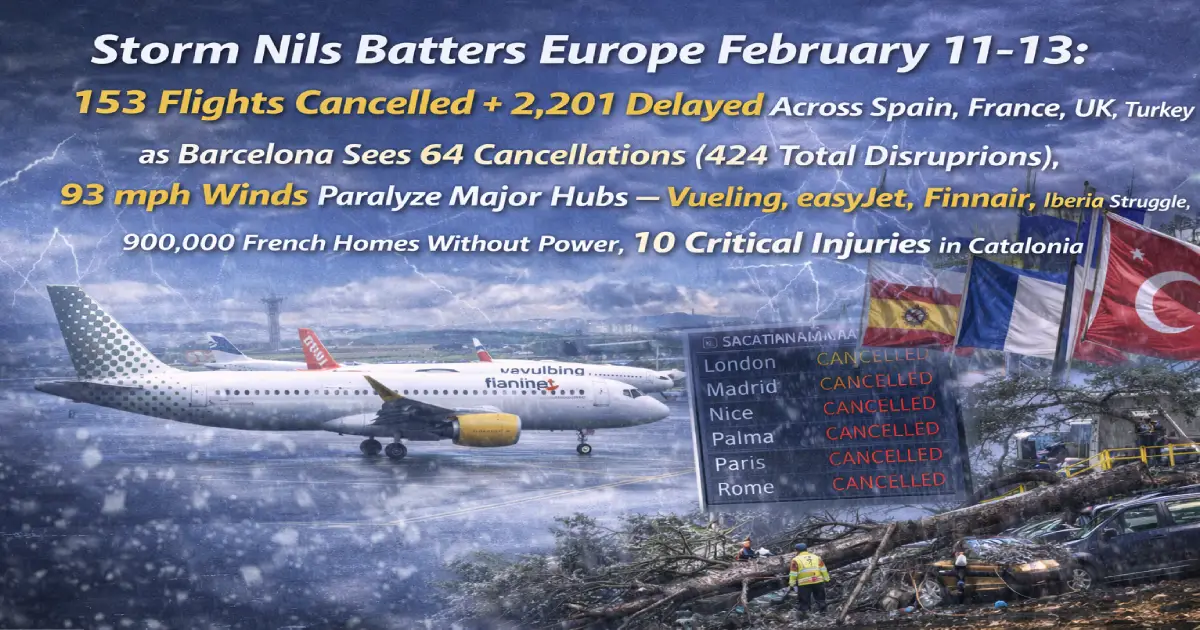
EUROPEAN CRISIS: Storm Nils, a powerful Atlantic weather system packing winds equivalent to a Category 1 hurricane (up to 150 km/h / 93 mph), has brought widespread aviation chaos across Western Europe from February 11-13, 2026, triggering 153 flight cancellations and 2,201 delays affecting tens of thousands of travelers across Spain, Portugal, France, UK, and Turkey as gale-force winds, torrential rain, and flooding overwhelmed Barcelona (64 cancellations + 360 delays), Paris Charles de Gaulle (6 cancellations + 182 delays), and Istanbul (5 cancellations + 311 combined delays at IST + SAW) while carriers like Vueling, easyJet, Finnair, and Iberia faced impossible conditions with crosswinds making take-offs and landings unsafe, aircraft diverted mid-flight, and ground operations paralyzed—leaving passengers stranded overnight in terminals, missing critical connections, and scrambling for rebooking as Spanish authorities issued red weather warnings and France deployed 1,400 technicians to restore power to 900,000 households while Catalonia reported 10 people hospitalized (one critical) from collapsing roofs, falling trees, and debris, and aviation experts warn Storm Oriana will strike Friday-Saturday February 13-14 continuing the “long series” of back-to-back storms that began in late December.
Published: February 13, 2026
Storm Dates: February 11-13, 2026 (Peak: Thursday February 12)
Total Disruptions: 2,354 flights (153 cancellations + 2,201 delays)
Countries Affected: Spain, Portugal, France, UK, Turkey
Peak Wind Speed: 167 km/h (104 mph) at Puig Sesolles, Catalonia
Power Outages: 900,000 households in France (Nouvelle-Aquitaine, Occitanie)
Injuries: 10 hospitalized in Catalonia (1 critical, 1 very serious, 3 serious)
Next Storm: Storm Oriana (February 13-14, 2026)
The Numbers: 2,354 Total Disruptions
Storm Nils has created one of Europe’s worst aviation disruptions of the 2026 winter season:
Overall Impact (February 11-13):
- ✈️ 153 CANCELLATIONS (outright cancelled flights)
- ✈️ 2,201 DELAYS (many exceeding 2-4+ hours)
- ✈️ 2,354 TOTAL DISRUPTIONS (nearly 10% of Europe’s daily operations)
- ✈️ Tens of thousands of passengers affected
- ✈️ Ripple effects: Multi-day backlogs as aircraft/crews out of position
Context:
- Europe’s major hubs typically operate 20,000-25,000 flights daily
- 2,354 disruptions = ~10% of continent’s daily operations affected
- This rivals some of the worst weather-related disruptions in recent European aviation history
Airport-by-Airport Breakdown
Barcelona El Prat (BCN) – The Epicenter
Why Barcelona was hardest hit:
- Storm Nils swept directly across Catalonia
- Crosswinds exceeded safe landing/takeoff limits
- Low visibility from rain/mist
- Coastal location = maximum wind exposure
The Numbers:
- 64 CANCELLATIONS (both departures + arrivals)
- 360 DELAYS
- 424 TOTAL DISRUPTIONS (Barcelona alone = 18% of all European disruptions)
- 10 DIVERSIONS (aircraft couldn’t land, sent to alternate airports)
- 4 GO-AROUNDS (attempted landing, aborted due to conditions)
Wind Conditions at Barcelona Airport:
- Average winds: 61 km/h (38 mph)
- Peak gusts: 92 km/h (57 mph)
- Conditions persisted: Through Thursday evening (expected end 7 PM local)
Specific airlines affected:
- Vueling: Largest operator at Barcelona, dozens of cancellations
- Iberia: Multiple domestic/international routes cancelled
- easyJet: UK-Spain leisure routes heavily disrupted
- Air Europa: Regional connections severed
Passenger experience:
- Departure boards “dominated by red cancellation notices”
- Hours-long queues at airline desks
- Limited hotel availability (Barcelona fully booked)
- Many passengers advised to return home rather than wait at airport
Paris Charles de Gaulle (CDG) – Major Hub Strained
Impact:
- 6 CANCELLATIONS
- 182 DELAYS
- 188 TOTAL DISRUPTIONS
Why Paris was affected:
- Storm’s tail end brought strong crosswinds to western France
- CDG is major international hub = tightly scheduled operations
- Delays cascade when aircraft arrive late from Barcelona, UK
Passenger impact:
- International connections missed (US, Asia, Africa flights)
- Long-haul passengers stranded overnight
- Hotels near CDG overwhelmed
Istanbul Airports – Eastern Mediterranean Complications
Istanbul Airport (IST):
- 3 CANCELLATIONS
- 165 DELAYS
- 168 TOTAL DISRUPTIONS
Istanbul Sabiha Gökçen (SAW):
- 2 CANCELLATIONS
- 146 DELAYS
- 148 TOTAL DISRUPTIONS
Combined Istanbul impact: 316 disruptions
Why Istanbul:
- Storm Nils’ effects extended to eastern Mediterranean
- Unstable air masses created turbulence over Turkish airspace
- Aircraft arriving from storm-affected Europe = delayed/out of position
- Istanbul is critical Europe-Asia-Middle East hub = cascading delays
London Airports – UK Exposure
London Heathrow (LHR):
- Delays: Elevated (exact number not disclosed, but “similar pressures” to Barcelona)
- Why: UK-Spain routes heavily disrupted; aircraft/crews stuck in Barcelona/Madrid
- Airlines affected: British Airways, easyJet (dense network to Spain/Portugal)
London Gatwick (LGW):
- Delays: Moderate
- Why: easyJet operates extensive leisure routes to Spain; cancellations in Barcelona = knock-on effects
Passenger complaints:
- “Long queues at check-in and security” (BBC reports)
- British holidaymakers stuck in Spain unable to return
- easyJet rebooking options limited (high demand, few seats)
Other Affected Airports
Spain:
- Madrid (MAD): Cancellations + delays (exact numbers not disclosed)
- Palma de Mallorca (PMI): Leisure routes cancelled
- Alicante (ALC): Northern European connections severed
- Valencia (VLC): Domestic routes disrupted
- Malaga (AGP): UK holiday flights cancelled
France:
- Lyon: Train cancellations from Barcelona affected connecting passengers
- Toulouse: Regional flights disrupted
Portugal:
- Lisbon (LIS): Storm’s western edge brought rain/wind
- Porto (OPO): Delays reported
The Storm: Category 1 Hurricane-Equivalent Winds
Wind Speed Records (February 11-12)
Catalonia (Spain):
- Puig Sesolles (Montseny): 167 km/h (104 mph) – HIGHEST RECORDED
- Port de Barcelona: 105 km/h (65 mph)
- Mataró: 104 km/h (65 mph)
- Molló (Ripollès): 114 km/h (71 mph)
- Font-rubí: 103 km/h (64 mph)
Aviation impact:
- Crosswind limits: Most commercial aircraft have crosswind landing limits of 35-40 knots (40-46 mph / 65-74 km/h)
- Storm Nils winds: Exceeded safe limits at multiple airports
- Result: Pilots couldn’t land safely; go-arounds, diversions, cancellations
Rain and Flooding
Andalusia (southern Spain):
- Dozens of flooding incidents reported
- Puente de la Sierra (Jaén): Residential areas at risk from rising rivers
- Dam releases: Ciudad Real area opened floodgates to prevent downstream flooding
Galicia (northwest Spain):
- 3 rivers on maximum alert for overflowing
- Dam flows increasing significantly = more flooding expected
Catalonia:
- Torrential rain compounded wind damage
- Schools closed across region
- Work-from-home orders issued by labor minister
Human Casualties
10 people hospitalized in Catalonia:
1 CRITICAL:
- 46-year-old struck by collapsing roof at industrial warehouse
- Treatment: Vall d’Hebron Hospital, Barcelona
1 VERY SERIOUS:
- 22-year-old hit by falling tree
- Treatment: Bellvitge Hospital
3 SERIOUS:
- 68-year-old with pelvic/femur fractures, chest trauma from falling lamppost
- Others: Various injuries from debris, fallen structures
5 MODERATE:
- Additional injuries from storm-related accidents
Structural damage:
- Roof and wall collapse at factory in L’Hospitalet de Llobregat
- Trees downed across roads, rail lines
- Motorcycles knocked over by wind gusts in Barcelona streets
French Power Crisis: 900,000 Homes Dark
The Numbers
Power outages:
- 900,000 households without electricity (as of Thursday morning)
- Regions affected: Nouvelle-Aquitaine, Occitanie (southwestern France)
- Cause: Winds “flooded the grid” (knocked down power lines, damaged infrastructure)
Response:
- Enedis (distribution operator): Deployed 1,400 technicians to restore power
- EDF (Electricite de France): Curtailed production at some nuclear reactors for safety
Timeline:
- Power restoration ongoing (estimated days for full recovery)
Airline-by-Airline Impact
Vueling Airlines (Spanish Low-Cost)
Why Vueling was hit hardest:
- Largest operator at Barcelona (home base)
- Extensive Spanish network: Barcelona, Madrid, Palma, regional cities
- High-frequency routes: Barcelona-Madrid, Barcelona-London, Barcelona-Paris = dozens of daily flights
Response:
- Offered passengers flexibility and free changes on flights departing/arriving Barcelona + Palma until 3 PM Thursday
- Advised travelers to check flight status before heading to airport
- Rebooking backlog = days to accommodate all affected passengers
easyJet (UK Low-Cost)
Why easyJet struggled:
- Dense UK-Spain/Portugal network: London, Manchester, Bristol, Liverpool → Barcelona, Malaga, Alicante, Lisbon
- Holiday destination focus: Leisure travelers = inflexible travel dates (non-refundable hotels, tours)
Impact:
- “Elevated levels of both delayed and cancelled services” (company statement)
- UK passengers stuck in Spain unable to return
- Rebooking options limited (high demand, few seats on competing airlines)
Iberia (Spanish Flag Carrier)
Routes affected:
- Domestic: Madrid-Barcelona, regional connections
- International: Barcelona/Madrid → Paris, London, Frankfurt, Rome
Aircraft deployment:
- Widebody long-haul aircraft stuck at Barcelona = missed transatlantic departures
Finnair (Finland)
Why Finnair mentioned:
- Operates Helsinki-Barcelona route
- Storm disrupted Thursday operations
- Passengers connecting through Helsinki to Asia missed flights
Air France, British Airways, Turkish Airlines
Cross-European impact:
- Air France: Paris hub affected = global network ripple effects
- British Airways: UK-Spain routes + connections through London Heathrow
- Turkish Airlines: Istanbul hub = Europe-Asia-Middle East connections disrupted
Why This Storm Was So Disruptive
Aviation’s Weather Vulnerability
Crosswind limits:
- Most commercial jets: 35-40 knot crosswind limit (40-46 mph / 65-74 km/h)
- Storm Nils: Wind gusts exceeded 90 km/h (56 mph) at airports
- Result: Unsafe to land/takeoff during gusts
Low visibility:
- Heavy rain + mist reduced visibility below instrument minimums
- Pilots couldn’t see runway clearly enough to land safely
Ground operations:
- High winds made baggage loading/unloading hazardous
- Ground crew safety limits = operations suspended during worst gusts
Europe’s Hub-and-Spoke Fragility
Tight scheduling:
- European airlines operate tightly banked schedules (flights arrive/depart in waves)
- Aircraft rotate through multiple cities daily
- One cancellation = cascading disruptions
Example cascade:
- Barcelona cancels Madrid-bound flight (aircraft stuck)
- Madrid-Paris flight cancelled (no aircraft)
- Paris-London delayed (waiting for late Madrid arrival)
- London-New York delayed (connecting passengers miss flight)
Capacity constraints:
- Major hubs operate near capacity under normal conditions
- Storm delays = immediate backlog
- Rebooking options limited (few spare seats)
Red Weather Warnings: Spanish Authorities
AEMET (Spanish Meteorology Agency)
Warnings issued:
- Red alerts: Northern Spain, Catalonia, eastern seaboard
- Hazards: Wind gusts approaching/exceeding 100 km/h, coastal flooding, difficult flying conditions
Public advisories:
- Stay indoors unless travel essential
- Avoid coastal areas (storm surge risk)
- Secure outdoor objects (furniture, equipment = flying debris hazards)
Schools closed:
- Across Catalonia (Thursday February 12)
- Safety measure to prevent student injuries
Work-from-home orders:
- Catalan labor minister urged employers to allow remote work “whenever possible”
- Employees unable to reach workplace = entitled to paid leave
- “Priority today is to guarantee everyone’s safety”
Passenger Rights: What Travelers Are Entitled To
EU Regulation 261/2004 Compensation
Important: Storms are typically “extraordinary circumstances” = NO cash compensation required
However, airlines MUST provide:
- ✅ Free rebooking on next available flight
- ✅ Full refund if choosing not to travel
- ✅ Meals and refreshments during delays
- ✅ Hotel accommodation if overnight delay required (though availability limited during mass disruptions)
- ✅ Transportation to/from hotel
What you DON’T get:
- ❌ Cash compensation (€250-€600) for delays/cancellations
- ❌ Compensation for hotel/meals (airlines argue “extraordinary circumstances”)
What to Do RIGHT NOW
1. Check flight status immediately:
- Airline website/app
- FlightAware, FlightRadar24
- Airport website
2. DON’T wait for airline to contact you:
- Proactively rebook online (faster than phone/airport desk)
- Airline apps typically fastest
3. Alternative transportation:
- Trains: Europe has excellent rail network
- Barcelona → Madrid: AVE high-speed train, 2.5 hours
- Paris → London: Eurostar, 2.5 hours
- Consider rail if flight severely delayed
- Rental cars: Limited availability during mass disruptions
4. Hotels:
- Book immediately if stranded (don’t wait for airline voucher)
- Airports nearby often fully booked
- Consider city center hotels (use airport train/bus)
5. Travel insurance:
- Check policy for trip delay coverage
- Some policies cover hotels/meals during weather delays
- File claim with receipts
What Happens Next: Storm Oriana Incoming
Friday-Saturday February 13-14
AEMET (Spanish Met Agency):
“Storm Oriana may be, at least for a few days, the last storm in this long series that began at the end of December.”
Storm Oriana forecast:
- Arrival: Friday afternoon/evening February 13
- Duration: Through Saturday February 14
- Hazards:
- Very strong wind gusts
- Rough seas (coastal flooding) Heavy rain and snow at low elevations
Aviation impact (expected):
- Additional flight cancellations/delays Friday-Saturday
- Airports likely to issue advisories
- Passengers traveling this weekend = high cancellation risk
When will it end:
- AEMET suggests Oriana = “last storm” for now
- But cautioned: “At least for a few days”
- Weather patterns remain unsettled
Historical Context: Europe’s Winter 2026 Crisis
Storm Nils is part of a relentless pattern of winter disruptions:
January-February 2026 Major Events
Storm Goretti (Early February):
- Germany, Netherlands, France hit hard
- Amsterdam Schiphol: 317 cancellations + 508 delays in one day
- 6 deaths, widespread power outages
Berlin Black Ice Shutdown (February 5-6):
- Berlin Brandenburg Airport completely closed for hours
- 190 flights cancelled
- Freezing rain made runways unusable
Amsterdam Schiphol De-Icing Crisis (January):
- De-icing fluid shortages
- 300+ flights cancelled over multiple days
- 300,000 passengers affected
UK Airports Meltdown (Late January):
- Heathrow: Passengers sleeping on terminal floors
- 1,670 flights disrupted
- Staffing crisis + weather
Pattern:
- 5,000+ flights disrupted in Europe since January 1, 2026
- Back-to-back storms with minimal recovery time
- Infrastructure overwhelmed (de-icing, snow removal, power grids)
FAQs
Q: Will my flight be cancelled if I’m traveling to/from Spain this weekend? A: High risk. Storm Oriana arrives Friday-Saturday. Check flight status hourly. Consider rebooking for next week if possible.
Q: Can I get compensation for Storm Nils cancellations/delays? A: No cash compensation (storms = “extraordinary circumstances”). But you get free rebooking or refund.
Q: What if I’m connecting through Barcelona/Paris and missed my connection due to storm? A: If booked on single ticket, airline must rebook you at no charge. If separate tickets, you’re responsible.
Q: Should I go to the airport if my flight status says “on time” but I see storm warnings? A: Yes, but check status every hour before departure. Airlines sometimes update status late.
Q: Can I take the train instead? A: Yes! Europe has excellent rail network:
- Barcelona → Madrid: AVE 2.5 hours
- Paris → London: Eurostar 2.5 hours
- Barcelona → Paris: ~6 hours (slower but reliable)
Q: What happens if Storm Oriana is as bad as Nils? A: Expect similar disruptions Friday-Saturday. Airlines may proactively cancel flights Thursday evening for Friday operations.
Q: How long until operations return to normal? A: Typically 2-3 days after storm passes. Expect residual delays Monday-Tuesday as aircraft/crews reposition.
The Bottom Line
Storm Nils has delivered one of Europe’s most severe aviation disruptions of the 2026 winter season, with 153 cancellations and 2,201 delays affecting tens of thousands across Spain, Portugal, France, UK, and Turkey as Category 1 hurricane-equivalent winds (up to 167 km/h / 104 mph) overwhelmed Barcelona (64 cancellations + 360 delays), Paris CDG (6 cancellations + 182 delays), and Istanbul (5 cancellations + 311 delays) while Vueling, easyJet, Iberia, and other carriers faced impossible conditions—leaving passengers stranded, connections missed, and rebooking options scarce as France battles 900,000-household power outages and Catalonia treats 10 storm-related injuries including one critical.
For travelers: Key takeaways:
- ✅ Storm Oriana arriving Friday-Saturday – Expect more disruptions
- ✅ Check flight status hourly – Conditions changing rapidly
- ✅ Consider rail alternatives – Europe’s trains reliable
- ✅ Know your rights – Free rebooking or refund guaranteed (but no cash compensation)
- ✅ Book hotels early – Don’t wait for airline to offer
For Europe:
- Winter 2026 = relentless storm pattern (5,000+ flights disrupted since January)
- Infrastructure struggling (power grids, airports, rail)
- Climate patterns = more frequent, intense storms expected
Whether Storm Oriana marks the end of this “long series” or merely a brief pause remains to be seen—but for European aviation, February 2026 has already cemented its place as one of the most challenging winter seasons in recent memory.
For More Information:
Related Articles:
Posted By : Vinay
As a lead contributor for Travel Tourister, Vinay is dedicated to serving our Tier 1 audience (US, UK, Canada, Australia). His mission is to deliver precise, fact-checked news and actionable, data-driven articles that empower readers to make informed decisions, minimize travel risks, and maximize their adventure without compromising safety or budget.




 Call
Call Enquiry