Published on : 16 Jan 2026
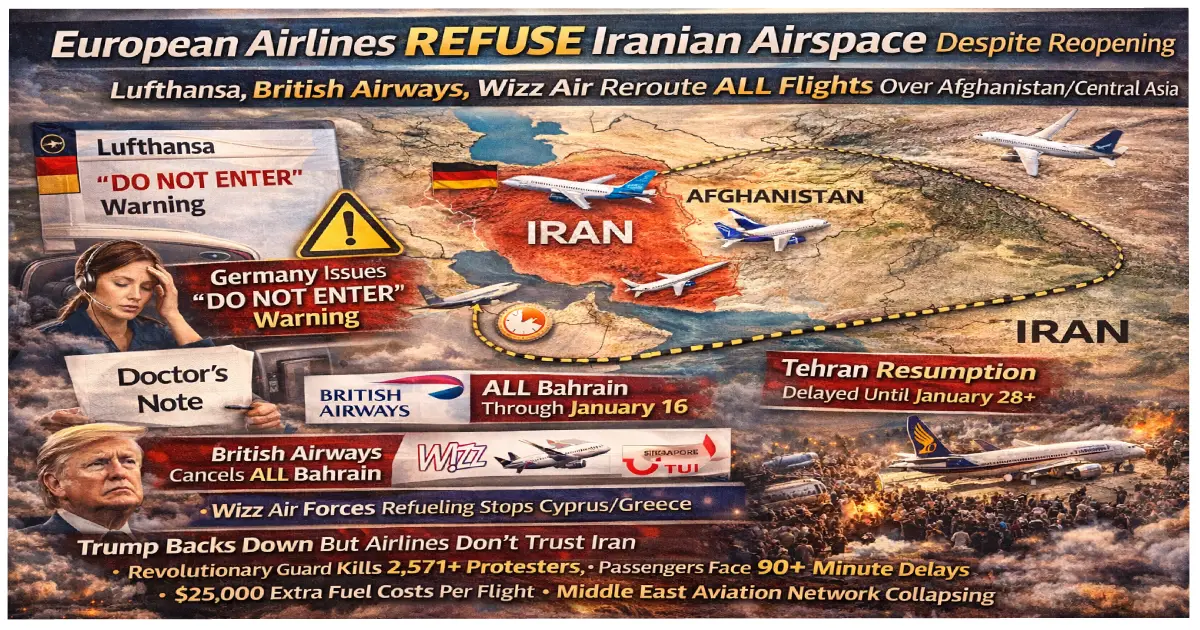
Breaking: Despite Iran reopening its airspace Thursday morning January 16, 2026 after a sudden 5-hour closure overnight, major European airlines including Lufthansa, British Airways, Wizz Air, KLM, Finnair, and Singapore Airlines are REFUSING to resume Iranian airspace usage—forcing flights to detour over Afghanistan and Central Asia in routes adding 60-90 minutes flight time and $15,000-$30,000 extra fuel costs per flight. Germany issued emergency guidance Wednesday cautioning German operators “DO NOT ENTER” Iranian airspace, overriding previous advisories, while Lufthansa confirmed it will bypass Iranian AND Iraqi airspace “until further notice” with Tehran flight resumption delayed from January 16 to “at least January 28.” The aviation boycott intensified after Iran’s mysterious Wednesday night airspace closure (1:45am-7am local time) amid fears of US military strikes following President Trump’s threats to rescue Iranian protesters—though Trump later softened rhetoric saying “killings have stopped.” British Airways cancelled ALL Bahrain flights through January 16, Wizz Air warned westbound Dubai/Abu Dhabi flights require refueling stops in Cyprus or Greece, and flight tracking data shows European carriers routing over Afghanistan despite Iran declaring airspace “fully operational” Thursday morning. The mass airline exodus leaves Iran’s aviation network 70%+ isolated as Revolutionary Guard crackdown kills 2,571+ protesters, creating worst civil unrest since 1979 revolution—with airlines prioritizing crew safety over shorter routes despite losing millions in operational efficiency.
Published: January 16, 2026, 10:00 AM EST (Day 8 of Iran Crisis) Airspace Status: Reopened 7:00am Iran time Thursday (3:30am UTC) Closure Duration: 5 hours overnight Wednesday-Thursday Airlines Avoiding Iran: Lufthansa Group, British Airways/IAG, Wizz Air, KLM, Finnair, Singapore Airlines, TUI, Air France Lufthansa Tehran Resumption: Delayed from January 16 → “At Least January 28” Germany Aviation Warning: “DO NOT ENTER Iranian Airspace” (January 15) British Airways: ALL Bahrain flights cancelled through January 16 Wizz Air: Mandatory refueling stops Cyprus/Greece for westbound Gulf flights Revolutionary Guard Death Toll: 2,571+ protesters killed (US HRANA rights group) Extra Flight Time: 60-90 minutes per rerouted flight Extra Fuel Cost: $15,000-$30,000 per flight Iran Aviation Isolation: 70%+ international connectivity lost
Iran’s Civil Aviation Organization announced Thursday morning January 16 that airspace had fully reopened after an unexplained 5-hour closure overnight—but European airlines aren’t buying it.
What Happened Wednesday Night:
10:15pm EST Wednesday / 1:45am Thursday Iran time:
Timeline of Closure:
Flight Tracking During Closure:
FlightRadar24 data at 6:05am Iran time (Thursday morning):
3:30am UTC / 7:00am Iran time:
4:00am UTC / 7:30am Iran time:
Why the Closure?
Official explanation: NONE. Iran has not publicly stated why airspace closed.
Speculation:
Aviation Safety Group OpsGroup Warning:
“The airspace closures could signal further security or military activity and warn of the risk of missile launches or heightened air defence, increasing the risk of misidentification of civil traffic.”
Translation: Airlines fear another Ukraine International Airlines Flight 752 scenario—Iran’s 2020 shootdown of Boeing 737 that killed all 176 aboard after Iranian air defences “misidentified” civilian aircraft as hostile target.
Despite airspace technically open, major carriers announced Thursday they will AVOID Iranian (and Iraqi) airspace indefinitely.
Official Statement Thursday:
“In an emailed response to CNBC on Thursday, the Lufthansa Group said it would bypass Iranian and Iraqi airspace until further notice, with some flights canceled.”
What This Means:
Affected airlines:
Routes impacted:
Tehran Service Status:
Original plan: Resume Frankfurt-Tehran January 16, 2026 (after 6-month suspension)
New plan: “Will not return to the route until at least late January” (January 28+ earliest)
Reason: “Safety concerns for passengers and crew”
The January 28 Date:
Lufthansa announced January 12 (before airspace closure) that Tehran resumption would be deferred from January 16 to “at least January 28.” Thursday’s events make even January 28 unlikely.
Financial Impact:
Lufthansa loses:
Official Statement Thursday:
“A spokesperson for British Airways owner IAG said all British Airways flights to Bahrain were cancelled up to and including January 16.”
Bahrain Cancellations:
Route: London Heathrow-Bahrain (BA flight numbers 123/124) Frequency: Daily service Cancellation period: January 9-16 (8 days) Passengers affected: 1,500-2,000 (estimated 200-seat A350 × 8 days)
Why Bahrain?
Bahrain is a Persian Gulf island nation. To reach Bahrain from London, aircraft normally fly OVER Iran. With Iranian airspace deemed unsafe, British Airways lacks viable routing alternatives that make commercial sense.
British Airways’ Iran Policy:
“Some European carriers, such as British Airways, have avoided Iranian airspace for months and are continuing to track around the country.”
Translation: BA has been avoiding Iran since mid-2025 due to regional tensions. Current crisis reinforces that decision.
Alternative Routing:
Normal route: London → Turkey → Iran → Bahrain (6 hours) Detour option 1: London → Egypt → Saudi Arabia → Bahrain (7+ hours, overwater, fuel-intensive) Detour option 2: NOT COMMERCIALLY VIABLE
Result: BA cancels service entirely rather than operate unprofitable detour routes.
Official Statement Thursday:
“We avoid Iraqi and Iranian airspaces, therefore some westbound flights from Dubai and Abu Dhabi airports will have to make (refuelling and crew change) stops in Larnaca, Cyprus or Thessaloniki, Greece.”
The Refueling Nightmare:
Normal route (using Iran):
Detour route (avoiding Iran):
Solution: Mandatory fuel/crew stops
Fuel stop airports:
Impact on passengers:
✈️ Normal travel time: 6 hours direct ✈️ Detour travel time: 10-12 hours (with fuel stop) ✈️ Extra cost: €100-€200 per passenger (fuel surcharges) ✈️ Missed connections: Passengers miss onward flights from Budapest
Wizz Air’s Dilemma:
Ultra-low-cost carrier business model depends on:
Iran detours DESTROY this model:
Financial pain:
Estimated €50,000-€100,000 daily loss for Wizz Air due to Iran detours.
Official Statement Thursday:
“KLM is currently avoiding Iranian airspace as a precaution—a route we already rarely use. Last night’s closure of Iranian airspace therefore had no effect on our operations.”
Translation:
KLM already avoided Iran BEFORE this week’s crisis, so Wednesday’s airspace closure didn’t disrupt them further.
Why KLM Avoided Iran Already:
Current routing:
Amsterdam-Bangkok example:
Extra cost: €18,000 fuel per flight, but KLM already absorbed this pre-crisis.
Statement to Finnish Media Thursday:
“Finnair has stopped flying through Iraqi airspace, travelling to Doha and Dubai over Saudi Arabia instead. The carrier had already been avoiding Iranian, Syrian and Israeli airspace for security reasons.”
Finnair’s Multi-Threat Avoidance:
Airspaces currently avoided: ✗ Iran (protests, military threat) ✗ Iraq (regional instability) ✗ Syria (civil war, Russian military presence) ✗ Israel (Gaza conflict, missile attacks)
How Finnair Gets to Middle East:
Helsinki-Doha route:
Extra distance: 400 miles Extra time: 45 minutes Extra fuel cost: €12,000 per flight
Why Finland’s Airlines Especially Cautious:
Geographic position forces Nordic carriers through Russian airspace to reach Asia—already adding risk/cost. Further detours around Iran compound operational challenges.
Flight Tracking Data Thursday:
“Despite the airspace reopening, many airlines, including Singapore Airlines and TUI, continued to use alternative routes, according to FlightRadar24.”
Singapore Airlines’ Iran Avoidance:
Routes affected:
Normal routing (through Iran): Singapore → India → Pakistan → Iran → Turkey → Europe
Detour routing (avoiding Iran): Singapore → India → Afghanistan → Central Asia → Turkey → Europe
Impact:
Flight Tracking Thursday:
TUI charter flights from Europe to Middle East/Maldives rerouting around Iran despite airspace opening.
Why Tour Operators Especially Cautious:
TUI chooses higher operating costs over perceived safety risk.
Flight Operations Thursday:
“Carriers like Ryanair have moved routes away from the Middle East in recent months and others including Air France have long avoided Iranian airspace.”
Air France’s Iran Policy:
Air France has avoided Iranian airspace since 2019 following regional tensions. Current crisis doesn’t change existing policy—they’re already detouring.
French Government Position:
France hasn’t issued formal aviation warnings like Germany, but Air France’s conservative approach reflects government risk assessment.
Not all carriers are avoiding Iran—Middle East airlines continue operations, accepting higher risk for commercial reasons.
Current status:
“Many airlines are, however, still continuing to use Iranian airspace for overflights, including the likes of Emirates.”
Why Emirates Continues:
Emirates’ calculation:
Route example: Dubai-Paris
Through Iran:
Around Iran (via Saudi Arabia):
Emirates decides: Risk of overflying Iran < Financial loss of detouring
But Emirates Tehran flights?
Emirates HAS suspended direct Dubai-Tehran passenger services (along with most international carriers). But Emirates continues using Iranian airspace for flights to other destinations.
Overflight status:
Qatar Airways continues using Iranian airspace for Asia-Europe routes while suspending passenger service TO Iran.
The distinction:
Risk assessment logic:
Overflights at cruising altitude face primarily:
Landing in Tehran faces:
Qatar Airways judges overflights acceptable, passenger service not.
Complex position:
Turkish Airlines suspended ALL direct Tehran/Tabriz/Mashhad passenger flights January 9-10, but flight tracking shows Turkish carriers still using Iranian airspace for other routes.
Turkey-Iran relations:
Turkish Airlines likely resumes Tehran passenger service before European carriers—but not yet as of January 16.
Germany took unprecedented step Wednesday of issuing emergency aviation guidance telling German operators to STAY OUT of Iranian airspace.
Official German Guidance January 15:
NOTAM B0036/26:
“SECURITY – HAZARDOUS SITUATION IN IRAN. CIVIL GERMAN AIR OPERATORS ARE RECOMMENDED NOT TO ENTER FIR TEHRAN (OIIX).”
What makes this significant:
Previous guidance (before Jan 15): “Exercise caution when operating in Iranian airspace”
New guidance (Jan 15): “DO NOT ENTER Iranian airspace”
This is nuclear option for aviation regulators—telling airlines to completely avoid an entire country’s airspace.
When did Germany last issue “DO NOT ENTER” for major country?
Iran joins list of world’s most dangerous airspaces.
Why Germany specifically?
Impact beyond Lufthansa:
German guidance influences:
Once Germany says “DO NOT ENTER,” rest of Europe follows within 24-48 hours.
Italy took different approach than Germany—didn’t prohibit Iranian airspace but demanded airlines prove they’ve assessed risks.
Italian Civil Aviation Authority Notice:
“ITALIAN AIR CARRIERS AND CAPTAINS OF AIRCRAFT IN CHARGE OF AIR SERVICES OPERATED BY CARRIERS HOLDING AN OPERATING LICENSE ISSUED BY ITALY… ARE RECOMMENDED TO ENSURE THAT A ROBUST RISK ASSESSMENT IS IN PLACE TOGETHER WITH A HIGH LEVEL OF CONTINGENCY PLANNING FOR OPERATING IN AIRSPACE OF IRAN OIIX FIR ACCORDING TO EASA SAFETY DIRECTIVES.”
Translation:
Italy: “We’re not BANNING Iranian airspace, but if you fly there, you better have damn good justification and contingency plans. If something goes wrong, don’t say we didn’t warn you.”
This puts burden on airlines:
If Italian airline flies over Iran and:
Most Italian carriers avoid Iran rather than assume liability.
Airlines aren’t avoiding Iran over theoretical risks—the Revolutionary Guard crackdown is real and deadly.
US-Based HRANA Rights Group Count (as of January 16):
Total deaths: 2,571+ protesters killed by security forces
Breakdown by week:
Methods of killing:
This is NOT crowd control. This is massacre.
Comparison to historical Iranian crackdowns:
This is Iran’s deadliest crackdown in modern history.
Revolutionary Guard Threat:
Iran’s Supreme Leader Ayatollah Khamenei and Revolutionary Guard commanders have openly threatened “massive show of force” to crush protests completely.
What airlines see:
Airlines ask: “Why risk our crews’ lives for one route?”
Answer: They won’t.
The Wednesday night airspace closure occurred directly after President Trump’s threats against Iran.
Trump’s Escalation (Tuesday-Wednesday):
Tuesday statement: “The Iranian people should keep demonstrating. Help is on its way. We’re watching what’s happening, and help is on its way.”
Wednesday statement: “If they’re going to be killed, we’re going to come to their rescue. That I can tell you.”
Iran’s response:
Iranian Foreign Ministry: “Any US military action against Iran will result in attacks on American forces throughout the Middle East region.”
US force movements:
Iran’s airspace closure Wednesday night came amid these tensions—interpreted as defensive posture against possible US strikes.
Trump’s Backdown (Wednesday night):
“I have been assured by important sources that the killing of protesters in Iran has stopped. We’ll watch it and see.”
Translation: Trump signaling he WON’T launch military strikes after all.
But airlines don’t trust this:
Even if Trump backs down, situation remains:
Airlines aren’t taking chances based on Trump’s tweets.
Avoiding Iranian airspace isn’t just inconvenient—it’s financially devastating.
Cost Analysis Per Flight:
Route example: Frankfurt-Delhi (Lufthansa)
Normal routing (through Iran):
Detour routing (around Iran via Central Asia):
Extra cost per flight: €15,000
Lufthansa operates 15+ Europe-Asia flights daily affected by Iran detours:
Daily extra cost: 15 flights × €15,000 = €225,000 per day Weekly extra cost: €1.6 million Monthly extra cost: €6.75 million
And that’s just Lufthansa.
Industry-Wide Iran Detour Costs:
Estimated airlines affected: 50+ carriers Estimated daily flights rerouted: 200+ Average extra cost per flight: $20,000 Daily industry-wide cost: $4 million Monthly industry-wide cost: $120 million
Lost revenue from cancelled Tehran flights:
Pre-crisis Tehran connectivity:
Total monthly aviation sector losses from Iran crisis:
Detour costs: $120 million Lost Tehran revenue: $360 million Combined: $480 million per month
This is unsustainable.
The airline boycott of Iranian airspace directly impacts millions of passengers.
Typical passenger experience:
Booking: London-Mumbai via Frankfurt (Lufthansa)
Original itinerary:
Actual itinerary (Iran detour):
Missed connection risk:
Passenger books 2-hour Frankfurt connection thinking plenty of time. Inbound flight delayed 30 minutes (weather). Iran detour adds 90 minutes. Total delay: 2 hours → Missed connection to Mumbai.
Lufthansa rebooking: Next flight 24 hours later.
Passenger hotel costs: €150 (out of pocket, airline won’t cover “extraordinary circumstances”)
Original booking: Dubai-Budapest direct, 6 hours, €99 ticket
Actual experience:
Passenger comments (Reddit):
“Wizz Air sent email 18 hours before flight saying ‘your flight will make technical stop in Cyprus.’ No explanation why. No compensation offered. Just ‘deal with it.’ I missed my daughter’s birthday party in Budapest because we landed 3 hours late. Never booking Wizz Air again.”
Original routing (if Iran open): Amsterdam → Iran → India → Bangkok (10 hours)
Actual routing (Iran closed): Amsterdam → Saudi Arabia → Oman → India → Bangkok (11 hours)
Passenger impact:
KLM announcement to passengers:
“Due to operational requirements, your flight routing has been adjusted. Total flight time remains within acceptable parameters per your ticket contract.”
Translation: “We’re detouring around Iran. You’ll be 1 hour late. Too bad, contract says we can change routing anytime.”
Beyond international transit passengers, Iran’s domestic tourism is being destroyed.
Pre-Crisis Iran Tourism (2025):
Current Crisis Impact:
Foreign visitor collapse:
Hotels empty:
Tehran’s Grand Azadi Hotel (5-star):
Isfahan’s Abbasi Hotel (UNESCO heritage site):
Tourist sites closed:
Iranian government ordered closure of major tourist attractions January 10:
Tour operators:
International tour companies cancelling ALL Iran departures through March 2026 minimum:
Iranian tour guides:
“I haven’t had a booking in 3 weeks,” said Tehran-based guide Reza. “I had 15 tours scheduled January-March. ALL cancelled. No income. Savings running out. I don’t know what I’ll do.”
Long-term damage:
Even after crisis ends, rebuilding Iran’s tourism reputation will take 5-10 years.
Tourists have long memories. “Remember when Iran shot down that plane? Remember when tourists got trapped during protests? I’m not going there.”
Aviation analysts modeling four possible outcomes:
Timeline: Crisis ends within 7 days
What happens:
Aviation impact:
Likelihood: 5% (unlikely)
Wednesday’s airspace closure and Trump backdown suggest situation too volatile for quick resolution.
Timeline: Protests continue 4-8 weeks at lower intensity
What happens:
Aviation impact:
Likelihood: 50% (most probable)
This matches Iran’s historical pattern: brutal crackdown followed by simmering unrest that eventually fades.
Timeline: Crisis spreads beyond Iran’s borders
What happens:
Aviation impact:
Likelihood: 35% (elevated risk)
Trump’s threats + Iranian counterthreats + US force movements = powder keg.
Wednesday’s airspace closure suggests Iran preparing for this scenario.
Timeline: Iranian government loses control
What happens:
Aviation impact:
Likelihood: 10% (possible but unlikely)
Iranian regime has survived challenges before (1979, 2009, 2019, 2022). But current crisis is unprecedented scale.
If your flight is affected by Iran detours or cancellations:
IF airline cancels your flight:
✅ Full refund OR rerouting at no extra cost ✅ €250-€600 compensation (depending on distance, delay) ✅ Meals + accommodation if overnight delay
BUT airlines will claim “extraordinary circumstances”:
Airlines argue: “Iran crisis = extraordinary circumstances beyond our control, so we don’t owe compensation.”
Passenger strategy:
⚖️ File claim anyway – some airlines pay to avoid legal fight ⚖️ Focus on cancellation (harder to avoid than delay compensation) ⚖️ Cite LACK of advance notice (airlines knew about Iran crisis days earlier)
❌ No federal compensation law like EU261 ✅ Refund for cancelled flight (DOT requires this) ✅ Rebooking at no extra cost ❌ No meal/hotel requirements (airline discretion)
Credit card benefits:
Many US credit cards offer:
Check your credit card benefits BEFORE disputing charges.
Policies that cover “civil unrest”:
✅ Trip cancellation: If you cancel Iran trip proactively ✅ Trip interruption: If trapped in Iran and need emergency evacuation ✅ Emergency medical: If injured during protests ✅ Evacuation coverage: Can be $50,000-$100,000 benefit
What’s NOT covered:
❌ “I don’t feel like going anymore” (must be objective threat) ❌ Government “advises against travel” doesn’t always trigger coverage ❌ Pre-existing condition: If you bought insurance AFTER protests started
File claims immediately with:
✅ Contact airline (phone + email for documentation) ✅ Request full refund (don’t accept voucher unless you want it) ✅ Screenshot everything (booking confirmation, cancellation notice, airline website) ✅ File travel insurance claim (even if you think you won’t qualify) ✅ Alert credit card issuer (trip protection benefits) ✅ Check government travel warnings (US, UK, Canada, Australia all advise “Do Not Travel”)
❌ Don’t wait for airline to contact you (they’re overwhelmed) ❌ Don’t accept future travel credit (airline might go bankrupt, you lose money) ❌ Don’t book alternative Iran flights (crisis not resolved) ❌ Don’t try to “tough it out” (situation deteriorating)
📞 US Embassy emergency number: +41-31-357-7011 (US Embassy Switzerland protects US interests in Iran) 📧 Email: ConsularBern@state.gov 🌐 Register: US State Department STEP program (Smart Traveler Enrollment Program)
US State Department Guidance: “Do not travel to Iran. Reconsider travel to Iran. US citizens in Iran should depart immediately while commercial options remain available.”
📞 UK Foreign Office: +44-207-008-5000 🌐 Register: British Embassy notification system 📧 Email: FCOIranenquiries@fco.gov.uk
UK Foreign Office Guidance: “The FCDO advises against all travel to Iran. British nationals in Iran should leave by commercial means while still available.”
📞 Global Affairs Canada: +1-613-996-8885 🌐 Registration: Canada’s Travel Registration system
Canadian Guidance: “Avoid all travel to Iran. Canadians currently in Iran should consider leaving while commercial flights remain available.”
📞 DFAT Consular Emergency: +61-2-6261-3305 🌐 Register: Smartraveller.gov.au
Australian Guidance: “Do not travel to Iran. Australians in Iran should consider leaving while it is safe to do so.”
If you wanted Persian culture/history but can’t go to Iran:
European airlines’ mass boycott of Iranian airspace January 16, 2026—led by Germany’s unprecedented “DO NOT ENTER” warning, Lufthansa’s Tehran service delay through January 28+, British Airways’ continued Bahrain cancellations, and Wizz Air’s mandatory Cyprus/Greece fuel stops—demonstrates aviation industry’s complete loss of confidence in Iran’s stability despite Thursday morning’s airspace reopening after 5-hour overnight closure.
The Revolutionary Guard’s killing of 2,571+ protesters, combined with Wednesday’s unexplained airspace shutdown amid Trump military strike threats (later walked back), has created aviation risk calculus where European carriers judge crew safety and passenger confidence MORE IMPORTANT than $15,000-$30,000 per-flight fuel cost penalties from Afghanistan/Central Asia detours.
For Iran’s aviation sector and tourism industry, the verdict is devastating:
Losses:
For travelers, brutal lessons are clear:
The skies over Iran have gone dark—and European airlines aren’t betting on lights returning anytime soon.
When Germany tells its airlines “DO NOT ENTER” an entire country’s airspace, that’s the aviation equivalent of DEFCON 2. We’re one incident away from complete Middle East aviation network collapse.
Iran’s isolation is complete. The world is flying around it. And nobody knows when—or if—that changes.
United States: 🌐 travel.state.gov/iran 📱 Download: “Smart Traveler” app ⚠️ Current Level: Level 4 – Do Not Travel
United Kingdom: 🌐 gov.uk/foreign-travel-advice/iran ⚠️ Current Advice: Advise against all travel
Canada: 🌐 travel.gc.ca/destinations/iran ⚠️ Current Advisory: Avoid all travel
Australia: 🌐 smartraveller.gov.au/destinations/middle-east/iran ⚠️ Current Level: Do not travel
Germany: 🌐 auswaertiges-amt.de ⚠️ Current Warning: Warnung vor Reisen (Warning against travel)
Lufthansa Group: 📞 Germany: +49-69-86-799-799 📞 US: 1-800-645-3880 🌐 lufthansa.com
British Airways: 📞 UK: 0344-493-0787 📞 US: 1-800-247-9297 🌐 ba.com
Wizz Air: 📞 Europe: +36-1-777-9499 🌐 wizzair.com
KLM: 📞 Netherlands: +31-20-474-7747 📞 US: 1-866-434-0320 🌐 klm.com
Emirates: 📞 UAE: +971-4-214-4444 📞 US: 1-800-777-3999 🌐 emirates.com
Qatar Airways: 📞 Qatar: +974-4023-0000 📞 US: 1-877-777-2827 🌐 qatarairways.com
FlightRadar24: 🌐 flightradar24.com 💡 Real-time aircraft positions, see Iran detours live
FlightAware: 🌐 flightaware.com 💡 Flight status, delays, cancellations
Plane Finder: 🌐 planefinder.net 💡 Alternative tracking service
Allianz Global Assistance: 📞 1-866-884-3556 🌐 allianztravelinsurance.com
World Nomads: 📞 +1-720-496-1217 🌐 worldnomads.com
Travel Guard (AIG): 📞 1-800-826-4919 🌐 travelguard.com
Seven Corners: 📞 1-888-980-2627 🌐 sevencorners.com
Chase Sapphire Reserve: 📞 1-800-432-3117 💡 $10,000 trip cancellation/interruption coverage
Amex Platinum: 📞 1-800-525-3355 💡 $10,000 trip cancellation coverage
Citi Prestige: 📞 1-800-950-5114 💡 $10,000 trip cancellation coverage
Capital One Venture X: 📞 1-877-383-4802 💡 $10,000 trip cancellation coverage
Safe Airspace (OpsGroup): 🌐 safeairspace.net/iran 💡 Real-time airspace risk assessments
EUROCONTROL: 🌐 eurocontrol.int 💡 European aviation authority notices
US Federal Aviation Administration: 🌐 faa.gov/air_traffic/publications/us_restrictions 💡 US airspace restrictions, NOTAMs
European Aviation Safety Agency (EASA): 🌐 easa.europa.eu 💡 European safety directives
Iran International: 🌐 iranintl.com 💡 Independent Iranian news (London-based)
BBC Persian: 🌐 bbc.com/persian 💡 Farsi and English coverage
Radio Farda: 🌐 radiofarda.com 💡 US-funded Iranian news
Al Jazeera: 🌐 aljazeera.com/tag/iran 💡 Qatar-based regional coverage
Reuters Middle East: 🌐 reuters.com/world/middle-east 💡 Breaking news wire service
HRANA (Human Rights Activists News Agency): 🌐 en.hrana.org 💡 Tracks protest deaths, arrests
Amnesty International: 🌐 amnesty.org/iran 💡 Human rights reports
Human Rights Watch: 🌐 hrw.org/middle-east/n-africa/iran 💡 Investigative reports on Iran
Related Travel Tourister Articles:
Posted By : Vinay
This article is provided for general informational purposes only and is based on information available at the time of publication. Travel advisories, airline schedules, airport operations, visa requirements, government regulations, and other travel-related information are subject to change without prior notice. While Travel Tourister makes reasonable efforts to verify information using official announcements, government publications, airline and airport communications, and other reliable sources, we cannot guarantee that all information remains complete, accurate, or up to date at all times. Readers should independently verify any information that may affect their travel plans with the relevant airline, airport authority, government agency, embassy, or other official source before making travel, financial, or other decisions. Travel Tourister shall not be liable for any direct or indirect loss, inconvenience, or damages arising from the use of or reliance on the information contained in this article. Nothing in this publication constitutes legal, immigration, financial, or professional travel advice. If you believe any information in this article is inaccurate or outdated, please contact our editorial team. We review all credible correction requests promptly and update our content whenever appropriate.
Lastest News
2nd Floor, 39, Above Kirti Club, DLF Industrial Area, Kirti Nagar, New Delhi, Delhi 110015



Travel Tourister is a leading Travel portal where we introduce travellers to trusted travel agents to make their journey hasselfree, memorable And happy. Travel Tourister is a platform where travellers get Tour packages ,Hotel packages deals through trusted travel companies And hoteliers who are working with us across the world. We always try to find new and more travel agents and hoteliers from every nook and corners across the world so that you could compare the deals with different travel agents and hoteliers and book your tour or hotel with the one you have chosen according to your taste and budget.
Copyright © Travel Tourister, India. All Rights Reserved

 Call
Call Enquiry