Published on : 06 Apr 2026
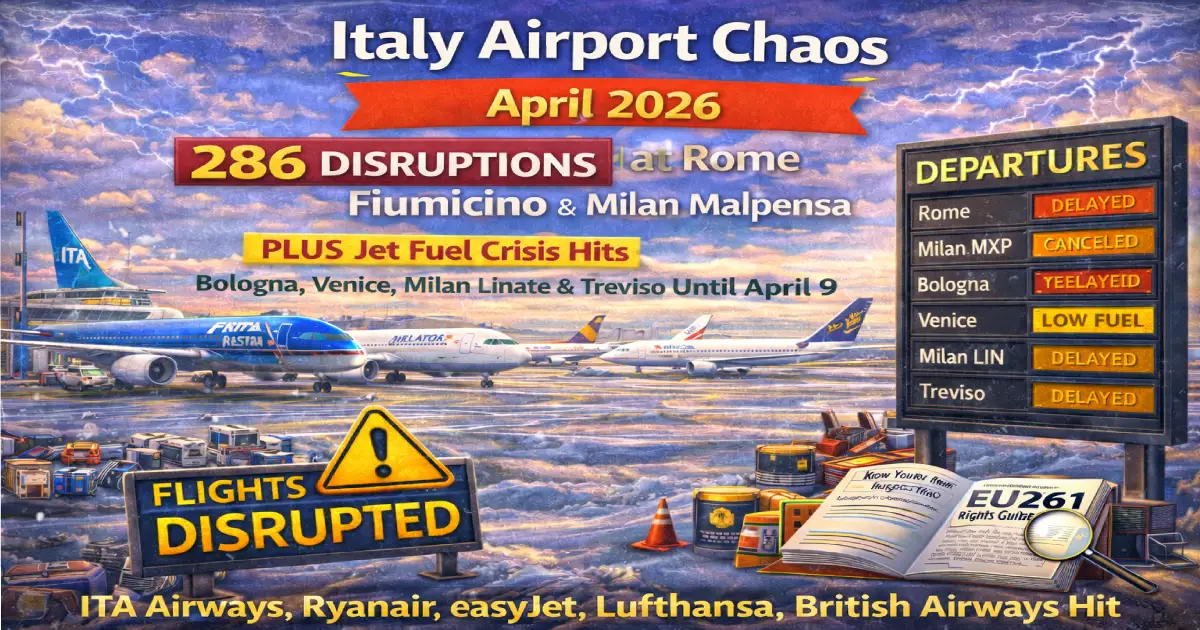
Breaking: Italy is simultaneously battling two independent aviation crises this Easter — and together they make it one of the most disrupted aviation environments in Europe right now. Crisis One: Rome Fiumicino and Milan Malpensa have recorded a combined 286 disruptions — 271 delayed flights and 15 cancellations — stranding hundreds of passengers on domestic and international routes to London, Paris, Frankfurt, and beyond. ITA Airways, Ryanair, easyJet, Lufthansa, and British Airways are all affected. Crisis Two: A confirmed jet fuel shortage — triggered directly by the Iran war’s closure of the Strait of Hormuz — has forced Air BP Italia to issue emergency NOTAMs imposing strict fuel rationing at four Northern Italian airports: Bologna, Milan Linate, Venice Marco Polo, and Treviso. These restrictions run until at least April 9, 2026. Short-haul flights are being capped at just 2,000 litres of uplift per aircraft — a fraction of normal requirements — forcing airlines to tanker fuel from other airports, make unscheduled technical stops, reduce passenger loads, or cancel services entirely. This is not a routine disruption story. Italy’s double crisis is the first confirmed instance of the Iran war’s Strait of Hormuz oil blockade physically grounding short-haul European flights through fuel rationing. If you are flying to, from, or through Italy in the next 72 hours — this is everything you need to know, including your complete EU261 compensation rights.
Published: April 6, 2026 — Easter Monday 🔴 LIVE Crisis 1 — Flight Disruptions: Rome Fiumicino (FCO): 3 cancellations · 91 delays Milan Malpensa (MXP): Multiple cancellations · significant delays Combined Rome + Milan: 15 cancellations · 271 delays = 286 total disruptions Airlines Hit: ITA Airways · Ryanair · easyJet · Lufthansa · British Airways · Air France · Qatar Airways · Gulf Air · El Al · Iberia Routes Disrupted: London · Paris · Frankfurt · Amsterdam · Madrid · Singapore · New York · Tokyo · Dubai Crisis 2 — Jet Fuel Rationing (NOTAM Active): Bologna (BLQ): 2,000 litre fuel cap per non-priority aircraft Milan Linate (LIN): Restrictions active — non-priority cap in place Venice Marco Polo (VCE): 2,000 litre cap — pilots advised to refuel before arriving Treviso (TSF): 2,500 litre cap per non-priority aircraft Fuel Restriction Window: April 2 – April 9, 2026 Priority flights: Medical · State · Long-haul (3+ hours) Short-haul flights: Capped, tanker-required, or at risk of cancellation Cause: Air BP Italia NOTAM — Strait of Hormuz oil blockade — Mediterranean Jet A-1 prices up 22% Source confirmed by: Bloomberg · Fortune · Il Sole 24 Ore · NOTAM filings · ENAC
Italy is experiencing a double crisis that has no precedent in European aviation this spring. Most airports around the world are dealing with one disruption driver at a time — weather, or strikes, or operational strain. Italy is simultaneously managing a major flight disruption event at its two biggest hubs and a confirmed fuel rationing emergency at four Northern Italian airports driven directly by the geopolitical conflict in the Middle East. Understanding both crises separately — and how they compound each other — is essential for any traveller flying to, from, or through Italy right now.
Crisis 1 — The Flight Disruption at Rome and Milan is driven by the confluence of Easter peak demand, lingering staffing pressures across Italian ground handling, European ATC congestion, and the global aviation network disruption caused by rerouted long-haul aircraft avoiding Middle East airspace. When aircraft have to fly longer routes from Asian and Gulf hubs into Europe — bypassing Iranian-controlled airspace — they arrive later, displace crew rest windows, and miss the tight rotation windows that European short-haul networks depend on. At Rome Fiumicino and Milan Malpensa, the result is 286 disruptions today.
Crisis 2 — The Jet Fuel Rationing Emergency is the first confirmed case in Europe of the Iran war physically constraining airport operations through fuel supply failure. The Strait of Hormuz carries approximately 20% of global oil — and the US-Israel conflict that began February 28, 2026 has effectively closed it to normal tanker traffic. Oil tankers from Gulf producers are now rerouting around the Cape of Good Hope, adding 10–14 days to delivery schedules. Mediterranean Jet A-1 fuel prices have surged to $1,150 per metric tonne — a 22% increase in spot markets. Air BP Italia, one of Italy’s primary aviation fuel suppliers, has run critically low at four Northern Italian airports and has issued formal NOTAMs instructing airlines to accept reduced fuel uplift or make technical stops elsewhere.
Together, these two crises make Italy the most complex aviation environment in Europe today.
Rome Fiumicino is Italy’s largest airport and its primary international gateway, handling approximately 45,000 passengers daily across 200+ daily flight movements. As Easter Monday is the peak return-travel day for millions of tourists who visited Rome over the holiday weekend, the disruption is hitting at the worst possible moment.
Today’s confirmed disruptions at Fiumicino:
The build-up of delays began in the morning as aircraft that were supposed to arrive from Northern European hubs — themselves dealing with Storm Dave aftermath — came in late. Late arrivals meant late turnarounds. Late turnarounds meant late departures on routes to London, Paris, Frankfurt, and Amsterdam. By midday, the cascade had spread across the entire departure board.
International routes most affected at Rome Fiumicino today:
Domestic routes hit:
Milan Malpensa — Northern Italy’s primary international hub — is the second major disruption centre today. As the busiest airport for long-haul connections from Northern Italy to North America, Asia, and the Gulf, Malpensa’s disruptions have an outsized global ripple effect. A delay at Malpensa does not stay in Milan — it affects passengers booked on connections through London, Frankfurt, Amsterdam, and Doha.
Combined Rome Fiumicino + Milan Malpensa disruptions today:
ITA Airways, which operates Italy’s primary domestic and international network, accounts for the largest share of disrupted services. Ryanair and easyJet — which together operate hundreds of European short-haul flights per day out of Milan and Rome — are also heavily affected. Lufthansa connections to German hubs are disrupted. British Airways services between Italy and London Heathrow are caught in the congestion, particularly on routes where schedules are already tightly packed after the Easter weekend peak.
This is the story that sets Italy apart from every other European aviation disruption right now. The jet fuel crisis at Bologna, Milan Linate, Venice Marco Polo, and Treviso is not a weather event, not a strike, and not an operational mishap. It is the direct consequence of the Iran war hitting Europe’s fuel supply chains — and Italy is the first European country to see it translate into airport-level rationing.
On April 4, 2026, Air BP Italia — one of Italy’s primary aviation fuel suppliers — issued an official NOTAM (Notice to Airmen) announcing emergency fuel quantity restrictions at four Northern Italian airports, effective immediately and running until at least April 9, 2026. The NOTAM was confirmed by Bloomberg, Fortune, Il Sole 24 Ore, and ENAC (Italy’s Civil Aviation Authority).
The root cause: The Strait of Hormuz carries approximately 20% of the world’s oil supply. The US-Israel strikes on Iran that began February 28, 2026 have effectively closed normal tanker traffic through the Strait. Oil tankers from Gulf producers — including those supplying Air BP Italia’s Jet A-1 kerosene for Italian airports — are now being rerouted around Africa’s Cape of Good Hope, adding 10–14 days to delivery schedules and creating a critical supply gap at regional storage facilities. Italian Ministry of Infrastructure data confirms that regional fuel stocks reached critical levels on April 3, 2026, forcing the Air BP Italia NOTAM to be issued the following day.
| Airport | Code | Fuel Cap (Non-Priority Flights) | Special Warning |
|---|---|---|---|
| Bologna Guglielmo Marconi | BLQ | 2,000 litres max per aircraft | Restrictions active |
| Milan Linate | LIN | Cap active — exact limit not published | Restrictions active |
| Venice Marco Polo | VCE | 2,000 litres max per aircraft | Pilots advised to refuel BEFORE arriving |
| Treviso Antonio Canova | TSF | 2,500 litres max per aircraft | LCC operations critically impacted |
Venice is the most critical situation. Il Sole 24 Ore, which reviewed the full NOTAM text, reported that Venice Marco Polo is the only one of the four airports for which the NOTAM includes an explicit pilot recommendation to refuel at the previous airport before arriving — a clear signal that fuel availability at Venice is the most severely constrained of the four.
Under the Air BP Italia NOTAM, fuel priority is strictly allocated in this order:
The 2,000-litre cap on short-haul flights is operationally severe. A typical Airbus A320 or Boeing 737 — the standard aircraft for European short-haul routes — carries between 18,000 and 26,000 litres of usable fuel for a normal service. A 2,000-litre uplift restriction forces airlines into impossible choices.
Airlines operating short-haul routes at the affected airports have three options — and none of them are ideal:
Option 1 — Tankering: The airline loads extra fuel at the previous airport (outside Italy) before departing for Bologna, Venice, Milan Linate, or Treviso. This adds weight, burns more fuel on the inbound leg, reduces cargo and sometimes passenger capacity due to weight limits, and extends boarding and fueling time. It adds cost and complexity to every rotation.
Option 2 — Technical Stop: The aircraft lands at an intermediate airport outside the restricted zone to refuel before continuing to its Italian destination or returning home. This adds 45–90 minutes to affected routes, potentially triggering crew duty time violations and cascading the delay to the next sector.
Option 3 — Cancellation: If neither tankering nor a technical stop is operationally viable — particularly for very short routes where there is no practical intermediate stop — the airline cancels the service entirely.
For Ryanair and other low-cost carriers at Treviso — which operate a point-to-point model with minimal ground time and zero buffer for technical stops — this is an existential operational challenge. Low-cost carriers rely on 25–30 minute turnarounds. A technical stop requirement doubles or triples their minimum rotation time. Ryanair CEO Michael O’Leary has publicly warned that if the Strait of Hormuz conflict continues, fuel supply disruptions could force airlines to cut routes or reduce capacity at short notice — and today’s Italy situation is exactly the scenario he described.
| Airport | Primary Carriers Exposed |
|---|---|
| Bologna (BLQ) | Ryanair · easyJet · Wizz Air · ITA Airways · Vueling |
| Milan Linate (LIN) | ITA Airways · easyJet · Lufthansa · Alitalia successors · Swiss · British Airways CityFlyer |
| Venice Marco Polo (VCE) | easyJet · Ryanair · Vueling · Air France · Lufthansa · Austrian · Brussels Airlines |
| Treviso (TSF) | Ryanair ← primary carrier, most exposed |
Ryanair operates the highest volume of short-haul departures from Treviso of any carrier. Its entire operating model — tight turnarounds, no spare aircraft, no fuel buffer — is structurally incompatible with the NOTAM restrictions. Passengers booked on Ryanair services from Treviso through April 9 are at the highest risk of disruption.
When the flight disruption at Rome and Milan and the fuel crisis at Bologna, Milan Linate, Venice, and Treviso are viewed together, the compound effect becomes clear.
An aircraft delayed at Rome Fiumicino arriving late into Milan Malpensa — where it was supposed to refuel and continue to Bologna — now arrives late AND faces a fuel cap at its next destination. The crew is running toward their duty time limit. The tank cannot be fully replenished at Bologna. The airline must either tanker from Milan or make the route work with reduced fuel. If neither is possible, the sector cancels.
The cascade is severe precisely because Italy’s aviation network — like all hub-and-spoke networks — is designed with minimal slack. Every rotation depends on the previous one completing on time. When both ends of the system are disrupted simultaneously, the collapse is faster and deeper than either crisis alone would produce.
For the period April 6–9, 2026, Italy represents the most complex overlapping aviation challenge in Europe.
Italy is a full EU member state, and EU Regulation 261/2004 applies in full to all flights departing from Italian airports, and to flights arriving in Italy on EU-based carriers.
| Situation | Distance | Compensation |
|---|---|---|
| Arrival delay 3+ hours | Under 1,500 km | €250 |
| Arrival delay 3+ hours | 1,500–3,500 km | €400 |
| Arrival delay 3+ hours | Over 3,500 km | €600 |
| Cancellation (less than 14 days notice) | Under 1,500 km | €250 |
| Cancellation (less than 14 days notice) | 1,500–3,500 km | €400 |
| Cancellation (less than 14 days notice) | Over 3,500 km | €600 |
Critical rule — the fuel crisis exception: Airlines may argue that fuel supply restrictions caused by the Strait of Hormuz crisis constitute “extraordinary circumstances” — which would exempt them from paying the €250–€600 financial compensation. However, this is legally contested. The extraordinary circumstances exemption applies when the cause is beyond the airline’s control AND could not have been avoided even if all reasonable measures were taken. Given that the NOTAM was issued on April 4 — two days before Easter Monday — airlines had advance notice of the restriction. Whether that advance notice removes the extraordinary circumstances defence is a question for national enforcement bodies and the courts. Do not accept a refusal to pay compensation without escalating — file the claim and let the Italian CAA decide.
Regardless of whether the disruption is caused by the fuel crisis (extraordinary circumstances) or operational failure (airline-controlled), Article 9 Duty of Care is always mandatory:
| Wait Time | What the Airline Must Provide |
|---|---|
| 2+ hour delay | Meals and refreshments |
| 2+ hour delay | Electronic communication (phone call, email access) |
| Overnight stranding | Hotel accommodation |
| Overnight stranding | Ground transport to and from hotel |
| Cancellation | Right to refund OR rebooking — passenger’s choice |
The exact words to use at the airline desk (in English): “I am invoking my right to care under Article 9 of EU Regulation 261/2004. I require meal vouchers / hotel accommodation / ground transport.”
In Italian: “Invoco il mio diritto di assistenza ai sensi dell’Articolo 9 del Regolamento UE 261/2004. Richiedo buoni pasto / alloggio in hotel / trasporto.”
The airline will not offer this proactively. You must ask, and ask assertively.
Step 1 — Check your specific flight before leaving for the airport Open your airline’s app. Check the flight number — not just the route. For ITA Airways: ita-airways.com/flight-status. For Ryanair: ryanair.com/flight-status. For easyJet: easyjet.com/en/disruption. Do not rely on Italian airport boards alone.
Step 2 — If flying from Bologna, Venice, Milan Linate, or Treviso — contact your airline now These four airports are under active NOTAM fuel restrictions until April 9. If your flight is a short-haul European route departing from any of these airports, call your airline now and ask: “Is my flight confirmed to operate without technical stops or payload reductions due to the Air BP Italia fuel restriction?” Get the answer in writing or by email if possible.
Step 3 — If flying Ryanair from Treviso — highest risk category Ryanair at Treviso faces the most severe operational challenge of any carrier at any restricted airport. If your flight is Ryanair from TSF before April 9, check the Ryanair app every 2 hours. Enable push notifications. Consider whether rebooking voluntarily to Venice or Malpensa — where Ryanair also operates — gives you more certainty.
Step 4 — Pilots told to refuel before arriving at Venice — longer boarding times If you are flying into Venice Marco Polo from another European city, your aircraft may have carried extra fuel from the departure airport. This means a heavier landing and potentially extended boarding procedures. Build 30 extra minutes into your post-landing plans at Venice.
Step 5 — At Rome Fiumicino and Milan Malpensa — arrive 60 minutes earlier than normal With 286 disruptions today at these two airports, security and check-in queues are running significantly longer than normal. Build 60 extra minutes into your pre-departure airport window.
Step 6 — If delayed 2+ hours — demand meal vouchers under EU261 Article 9 Go to the airline desk. Say: “I am invoking Article 9 EU Regulation 261/2004 — I require meal vouchers.” Keep every food and drink receipt.
Step 7 — If cancelled — demand rebooking or full refund You choose: rebooking on the next available flight at no extra cost, or a full cash refund to your original payment method. Do not accept travel credits as a substitute for a cash refund if you want your money back.
Step 8 — If making a technical stop due to fuel restriction If your airline reroutes you through an intermediate airport — adding an unscheduled stop — this constitutes a significant change to your itinerary. If the rerouting causes a 3-hour or greater delay at your final destination, you may be entitled to EU261 compensation. Document your original scheduled arrival time and your actual arrival time.
Step 9 — If stranded overnight — demand hotel accommodation Say: “My flight has been cancelled and there is no same-day rebooking. Under Article 9 EU Regulation 261/2004 I require hotel accommodation and ground transport.” Keep all hotel and transport receipts.
Step 10 — File your EU261 claim within 2 years Italy’s national limitation period for EU261 claims is 2 years. File with the airline within 6 weeks. If refused — escalate to ENAC at enac.gov.it.
Flight disruptions at Rome and Milan: Expected to begin easing from Tuesday, April 7 as Easter Monday return demand drops and Storm Dave’s aftermath clears from Northern European feeder hubs. Full normalisation expected by Wednesday–Thursday.
Fuel restrictions at Bologna, Venice, Milan Linate, Treviso: The current NOTAM runs until April 9, 2026. Whether it is extended depends on how quickly Air BP Italia can replenish stocks from alternative suppliers or rerouted tankers. Airport operator Save — which manages Venice, Treviso, and nearby Verona — has noted that multiple fuel suppliers operate at their airports, and most airlines are continuing without widespread issues. However, Ryanair’s CEO has publicly warned that if the Strait of Hormuz conflict continues, physical fuel availability in Europe could become critically constrained from mid-April as the last pre-crisis tanker shipments deplete and Cape of Good Hope rerouting delays accumulate.
The bigger picture — summer 2026: The fuel crisis is not going away. Brent crude remains above $100 per barrel. Mediterranean Jet A-1 prices are 22% above pre-crisis levels. Airlines with strong fuel hedging — Ryanair (approximately 80% hedged through mid-2026), IAG (60–70%) — have a buffer. Airlines without hedging face immediate cost pressure. If the conflict persists, the summer 2026 travel season across Southern Europe faces a structural fuel supply risk that goes far beyond Italy’s Easter week NOTAM.
| Resource | Link / Contact |
|---|---|
| ITA Airways Flight Status | ita-airways.com |
| Ryanair Flight Status | ryanair.com/flight-status |
| easyJet Disruption | easyjet.com/en/disruption |
| Lufthansa Disruption | lufthansa.com/travel-disruptions |
| British Airways Travel Alerts | britishairways.com/travel-alerts |
| Rome Fiumicino Airport | adr.it |
| Milan Malpensa Airport | milanomalpensa-airport.com |
| Venice Marco Polo Airport | veneziaairport.it |
| Bologna Airport | bologna-airport.it |
| FlightAware Live Tracking | flightaware.com |
| EU261 Rights Official Guide | europa.eu/youreurope/citizens/travel/passenger-rights/air |
| ENAC Passenger Rights (Italy) | enac.gov.it |
| UK CAA Passenger Rights | caa.co.uk/passengers |
Italy is simultaneously dealing with two aviation crises this Easter — and together they make it the most complex flight environment in Europe right now. At Rome Fiumicino and Milan Malpensa, 271 flights are delayed and 15 cancelled today — 286 disruptions hitting ITA Airways, Ryanair, easyJet, Lufthansa, British Airways, Air France, and Qatar Airways across domestic and international routes. Separately, a confirmed jet fuel rationing emergency — the first of its kind in Europe from the Iran war — is restricting fuel uplift at Bologna, Milan Linate, Venice Marco Polo, and Treviso until at least April 9. Short-haul flights face a 2,000-litre cap. Venice has warned pilots to refuel before arriving. Ryanair at Treviso faces the most severe operational challenge. Mediterranean Jet A-1 prices are up 22%.
If you are flying to, from, or through Italy before April 9:
The fuel restrictions end April 9 — but the deeper fuel supply concern extends into summer.
For More Resources:
Related Articles:
Sources: Bloomberg (April 5, 2026), Fortune (April 5, 2026), Il Sole 24 Ore (April 5, 2026), NOTAM filings — Air BP Italia (April 4, 2026), ENAC Italy, Euro Weekly News, VisaHQ, Dolcevia.com — April 6, 2026
Posted By : Vinay
This article is provided for general informational purposes only and is based on information available at the time of publication. Travel advisories, airline schedules, airport operations, visa requirements, government regulations, and other travel-related information are subject to change without prior notice. While Travel Tourister makes reasonable efforts to verify information using official announcements, government publications, airline and airport communications, and other reliable sources, we cannot guarantee that all information remains complete, accurate, or up to date at all times. Readers should independently verify any information that may affect their travel plans with the relevant airline, airport authority, government agency, embassy, or other official source before making travel, financial, or other decisions. Travel Tourister shall not be liable for any direct or indirect loss, inconvenience, or damages arising from the use of or reliance on the information contained in this article. Nothing in this publication constitutes legal, immigration, financial, or professional travel advice. If you believe any information in this article is inaccurate or outdated, please contact our editorial team. We review all credible correction requests promptly and update our content whenever appropriate.
Lastest News
2nd Floor, 39, Above Kirti Club, DLF Industrial Area, Kirti Nagar, New Delhi, Delhi 110015



Travel Tourister is a leading Travel portal where we introduce travellers to trusted travel agents to make their journey hasselfree, memorable And happy. Travel Tourister is a platform where travellers get Tour packages ,Hotel packages deals through trusted travel companies And hoteliers who are working with us across the world. We always try to find new and more travel agents and hoteliers from every nook and corners across the world so that you could compare the deals with different travel agents and hoteliers and book your tour or hotel with the one you have chosen according to your taste and budget.
Copyright © Travel Tourister, India. All Rights Reserved

 Call
Call Enquiry