Published on : 20 Jun 2026
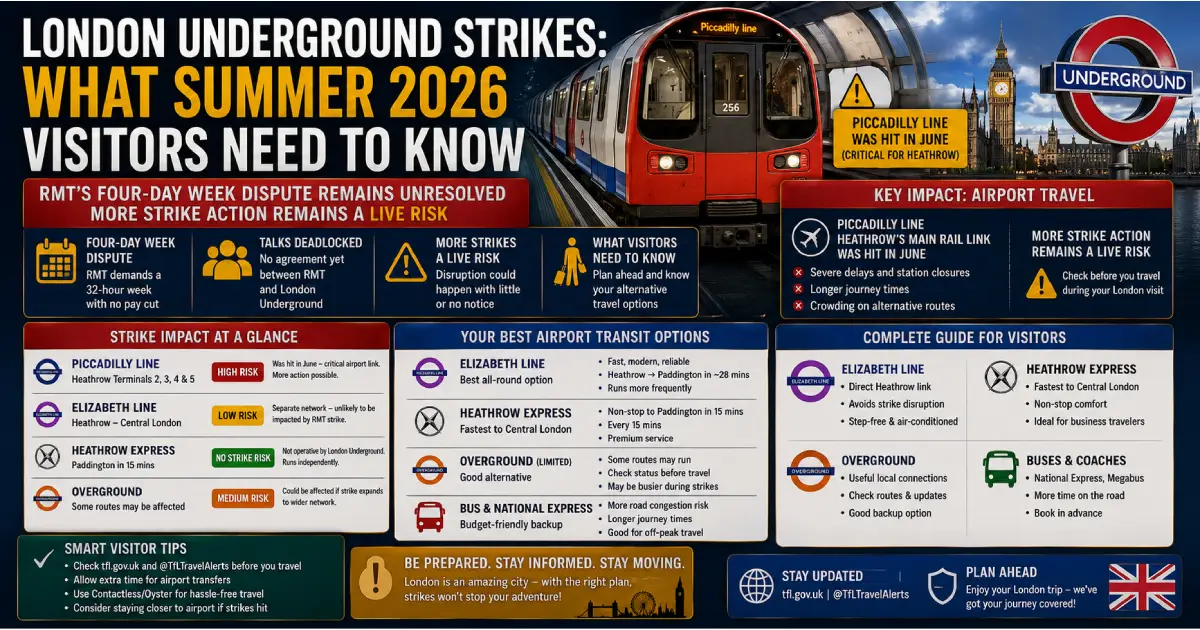
The strikes that hit London’s Piccadilly line — Heathrow’s main rail connection — have ended for now. The dispute that caused them has not.
If you are planning a UK summer holiday and your itinerary includes London, here is the situation in plain terms. RMT union drivers on the London Underground walked out twice at the start of June 2026, in a dispute over Transport for London’s proposed introduction of a compressed four-day working week for tube drivers. The June strikes — which followed an earlier round of action in April, and several rounds of planned May strikes that were called off at the last minute — affected the Circle line, the Piccadilly line, the Metropolitan line between Baker Street and Aldgate, and the Central line between White City and Liverpool Street.
The Piccadilly line is the detail that matters most for international visitors: it is the primary direct Underground connection between Heathrow Airport and central London. When the Piccadilly line goes down, the cheapest and most commonly used rail route from Heathrow’s terminals into the city goes with it.
The good news is that London’s latest bout of tube strikes has finished, with no current plans for further industrial action as of mid-June. The more important news for anyone planning travel this summer: the underlying dispute is not resolved. TfL and the RMT remain at odds over the four-day week proposal, and the union has stated explicitly that more industrial action could follow if no agreement is reached. For a visitor booking flights and accommodation for July, August, or September, this means the Piccadilly line strike risk is dormant, not eliminated.
This guide explains what actually happened, what is and isn’t currently planned, and — most usefully — exactly which alternative routes get you from Heathrow to central London if the Piccadilly line is disrupted on the day you travel.
Published: June 20, 2026 — Saturday Dispute: RMT vs Transport for London — proposed compressed four-day working week for Tube drivers Status as of today: Current period of industrial action ended June 5, 2026 — no further strikes formally announced Risk level for summer 2026: ⚠️ Live and unresolved — RMT has stated further action is possible if talks fail June strike dates that already passed: Tuesday June 2 and Thursday June 4, 2026 (24-hour strikes, 12:00–11:59 the following day) Lines affected during June strikes: Circle line (no service) · Piccadilly line (no service) · Metropolitan line, Baker Street–Aldgate section (no service) · Central line, White City–Liverpool Street section (no service) Critical for visitors: Piccadilly line is Heathrow’s primary direct Underground connection to central London NOT affected by any RMT Underground strike: Elizabeth line · London Overground · DLR · Buses · Trams · Eurostar Other unaffected route to Heathrow: Heathrow Express (mainline rail, not Underground) Driver behind dispute: TfL’s plan to let drivers opt into compressed four-day weeks (currently piloted on the Bakerloo line) vs RMT concerns over fatigue, shift length and safety Comparison union: ASLEF (the other tube drivers’ union) has already accepted the four-day week proposal TfL’s position: The four-day week is voluntary — no driver will be forced to take it Where to check live strike status before you travel: tfl.gov.uk/status-updates and rmt.org.uk
For anyone unfamiliar with London’s transport map, the Piccadilly line carries outsized importance for international visitors specifically because it is the direct Underground service connecting Heathrow Airport’s Terminals 2, 3, 4, and 5 to central London, stopping at major visitor destinations including South Kensington, Knightsbridge, Piccadilly Circus, Leicester Square, Covent Garden (nearby), and King’s Cross St. Pancras.
For millions of visitors every year, the Piccadilly line is the default, cheapest option for getting from the airport into the city — a single Tube fare using a contactless card or Oyster card, no advance booking required, running roughly every 5–10 minutes throughout the day. When it is disrupted, visitors who don’t know London’s transport network well can find themselves stranded at the airport without an obvious next step, especially after a long-haul flight when the instinct is to follow the most familiar-looking signage.
This is exactly why the June strikes generated significant visitor-facing concern, even though London’s wider transport network — buses, the Elizabeth line, the Overground, and the dedicated Heathrow Express — continued operating normally throughout.
Understanding the pattern of this dispute helps explain why “more strikes could happen” is a realistic risk rather than vague speculation.
The root cause: The dispute stems from TfL’s introduction of a compressed four-day working week for Tube drivers, currently being trialled on the Bakerloo line. The four-day model lets drivers work longer hours across fewer days rather than the standard five-day week. TfL has stressed throughout that the scheme is voluntary — no driver is being forced into it — and has framed it as a work-life balance improvement, while RMT has raised concerns about driver fatigue, reduced flexibility, longer shift lengths, and the potential safety impact of extended shifts in what it describes as a safety-critical role.
Early 2026: RMT announced six strike dates across April, May, and June — two each month — following a majority vote among members in favour of industrial action.
April 21–24: The first confirmed strikes went ahead.
May 19–22: Two planned strike rounds were suspended at the last minute (in one case, just 24 hours before they were due to begin) as talks at conciliation service ACAS showed progress.
June 2 and June 4: With talks failing to produce a resolution, RMT confirmed two new 24-hour strikes for June, after the originally planned June dates had also been cancelled. These went ahead as scheduled, with the Circle, Piccadilly, and parts of the Metropolitan and Central lines suspended for the full 24-hour periods, plus residual disruption into the following mornings as services returned to normal.
Since June 5: No further strike dates have been formally announced. TfL’s Chief Operating Officer Claire Mann has stated TfL remains in discussions with the union “to find a way to avoid disruption to London,” while RMT has not confirmed the dispute is resolved.
The critical unresolved fact: ASLEF, the other major Tube drivers’ union, has already accepted the four-day week deal — meaning the dispute is specifically with RMT, and a resolution requires RMT-specific agreement rather than a blanket policy reversal that would satisfy both unions equally. This makes a clean, fast resolution less straightforward than it might otherwise be.
This is the most practically useful section of this guide. If you land at Heathrow on a day when the Piccadilly line is affected by strike action — or simply experiencing one of its periodic non-strike service disruptions, which happen independently of industrial action — here are your real options, fastest to slowest.
The Elizabeth line does not count as part of the London Underground network and has not been affected by any of the 2026 RMT Underground strikes. It connects Heathrow Terminals 2, 3, 4, and 5 directly to central London, running via Paddington to Liverpool Street and beyond, with significantly faster journey times than the Piccadilly line on the central London stretch — the Elizabeth line’s modern, high-frequency service typically reaches Paddington in around 30 minutes from the airport.
Why it’s the best backup: It uses the same Heathrow stations as the Piccadilly line (you do not need to go anywhere different at the airport), it accepts the same contactless and Oyster payment, and on strike days it tends to be considerably less crowded than the alternative routes since fewer visitors know to look for it.
How to find it at Heathrow: Follow signage for “Trains” or “Rail” at your terminal — both the Piccadilly line and Elizabeth line platforms are typically accessed via the same underground rail station serving Terminals 2 and 3, with Terminal 5 and Terminal 4 having their own direct stations also served by both lines.
The Heathrow Express is a dedicated mainline rail service (not part of the Underground network) connecting Heathrow directly to London Paddington in approximately 15 minutes — the fastest option to central London, though also the most expensive. It is entirely unaffected by Underground strikes since it operates as a separate rail franchise.
Cost consideration: Heathrow Express fares are significantly higher than a standard Tube or Elizabeth line fare — typically £25–£30+ one-way if not booked in advance, though advance online booking can reduce this substantially. For visitors prioritising speed and certainty over cost on a disrupted day, it is the most reliable option.
Buses are entirely unaffected by Underground strikes and continue running normally throughout any RMT Tube industrial action. National Express and other coach operators run frequent services from Heathrow’s Central Bus Station to Victoria Coach Station and other London points, typically taking 45–75 minutes depending on traffic.
Best for: Budget-conscious travellers, or those travelling with substantial luggage where the bus’s hold storage is more practical than navigating Tube stairs and escalators.
Always available regardless of Tube strike status, though subject to surge pricing and traffic delays — particularly significant on strike days when displaced Tube passengers shift demand onto road transport. Black cabs and pre-booked airport transfers remain a reliable, if pricier, fallback. Expect £60–£90+ to central London depending on traffic and time of day.
Tubes and trains are rarely on strike at the same time, meaning travellers can usually use the non-striking option to reach their destination — for example, if the Piccadilly line is on strike, the Elizabeth line or Heathrow Express will typically still be running normally. This pattern has held consistently across the 2026 RMT action and is a reliable rule of thumb: a single Underground line strike does not mean London’s entire rail network to Heathrow is down, even when it might feel that way from airport signage and crowding.
For anxious travellers checking this before booking flights, here is the explicit list of services that are NOT subject to the RMT’s Underground dispute and have not been affected by any 2026 strike action related to this dispute:
This is genuinely useful context: even at the height of June’s disruption, the vast majority of London’s transport network continued operating normally. The strikes are targeted, affecting specific Underground lines on specific days — not a citywide transport shutdown.
Before you book: This dispute is not a reason to avoid London or change your travel dates. The strikes that have occurred have been confined to specific 24-hour windows on specific announced dates, not open-ended or unpredictable shutdowns. If no new strikes are announced, the entire issue is moot for your trip.
Check before you fly: In the 1–2 weeks before your departure, check tfl.gov.uk/status-updates for any newly announced strike dates. RMT strikes in 2026 have consistently been announced with at least 1–2 weeks’ notice (sometimes longer, with cancellations possible right up to 24 hours before), giving travellers reasonable time to plan an alternative route if your travel date coincides.
On arrival day, regardless of strike status: Look for Elizabeth line signage at Heathrow alongside Piccadilly line signage — using the Elizabeth line by default, even on a non-strike day, often gets you into central London faster anyway, since it is a newer, higher-capacity line with fewer stops than the Piccadilly line’s airport-to-city stretch.
Build in buffer time: If your itinerary includes a tight connection from Heathrow to a specific London commitment — a hotel check-in deadline, a theatre booking, a connecting train at a London terminus — allow an extra 30–45 minutes of buffer during the UK summer travel season generally, independent of strike risk, given the elevated passenger volumes London typically sees in July and August.
For onward UK rail connections: If your journey continues beyond London via National Rail (to other UK cities, for example), note that National Rail services are governed by separate disputes and separate unions from this specific RMT Underground dispute — check nationalrail.co.uk independently for any unrelated rail strike action that might be active during your travel dates.
For travellers planning later summer 2026 trips — August or September — it is worth understanding why this is not simply a closed chapter. The structural disagreement between TfL and RMT is unresolved: TfL wants to expand its voluntary four-day working week pilot beyond the Bakerloo line, and RMT has not endorsed this expansion, even though the rival ASLEF union has already accepted similar terms. Historically, London Underground disputes of this type — particularly those involving shift patterns, fatigue, and safety arguments — have taken months or longer to fully resolve, often punctuated by periods of calm between fresh rounds of action when negotiations stall.
The responsible planning assumption for summer 2026 is: the risk is real but manageable, the disruption pattern (when it occurs) is predictable and announced in advance, and the alternative routes via Elizabeth line, Heathrow Express, and buses are robust enough that a Piccadilly line strike should be an inconvenience rather than a trip-threatening event for any visitor who knows these alternatives exist.
Posted By : Vinay
This article is provided for general informational purposes only and is based on information available at the time of publication. Travel advisories, airline schedules, airport operations, visa requirements, government regulations, and other travel-related information are subject to change without prior notice. While Travel Tourister makes reasonable efforts to verify information using official announcements, government publications, airline and airport communications, and other reliable sources, we cannot guarantee that all information remains complete, accurate, or up to date at all times. Readers should independently verify any information that may affect their travel plans with the relevant airline, airport authority, government agency, embassy, or other official source before making travel, financial, or other decisions. Travel Tourister shall not be liable for any direct or indirect loss, inconvenience, or damages arising from the use of or reliance on the information contained in this article. Nothing in this publication constitutes legal, immigration, financial, or professional travel advice. If you believe any information in this article is inaccurate or outdated, please contact our editorial team. We review all credible correction requests promptly and update our content whenever appropriate.
Lastest News
2nd Floor, 39, Above Kirti Club, DLF Industrial Area, Kirti Nagar, New Delhi, Delhi 110015



Travel Tourister is a leading Travel portal where we introduce travellers to trusted travel agents to make their journey hasselfree, memorable And happy. Travel Tourister is a platform where travellers get Tour packages ,Hotel packages deals through trusted travel companies And hoteliers who are working with us across the world. We always try to find new and more travel agents and hoteliers from every nook and corners across the world so that you could compare the deals with different travel agents and hoteliers and book your tour or hotel with the one you have chosen according to your taste and budget.
Copyright © Travel Tourister, India. All Rights Reserved

 Call
Call Enquiry