Published on : 06 May 2026
The Spirit ghost flights are finally stopping at Miami. And what’s replacing them at MIA is a very different kind of disruption.
For four consecutive days after Spirit Airlines ceased operations on May 2, Miami International Airport’s departure boards carried an eerie echo: 18 Spirit cancellations per day — flights that would never operate, entered into the system and then formally cancelled, one by one, as Spirit’s orderly wind-down processed every scheduled rotation in its former network. Yesterday, May 5, Miami International Airport recorded 157 delays and 21 cancellations — Spirit Airlines accounted for 18 of those cancellations alone, the most impactful carrier in the airport’s disruption picture for the fourth consecutive day since the shutdown began.
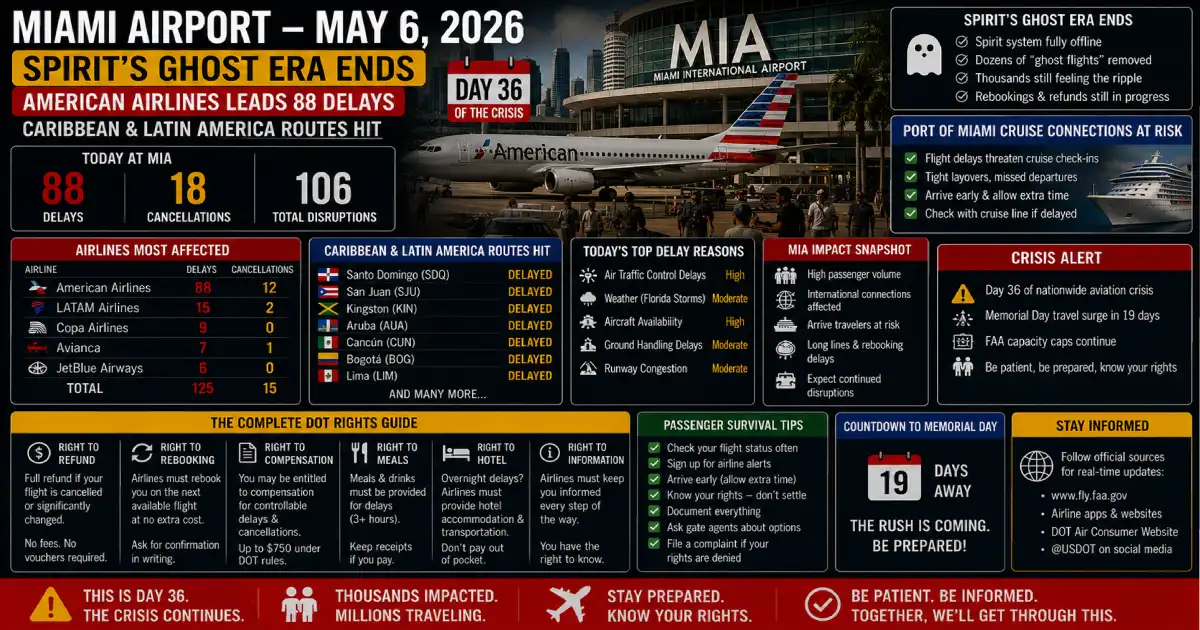
Today, those Spirit ghost cancellations are largely done. Miami International Airport recorded 88 delays and 6 cancellations on May 6 — a significant improvement from the 178 total disruptions of May 5 — affecting American Airlines, Delta Air Lines, United Airlines and more across domestic and international routes to New York, Los Angeles, London, Toronto and Atlanta.
94 total disruptions. That is MIA’s best day since the post-Easter crisis began on April 1. The Spirit ghost flights have cleared. The displacement surge is being absorbed. Miami is, cautiously, beginning to breathe again.
But cautiously is the operative word. Because American Airlines — which operates approximately 200+ daily departures at MIA, making it the airport’s dominant carrier — is still posting the crisis’s most elevated delay profile of any single carrier at a single hub. The Caribbean and Latin America routes that make MIA uniquely important in the national aviation architecture are still running hot. And the Port of Miami — the world’s busiest cruise port, sending 6 million passengers per year — is still dispatching passengers through an airport that has been running disrupted for 36 consecutive days.
Published: May 6, 2026 — (Day 36 · Spirit Day 5) MIA total today: 94 — 88 delays + 6 cancellations vs May 5: 178 total (157 + 21) — 46% improvement — first sign of genuine MIA recovery Spirit ghost cancellations today: ✅ Largely cleared — Spirit wind-down processing nearing completion at MIA American Airlines: Highest delay count — 88 delays across today and yesterday combined — dominant carrier at 200+ daily MIA departures Delta Air Lines: 6 cancellations (May 5) / improving today United Airlines: Moderate delays continuing International routes disrupted: London Heathrow (LHR) · Toronto Pearson (YYZ) · Madrid–Barajas (MAD) · Barcelona (BCN) · Frankfurt (FRA) · Caribbean (multiple) · Latin America (multiple) Port of Miami risk: 6 million cruise passengers/year — day-before-embarkation MIA connections at risk for Royal Caribbean, MSC, Carnival Spirit MIA legacy: 2nd largest Spirit hub (behind FLL) — 24,000+ annual Spirit flights — now zero Rescue fares still active: American (fare caps) · United (support) · Frontier (competitive pricing) JetBlue $99 rescue fare: ❌ Expired yesterday May 5 at 11:59pm FAA O’Hare cap: 11 days away — May 17 Memorial Day: 19 days away — May 25 DOT refund right: ✅ Mandatory cash refund for all cancellations — 7 business days EU261 at MIA: ✅ Applies to British Airways, Iberia, Air France, KLM, Lufthansa departing MIA to Europe
Chicago O’Hare is the national cascade engine. Atlanta is Delta’s crew crisis epicentre. Los Angeles is the trans-Pacific gateway. Fort Lauderdale was Spirit’s hub. Miami International Airport is all of these things and more — and it serves communities of travellers that none of the other crisis-affected airports serve in the same way.
Situated in South Florida, Miami serves as a major international gateway linking North America with Latin America, Europe, and beyond. Its strategic importance means that even moderate disruptions can quickly escalate into global travel challenges.
The populations MIA serves that are uniquely affected by the 36-day crisis:
Latin American communities — Miami is the primary US gateway for Colombia, Venezuela, Ecuador, Peru, Brazil, Argentina, Chile and across Central America. American Airlines, LATAM, Avianca, Copa Airlines and dozens of regional carriers connect Miami to over 60 Latin American cities. A day of 88 MIA delays means 88 broken connections into the Latin American diaspora network — families separated by delayed arrivals from Bogotá, disrupted business connections from São Paulo, tourism from Mexico City running hours late.
Caribbean travellers — MIA serves more Caribbean islands than any other US airport. Nassau, Havana, Kingston, Port au Prince, Santo Domingo, Bridgetown, Castries, St. Maarten — the list runs to over 30 destinations. American Airlines and regional carriers serve this network almost entirely from MIA. For Caribbean island residents whose only practical US connection runs through Miami, a disruption day is not an inconvenience. It is a stranding event.
Cruise passengers at Port of Miami — The Port of Miami is the world’s busiest cruise homeport. Royal Caribbean, MSC Cruises, Carnival, Norwegian, Virgin Voyages and Celebrity Cruises all operate from Miami. Miami’s airline and passenger growth has been intense, with 2024 setting an all-time record before a modest decline in 2025. As schedules grow denser, the margin for absorbing disruptions without cascading into cancellations becomes thinner. For the thousands of cruise passengers who arrive at MIA the day before embarkation, a missed flight means a missed ship — and missing a cruise ship is not a refundable event.
South American business corridor — Miami’s corporate sector connects US multinationals to South American operations. The Miami–Bogotá, Miami–São Paulo, Miami–Lima, and Miami–Buenos Aires routes carry high volumes of time-sensitive business travel. An 88-delay day at MIA on a Tuesday — a prime business travel day — translates directly into missed board meetings, delayed deal closings, and supply chain disruptions.
Before discussing today’s partial recovery, the May 5 picture deserves full examination — because it represents what Spirit’s ghost flight phenomenon looked like at its worst in Miami.
On May 5, Miami International Airport recorded 157 delays and 21 cancellations. Spirit Airlines accounted for 18 of those cancellations — the most of any carrier. American Airlines led in delays with 72 affected flights. Delta reported 2 cancellations and 2 delays. Air Canada Rouge had 1 cancellation. Southwest posted 9 delays without cancellations. United recorded 3 delays. International routes to Madrid, Barcelona, Frankfurt and Toronto all experienced delays.
Spirit’s 18 cancellations at MIA on May 5 were not real disruptions — no passenger was at the gate expecting to board those flights. But they drove the cancellation count to 21 total, making it appear as if MIA was having one of its worst cancellation days of the crisis. Beneath the Spirit ghost numbers, the real MIA story on May 5 was American Airlines’ 72 delays — an indication that American’s domestic and international network through Miami is under sustained operational strain even as Spirit’s shadow clears.
The good news in today’s numbers: with the Spirit ghost flights largely processed, the 6 cancellations on May 6 reflect real operational disruptions — a much smaller number, and the first indicator that MIA’s cancellation environment may be normalising toward pre-crisis levels.
American Airlines operates Miami International as one of its three primary hubs alongside Dallas Fort Worth and Philadelphia. American Airlines experienced the highest number of delays at MIA with 220 delays over the May 4 period, accounting for a substantial portion of overall disruptions, with the delay volume suggesting network-wide scheduling challenges rather than flight suspensions.
American’s Miami operation is structurally different from its Dallas or Philadelphia hubs. MIA is American’s international gateway — the hub from which it operates to more Latin American and Caribbean destinations than any other carrier in the world. This means a disruption at MIA has immediate international implications that a disruption at DFW or PHL does not.
When an American Airlines flight from New York arrives at MIA 90 minutes late, every passenger on that flight who is connecting to Bogotá, Lima, Buenos Aires, or Nassau is now 90+ minutes late to their connection. American’s MIA international bank — the coordinated arrival of multiple domestic inbounds to enable simultaneous transborder connections — is structured around precise timing. When the domestic inbounds are late from O’Hare, JFK, or Atlanta (all currently running elevated disruption), the entire international connection bank at MIA falls apart.
American Airlines waivers: Check aa.com → Manage My Booking → Travel Alerts. American has maintained rolling waivers throughout the crisis. If your MIA itinerary is eligible, fee-free date changes to alternative dates or routing via Charlotte (CLT) — MIA’s closest equivalent hub — may be available.
The international routes that make MIA uniquely important are the routes least covered by other US crisis articles. Here is the status by corridor:
American Airlines, JetBlue, InterCaribbean Airways, Caribbean Airlines and multiple charter operators all serve Caribbean destinations from MIA. Today’s 88 delays at MIA are cascading into Caribbean arrival slots — passengers expected in Nassau at 14:00 are now projected for 15:30–16:00, which compresses tour pickup windows, hotel check-in queues, and for cruise-port passengers, pre-embarkation shore excursions.
Routes most at risk today: Nassau (NAS) · Kingston (KIN) · Montego Bay (MBJ) · Port-au-Prince (PAP) · Santo Domingo (SDQ) · Havana (HAV) · St. Maarten (SXM) · Bridgetown (BGI) · Georgetown (GEO)
The Latin America corridors from MIA are the airport’s highest-frequency international operation. American alone operates daily or multiple-daily service to Bogotá, Lima, Santiago, Buenos Aires, São Paulo, Rio de Janeiro, Mexico City, Cancún, Quito, Guayaquil, Medellín, Cali and beyond.
International routes to Madrid, Barcelona, Frankfurt, and Toronto experienced delays yesterday — and the Latin American network was similarly affected, with disruptions extending to connections involving the Caribbean and Latin America.
Today’s specific risk: the afternoon Latin America departure bank at MIA — typically 14:00–18:00 — aligns with the peak period when domestic inbound delays (from morning cascades at O’Hare and Atlanta) are feeding the most disrupted aircraft into MIA’s international gate areas.
Routes to New York, Los Angeles, London, Toronto and Atlanta are among those disrupted today. The London Heathrow service from MIA (operated by British Airways and American’s joint business) is one of the most commercially important transatlantic routes at the airport. Any MIA–LHR delay of 3+ hours for controllable reasons triggers EU261 at €600 per passenger.
International routes from MIA with EU261 applicability today: London Heathrow (British Airways, American) · Madrid–Barajas (Iberia, American) · Paris CDG (Air France) · Amsterdam (KLM) · Frankfurt (Lufthansa) · Barcelona (Vueling, Iberia)
This is the uniquely Miami angle that no other disruption article in this series addresses.
The Port of Miami sends approximately 6 million passengers per year on cruises departing from its 12 cruise terminals. The vast majority of those passengers fly into Miami International Airport — typically arriving the day before embarkation. Royal Caribbean, MSC Cruises (now operating European-repositioned ships including MSC Euribia in its May European season), Carnival, Norwegian, Celebrity Cruises and Virgin Voyages all homeport in Miami.
The cruise connection problem created by 36 consecutive days of MIA disruption:
If you miss your ship, you do not get a refund on the cruise. Cruise lines are not airlines. They operate on fixed departure times — Royal Caribbean’s Harmony of the Seas does not wait because passengers from Chicago’s O’Hare connection are running 3 hours late. The ship sails at the scheduled time. Passengers who arrive at the Port of Miami after their ship has departed — due to an American Airlines delay at MIA — must make their own way to the ship’s first port of call at their own expense. A New York–Miami–Caribbean cruise passenger whose MIA connection is delayed and who misses embarkation may face flights to Nassau, San Juan or Cozumel that cost $400–$1,000+ in last-minute fares, on top of a cruise fare they have already paid in full.
What cruise passengers must do today:
✅ Book your cruise pre-departure night in Miami — do not arrive MIA on embarkation day. A $120 hotel in Miami the night before embarkation is the cheapest insurance policy in travel.
✅ Book the earliest possible flight to Miami. The earlier your arrival, the more time the system has to absorb delays. A passenger arriving at MIA at 08:00 on embarkation morning has 8+ hours of buffer before a typical 16:00 ship departure. A passenger arriving at 13:00 has 3 hours — which today is not a safe margin.
✅ Purchase travel insurance with “cruise missed departure” cover. This specifically covers the scenario where a flight delay causes you to miss embarkation, covering the cost of flights to the ship’s first port of call and sometimes the cost of missed embarkation night onboard.
✅ Use cruise line transfer packages. Royal Caribbean, Carnival and MSC all offer pre-packaged airport–port transfers for passengers arriving on the embarkation day. These transfers will wait for passengers with confirmed cruise bookings if the flight is delayed — unlike an Uber, which will not. Book transfers through your cruise line’s official transfer programme, not third-party operators.
Spirit Airlines operated MIA as its second-largest hub behind Fort Lauderdale. Spirit Airlines reported 18 cancellations at MIA on May 4, making it the most impacted carrier in terms of cancellations — the highest among all airlines. Spirit’s departure from MIA removes a carrier that operated significant daily volume on routes connecting Miami to New York, Chicago, Baltimore, Detroit, and Atlanta at fares that drove the South Florida tourism and diaspora economy.
The fare implications for MIA’s Caribbean and Latin American communities are acute. Spirit’s Caribbean routes — Nassau, Montego Bay, Kingston, Punta Cana, Santo Domingo — were priced at 30–50% below American’s equivalent services. Caribbean American families, many of whom travel on tight budgets to maintain family connections, now face American’s standard fares on routes where no equivalent low-cost carrier exists.
Spirit’s Latin American presence at MIA was smaller — most Latin American routes were operated by LATAM, Avianca, Copa and American at prices Spirit did not undercut as significantly. But the removal of Spirit’s capacity on Miami–New York, Miami–Chicago and Miami–Atlanta routes — key trunk routes that feed Latin American and Caribbean connections into MIA’s international hub — reduces the total seat supply on those feeder corridors. Less supply means higher prices. Higher prices on Miami feeders mean more expensive total itineraries for Caribbean and Latin American travellers.
The communities that feel Spirit’s absence most acutely at MIA are not the leisure travellers who will book American instead — they are the price-sensitive diaspora travellers for whom Spirit’s low fares were the difference between making the trip and not.
Every cancelled MIA flight today triggers an unconditional right to a full cash refund to your original payment method within 7 business days. Airlines cannot insist on a voucher.
“I am requesting a full cash refund to my original payment method under DOT regulations.”
Spirit: Automatic refund processing underway for credit/debit cards. File a simultaneous credit card chargeback under the Fair Credit Billing Act for “services not rendered.”
For delays caused by crew shortage, scheduling failure, or aircraft positioning — not weather: ✅ Meal vouchers at 3+ hour controllable delays ✅ Hotel accommodation for controllable overnight cancellations ✅ Rebooking on next available flight — American, United and Delta will rebook onto partner carriers; Southwest will not
Ask at the gate desk at 3 hours. Say: “My flight has been delayed over three hours due to an airline operational issue. I am requesting meal vouchers under your DOT customer service commitment.” Keep every receipt.
For British Airways, Iberia, Air France, KLM, or Lufthansa departing MIA to Europe: EU261 applies if delay at destination is 3+ hours for controllable reasons. Compensation up to €600 per person.
Ask for specific reason in writing at the MIA gate before boarding.
Chase Sapphire and Amex Platinum both offer up to $500 per person for delays over 6 hours. Keep all receipts from the moment your delay is confirmed. File claim with your card issuer independently from any airline duty of care claim.
If your MIA delay causes you to miss your cruise embarkation:
Today’s 94 total disruptions represent MIA’s best day in five weeks. Here is the honest assessment of whether the improvement is structural or temporary:
Structural improvements: Spirit’s ghost flights are clearing. The 18 Spirit cancellations per day that artificially inflated MIA’s disruption numbers on May 2–5 are ending. The underlying MIA operation — absent Spirit’s ghost signal — is recording 88 delays and 6 real cancellations today. That is elevated compared to pre-crisis norms but not catastrophic.
Remaining structural risks: American Airlines’ delay count at MIA remains elevated — 88 delays in a single morning window. The cascade from O’Hare, Atlanta and Dallas continues to feed late inbounds into MIA’s connection banks. The TSA staffing deficit (Day 81) continues to slow security processing. Memorial Day is 19 days away — if American cannot reduce its delay footprint at MIA before May 24, Memorial Day weekend at this airport will be extremely difficult.
The verdict: MIA is beginning to recover. It is not recovered. Today is a better day — not a resolved crisis.
| Airline | Action | Contact |
|---|---|---|
| American Airlines | aa.com → My Trips / AA App | 1-800-433-7300 |
| Delta Air Lines | delta.com → My Trips / Fly Delta App | 1-800-221-1212 |
| United Airlines | united.com → My Trips | 1-800-864-8331 |
| Southwest Airlines | southwest.com → Change/Cancel | 1-800-435-9792 |
| British Airways | ba.com → EU261 Compensation | 1-800-247-9297 |
| Iberia | iberia.com → Customer Service | 1-800-772-4642 |
| Air France | airfrance.com → My Bookings | 1-800-237-2747 |
| Avianca | avianca.com → My Trips | 1-800-284-2622 |
| LATAM | latamairlines.com → My Trips | 1-866-435-9526 |
| Copa Airlines | copaair.com → My Trips | 1-800-359-2672 |
| Spirit | spirit.com (refund queries only) | Lines closed |
MIA real-time flight status: miami-airport.com/flight-info.asp FlightAware: flightaware.com → Search MIA Port of Miami cruises emergency: Contact your cruise line directly DOT consumer complaint: airconsumer.dot.gov EU261 claims: airhelp.com · flightright.eu
Related Articles:
Posted By : Vinay
This article is provided for general informational purposes only and is based on information available at the time of publication. Travel advisories, airline schedules, airport operations, visa requirements, government regulations, and other travel-related information are subject to change without prior notice. While Travel Tourister makes reasonable efforts to verify information using official announcements, government publications, airline and airport communications, and other reliable sources, we cannot guarantee that all information remains complete, accurate, or up to date at all times. Readers should independently verify any information that may affect their travel plans with the relevant airline, airport authority, government agency, embassy, or other official source before making travel, financial, or other decisions. Travel Tourister shall not be liable for any direct or indirect loss, inconvenience, or damages arising from the use of or reliance on the information contained in this article. Nothing in this publication constitutes legal, immigration, financial, or professional travel advice. If you believe any information in this article is inaccurate or outdated, please contact our editorial team. We review all credible correction requests promptly and update our content whenever appropriate.
Lastest News
2nd Floor, 39, Above Kirti Club, DLF Industrial Area, Kirti Nagar, New Delhi, Delhi 110015



Travel Tourister is a leading Travel portal where we introduce travellers to trusted travel agents to make their journey hasselfree, memorable And happy. Travel Tourister is a platform where travellers get Tour packages ,Hotel packages deals through trusted travel companies And hoteliers who are working with us across the world. We always try to find new and more travel agents and hoteliers from every nook and corners across the world so that you could compare the deals with different travel agents and hoteliers and book your tour or hotel with the one you have chosen according to your taste and budget.
Copyright © Travel Tourister, India. All Rights Reserved

 Call
Call Enquiry