Published on : 12 Oct 2026
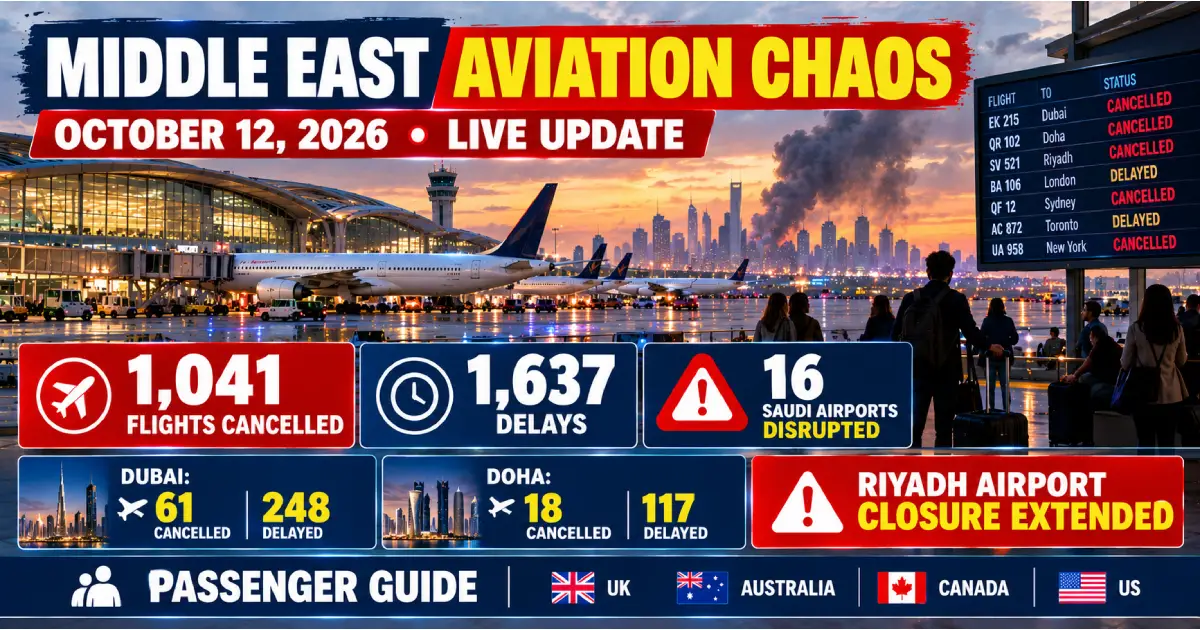
The Middle East aviation crisis reached its most severe point of the entire 2026 conflict on the weekend of October 10–12. A total of 1,041 flight cancellations and 1,637 delays have been recorded across the Arabian Peninsula, with 16 Saudi commercial airports disrupted or effectively closed. The cascade has reached beyond Saudi Arabia’s borders: Dubai International recorded 61 cancellations and 248 delays; Hamad International in Doha recorded 18 cancellations and 117 delays. The world’s busiest international aviation corridor — the Gulf airbridge connecting Europe and North America to Asia and Australasia — is operating under conditions not seen since the February 28 conflict began. This is your complete, verified, airport-by-airport and airline-by-airline breakdown of what is happening right now.
Data sourced from FlightAware, Nomad Lawyer and Gulf Business, recorded October 11 at 5:34pm ET (October 12 at 1:34am GST).
| Metric | October 10–12, 2026 |
|---|---|
| Total Middle East cancellations | 1,041 |
| Total Middle East delays | 1,637 |
| Saudi airports affected | 16 |
| Riyadh (RUH) cancellations | 291 (73% of departures — Oct 10) + ongoing Oct 11 |
| Dubai (DXB) cancellations | 61 |
| Dubai (DXB) delays | 248 |
| Doha (DOH) cancellations | 18 |
| Doha (DOH) delays | 117 |
| Riyadh disruption index | 5.0 — maximum severe |
| Crisis classification | Largest single-weekend disruption of entire 2026 conflict |
| Conflict duration | 227 days — February 28 to October 12, 2026 |
Flight disruption has been severe, with nearly three-quarters of scheduled departures at King Khalid International Airport cancelled on Sunday. The airport’s disruption index stood at 5.0, reflecting severe disruption. FlightAware data cited by Arab News showed at least 291 flights had been cancelled at the airport over the preceding 24 hours.
A disruption index of 5.0 is the maximum measurable severity on FlightAware’s scale. King Khalid International has now been struck three times in four days — October 8, October 10 and October 11. Each successive attack has found an airport still recovering from the previous one. The result is compounding disruption with no recovery window between events.
The airport’s ability to resume normal operations depends entirely on whether further strikes occur — a question that no airline, regulator or government can currently answer with confidence.
Dubai International recorded 61 cancellations and 248 delays — severe Gulf congestion and flight diversions.
Dubai’s 61 cancellations are directly attributable to two cascading effects. First, fleets and crews that were positioned for Dubai–Riyadh rotations are now grounded with nowhere to fly — removing aircraft capacity from other DXB operations. Second, passengers who were transiting Dubai to reach Saudi Arabian destinations have had their onward sectors cancelled, creating a wave of stranded transit passengers at Terminal 3.
Emirates has not formally suspended Saudi Arabia services but is conducting daily operational reviews. Its Saudi network includes Dubai–Riyadh, Dubai–Jeddah and Dubai–Dammam — three of the Arabian Peninsula’s highest-frequency routes. Any Emirates suspension would immediately add hundreds more cancellations to DXB’s already stressed schedule.
248 delays at DXB reflects the airspace congestion created when Saudi traffic is diverted, rerouted or grounded — every flight that would normally transit Saudi airspace must now take longer alternative corridors, adding fuel burn, flight time and cumulative schedule pressure across the DXB network.
Hamad International Doha recorded 18 cancellations and 117 delays — rerouted Gulf corridor flight paths.
Qatar Airways’ exposure is structural and severe. As the dominant carrier at Doha — operating one of the world’s most geographically sprawling long-haul networks — Qatar Airways cannot reroute around Saudi Arabia without significantly lengthening virtually every flight between Europe and Asia. The 18 cancellations and 117 delays at Doha represent only what is visible in current FlightAware data. The operational pressure on Qatar Airways’ scheduling team is considerably larger than these numbers suggest.
Qatar Airways also operates Doha–Riyadh, Doha–Jeddah and Doha–Dammam services — all subject to daily operational review. A formal Qatar Airways suspension of Saudi Arabia routes would double the visible disruption at Doha immediately.
Jeddah is Saudi Arabia’s second-largest airport and the primary gateway for Umrah pilgrims travelling to Mecca. The disruption has also affected religious travel, with Umrah pilgrims among those caught in the attacks and subsequent flight cancellations.
Jeddah’s disruption is particularly significant for the UK, where a large community of Muslim travellers undertake Umrah year-round. Airlines operating UK–Jeddah services include Saudi Arabian Airlines, Gulf Air, flynas, Pegasus and connection options via Emirates and Qatar Airways.
Germany’s guidance identifies Dammam airport as a recent target. King Fahd International in Dammam serves the Eastern Province — Saudi Arabia’s industrial and oil heartland — and is the primary airport for expatriates working in the petroleum sector. EASA’s formal Saudi Arabia airspace warning, issued following the October 8 A320 destruction, specifically covers Dammam as a facility at elevated risk.
In total, 16 commercial airfields across the Kingdom reported flight cancellations, creating an immediate operational void across the Arabian Peninsula.
The 12 additional affected facilities include Medina’s Prince Mohammad Bin Abdulaziz Airport, Taif Regional, Ha’il Regional, Tabuk Regional, Yanbu Airport and seven further provincial airports. Each represents a community or industrial centre that is now effectively cut off from domestic and regional air connectivity.
Saudia’s network-wide disruption has reached a level where normal operational metrics are no longer meaningful. The carrier’s Saturday data showed 162 cancellations and 108 delays — a 75%+ disruption of its entire scheduled operation. Sunday’s third consecutive attack on its home base airport means the operational picture on Monday October 12 is similarly severe.
Saudia is operating where possible on domestic Saudi routes that avoid the most exposed corridors, but its international network is effectively suspended. Passengers holding Saudia tickets to international destinations should treat those flights as cancelled for planning purposes and contact the airline for rebooking or refund.
flynas documented 89 delays and 3 cancellations with a 34% delay rate in the week before the weekend escalation. Its concentrated Saudi domestic and regional network means 100% of its operations are within or directly adjacent to the disruption zone.
Turkish Airlines continues to operate Istanbul–Riyadh and Istanbul–Jeddah services as of October 12. This makes Turkish Airlines the carrier most visibly at risk — it is operating into an airport that has now been struck five times in six days. Passengers on Turkish Airlines to Saudi Arabia should check thy.com before every departure.
Qatar Airways is conducting daily operational reviews for all Saudi destinations. Its Doha–Riyadh, Doha–Jeddah and Doha–Dammam services are the most exposed. As of October 12, these services have not been formally suspended — but the 18 cancellations and 117 delays already visible at Hamad International indicate the operational pressure is significant.
Emirates maintains Dubai–Riyadh and Dubai–Jeddah services under daily review. Its decision not to formally suspend — despite the October 8 A320 destruction and three successive weekend strikes — is operationally notable. However, the 61 cancellations and 248 delays already visible at DXB suggest the cascading impact is being absorbed by the broader Emirates operation regardless of formal suspension status.
Full carrier status table — October 12, 2026:
| Airline | Saudi Arabia Status | Based At | Exposure Level |
|---|---|---|---|
| Saudia | ⛔ Effectively suspended | RUH | Maximum |
| flynas | ⛔ Severely disrupted | RUH | Maximum |
| flyadeal | ⛔ Severely disrupted | RUH | Maximum |
| Riyadh Air | ⛔ Home base attacked | RUH | Maximum |
| Lufthansa Group | ❌ Formally suspended to Oct 16 | FRA/MUC/ZRH/VIE | Suspended |
| Turkish Airlines | ⚠️ Still operating — review daily | IST | Very High |
| Qatar Airways | ⚠️ Daily review — not yet suspended | DOH | Very High |
| Emirates | ⚠️ Daily review — not yet suspended | DXB | High |
| Gulf Air | ⚠️ Monitoring | BAH | High |
| British Airways | Nov 3 planned return — under review | LHR | Under Review |
The language of an “East–West aviation bridge” is not hyperbole. While security incidents in the Arabian Peninsula typically result in isolated air corridor detours, the weekend of October 11, 2026, ruptured the world’s most critical East–West aviation bridge, grounding 1,041 flights and triggering 1,637 delays.
Here is why this matters even if you are not flying to Saudi Arabia:
Every flight from Europe to South Asia transits Gulf airspace. London to Mumbai. Paris to Delhi. Frankfurt to Bangalore. Amsterdam to Colombo. None of these flights touch Saudi soil — but all of them depend on safe passage through the air corridors over Saudi Arabia, the UAE and Qatar.
When those corridors are compressed — when airlines must reroute around Saudi airspace restrictions, when overflight permissions become uncertain, when approach rates at Dubai and Doha are reduced because of disruption radiating from Riyadh — the delays cascade outward within hours.
The ripple effect in numbers: 1,041 direct Saudi cancellations → 61 Dubai cascade cancellations → 18 Doha cascade cancellations → hundreds of onward connections missed at every hub those passengers were transiting through → delays at London Heathrow, Frankfurt, Paris CDG, Sydney, Melbourne, Toronto, New York as inbound transatlantic and transpacific flights arrive late because their crews or aircraft were caught in the Gulf disruption.
October 12 is not just a Middle East story. It is a global aviation story.
Direct Saudi Arabia travel: Check your airline immediately. If you are flying to Saudi Arabia on any carrier through any hub, treat your flight as “at risk” until confirmed operating on the day. British Airways has not yet suspended its November 3 Riyadh return — but monitor ba.com daily. Umrah packages: check ATOL protection and your travel insurer’s war/conflict clause immediately.
Connecting through Dubai or Doha: The 61 Dubai cancellations and 18 Doha cancellations directly affect UK passengers transiting DXB or DOH for onward connections. If your connecting window at either hub is under 90 minutes today, build contingency plans. If your connection is cancelled, UK261 rights apply to your UK-departing flight — your airline must rebook you to your final destination at no extra cost.
Flying over Gulf airspace (every UK–Asia flight): Your journey time may be slightly longer as carriers make minor routing adjustments. This is unlikely to cause significant delays today but monitor your airline’s app for any schedule changes on long-haul flights to South Asia, Southeast Asia and Australasia.
Every major Australian long-haul route to Europe transits Gulf airspace. Emirates via Dubai, Qantas via Singapore with Gulf airspace transit, Qatar Airways via Doha — all three primary Australia–Europe corridor options are affected by today’s Gulf disruption.
Australia follows the US, UK and more countries to update its Saudi Arabia travel advisory. DFAT’s current advice warns against travel to King Khalid Airport specifically. If your itinerary connects through Dubai or Doha to a Saudi destination — your onward sector is at high risk.
Emirates is Australia’s most-used carrier to Europe. Dubai’s 61 cancellations and 248 delays today represent a significant operational disruption at the airport Australians use most. Monitor the Emirates app closely for any Australian service impacts.
Air Canada’s suspension of Dubai flights until March 2027 means most Canadians route through Doha (Qatar Airways) or Istanbul (Turkish Airlines) to reach the Middle East. Both hubs are showing disruption today. Doha’s 18 cancellations and 117 delays affect any Canadian passenger transiting QR services through Hamad International.
Under Canada’s APPR, if your carrier cancels any sector of your itinerary, you are entitled to rebooking to your final destination at no extra cost or a full refund.
No US carrier directly operates Saudi Arabia routes. Delta’s October 23 Atlanta–Riyadh launch is effectively cancelled. US passengers route to Saudi Arabia via Emirates (JFK, LAX, IAH, IAD to Dubai then onward), Qatar Airways (multiple US gateways via Doha) or Turkish Airlines (JFK, LAX, ORD via Istanbul).
All three carriers are operating under daily review conditions. If you hold a US-originating ticket with an onward Saudi Arabia sector through any of these carriers, contact your airline immediately. Under US DOT rules, if the airline cancels any sector of your itinerary, a full cash refund to your original payment method is available unconditionally.
| Your Departure Country | Framework | Saudi Cancellation Rights | Care Rights |
|---|---|---|---|
| United Kingdom | UK261 | Full refund OR rebooking | Meals + hotel unconditional |
| European Union | EU261 | Full refund OR rebooking | Meals + hotel unconditional |
| United States | US DOT | Full cash refund — unconditional | Voluntary (no mandate) |
| Canada | APPR | Rebooking or full refund | Meals + hotel (8hr+ delay) |
| Australia | ACL | Rebooking at no cost | Airline Conditions of Carriage |
| UAE | GCAA | Refund + rebooking | Meals + hotel |
| Qatar | QCAA | Rebooking | Qatar Airways CoC |
| Saudi Arabia | GACA | Refund + rebooking | Saudia CoC |
Extraordinary circumstances — the critical rule: A Houthi missile attack on a civilian airport is extraordinary circumstances. This removes the airline’s obligation to pay fixed cash compensation (€250–€600 under EU261/UK261). It NEVER removes your right to a full refund if the airline cancels your flight, or your care rights (meals and hotel) during a significant delay.
| Date | Event | Cancellations | Delays |
|---|---|---|---|
| Feb 28 | Crisis begins — 7 nations’ airspace closed | 1,800+ | Severe |
| Jul 16 | Abha Airport attacked | 208 | Major |
| Sept 19 | Riyadh airport missile + Aramco | Significant | Major |
| Oct 6 | Abha attack — 2 killed, 28 injured | Abha disrupted | Regional |
| Oct 7 | Riyadh — 1 killed, 8 injured | 333 at RUH | 1,692 Middle East |
| Oct 8 | Riyadh — Saudia A320 destroyed | ~300 | Severe |
| Oct 10 | Riyadh — 12 killed, 309 injured | 291 (73% of RUH) | Severe |
| Oct 11 | Riyadh — third weekend strike | 1,041 weekend total | 1,637 |
| Oct 12 | Dubai 61 cancels, Doha 18 cancels | Cascade ongoing | 248 + 117 |
The acceleration from one attack per month in the early conflict to five attacks in six days represents a qualitative shift in Houthi operational tempo targeting civilian aviation.
Posted By : Vinay
This article is provided for general informational purposes only and is based on information available at the time of publication. Travel advisories, airline schedules, airport operations, visa requirements, government regulations, and other travel-related information are subject to change without prior notice. While Travel Tourister makes reasonable efforts to verify information using official announcements, government publications, airline and airport communications, and other reliable sources, we cannot guarantee that all information remains complete, accurate, or up to date at all times. Readers should independently verify any information that may affect their travel plans with the relevant airline, airport authority, government agency, embassy, or other official source before making travel, financial, or other decisions. Travel Tourister shall not be liable for any direct or indirect loss, inconvenience, or damages arising from the use of or reliance on the information contained in this article. Nothing in this publication constitutes legal, immigration, financial, or professional travel advice. If you believe any information in this article is inaccurate or outdated, please contact our editorial team. We review all credible correction requests promptly and update our content whenever appropriate.
Lastest News
2nd Floor, 39, Above Kirti Club, DLF Industrial Area, Kirti Nagar, New Delhi, Delhi 110015



Travel Tourister is a leading Travel portal where we introduce travellers to trusted travel agents to make their journey hasselfree, memorable And happy. Travel Tourister is a platform where travellers get Tour packages ,Hotel packages deals through trusted travel companies And hoteliers who are working with us across the world. We always try to find new and more travel agents and hoteliers from every nook and corners across the world so that you could compare the deals with different travel agents and hoteliers and book your tour or hotel with the one you have chosen according to your taste and budget.
Copyright © Travel Tourister, India. All Rights Reserved

 Call
Call Enquiry