Published on : 05 Mar 2026
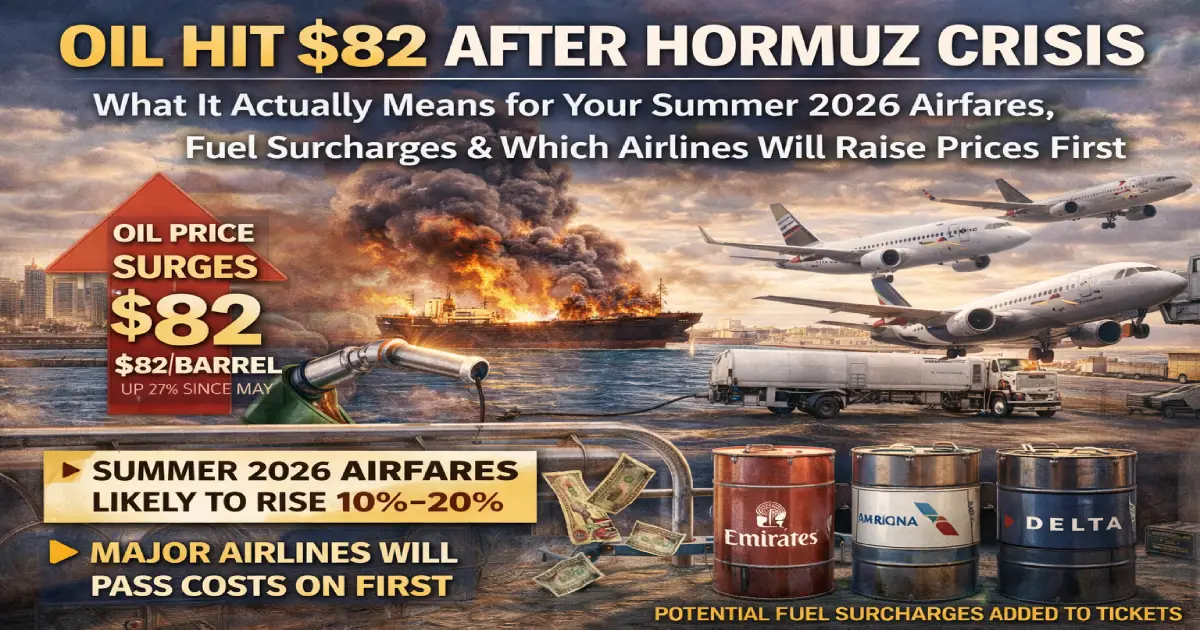
Published: March 5, 2026 Brent Crude Today: ~$82/barrel (Wednesday close) — up from $73/barrel before Operation Epic Fury Pre-Crisis Baseline: $65/barrel (Goldman Sachs fair value without disruption) WTI Today: ~$75/barrel Strait of Hormuz: Effectively closed — tanker traffic dropped from 24 ships/day to 4 (March 1); now near zero for commercial operators Goldman Sachs Scenario: 5-week disruption = $100/barrel Brent Barclays / UBS Scenario: Extended disruption = $100–$120/barrel OPEC+ Response: +206,000 barrels/day increase pledged — not enough to cover Hormuz disruption Trump Response: US Navy to escort tankers; DFC insurance offered — markets partially eased Goldman Sachs Fair Value (no disruption): $65/barrel Goldman Sachs Q2 2026 Forecast: $76/barrel average (revised up $10 — based on 5-day disruption then gradual recovery) Jet Fuel Lag: Jet fuel price increases follow crude with a 4–6 week lag Airline Fuel Cost Share: 20–35% of total operating costs (varies by carrier) Surcharge Trigger: Most European carriers raise surcharges when Brent sustains above $80–85/barrel Hedging Leaders: Ryanair (84% H1 2026 at $77/bbl) | Air France-KLM (87% 1-year) | easyJet (84% H1) | Lufthansa (76% 2025, 28% 2026) Most Exposed (unhedged): American Airlines, United Airlines — confirmed zero or minimal fuel hedging for 2026 Delta: Natural hedge via Trainer refinery in Pennsylvania Southwest: Dropped fuel hedging in 2025 after paying $157M in premiums — now fully exposed Summer 2026 Fare Impact: 6–14% price increase on unhedged transatlantic and transpacific routes if $82 oil sustains; 3–6% if Hormuz normalises within 4 weeks
Airlines have not yet put up fares for summer 2026. But their revenue management systems are running scenarios right now. The $82 Brent crude close on Wednesday — up 13% from before Operation Epic Fury — has triggered automatic repricing algorithms across every major airline’s yield management platform. The question for every traveller booking summer 2026 flights over the next two to four weeks is not whether fuel costs will rise, but how much of that cost increase airlines will push to consumers, how fast, and which routes will be hit hardest. This guide tells you exactly what $82 oil means for your summer plans, which airlines are shielded by hedges, which are fully exposed, and the five booking decisions you should make right now.
To understand what $82 oil means for your airfare, you first need to understand where it came from and where it is going.
Global benchmark Brent jumped 9%, or $6.65, to $79.45 on Sunday March 2, hitting its highest level since the US and Israel bombed Iran’s nuclear facilities in June 2025. Since then it has climbed further — Brent rose more than 1% on Wednesday, averaging out at more than $82 a barrel, while WTI crude traded just below $75.
The scale of the supply disruption driving this move is without historical precedent. About 20% of global oil consumption passes through the Strait of Hormuz. Four vessels have been hit in Gulf waters since the conflict began; with shipping companies and their insurers concerned about vessel safety, tankers are not risking passage through the strait.
Crude tanker transits through the Strait of Hormuz dropped to four vessels on Sunday, March 1, compared with an average of 24 per day since January, according to energy markets intelligence company Vortexa. By March 4, commercial transit had effectively reached zero.
Technically, the strait has not been physically blocked. However, the withdrawal of commercial operators, major oil companies, and insurers has created a de facto closure for most global shipping. Insurance premiums at six-year highs make transit economically unviable for most operators.
The Goldman Sachs roadmap: Goldman Sachs head of oil research Daan Struyven noted that without sustained supply disruptions, Goldman estimates the fair value for Brent crude to be around $65 per barrel. The current $78–$82 price point reveals exactly what traders are betting on: a disruption lasting about four weeks.
The critical variable is time. The impact on oil prices is a “convex function” of the disruption’s length. If the conflict is brief — lasting only a few days or a week — the impact on prices will be disproportionately smaller. In a short-term scenario, crude oil can simply be stored on land in Middle Eastern producing countries, delaying deliveries but leaving cumulative global supply unaffected.
Goldman Sachs raised its oil-price forecast for the second quarter, expecting Brent crude to average $10 more than before at $76 per barrel. This projection is based on five more days of very low exports via the Strait of Hormuz, and then a gradual recovery over the following month. However, they warned that if there are five weeks of disruption, the price could reach $100 for a barrel of oil.
Barclays analysts told clients that Brent could hit $100 per barrel as the security situation spirals. UBS analysts noted it is even possible the market is looking at a material disruption that sends Brent spot prices above $120 per barrel.
The partial relief: Prices eased significantly in late afternoon trading after Trump sought to reassure ship owners that they could safely transit the Strait of Hormuz. Trump said the US Development Finance Corporation will “provide, at a very reasonable price, political risk insurance and guarantees” for the financial security of all maritime trade through the Gulf. “If necessary, the United States Navy will begin escorting tankers through the Strait of Hormuz, as soon as possible,” the president said. This announcement pulled Brent back from the high-$80s toward $82.
Understanding how oil price changes translate to airfare changes requires understanding the chain of transmission between a barrel of crude in the Persian Gulf and the ticket price on your screen. The process has four steps and takes 6–14 weeks end-to-end.
Step 1 — Crude oil to jet fuel (lag: 2–4 weeks) Jet fuel is a refined petroleum product derived from crude oil. It does not price identically to crude — the “crack spread” between crude and jet fuel reflects refinery capacity, regional supply, and demand. Jet fuel disruption will follow crude price moves with a slight lag but is likely to be more persistent. Kpler’s analysts note that the Jamnagar refinery complex in India (Reliance Industries) is the primary alternative source clearing EU jet demand when Gulf refineries are constrained — but redirecting supply takes time.
Step 2 — Jet fuel contracts and hedging (lag: 0 weeks for unhedged; weeks to months for hedged) Airlines buy jet fuel through a combination of spot purchases, forward contracts, and financial hedging instruments. The price an airline pays for fuel today depends on when and how it locked in forward contracts. When an airline is well-hedged, it is less likely to implement sudden “fuel surcharges” when oil prices spike. Conversely, airlines that do not hedge are more sensitive to short-term market fluctuations, which can lead to higher volatility in airfares.
Step 3 — Revenue management repricing (lag: 1–4 weeks) When airlines’ fuel cost models update with higher jet fuel prices, their automated revenue management systems begin adjusting future fare buckets. This typically starts with forward-booking inventory for dates 30–90 days out. Summer 2026 fares for June–August are now being repriced in real time. Fares already sold at lower prices are locked in — but new bookings from today onward are increasingly priced at the higher fuel cost assumption.
Step 4 — Formal fuel surcharge adjustments (lag: 4–8 weeks after crude move) Airlines formally revise their published fuel surcharges on a regular schedule. British Airways, Lufthansa, Singapore Airlines, and most international carriers publish surcharge tables that update quarterly or when crude sustains above a trigger level. The ‘YR Carrier-imposed surcharge’ amount exceeds $2,000 on a business round-trip ticket between the US and Europe and is at €900 between Europe and North America. It usually stands for 20% to 30% of the total cost of an intercontinental ticket. If $82 oil sustains through March and April, expect formal surcharge revisions in May — hitting summer 2026 bookings made after mid-March.
The bottom line on timing: Fares for travel in May–June 2026 are being repriced RIGHT NOW in revenue management systems. Fares for July–August will follow in 2–4 weeks. Formal surcharge tables will update in April–May. Fuel represents 17–21% of US carriers’ operating costs — recent crude price spikes triggered sharp share declines in United, American, and Delta as hedging exposure remains varied.
This is the most important section for understanding which airlines will raise fares fastest. A carrier with 84% of its fuel hedged at $77/barrel is barely affected by today’s $82 oil. A carrier with zero hedging pays the full $82 — and passes as much as possible to consumers.
Ryanair Ryanair CEO Michael O’Leary said in January the company was 84% hedged at $77 per barrel for the current quarter and had hedged 80% of jet fuel requirements at about $67 per barrel for next quarter. At 84% hedged at $77, Ryanair is almost entirely shielded from today’s $82 oil through mid-2026. Its unhedged 16% exposure costs more, but the impact on total fuel spend is modest. Fare impact for you: Ryanair European routes are the least likely to see sudden fare increases. Ryanair’s hedging was specifically designed to protect its low-cost model from exactly this type of geopolitical shock.
easyJet easyJet had hedged 84% of its fuel needs for the first half of 2026 at an average cost of $715 per metric ton, 62% for the second half, and 43% for the first half of 2027. Like Ryanair, easyJet’s H1 2026 exposure is heavily covered. H2 2026 at 62% coverage leaves more exposure — expect easyJet fares to begin reflecting higher fuel costs more noticeably from September onward. Fare impact for you: Spring and early summer easyJet fares well-protected. Late summer and autumn more exposed.
Air France-KLM Air France-KLM said it had adjusted its fuel hedging policy to increase its total exposure over one year consumption to 87% from 68%, extending its hedging horizon to eight quarters from six. At 87% hedged over one year, Air France-KLM is the best-protected major network carrier. Paris CDG and Amsterdam Schiphol long-haul routes are well-insulated. Fare impact for you: Air France and KLM transatlantic and Asia fares among the most stable through summer 2026.
Lufthansa Group Lufthansa said its hedging has a horizon up to 24 months, with about 76% of forecast 2025 fuel requirement hedged and about 28% of forecast 2026 requirement covered. The 28% 2026 hedging figure is notably lower than Air France-KLM — meaning Lufthansa has significant 2026 fuel exposure. For H2 2026 specifically, Lufthansa is largely buying at spot prices. Fare impact for you: Lufthansa H1 2026 (spring) fares more stable. H2 2026 (summer) significantly more exposed to $82+ oil. Business class surcharge revisions more likely in May.
Wizz Air Wizz Air said in January it was hedging 83% of its jet-fuel needs for the year to March 2026 at a price between $681–$749 per metric tonne. Strong coverage through March. Coverage for April onward less clear.
IAG (British Airways, Iberia, Vueling, Aer Lingus) IAG’s hedging policy is among the most aggressive of European network carriers. British Airways in particular typically maintains 18–24 month forward hedging coverage. This is important for transatlantic routes. Fare impact for you: British Airways transatlantic fares relatively stable through summer 2026. BA’s YR surcharge table may still increase — but from a hedged fuel base, not spot prices.
Qantas Qantas historically hedges 70–90% of near-term fuel requirements and reduces coverage for periods further out. The airline has confirmed it will not be flying through Middle East airspace — Perth–London QF9/QF10 bypasses the region entirely via the south polar route, so routing cost is unaffected. Fuel price exposure for Qantas’s trans-Pacific and Indian Ocean routes is the main concern. Fare impact for you: Qantas summer fares (Australian winter) relatively stable in near term. Monitor for September 2026 onward as hedges roll off.
Singapore Airlines / Cathay Pacific Both carriers hedge significant portions of fuel needs. Singapore Airlines hedging ratios are typically 40–50% for 12 months forward. Cathay Pacific famously suffered catastrophic hedging losses in 2008 but has maintained more conservative hedging since. Fare impact for you: Asia-Pacific routes face genuine fuel cost pressure given exposure to Hormuz-routed fuel supply chains. Singapore and Hong Kong are among the most exposed hub cities to prolonged Gulf disruptions.
American Airlines American Airlines, Delta Air Lines, and United Airlines have not hedged their jet fuel in recent years as a deliberate strategy — a policy that paid off when oil was low but leaves all three fully exposed now. American Airlines’ share price fell sharply after Operation Epic Fury as the market repriced its fuel cost exposure. Fare impact for you: American Airlines transatlantic and transpacific routes are the most likely to see rapid fare increases. Revenue management systems are already adjusting. Summer 2026 bookings made after mid-March will increasingly reflect $82+ oil assumptions.
United Airlines Same position as American. United has minimal hedging and is fully exposed to spot jet fuel prices. Fuel represents 17–21% of US carriers’ operating costs — recent crude price spikes triggered sharp share declines in United, American, and Delta. That stock drop is the market predicting exactly what we are describing here: higher costs that will pressure either margins or fares. Fare impact for you: United transatlantic (Newark, Dulles, SFO to Europe) and transpacific routes most at risk for near-term fare increases.
Southwest Airlines Southwest Airlines recently announced it would drop its fuel hedging policy in 2025 after paying $157 million in premiums in 2024 alone, with management stating the practice was no longer economically viable. Southwest famously saved more than $4 billion through aggressive hedging between 1999 and 2008. The decision to stop hedging in 2025 now looks poorly timed. Southwest’s domestic-only US network is less exposed to international route fuel economics — but with $82 Brent permeating all jet fuel prices including domestic US, Southwest’s full spot exposure means its famously low fares face real pressure for the first time in years. Fare impact for you: Southwest domestic US summer fares — the cheapest benchmark for US leisure travel — are at risk of meaningful increases if $82+ oil sustains.
Delta Air Lines (complex — natural hedge) Delta Air Lines famously purchased its own oil refinery (Trainer Refinery) in Pennsylvania. By owning the refining process, Delta “naturally hedges” by capturing the crack spread — the difference between the price of crude oil and the refined products like jet fuel. This means Delta benefits from the increased value of refined jet fuel relative to crude when oil prices rise — partially offsetting the higher cost. Delta is neither fully protected nor fully exposed. Fare impact for you: Delta’s refinery hedge is partial — it covers Northeast US operations specifically. Delta transatlantic and transpacific routes still carry meaningful fuel cost exposure at $82 oil.
Not all routes are equally exposed to the Hormuz/oil shock. Here is where the pressure is greatest:
Transatlantic (US / Canada ↔ Europe): The most exposed routes in absolute dollar terms. A London–New York flight consumes approximately 75,000 litres of jet fuel return. At $82 Brent (vs. $65 fair value), that is roughly $1,400 in additional fuel cost per flight. Spread across 250 seats, that is $5.60 per passenger per seat — modest. But airlines facing $82 oil on every flight multiply this across their entire networks, and the margin pressure pushes up all forward pricing. Most at risk: American Airlines and United Airlines transatlantic. Both unhedged. Both repricing now. Safer bet: Air France, British Airways, KLM — all well-hedged through H1 2026.
Asia-Pacific (Australia, Japan, South Korea, India ↔ Europe/US): These routes face a double exposure: higher jet fuel prices AND longer routing due to Middle East airspace closures. Singapore Airlines, Cathay Pacific, and Qantas are all adding 60–90 minutes of flying time per flight to avoid Gulf airspace — meaning more fuel burned at every price level. Asian energy security is most exposed to the Hormuz crisis, with India and China facing acute supply risks across crude, LPG, and LNG. Singapore and Hong Kong’s proximity to Gulf-dependent fuel supply chains adds a structural vulnerability beyond just oil prices.
Gulf Hub Connections (via Dubai/Doha/Abu Dhabi): Emirates, Qatar Airways, and Etihad are currently grounded or severely restricted. When they return, their operating economics will reflect $82+ jet fuel on rerouted or fuel-tanked operations. Emirates’ decision to suspend ticket sales until March 21 is partly about managing the extraordinary fuel cost environment — it does not want to sell seats at pre-crisis fuel prices when its actual costs are dramatically higher.
Domestic US: US domestic fuel is priced off WTI crude (currently ~$75) rather than Brent. Patrick de Haan of GasBuddy estimates that the spike in crude oil prices will push US gasoline prices up by 10–30 cents on average, with some individual stations seeing prices rise as much as 85 cents. The same dynamic applies to domestic jet fuel. Domestic US fare pressure is real but less acute than transatlantic.
Intra-European: European jet fuel prices track Brent and European refinery output. At $82 Brent, European low-cost carriers face the same fuel market — but Ryanair and easyJet’s hedging buffers most of the near-term impact.
Short-haul intra-Asia and Pacific: Lower fuel burn per flight means the per-seat oil cost increase is smaller in absolute terms. Jetstar, AirAsia, IndiGo — all running short routes where fuel is a smaller absolute cost. The proportional pressure exists but the dollar amount per ticket is smaller.
Trump’s US Navy escort announcement begins moving tankers. Iranian forces stand down gradually. In a short-term scenario, crude oil can simply be stored on land in Middle Eastern producing countries, delaying deliveries but leaving cumulative global supply unaffected. Brent retreats from $82 toward $70–73 (Goldman’s Q2 fair value with short disruption). Jet fuel prices follow down with a 3–4 week lag.
Airfare impact: Summer 2026 fares increase only 2–4% above pre-crisis levels on most routes. No formal surcharge revision required. Some revenue management repricing already locked in, but airlines allow it to dissipate through competition.
What you should do: Book summer flights now — prices are still based partly on pre-crisis assumptions and you lock in before any full repricing cycle completes.
This is exactly what the current $82 oil price is implying. According to Goldman Sachs, the current $78–82 price point reveals what traders are betting on: a disruption lasting about four weeks. Brent averages $76/barrel in Q2 (Goldman’s revised forecast). Formal surcharge revisions hit in April–May for H2 2026 departures.
Airfare impact: Summer 2026 transatlantic fares on unhedged US carriers (American, United, Southwest) rise 6–10%. European carriers with strong hedges (Air France-KLM, IAG, Ryanair, easyJet) see smaller increases of 2–4%. Long-haul Asia-Pacific routes (Singapore, Cathay, Qantas) see 5–8% increases due to combined fuel cost + routing detour pressure.
What you should do: Book transatlantic and Asia-Pacific summer flights within the next 2 weeks — before formal surcharge revisions hit in April. The window between now and April 15 is the last period when published fares still partly reflect pre-crisis fuel assumptions.
Goldman Sachs warned that if there are five weeks of disruption from the Strait of Hormuz, the price could be as high as $100 for a barrel of oil. At $100 Brent, the economics of aviation change structurally. Formal fuel surcharge increases become unavoidable across all carriers. Hedged airlines begin exhausting their forward cover. Revenue management repricing becomes aggressive.
Airfare impact: Summer 2026 transatlantic fares on unhedged carriers rise 12–18%. Even hedged European carriers see 5–8% increases as forward cover is consumed. Long-haul leisure routes (Australia–UK, US–Southeast Asia) see 10–15% fare increases. Budget carrier route networks begin to shrink as marginal routes become unprofitable.
What you should do: Book summer travel immediately. At $100+ oil, waiting means materially higher fares. Lock in now, even at prices that feel high, because the alternative is worse. Consider travel insurance with “cancel for any reason” coverage.
UBS analysts noted it is even possible that the market is looking at a material disruption that sends Brent spot prices above $120 per barrel. This scenario requires sustained military action, significant damage to Saudi/UAE production facilities, or prolonged Iranian port strikes. At $120 oil, the aviation industry enters crisis territory similar to 2008 — when $147 oil caused airline bankruptcies and mass route cancellations.
Airfare impact: Catastrophic. Summer 2026 as a travel season would be partially lost. Fuel surcharges would exceed $500 per person on transatlantic routes. Multiple carriers would suspend unprofitable routes. The leisure travel market would contract sharply.
What you should do: If this scenario materialises, book refundable fares only and carry comprehensive travel insurance.
Most travellers do not know that a significant portion of their airline ticket is classified as a “fuel surcharge” — and that surcharge does not behave the way the name implies.
The renamed ‘YR Carrier-imposed surcharge’ amount exceeds $2,000 on a business round-trip ticket between the US and Europe and is at €900 between Europe and North America. It usually stands for 20%–30% of the total cost of an intercontinental ticket.
The dirty secret of fuel surcharges: When airlines first introduced fuel surcharges in 2004, these surcharges were intended to offset a proportion of the airlines’ increased fuel costs above a threshold price for a barrel of oil. But the system is no longer transparent. The variation in surcharges has not followed the price evolution of a barrel of oil for many years.
In other words: airlines raised surcharges when oil went up, but did not lower them when oil went down. The “fuel surcharge” became a permanent revenue line that bears no consistent relationship to actual fuel prices.
What this means for you right now: When airlines say they are “adding a fuel surcharge” in response to $82 oil, they are adding to an already high baseline. The new charge is largely opaque — you will see total fare increases, not itemised fuel surcharge line items, in most booking systems.
Which airlines show fuel surcharges explicitly:
Points and miles bookings: Award tickets booked with Avios, Aeroplan, Velocity Points, or other loyalty currencies typically still require payment of fuel surcharges (YQ/YR). If oil stays at $82+, expect the cash surcharge component of award tickets to increase when airlines update their surcharge tables in April–May. Book award travel before these revisions if possible.
Based on everything above, here are the five most time-sensitive actions for travellers planning summer 2026:
Decision 1 — Book transatlantic on European carriers, not US carriers Air France, KLM, British Airways, and Iberia are 76–87% hedged for H1 2026. American and United are at or near zero hedging. The same London–New York or Paris–Chicago route will be repriced significantly faster on US carriers than on their European competitors. For summer travel on the North Atlantic, book a hedged European carrier today.
Decision 2 — Book summer flights before April 15 The formal surcharge revision cycle typically runs quarterly. Most airlines will update their summer 2026 fuel surcharge tables in April for fares sold from that point. Booking before April 15 locks in prices based on partially pre-crisis assumptions in at least some fare buckets.
Decision 3 — Consider flying via non-Gulf hubs Every additional hour of flying on a rerouted Gulf-avoiding flight is additional fuel cost. Routes connecting through London, Paris, Frankfurt, Zurich, or Tokyo add no Middle East routing premium. Routes connecting through Dubai (when it reopens) or Doha face continued uncertainty and potential reroutings into late 2026.
Decision 4 — Book refundable fares or buy “cancel for any reason” travel insurance The $100 oil scenario (20% probability) would likely trigger fare spikes significant enough to make cancelling a cheaper option than flying. If you are booking summer flights now at $82-oil-influenced prices and the conflict resolves, you want the option to rebook at lower post-resolution prices. Refundable fares or CFAR insurance gives you that optionality.
Decision 5 — Pay attention to budget carrier route announcements in April If $82+ oil sustains, expect some marginal European and Asia-Pacific routes to be quietly dropped from summer 2026 schedules in April. Ryanair, Wizz Air, and easyJet may drop routes where fuel cost + surcharge makes the economics impossible at leisure fare levels. Check that your specific budget carrier route is still scheduled before booking non-refundable accommodation at the destination.
The complete halt of oil flows through the Strait of Hormuz is unprecedented. “We have not seen anything like this in pretty much the history of the Strait of Hormuz,” says Claudio Galimberti, chief economist at Rystad Energy.
Brent crude at $82 represents a $17 premium above Goldman Sachs’s pre-crisis fair value of $65. That premium will bleed into jet fuel prices over the next 4–6 weeks and into published airfare surcharges over 6–12 weeks. The carriers most exposed — American Airlines, United Airlines, Southwest Airlines — have no hedging buffer. The carriers most protected — Ryanair, easyJet, Air France-KLM — are substantially shielded through H1 2026.
For travellers: the window between now and April 15 is the booking sweet spot. Revenue management repricing has begun but has not yet been formalised into new surcharge tables. Book hedged European carriers for summer transatlantic travel. For Asia-Pacific routes, book before routing detour costs are permanently embedded. For US domestic travel, note that Southwest’s decision to stop hedging in 2025 leaves the defining benchmark of low-cost US fares more exposed to $82 oil than at any time in the company’s modern history.
Watch two things in the next two weeks: whether Trump’s Navy escort programme gets tankers moving through Hormuz again (the scenario that pulls oil back toward $73–76 and limits fare damage), and whether Goldman’s five-week disruption threshold — which triggers $100 oil — is breached. Those two data points will determine whether your summer 2026 holiday costs 6% more or 18% more than last year.
Posted By : Vinay
Lastest News
2nd Floor, 39, Above Kirti Club, DLF Industrial Area, Kirti Nagar, New Delhi, Delhi 110015



Travel Tourister is a leading Travel portal where we introduce travellers to trusted travel agents to make their journey hasselfree, memorable And happy. Travel Tourister is a platform where travellers get Tour packages ,Hotel packages deals through trusted travel companies And hoteliers who are working with us across the world. We always try to find new and more travel agents and hoteliers from every nook and corners across the world so that you could compare the deals with different travel agents and hoteliers and book your tour or hotel with the one you have chosen according to your taste and budget.
Copyright © Travel Tourister, India. All Rights Reserved

 Call
Call Enquiry