Published on : 25 Dec 2025
BREAKING TRAVEL NEWS
Published: December 25, 2025 | Updated: December 25, 2025 | Reading Time: 16 minutes
By: Travel Tourister News Desk
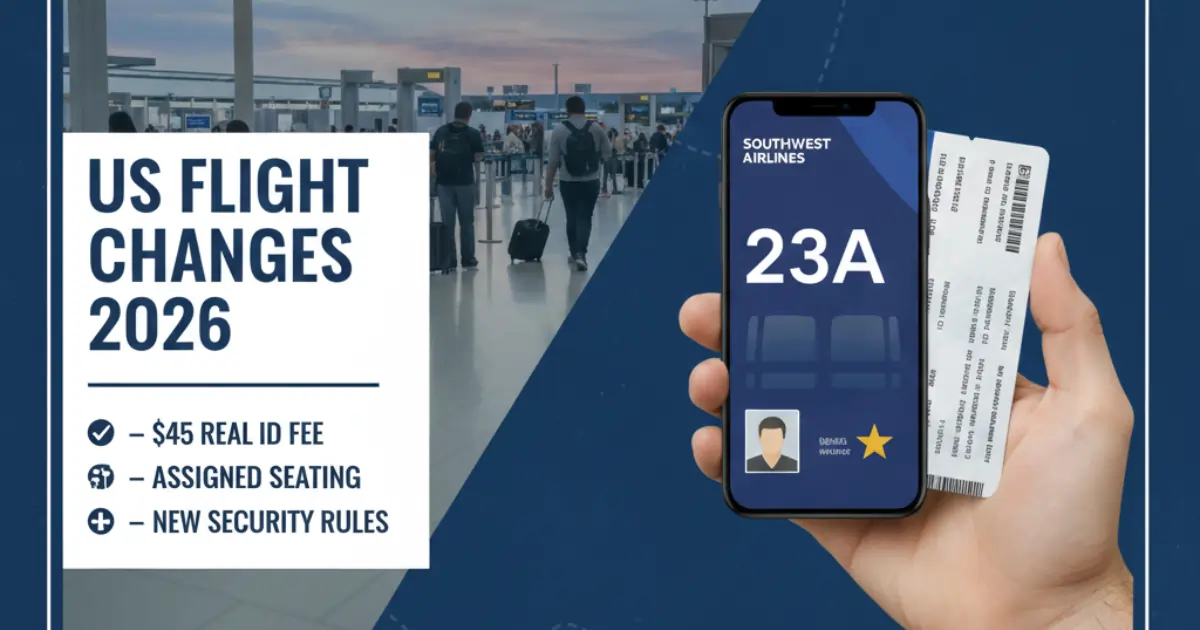
WASHINGTON, D.C. — American air travel is undergoing its most significant transformation in decades as multiple new rules take effect in January and February 2026. From a controversial $45 TSA fee for travelers without Real ID to Southwest Airlines’ historic end of open seating, passengers face a fundamentally different airport experience in the new year. With the TSA reporting that 6% of travelers—approximately 140 million passengers annually—still lack compliant identification, industry experts warn of unprecedented chaos at security checkpoints if travelers don’t prepare now.
Pro Tip: If your driver’s license doesn’t have a ⭐ star symbol in the upper corner, you’ll pay $45 every time you fly starting February 1, 2026—or risk being denied boarding entirely. Get your Real ID NOW or use a U.S. passport.
Starting February 1, 2026, the Transportation Security Administration will charge travelers without Real ID-compliant identification a non-refundable $45 fee to verify their identity through a new system called TSA Confirm.ID.
| Aspect | Details |
|---|---|
| Effective Date | February 1, 2026 |
| Fee Amount | $45 (non-refundable) |
| Originally Proposed | $18 (increased due to higher costs) |
| Coverage Period | 10 days from first flight |
| Age Requirement | 18 years and older |
| Processing Time | 10-30 minutes at airport |
| Guarantee | NO—payment doesn’t guarantee approval |
| Refund Policy | None if verification fails |
| Payment Options | Online before travel or at airport kiosks |
How TSA Confirm.ID Works:
Critical Warning: TSA officials emphasized that paying the $45 fee does NOT guarantee successful identity verification. If your identity cannot be confirmed, you will be denied entry to the secure area and unable to board your flight—with NO refund.
Pro Tip: TSA’s Adam Stahl, senior official performing deputy administrator duties, stated: “This fee ensures the cost to cover verification of an insufficient ID will come from the traveler, not the taxpayer.” Currently, 94% of passengers are already compliant, but that still leaves approximately 140 million travelers annually who may face this fee.
| ID Type | Notes | Where to Get |
|---|---|---|
| Real ID Driver’s License | Look for ⭐ star symbol | State DMV ($45 one-time fee) |
| U.S. Passport | Most versatile option | U.S. Passport Agency |
| U.S. Passport Card | Border crossings & domestic flights | U.S. Passport Agency |
| Global Entry Card | NEXUS, SENTRI, FAST | DHS Trusted Traveler Programs |
| Military ID | Active duty, retirees, dependents | Department of Defense |
| Permanent Resident Card | Green card | USCIS |
| Enhanced Driver’s License | MI, MN, WA, VT, NY | State DMV |
| Tribal ID (Enhanced) | Federally recognized tribes | Tribal authorities |
| Digital ID | Apple/Google/Samsung Wallet | Participating states only |
15 States Now Accepting Digital IDs:
Digital ID Features:
Pro Tip: Even if you have a Real ID, carry your U.S. passport as backup when flying. Lost or stolen IDs happen, and the $45 fee plus potential flight delays could ruin your trip. A passport eliminates all uncertainty.
Real ID is a federally mandated form of identification established after the September 11, 2001 terrorist attacks to standardize state-issued IDs and make them more difficult to counterfeit.
Visual Identification:
| Date | Milestone |
|---|---|
| 2005 | Real ID Act passed by Congress |
| 2008 | Original implementation date (delayed) |
| 2020-2023 | Multiple deadline extensions due to state pushback |
| May 7, 2025 | Official enforcement begins |
| January 2026 | Strict compliance expected nationwide |
| February 1, 2026 | $45 fee takes effect |
| May 5, 2027 | Complete enforcement—no warnings or grace periods |
Documents Typically Required:
Cost: Most states charge $30-$65 (varies by state) Processing Time: Same day at DMV in most states Validity: Typically 4-8 years depending on state
Pro Tip: Make a DMV appointment online ahead of time. Walk-in wait times can exceed 3 hours in major cities. Bring ALL required documents—missing even one means you’ll have to return and pay another application fee.
After 50+ years of open seating, Southwest Airlines is making its most dramatic policy change ever.
What’s Changing:
| Current System | New System (Jan 27, 2026) |
|---|---|
| Open seating | Assigned seats |
| A/B/C groups with numbers | Numbered groups 1-8 |
| Rush to board early | Select seat at booking |
| Position determines choice | Fare class determines options |
| No seat fees | Varies by fare type |
New Fare Structure with Seat Options:
| Fare Type | Seat Options | Cost |
|---|---|---|
| Standard | Standard seat assignment | Base fare |
| Preferred | Front cabin, early boarding | Base + premium |
| Extra Legroom | Exit rows, bulkhead seats | Base + premium |
What Stays the Same:
Updated “Customer of Size” Policy:
Previously, Southwest allowed customers needing extra space to discuss seating needs with gate agents on travel day and receive complimentary additional seats.
Under the new policy, details are still being finalized, but Southwest has indicated they will continue accommodating passengers who need extra space—the process will just work differently with assigned seating.
Pro Tip: Southwest Executive Vice President Tony Roach called this change part of the company’s “evolution” to give customers “more choice and greater control.” However, industry analysts note this likely reflects pressure to generate ancillary revenue like competitors United, Delta, and American, which collectively earned $7+ billion from baggage and seat fees in 2025.
1. Stricter Personal Item Enforcement
For years, travelers used oversized backpacks and totes as “personal items” to avoid baggage fees. In 2026, airlines are cracking down.
| Airline | Personal Item Dimensions | Enforcement Level |
|---|---|---|
| United | 9″ x 10″ x 17″ | High—sizing boxes at gates |
| American | 18″ x 14″ x 8″ | High—visual inspection |
| Delta | 18″ x 14″ x 8″ | High—charging at gate if oversized |
| Southwest | 18.5″ x 8.5″ x 13.5″ | Moderate—warnings first |
Gate Agent Checks Increasing:
Pro Tip: Use a structured bag that maintains its shape. Don’t stuff it to bursting. A personal item that’s obviously oversized will get flagged, and gate fees ($35-$65) are higher than checking bags at ticket counter ($30-$50).
2. Lithium Battery Restrictions Tightened
| Item | Carry-On | Checked Bag | Limits |
|---|---|---|---|
| Phone/Laptop Batteries | ✅ Allowed | ❌ Prohibited | Must be in device or case |
| Power Banks | ✅ Allowed | ❌ Prohibited | Under 100Wh (27,000mAh) |
| Spare Batteries | ✅ Allowed | ❌ Prohibited | Protected from short circuit |
| E-cigarettes/Vapes | ✅ Allowed | ❌ Prohibited | Cannot be used on plane |
| Large Power Banks | ⚠️ Airline approval | ❌ Prohibited | 100-160Wh require approval |
Why This Matters: Fire risk from lithium batteries in cargo holds is a major safety concern. TSA is now using advanced scanners that easily detect batteries. If found in checked luggage, your bag will be pulled and you may miss your flight.
Pro Tip: Remove all power banks, spare batteries, and vapes from checked bags. Pack them in carry-on with terminals protected (original packaging or plastic cases work best). One short circuit can cause a fire that grounds the entire aircraft.
One of the most welcome changes: TSA reversed its longstanding shoe removal requirement in July 2025.
What Changed:
Why the Change: Modern CT (computed tomography) scanners deployed at major airports can detect threats without shoe removal. This technology was the missing piece that finally made the policy reversal possible.
Pro Tip: Despite the rule change, airport staff report travelers are still automatically removing shoes, then being told to put them back on—creating bottlenecks. Keep shoes on unless specifically instructed otherwise.
New 3D scanners allow passengers to:
Availability: Currently at select lanes in major airports. Check signage or ask TSA officer before assuming you can leave items in bag.
Despite advanced scanners, the classic 3-1-1 rule remains:
3.4 Ounces (100ml): Each liquid/gel/aerosol container must be 3.4 oz or less 1 Quart Bag: All containers must fit in one clear, quart-sized plastic bag 1 Bag per Person: Only one bag allowed per traveler
Exceptions:
Pro Tip: International standard is 100ml—use 3.4 oz limit to avoid confusion between U.S. and international standards. Many travelers are caught with 4 oz bottles that are actually compliant (4 oz = 118ml) but look too large to security.
| Food Type | Status | Notes |
|---|---|---|
| Solid Foods | ✅ Allowed | Sandwiches, wraps, baked goods, fruit, candy |
| Packaged Snacks | ✅ Allowed | Chips, granola bars, trail mix, sealed foods |
| Soups & Stews | ❌ Not Allowed | Considered liquid |
| Yogurt & Pudding | ❌ Not Allowed | Must follow 3-1-1 rule (3.4 oz or less) |
| Peanut Butter | ❌ Not Allowed | Spreadable = liquid by TSA definition |
| Salsa & Dips | ❌ Not Allowed | Large containers prohibited |
| Frozen Foods | ⚠️ Conditional | Allowed if completely frozen at checkpoint |
Rule of Thumb: If it can splash, spill, or spread, TSA treats it as liquid.
Pro Tip: Bringing food from home can save $50-$100 on airport dining for families. Pack solid foods and buy drinks after security. Airport water fountains are free, and most have bottle-filling stations.
In September 2025, the Trump administration dropped a Biden-era plan that would have required airlines to provide automatic cash compensation for significant flight delays caused by issues within the carrier’s control.
What Was Proposed (Now Cancelled):
Current Reality (2026):
What You Still Have Rights To:
Pro Tip: Travel insurance has become essential in 2026. Squaremouth, a leading travel insurance comparison site, reports uptick in policy purchases following the compensation rule rollback. Look for policies covering trip delays, interruptions, cancellations, medical emergencies, and lost luggage. Budget $100-$300 per person depending on trip value.
New Routes Launching:
New Aircraft: 787-9P “Flagship Suite” Dreamliners
Free Wi-Fi Expansion:
Pro Tip: American Airlines will offer free Wi-Fi on more flights than any other domestic carrier starting January 2026. Sign up for AAdvantage before your flight (takes 5 minutes) to access complimentary internet at 35,000 feet.
Launched October 12, 2025, the European Union’s new biometric entry/exit system is replacing traditional passport stamps.
Key Details:
| Aspect | Information |
|---|---|
| Launch Date | October 12, 2025 (rolling deployment) |
| Full Implementation | April 10, 2026 |
| Who It Affects | All non-EU visitors to Schengen Area |
| Data Collected | Fingerprints, facial images, entry/exit dates |
| Purpose | Enhanced security, faster border processing |
| Passport Stamps | Being phased out (digital record instead) |
What This Means for Americans:
ETIAS Coming 2027: Europeans Travel Information and Authorization System (similar to U.S. ESTA) requires €20 authorization valid 3 years. Expected launch late 2026 or early 2027.
Pro Tip: The end of passport stamps is disappointing for travelers who collected them as souvenirs. Some European tourist offices are creating unofficial “tourist stamps” as mementos—ask at visitor centers if this matters to you.
EU, EEA, and Swiss citizens can no longer use national ID cards to enter the UK—valid passports now required. However, those with settled or pre-settled status can use biometric ID cards until December 31, 2025.
Budget airlines like Norse, French Bee, Play, and Icelandair are defining the price floor, with average fares from U.S. to Europe holding around $550-$650 roundtrip.
Impact:
Pro Tip: Airports producing cheapest international fares: EWR (Newark), JFK (New York), BOS (Boston), ORD (Chicago), LAX (Los Angeles). Consider positioning flights to these hubs for substantial savings.
Airlines adjust fares multiple times daily using artificial intelligence. Deals appear and disappear within hours.
Traveler Response:
U.S. airlines earned over $7 billion in baggage revenue alone in 2025, with figure expected to rise in 2026.
Traveler Adaptation:
Pro Tip: Travel credit cards offering free checked bags (Chase Sapphire Reserve, American Express Platinum, airline co-brand cards) can save families $200-$400 per trip. Annual fees often pay for themselves in baggage fee savings alone.
Remote work and flexible schedules have reduced peak season price gaps. Secondary European and Asian cities offer strong value nearly year-round.
Trending Destinations with Year-Round Value:
| Program | Annual Cost | Benefits | Processing Time |
|---|---|---|---|
| TSA PreCheck | $78 (5 years) = $15.60/year | Keep shoes/belt/jacket on; leave laptop/liquids in bag; dedicated lanes at 230+ airports | 3-5 minutes typical |
| CLEAR Plus | $189/year | Biometric verification, skip ID check line, partner with PreCheck for full benefits | 1-3 minutes typical |
| Global Entry | $100 (5 years) = $20/year | Includes TSA PreCheck, expedited customs re-entry to U.S., kiosks at major airports | 5-10 minutes typical |
| Mobile Passport | FREE | Expedited customs at select airports, submit via app | 10-15 minutes typical |
Pro Tip: Global Entry is the best value if you travel internationally even once per year. At $100 for 5 years ($20/year), it includes TSA PreCheck AND expedited customs processing. Many premium credit cards reimburse the application fee, making it essentially free.
Check Your ID:
Book Travel:
Pack Smart:
Document Verification:
Airport Arrival:
Without Real ID or Acceptable Alternative:
Worst Case: You’re denied verification, miss your flight, lose both ticket cost and $45 fee, and cannot fly domestically until you obtain compliant ID.
Pro Tip: TSA emphasizes that payment does NOT guarantee clearance. If traveling for crucial events (weddings, funerals, business meetings, cruises), do NOT risk flying without Real ID or passport. The consequences are too severe.
Roy Remington, Deputy Director, Pensacola International Airport:
“The only thing constant in aviation is change. We can’t control the pace of technological progress, and we’ll never control the wind.”
Joanne Magley, Director of Marketing, Daytona Beach International Airport:
“It has felt slightly busier than a typical year in terms of updates that affect passengers. Some of the churn is typical when there’s a federal leadership transition.”
Bobby Laurie, Travel Expert & Former Flight Attendant:
“I think one of the biggest changes was in September, the Trump administration dropped a Biden-era plan that would have required airlines to provide cash compensation for significant flight delays. As a result, there is no federal rule mandating that airlines pay passengers for delays caused by issues within the carrier’s control.”
Sarah Silbert, Points Path:
“One of the biggest shakeups in the travel industry this year comes from Southwest Airlines ending that longstanding perk [free checked bags] and has now joined the ranks of other major U.S. airlines by introducing hefty checked bag fees.”
Pro Tip: Industry experts unanimously agree: 2026 represents a turning point in U.S. air travel. The combination of mandatory Real ID, new fee structures, technology implementation, and policy reversals creates the most significant shift since post-9/11 security changes. Preparation is no longer optional—it’s essential.
You’ll be charged a non-refundable $45 fee to use TSA’s Confirm.ID identity verification system. This process takes 10-30 minutes and requires biometric verification, personal information validation, and knowledge-based questions. However, payment does NOT guarantee you’ll be cleared to fly. If your identity cannot be verified, you’ll be denied boarding and lose your $45 plus your flight ticket cost. The fee covers a 10-day travel window from your first flight.
Only if it’s Real ID compliant (look for the ⭐ star symbol). Regular driver’s licenses without the star are no longer acceptable for domestic flights without paying the $45 Confirm.ID fee. You can alternatively use a U.S. passport, passport card, military ID, Global Entry card, permanent resident card, or enhanced driver’s license from MI, MN, WA, VT, or NY.
Most states charge $30-$65 for a Real ID driver’s license, which is often just a one-time $30-$45 upgrade fee on top of your regular renewal cost. This is significantly cheaper than paying $45 every time you fly. The Real ID is typically valid for 4-8 years depending on your state. You’ll need to bring proof of identity (birth certificate/passport), Social Security card, and two proofs of residency to your DMV appointment.
Southwest hasn’t announced dramatic price increases, but the airline will now offer three fare types with different seat options: Standard (basic assigned seat), Preferred (front cabin/early boarding), and Extra Legroom (exit rows/bulkhead). This mirrors competitors’ pricing strategies. Expect to pay $15-$50 extra for preferred seating, similar to other airlines. The change takes effect January 27, 2026, ending Southwest’s 50+ year tradition of open seating.
No automatic compensation is required by law. The Trump administration cancelled the Biden-era rule that would have mandated $200-$755 payments for controllable delays. Each airline sets its own policy—some offer meal vouchers or hotel accommodations, others offer nothing. You are entitled to a full refund only if your flight is CANCELLED, not delayed. Travel insurance is now essential to cover delay costs.
Digital IDs from Apple Wallet, Google Wallet, and Samsung Wallet are accepted at 250+ TSA checkpoints as of December 2025, but only from 15 participating states (AZ, CA, CO, FL, GA, HI, IA, KY, MD, MS, OH, OK, TX, UT, VT). iPhone users can create a digital ID using a U.S. passport even in non-participating states. However, not all airports support digital IDs yet, so always carry physical ID as backup.
It depends on which scanner lane you use. Traditional scanners still require laptop/liquid removal. New CT (computed tomography) scanners at select lanes in major airports allow you to leave everything in your bag. Check the signage at your checkpoint or ask a TSA officer. The 3-1-1 liquid rule (3.4 oz containers in one quart bag) still applies at most checkpoints.
If you have no acceptable ID, you’ll pay the $45 Confirm.ID fee and undergo additional verification. However, TSA recommends arriving at least 2-3 hours early in this situation as the process takes time and approval isn’t guaranteed. If you have time before your flight, some states offer emergency temporary licenses. Always travel with backup ID (credit card with photo, employee badge) to help verification, though these aren’t officially accepted for boarding.
NO. Lithium battery power banks, spare batteries, and e-cigarettes are PROHIBITED in checked luggage due to fire risk. They must be in carry-on bags only, and batteries must be protected from short circuits (keep in original packaging or plastic case). Power banks under 100Wh (approximately 27,000mAh) are allowed in carry-on. Larger power banks (100-160Wh) require airline approval. TSA will pull checked bags containing batteries and you may miss your flight.
YES. With stricter enforcement, longer security lines due to Real ID confusion, and increased checkpoint screening, expedited programs save significant time. TSA PreCheck ($78/5 years = $15.60/year) lets you keep shoes/belt/jacket on and leave laptops in bags. Global Entry ($100/5 years = $20/year) includes TSA PreCheck PLUS expedited customs re-entry, making it the better value for international travelers. Many premium credit cards reimburse the application fee.
Southwest is ending its signature open seating policy on January 27, 2026. The new system includes assigned seating with three fare types: Standard, Preferred, and Extra Legroom. The boarding process changes from A/B/C groups with numbers to numbered groups 1-8. Southwest will still offer two free checked bags for credit card holders and A-List status members, maintaining this key differentiator from competitors.
No. Children under 18 do NOT need ID when traveling with an adult within the United States. The adult accompanying them must have acceptable identification (Real ID, passport, etc.). However, international travel requires children to have their own passports regardless of age. Always carry birth certificates for children when traveling in case age verification is needed.
Latest Updates:
Official Resources:
Disclaimer: Travel regulations change frequently. Always verify current requirements with official government sources (TSA.gov, DHS.gov) and your airline before traveling.
Information compiled from: Transportation Security Administration, Department of Homeland Security, Southwest Airlines, American Airlines, United Airlines, Delta Air Lines, U.S. Passport Agency, aviation industry experts, and airport authority announcements.
Last Updated: December 25, 2025 at 12:00 PM EST
Posted By : Vinay
This article is provided for general informational purposes only and is based on information available at the time of publication. Travel advisories, airline schedules, airport operations, visa requirements, government regulations, and other travel-related information are subject to change without prior notice. While Travel Tourister makes reasonable efforts to verify information using official announcements, government publications, airline and airport communications, and other reliable sources, we cannot guarantee that all information remains complete, accurate, or up to date at all times. Readers should independently verify any information that may affect their travel plans with the relevant airline, airport authority, government agency, embassy, or other official source before making travel, financial, or other decisions. Travel Tourister shall not be liable for any direct or indirect loss, inconvenience, or damages arising from the use of or reliance on the information contained in this article. Nothing in this publication constitutes legal, immigration, financial, or professional travel advice. If you believe any information in this article is inaccurate or outdated, please contact our editorial team. We review all credible correction requests promptly and update our content whenever appropriate.
Lastest News
2nd Floor, 39, Above Kirti Club, DLF Industrial Area, Kirti Nagar, New Delhi, Delhi 110015



Travel Tourister is a leading Travel portal where we introduce travellers to trusted travel agents to make their journey hasselfree, memorable And happy. Travel Tourister is a platform where travellers get Tour packages ,Hotel packages deals through trusted travel companies And hoteliers who are working with us across the world. We always try to find new and more travel agents and hoteliers from every nook and corners across the world so that you could compare the deals with different travel agents and hoteliers and book your tour or hotel with the one you have chosen according to your taste and budget.
Copyright © Travel Tourister, India. All Rights Reserved

 Call
Call Enquiry