Published on : 02 Apr 2026
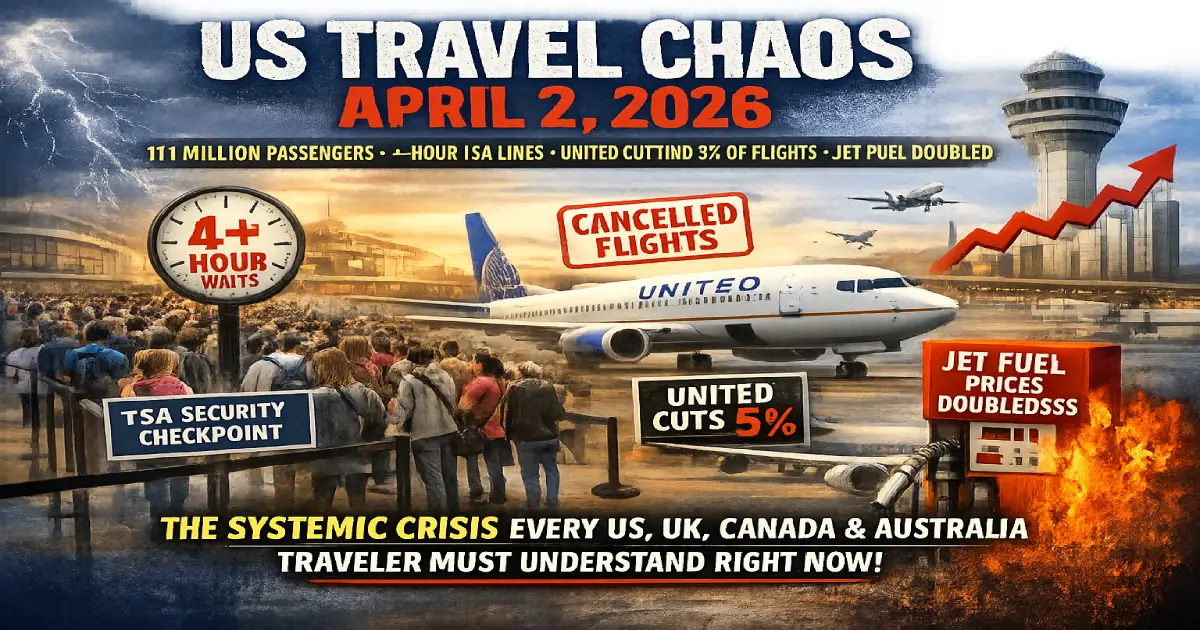
Breaking: US air travel is experiencing its most severe systemic crisis outside of the pandemic. Four separate emergencies have converged simultaneously in April 2026 — a 47-day DHS government shutdown leaving 50,000 TSA officers working without pay, record spring break volumes of 171 million passengers, jet fuel prices that have more than doubled following the Strait of Hormuz closure, and a cascading regional airline collapse threatening small-city air service across America. Transportation Secretary Sean Duffy has warned Congress: “If a deal isn’t cut, you’re going to see what’s happening today look like child’s play.” Here is everything every traveler needs to know right now.
Published: April 2, 2026 DHS Shutdown Duration: 47 consecutive days — TSA officers unpaid since February 14 Spring Break Passenger Volume: 171 million (March–April) — record high, up 4% year-on-year Daily Passengers: 2.8 million per day — highest ever recorded Jet Fuel Price Surge: $2.17 → $4.57 per gallon — more than doubled in 3 weeks United Airlines Capacity Cut: ~5% of Q2–Q3 2026 flights — red-eyes, midweek, Dubai, Tel Aviv suspended TSA Officers Resigned: 500+ since shutdown began Worst Single-Day US Disruptions (March 28): 4,495 total — 223 cancellations + 4,272 delays Republic Airways Status: Worst cancellation rate of any US carrier — second bankruptcy or liquidation being discussed
This is not a bad weather week. This is not a single airline’s operational failure. What US air travel is experiencing in April 2026 is a structural breakdown caused by four independent crises colliding with the busiest travel season in American aviation history.
Each crisis alone would be manageable. Together, they are overwhelming a system that was already operating with almost no slack.
The Department of Homeland Security partial shutdown began on February 14, 2026, after Congress failed to reach a funding deal. TSA officers — classified as essential employees — are legally required to report to work regardless. They are doing so without receiving pay.
The financial strain on TSA’s workforce is now translating directly into the travel experience of millions of passengers.
The hard numbers:
What this means at the checkpoint:
Acting Deputy TSA Administrator Adam Stahl warned: “It’s not hyperbole to suggest that we may have to quite literally shut down airports — particularly smaller ones — if callout rates go up.”
House Speaker Mike Johnson acknowledged airports “are reaching a breaking point.”
The CEOs of American Airlines, United Airlines, Delta, Southwest, JetBlue, Alaska Air, FedEx and UPS sent a rare joint open letter to Congress demanding the shutdown end. The letter stated: “Too many travelers are having to wait in extraordinarily long and painfully slow lines at checkpoints.”
What UK, Canadian and Australian travelers need to know:
If you are connecting through a US airport — particularly Houston, Atlanta, or New York — your connection buffer may no longer be adequate. What used to be a standard 60–90 minute domestic connection is now a high-risk itinerary. Build a minimum 3-hour connection window at any major US hub until the shutdown ends.
The spring travel surge that began in early March and runs through April 30 is shaping up as the busiest two-month period in American aviation history.
The numbers:
In a normal year, this level of demand would stretch airport and airline operations to their limits. In 2026, it is hitting a system already compromised by the TSA staffing crisis, rising fuel costs, and fragile regional carrier operations.
The cascading effect:
When a single checkpoint slows due to staffing — which is happening daily at multiple airports — passengers miss flights. Those passengers require rebooking onto already-full aircraft. This forces airlines to hold gate departures, placing aircraft out of position for their next rotation. Delays compound through the afternoon and evening across every hub and spoke in the network. What started as a 45-minute security queue at Houston Hobby at 7 AM can become a 3-hour departure delay at Dallas Fort Worth by noon.
On February 28, 2026, US military operations in Iran effectively closed the Strait of Hormuz — the narrow waterway through which roughly one-fifth of the world’s oil supply passes. The impact on aviation fuel has been immediate and severe.
The price collapse in numbers:
What United Airlines CEO Scott Kirby said in his staff memo:
“The reality is, jet fuel prices have more than doubled in the last three weeks. If prices stayed at this level, it would mean an extra $11 billion in annual expense just for jet fuel. For perspective, in United’s best year ever, we made less than $5 billion.”
United Airlines — the first major US carrier to formally announce capacity cuts — is reducing approximately 5% of its planned Q2 and Q3 2026 schedule. The cuts break down as follows:
✈️ ~3% from off-peak flying — red-eye flights, Tuesday/Wednesday/Saturday departures ✈️ ~1% from Chicago O’Hare — FAA-mandated capacity reductions already in place ✈️ ~1% from suspended international routes — Dubai and Tel Aviv suspended entirely
United expects to restore its full schedule by fall 2026. The airline is not furloughing staff, delaying aircraft orders, or cancelling its 120 planned deliveries including 20 Boeing 787s this year.
Other carriers responding:
What this means for airfares:
US domestic fares have surged from a pre-conflict average of $167 to $414 on many transcontinental routes — a 148% increase. International routes to Asia-Pacific are seeing increases above 300% in some markets. Summer 2026 bookings are already significantly more expensive than 2025. Book now if your dates are fixed — prices are not expected to fall while the Strait remains restricted.
For UK and Australian travelers:
Long-haul routes connecting via the Middle East — through Dubai, Abu Dhabi, and Doha — remain severely disrupted. Emirates has suspended its US services and extended flexible rebooking for affected tickets to April 30, 2026. KLM has suspended flights to Dubai, Riyadh, and Tel Aviv through May 17. Australia-bound flights from the UK and US that traditionally route via Gulf hubs are facing significant rerouting, adding hours to journey times and pushing prices sharply higher. Route through Singapore, Hong Kong, or Tokyo for Asia-Pacific travel as the most stable alternative currently available.
The most underreported element of the current US aviation crisis is the accelerating breakdown of Republic Airways — one of America’s largest regional carriers.
Republic operates under the American Eagle, Delta Connection, and United Express brands across approximately 1,300 daily flights to 142 cities in the US, Canada, Caribbean, and Mexico. Most passengers flying on these routes have no idea they are on a Republic aircraft — their ticket says American, Delta, or United.
The collapse in numbers:
Republic previously filed Chapter 11 in March 2016, emerged in July 2016, and has continued operating on minimal margins. The company recently completed the acquisition of Mesa Airlines — but the integration of two struggling regional operators, combined with the TSA staffing crisis reducing passenger flow and fuel costs squeezing margins, has created an unprecedented strain.
Why this matters to ordinary passengers:
Republic serves hundreds of small and mid-sized cities that have no alternative air service. Albany, Syracuse, Rochester, Indianapolis, and dozens of other communities rely entirely on Republic’s regional feeders to connect to the national network. If Republic ceases operations — even temporarily — those cities lose air service with no backup.
For UK, Canadian, and Australian travelers arriving into a major US hub and connecting to a secondary city, a Republic collapse mid-journey would strand you with no airline to file a complaint against, no rebooking obligation, and potentially no service at your destination for weeks.
| Airport | Risk Level | Primary Issue |
|---|---|---|
| Houston Hobby (HOU) | 🔴 CRITICAL | 50%+ TSA absenteeism, 3–4 hr security |
| LaGuardia (LGA) | 🔴 CRITICAL | Post-crash cascade + Republic collapses |
| Atlanta (ATL) | 🔴 HIGH | 38% TSA absenteeism, cascading delays |
| New Orleans (MSY) | 🔴 HIGH | TSA shortage, 2+ hr waits |
| Dallas Fort Worth (DFW) | 🟠 HIGH | 202 delays today, FAA capacity cuts |
| Houston IAH | 🟠 HIGH | 111 delays, 6 cancellations today |
| Newark (EWR) | 🟠 HIGH | FAA slot reductions, United capacity cuts |
| Chicago O’Hare (ORD) | 🟠 HIGH | FAA-mandated 1% United capacity cut |
| Los Angeles (LAX) | 🟡 MODERATE | Private TSA contractor — fewer issues |
| San Francisco (SFO) | 🟡 MODERATE | Private TSA contractor — FAA arrival caps |
| Boston Logan (BOS) | 🟡 MODERATE | Republic reliability risk |
Worst-hit carrier in Texas today with 129 DFW delays. Continuing to operate full schedule but absorbing maximum operational strain. Travel waivers active for weather-impacted routes. Check aa.com/travelinfo for current waivers before rebooking.
Formally cutting 5% of Q2–Q3 capacity. Dubai and Tel Aviv suspended. Off-peak red-eye and midweek routes being eliminated. O’Hare operations reduced per FAA directive. Demand remains at record levels — available seats on remaining routes are filling extremely fast. CEO Kirby advises booking summer travel now.
Has warned it may trim capacity if fuel prices hold. Currently absorbing costs through fare increases rather than formal capacity cuts. Watch for schedule changes on routes connecting via Gulf hub cities.
Led all US carriers with 679 disruptions on March 28 — the highest single-carrier single-day total of the spring season. As a US-only, no-interline carrier, Southwest cannot rebook stranded passengers onto other airlines. If your Southwest flight is cancelled, you are limited to Southwest’s own availability — which at 90%+ load factors may mean waiting 24–48 hours for the next open seat.
Do not book regional connections with very tight margins. Republic is the highest-risk carrier in the current environment. If you are connecting through a hub onto a Republic regional feeder, build a minimum 3-hour connection window. If Republic cancels, your ticket entitles you to a refund from the marketing carrier (American, Delta, or United) — not Republic directly.
The UK FCDO has issued a specific advisory warning of “travel disruption” and “longer than usual queues at some US airports.” If you are transiting the US to reach a final destination — even as a connecting passenger who does not clear US immigration — your aircraft may still be delayed by ground operations at the US hub.
✅ Add minimum 3-hour connection buffers at any major US hub ✅ Book the earliest outbound flight of the day from any US city — morning flights cascade least ✅ Avoid Gulf hub connections (Dubai, Abu Dhabi, Doha) until Hormuz situation stabilises — route via Singapore or Hong Kong instead
TSA lines affect you the moment you enter the US — even for a connecting flight. Canadian passport holders do not need a US visa or ESTA for short connections, but you will still clear US customs on arrival and TSA on departure.
✅ Do not book Republic Airways regional connections with tight timing ✅ Houston and Atlanta have the worst current wait times — avoid if routing is flexible ✅ Air Canada is not affected by the US TSA crisis on Canadian soil — but any US-routed itinerary is exposed
Australia to US routes currently routing via the Pacific (Los Angeles, San Francisco) rather than the Middle East are least affected by the fuel crisis — but the TSA situation at LAX and SFO still applies.
✅ LAX and SFO both use private TSA contractors — security lines are currently more stable than Atlanta and Houston ✅ Build extra buffer if connecting onward from LAX or SFO to East Coast or Midwest destinations ✅ Qantas is raising fuel surcharges — check your booking for fee increases
If your flight is CANCELLED:
✅ Full cash refund to original payment — no exceptions, even non-refundable fares ✅ Rebooking on next available flight at no charge ✅ If cancellation is within the airline’s control (staffing, mechanical): meal vouchers required ✅ If stranded overnight within airline’s control: hotel accommodation required ✅ File at airconsumer.dot.gov — keep every receipt
If your flight is DELAYED:
✅ Cash compensation NOT automatically required for delays (unlike EU261 in Europe) ✅ Duty of care (meals, accommodation) applies after 3 hours if delay is within airline’s control ✅ Full refund available if delay exceeds 3 hours domestic / 6 hours international and you choose not to travel ✅ Global Entry is currently paused nationwide — all international arrivals must use standard CBP lines — allow significant extra time
TSA PreCheck and CLEAR:
✅ TSA PreCheck remains fully operational — still significantly faster than standard lanes ✅ CLEAR is operating at participating airports and can reduce time further ✅ Both are worth activating before any US travel during this period
Step 1 — Book the first flight of the day Morning departures have not yet accumulated the cascading delays that build through the afternoon. A 6 AM flight is statistically your best chance of an on-time departure in the current environment.
Step 2 — Arrive early. Very early. Houston Hobby: 4–5 hours before departure. Atlanta, New Orleans, New York: 3 hours minimum. Dallas, Charlotte: 2.5–3 hours minimum. Do not trust yesterday’s wait times — TSA staffing can change shift by shift.
Step 3 — Check the MyTSA app before leaving for the airport The MyTSA app provides real-time checkpoint wait times by airport and terminal. Check it the morning of your flight and again 2 hours before departure.
Step 4 — Rebook through the app, not the counter Customer service queues can stretch across entire concourses during major disruption days. Every major airline offers full rebooking through its mobile app — use it the moment you see a delay notification.
Step 5 — Travel carry-on only if at all possible Checked baggage is slower to process during high-disruption days, and bags travelling on separate routing to their passenger can take 24–48 hours to reunite. Carry-on gives you maximum flexibility to switch flights or carriers.
Step 6 — Know Republic Airways is on your ticket if it says American Eagle, Delta Connection, or United Express Check your booking confirmation. If the operating carrier is not the marketing carrier, you are on a regional feeder. Build at minimum a 3-hour connection window and have the marketing carrier’s rebooking app active on your phone.
Step 7 — Document every expense from minute one If your delay or cancellation is within the airline’s control, you are entitled to reimbursement of reasonable meals, transport, and hotel costs. Keep digital copies of every receipt. File at airconsumer.dot.gov within 2 years of travel.
America’s aviation system is being tested by four simultaneous crises in April 2026. The DHS shutdown is the most urgent and the most politically resolvable — but Washington has not yet acted. The jet fuel crisis will persist as long as the Strait of Hormuz remains disrupted. Republic Airways’ fragility is a slow-motion crisis that could accelerate rapidly. And the passenger volumes pressing against a compromised system will not ease until May.
For US travelers, the message is simple: build more time into everything, know your rights before you need them, and do not assume any connection is safe.
For UK, Canadian, and Australian travelers passing through the US or booking US-operated legs: this is not a normal disruption period — plan accordingly and confirm your itinerary 24 hours before every departure.
This is what a systemic crisis looks like. Travel with a plan B.
For More Resources:
Related Articles:
Posted By : Vinay
This article is provided for general informational purposes only and is based on information available at the time of publication. Travel advisories, airline schedules, airport operations, visa requirements, government regulations, and other travel-related information are subject to change without prior notice. While Travel Tourister makes reasonable efforts to verify information using official announcements, government publications, airline and airport communications, and other reliable sources, we cannot guarantee that all information remains complete, accurate, or up to date at all times. Readers should independently verify any information that may affect their travel plans with the relevant airline, airport authority, government agency, embassy, or other official source before making travel, financial, or other decisions. Travel Tourister shall not be liable for any direct or indirect loss, inconvenience, or damages arising from the use of or reliance on the information contained in this article. Nothing in this publication constitutes legal, immigration, financial, or professional travel advice. If you believe any information in this article is inaccurate or outdated, please contact our editorial team. We review all credible correction requests promptly and update our content whenever appropriate.
Lastest News
2nd Floor, 39, Above Kirti Club, DLF Industrial Area, Kirti Nagar, New Delhi, Delhi 110015



Travel Tourister is a leading Travel portal where we introduce travellers to trusted travel agents to make their journey hasselfree, memorable And happy. Travel Tourister is a platform where travellers get Tour packages ,Hotel packages deals through trusted travel companies And hoteliers who are working with us across the world. We always try to find new and more travel agents and hoteliers from every nook and corners across the world so that you could compare the deals with different travel agents and hoteliers and book your tour or hotel with the one you have chosen according to your taste and budget.
Copyright © Travel Tourister, India. All Rights Reserved

 Call
Call Enquiry