Published on : 10 Jun 2026
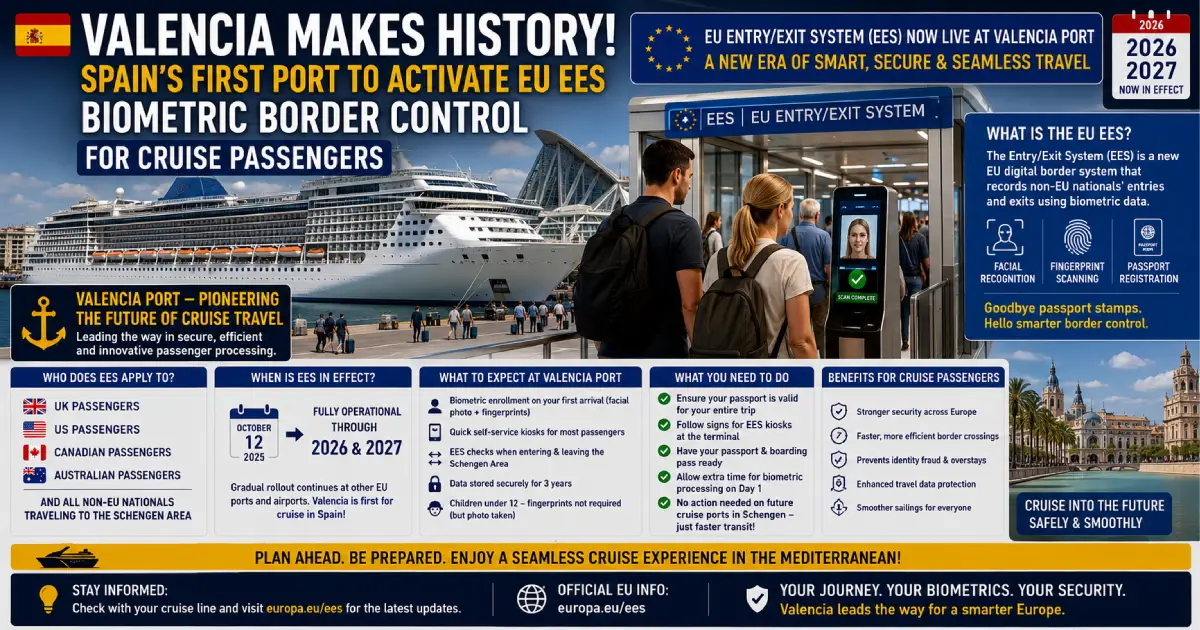
Breaking: The Port of Valencia has become the first port in Spain to activate a passenger border control system fully compatible with the EU Entry/Exit System (EES) — the biometric identification framework that requires fingerprint scanning and facial recognition for every non-EU national entering or exiting the Schengen Area. The €585,000 smart cabin facility, activated on June 4, 2026 and 75% co-funded by the EU’s Internal Security Fund, places Valencia ahead of every other Spanish cruise port including Barcelona, Palma, Málaga, and Cartagena in the Schengen smart-border rollout — and signals the beginning of a fundamental change in how British, American, Canadian, and Australian cruise passengers will experience Mediterranean port stops in Spain and across Europe. This matters right now because the Mediterranean cruise season is at peak (June–September 2026), because EES is mandatory across all Schengen airports as of April 10, 2026, and because Spanish seaports will reach mandatory compliance by mid-2027 — meaning every cruise passenger calling at Valencia from today is a test subject in the world’s most ambitious border digitalisation project. Barcelona, the Mediterranean’s busiest cruise port, has already deployed EES infrastructure across its Terminals C, E, G, and H — covering MSC, Royal Caribbean, and Carnival. Here is the complete guide to what EES means for your Mediterranean cruise in 2026 and 2027 — ship by ship, port by port, and nationality by nationality.
Published: June 10, 2026 (Wednesday) Event: Port of Valencia activates Spain’s first EES-compatible cruise border control facility! Activation date: June 4, 2026! Cost: €585,000 — 75% funded by EU Internal Security Fund! Technology: Biometric readers + passport e-gates + forensic document scanners! Affected passengers: ALL non-EU nationals — UK · US · Canada · Australia · NZ · Japan + more! Mandatory at seaports: Mid-2027 (currently pilot/training phase at Valencia!) Barcelona EES status: Already deployed at Terminals C, E, G, H — MSC, Royal Caribbean, Carnival! ETIAS status: Coming — Valencia facility also ETIAS-ready! Key impact: Biometric enrolment on FIRST Valencia call = faster re-entry for subsequent Schengen stops!
On June 4, 2026, the Port Authority of Valencia (APV) switched on a new EES-compatible border control station — a purpose-built modular facility containing biometric fingerprint readers, facial recognition cameras, passport document scanners, and a live connection to the EU’s central EES database.
The Port of Valencia has become the first port in Spain to deploy a passenger border control system compatible with the European Entry/Exit System. The facility strengthens identity verification procedures, document checks and passenger services, contributing to more streamlined and secure management of migration flows at the port. The Port of Valencia’s leadership in adopting this infrastructure positions it as a reference point for other Spanish ports as the EES framework is rolled out across EU member states.
What the Facility Looks Like:
The €585,000 smart cabin is a prefabricated module packed with biometric readers, passport e-gates and forensic document scanners — giving Policía Nacional officers the hardware they need to start testing EES and the forthcoming ETIAS travel authorisation in a maritime environment. The port’s IT team has installed secure tablets that allow officers to enrol fingerprints, capture facial images and obtain a real-time ETIAS clearance in under two minutes.
The Funding Model:
The project is 75% co-financed by the European Union through the European Fund for Internal Security (EFIS) and has a budget of 1,174,592.59 euros including VAT. The new station consists of a container that has been adapted and equipped for border control operations. The facility features large windows, thermal insulation, lighting, furniture, and state-of-the-art technology for passport scanning and passenger assistance.
What “Pilot Phase” Actually Means:
Although the Schengen smart-border package will not be mandatory for seaports until mid-2027, Valencia wants a long runway for staff training and systems integration. Initial trials will focus on weekend cruise calls and Balearic ferry departures where non-EU nationals account for roughly 12% of passengers.
In plain English: You will not be turned away at Valencia today for refusing biometric registration. But you WILL be asked to participate. The officers are training on real passengers. The system is live. And by mid-2027, it will be mandatory at every Spanish seaport — no opt-out.
The EU Entry/Exit System (EES) is the most significant change to Schengen border management since the euro — and most cruise passengers have never heard of it.
EES in Plain English:
✈️ What it replaces: Passport stamping — the manual ink stamp in your passport at Schengen borders is being phased out entirely and replaced by a digital biometric record! ✈️ What it collects: 4 fingerprints + facial photograph + passport data (name, nationality, document number, expiry) + entry/exit dates and locations! ✈️ Where it’s stored: EU central database — retained for 3 years (or 5 years if you overstay the 90-day limit!) ✈️ Who it covers: ALL non-EU nationals making short stays (up to 90 days in any 180-day period) in the 29 Schengen countries! ✈️ Who is exempt: EU/EEA citizens · Swiss citizens · UK citizens with a Frontier Worker Permit · long-term Schengen residents!
The 29 Schengen Countries (EES Applies):
Austria · Belgium · Croatia · Czech Republic · Denmark · Estonia · Finland · France · Germany · Greece · Hungary · Iceland · Italy · Latvia · Liechtenstein · Lithuania · Luxembourg · Malta · Netherlands · Norway · Poland · Portugal · Slovakia · Slovenia · Spain · Sweden · Switzerland + more!
Who Is Affected on Mediterranean Cruises:
✈️ British (UK) passport holders: YES — Brexit made UK citizens “third-country nationals” — EES applies on EVERY Schengen entry! ✈️ American (US) passport holders: YES — EES applies on every Schengen port stop! ✈️ Canadian passport holders: YES — EES applies! ✈️ Australian passport holders: YES — EES applies! ✈️ New Zealand passport holders: YES — EES applies! ✈️ Japanese passport holders: YES — EES applies! ✈️ EU passport holders: NO — exempt from EES! ✈️ Schengen country residents with valid permits: Generally exempt — check your permit status!
The 90-Day Rule EES Enforces:
Non-EU nationals are entitled to a maximum of 90 days in the Schengen Area in any 180-day rolling period. Before EES, this was poorly enforced — passport stamps were inconsistent. EES changes everything:
EES at airports is difficult. EES at cruise ports is dramatically more complex — and Valencia is navigating this challenge as Spain’s first test case.
Why Cruise EES is Harder Than Airport EES:
✈️ Volume: A single large cruise ship (MSC World Europa, Royal Caribbean Icon of the Seas) carries 5,000–7,000 passengers — all potentially needing biometric registration simultaneously in a narrow shore excursion window! ✈️ Time window: Cruise ships typically dock for 6–10 hours — passengers have 4–7 hours ashore — EES processing must happen within that window or passengers miss the ship! ✈️ Multiple ports: A 14-day Mediterranean cruise may call at Valencia, Barcelona, Marseille, Genoa, Civitavecchia, Athens, and Dubrovnik — ALL Schengen entries requiring EES checks! ✈️ Day trip exception: The biggest EES complexity for cruises — see below!
The Day Trip / Cruise Stop Exception:
This is the most important and most misunderstood aspect of EES for cruise passengers. As of April 10, 2026, all relevant Schengen countries should now have EES in place. In some countries, EES implementation will be in its early stages, so make sure you leave plenty of time to pass the necessary checks when heading to the port or airport.
The day trip rule in practice:
✈️ If your cruise ship docks at Valencia and you go ashore for the day: This counts as a Schengen ENTRY — EES biometric check required for first-time registrants! ✈️ If you stay on board: No Schengen border crossing = NO EES check required! ✈️ If you’ve already enrolled in EES (at a previous port or airport): Re-entry is faster — your biometrics are already in the database — verification only (no re-enrolment)! ✈️ First Schengen entry only: Biometric enrolment (fingerprints + facial scan) happens ONCE. Subsequent entries verify against the stored record — faster!
The Critical Practical Implication:
If you are on a Mediterranean cruise beginning in Barcelona and calling at Valencia, Marseille, Genoa, and Athens, your first port of call (Barcelona) is where EES enrolment happens. Every subsequent Schengen port (Valencia, Marseille, Genoa) is verification only — faster but still requires the biometric check.
This means: Your first Mediterranean port stop in 2026 determines your EES experience for the entire cruise.
Before focusing solely on Valencia, cruise passengers need to understand that Barcelona — the Mediterranean’s #1 cruise port by passenger volume — has already deployed EES infrastructure across all major cruise terminals:
The cost of implementation, co-financed by European Funds for Internal Security of the EU, has been valued at approximately €12 million, and includes the following infrastructure, distributed across cruise terminals: Terminal C (public), Terminal E (Carnival), Terminal G (Royal Caribbean) and Terminal H (MSC) and ferry terminals Contradique and Transmediterránea.
Barcelona EES Terminal Guide:
✈️ Terminal C: Public/general use — EES live! ✈️ Terminal E: Carnival Cruise Line — EES live! ✈️ Terminal G: Royal Caribbean International — EES live! ✈️ Terminal H: MSC Cruises — EES live! ✈️ Ferry terminals: Contradique + Transmediterránea — EES live!
Barcelona’s implementation in the port environment can be more complex than in the airport environment, especially until this process becomes part of the operational routine. The reason is the diversity of the model, which handles a significant volume of passengers between ferries and cruises. In 2024, passengers approached 5.4 million people, of which 1.74 million correspond to ferry passengers.
Practical implication: If your Mediterranean cruise starts or calls at Barcelona (as most do — it’s the #1 embarkation port), you will encounter EES before Valencia. Valencia’s deployment gives Policía Nacional additional capacity and positions Spain’s second cruise port as a backup and testing ground.
Valencia serves as a transit call (day stop) and embarkation/disembarkation port for multiple major cruise lines. All non-EU passengers on these lines are affected by EES when going ashore:
MSC Cruises: ✈️ Valencia calls: MSC Magnifica, MSC Musica, MSC Orchestra — all make Valencia calls on Mediterranean itineraries! ✈️ Passenger profile: Heavily European but with significant UK, US, Australian contingents! ✈️ EES impact: All non-EU MSC passengers disembarking at Valencia must pass EES processing! ✈️ MSC advice: Check MSC app 48 hours before Valencia call for updated pier instructions!
Royal Caribbean International: ✈️ Valencia calls: Wonder of the Seas, Navigator of the Seas, Vision of the Seas — all call at Valencia on Western Mediterranean itineraries! ✈️ UK/Australian market: Royal Caribbean heavily markets to UK and Australian passengers — EES affects a very high proportion of Royal Caribbean Valencia calls! ✈️ EES advice: Enrol at first Schengen port (usually Barcelona, Palma, or Marseille) — Valencia check will be faster as verification only!
Norwegian Cruise Line (NCL): ✈️ Valencia calls: Norwegian Epic, Norwegian Getaway — Western Mediterranean deployments! ✈️ US passenger concentration: NCL’s Mediterranean fleet carries high US passenger percentages — all affected!
Costa Cruises: ✈️ Valencia calls: Costa Diadema, Costa Favolosa — Italian line with significant European and South American passengers! ✈️ Non-EU nationals: US, UK, Canadian, Australian, Brazilian, Argentine passengers all affected!
Celebrity Cruises: ✈️ Valencia calls: Celebrity Reflection, Celebrity Silhouette — premium market with high UK and Australian passenger share! ✈️ Premium implication: Celebrity passengers paid £3,000–£8,000 per person — EES delays at Valencia reduce expensive shore time!
P&O Cruises (UK passengers specifically): ✈️ Valencia calls: Iona, Arvia — both make Valencia calls on Canary Islands/Mediterranean itineraries! ✈️ UK passenger base: P&O is almost exclusively British — ALL P&O passengers are non-EU (post-Brexit!) = 100% EES-applicable! ✈️ P&O priority: P&O should be the most proactive in communicating EES to passengers — verify information via pocruises.com!
Cunard (Queen Mary 2, Queen Anne): ✈️ Mediterranean calls: Queen Anne’s inaugural 2026 Mediterranean deployments include Spanish ports! ✈️ Transatlantic passengers: Many Cunard passengers fly to Barcelona/Valencia to join the ship — EES affects both air arrival AND embarkation!
The EES process at Valencia for a non-EU passenger is as follows:
If this is your FIRST Schengen entry (enrolment):
If you have ALREADY enrolled in EES (previous Schengen entry this trip):
The Key Time Warning:
Early arrival and hard-copy backups are advised during the shakedown period.
What “shakedown period” means for your Valencia shore excursion:
Valencia’s activation is one piece of a larger, carefully managed Spanish EES deployment:
Spain deliberately rolled out EES slowly — starting with a single Madrid flight, then expanding to airports, then land borders, with sea ports explicitly described as last. The Spanish government stated: “During the six-month trial period for the EU EES, it will be implemented gradually at Spanish border crossings, first at airports, then at land borders, and finally at sea borders.”
Spain’s EES Seaport Timeline:
✈️ February 20, 2026: Valencia activates Spain’s first seaport EES facility — pilot/training phase! ✈️ June 4, 2026: Valencia facility formally presented as operational! ✈️ Summer 2026: Valencia and Barcelona running EES in parallel — passengers may encounter both! ✈️ 2026–2027: Other major cruise ports (Palma, Málaga, Cartagena, Las Palmas, Santa Cruz de Tenerife) expected to add EES infrastructure! ✈️ Mid-2027: EES mandatory at ALL Spanish seaports — no opt-out, no exceptions!
Other Schengen Cruise Ports with EES (Beyond Spain):
If your Mediterranean cruise calls at non-Spanish Schengen ports, EES is equally active: ✈️ France: Marseille · Villefranche · Toulon — EES active April 10+! ✈️ Italy: Civitavecchia (Rome) · Genoa · Naples · Venice — EES active! ✈️ Greece: Piraeus (Athens) · Santorini · Mykonos · Corfu — EES active! ✈️ Croatia: Split · Dubrovnik · Kotor — EES active! ✈️ Malta: Valletta — EES active! ✈️ Portugal: Lisbon — EES active!
Non-Schengen Mediterranean Ports (EES does NOT apply):
✈️ Turkey: Istanbul, Kusadasi, Bodrum — Turkey is NOT Schengen — no EES! ✈️ Morocco: Casablanca, Tangier — not Schengen — no EES! ✈️ Israel: Haifa — not Schengen — no EES! ✈️ Cyprus: Limassol — EU member but NOT in Schengen — no EES yet! ✈️ UK: Southampton, Dover — Brexit = UK no longer Schengen — no EES! ✈️ Norway: Bergen, Flåm — Norway IS Schengen — EES APPLIES!
ETIAS (European Travel Information and Authorisation System) is the next layer — essentially a European equivalent of the US ESTA or Australian ETA:
✈️ What it is: Pre-travel authorisation required for all visa-exempt non-EU nationals entering Schengen! ✈️ Who needs it: UK · US · Canada · Australia · NZ · Japan + 60 other nationalities! ✈️ Cost: €7 per application! ✈️ Validity: 3 years or until passport expires! ✈️ Application: Online — results typically within minutes to 72 hours! ✈️ Valencia ready: Valencia’s smart cabin can obtain a real-time ETIAS clearance in under two minutes — the facility is ETIAS-ready from day one!
ETIAS for Cruise Passengers — Key Questions:
✈️ Do I need ETIAS to board a cruise in Barcelona/Valencia? YES — if you are a non-EU national and your home country requires ETIAS, you must have it before boarding! ✈️ Does ETIAS replace EES? NO — they work together. ETIAS is the pre-travel authorisation. EES is the real-time border registration. You need BOTH! ✈️ What if my cruise calls at non-Schengen ports (Turkey, Morocco)? ETIAS is not required for non-Schengen stops — but you will need ETIAS for every Schengen entry! ✈️ Apply at: etias.eu (official EU portal — be cautious of unofficial paid sites!)
As a consequence of the Brexit agreement, which made UK citizens “third-country nationals” in relation to the EU, all British holidaymakers and business passengers will be subject to EES checks on entry and exit.
UK cruise passengers must: ✈️ Allow 90 minutes extra at first Schengen port (usually Barcelona or Marseille)! ✈️ Know your 90-day limit: UK citizens get 90 days in Schengen per 180-day period — EES tracks every minute! ✈️ Carry your original passport — photocopies insufficient for EES biometric verification! ✈️ Ensure passport validity: Must be valid for duration of cruise PLUS 90 days (many cruise lines require 6-month validity)! ✈️ Check your days: If you already spent time in Schengen countries earlier this year — count carefully! EES calculates remaining days automatically and will flag you if you’re close to 90! ✈️ P&O + Cunard specific: Both cruise lines are almost entirely British — expect P&O and Cunard to issue specific EES guidance via My P&O Cruises and Cunard.com — check before sailing!
✈️ ESTA still required: US citizens need valid ESTA for air travel TO/FROM the US — but for Schengen ports, EES (not ESTA) is the relevant system! ✈️ 90-day rule: Americans historically visited Europe without tracking days — EES changes this permanently! Budget travellers who overstay Schengen will now be flagged automatically! ✈️ Biometric enrolment: First Schengen entry = 4-fingerprint + facial scan. Allow extra time at first Mediterranean port! ✈️ US cruise lines (Royal Caribbean, Norwegian, Celebrity, Carnival): All deploy ships in the Mediterranean with high US passenger percentages — EES communication should come from your cruise line pre-departure. If it hasn’t — call and ask!
✈️ ETA for flights: Canadians need a Canadian ETA for air travel through Canada — but for European cruise stops, EES is the relevant border system! ✈️ ETIAS (when live): Canadians will need ETIAS for Schengen entries — apply at etias.eu before sailing! ✈️ 90-day rule: Canadian snowbirds who winter in Spain (long-stay Canadians in the Costa del Sol, for example) are particularly affected — EES accurately tracks days and will enforce the 90/180 rule stringently! ✈️ Air Canada cruise connections (YYZ/YVR → Barcelona): Canadian passengers flying to embark Mediterranean cruises face EES at both air arrival (Barcelona airport) AND cruise terminal — budget 90+ minutes for initial airport EES processing before even reaching the ship!
✈️ Qantas–Qatar connection: Many Australian cruise passengers route London → Doha → Barcelona or Sydney → Dubai → Barcelona — the EES applies from the moment you enter Barcelona regardless of how you arrived! ✈️ ETIAS (when live): Australians will require ETIAS for Schengen entries — apply well in advance of cruise departure! ✈️ P&O Australia cruises (repositioning to Mediterranean): Some P&O Australia itineraries position ships through Suez to the Mediterranean — Australian passengers on these repositioning cruises will encounter EES at their first Schengen port! ✈️ Time zone advantage: Australian travel agents who book Mediterranean cruise clients should now include EES briefing as standard — Valencia’s deployment means Spanish ports are live!
The cruise industry has been slow to communicate EES comprehensively to passengers. Here is what you should expect — and what to demand if you haven’t received it:
What cruise lines SHOULD provide: ✈️ Pre-departure EES briefing document (via email or app 14+ days before sailing!) ✈️ Shore excursion timing that accounts for EES processing at Schengen ports! ✈️ Clear guidance on 90-day rule and days-counting calculator for UK/US/Canadian/Australian passengers! ✈️ Ship-specific port agent contact in case of EES processing delays that threaten missing the ship!
What to do if your cruise line hasn’t communicated this:
The Port of Valencia’s activation as Spain’s first EES-compatible cruise terminal is not a bureaucratic footnote. It is the opening chapter of a fundamental transformation of how non-EU nationals experience Mediterranean cruise travel — one that will be fully mandatory at ALL Spanish seaports by mid-2027 and that is already live at Barcelona’s four major cruise terminals. For the 26+ million British, American, Canadian, and Australian passengers who take Mediterranean cruises annually, EES represents the most significant border change since Schengen itself.
As of April 10, 2026, all the relevant Schengen countries should now have EES in place. In some countries, EES implementation will be in its early stages, so make sure you leave plenty of time to pass the necessary checks when heading to the port or airport. Valencia is doing exactly this — building operational competence during a pilot phase while cruise traffic is high, before mandatory enforcement begins in 2027.
For cruise passengers in the Mediterranean right now in June 2026: your first Schengen port stop requires biometric enrolment — 4 fingerprints + facial scan — and you should allow 45–90 extra minutes at that first port. Every subsequent Schengen stop is faster verification only. Staying on board at any Schengen port means no EES check. The 90-day Schengen limit is now digitally enforced — British, American, Canadian, and Australian long-stay visitors can no longer rely on inconsistent passport stamping. And Valencia’s new ETIAS-ready infrastructure means that when ETIAS launches — requiring pre-travel authorisation for all non-EU visitors — Spain’s cruise ports will be ready to verify it.
For UK passengers specifically: every Mediterranean cruise port stop in a Schengen country now requires an EES biometric check — Brexit made you a “third-country national” and there is no exemption, no queue bypass, and no way to avoid it. Allow extra time, carry your original passport, count your Schengen days carefully, and check with your cruise line for port-specific EES guidance before you sail.
Valencia first. Barcelona live across all terminals. Spain mandatory mid-2027. Mediterranean EES is here — and your next cruise will look different because of it.
For More Resources:
Related Articles:
Posted By : Vinay
This article is provided for general informational purposes only and is based on information available at the time of publication. Travel advisories, airline schedules, airport operations, visa requirements, government regulations, and other travel-related information are subject to change without prior notice. While Travel Tourister makes reasonable efforts to verify information using official announcements, government publications, airline and airport communications, and other reliable sources, we cannot guarantee that all information remains complete, accurate, or up to date at all times. Readers should independently verify any information that may affect their travel plans with the relevant airline, airport authority, government agency, embassy, or other official source before making travel, financial, or other decisions. Travel Tourister shall not be liable for any direct or indirect loss, inconvenience, or damages arising from the use of or reliance on the information contained in this article. Nothing in this publication constitutes legal, immigration, financial, or professional travel advice. If you believe any information in this article is inaccurate or outdated, please contact our editorial team. We review all credible correction requests promptly and update our content whenever appropriate.
Lastest News
2nd Floor, 39, Above Kirti Club, DLF Industrial Area, Kirti Nagar, New Delhi, Delhi 110015



Travel Tourister is a leading Travel portal where we introduce travellers to trusted travel agents to make their journey hasselfree, memorable And happy. Travel Tourister is a platform where travellers get Tour packages ,Hotel packages deals through trusted travel companies And hoteliers who are working with us across the world. We always try to find new and more travel agents and hoteliers from every nook and corners across the world so that you could compare the deals with different travel agents and hoteliers and book your tour or hotel with the one you have chosen according to your taste and budget.
Copyright © Travel Tourister, India. All Rights Reserved

 Call
Call Enquiry