Published on : 01 Apr 2026
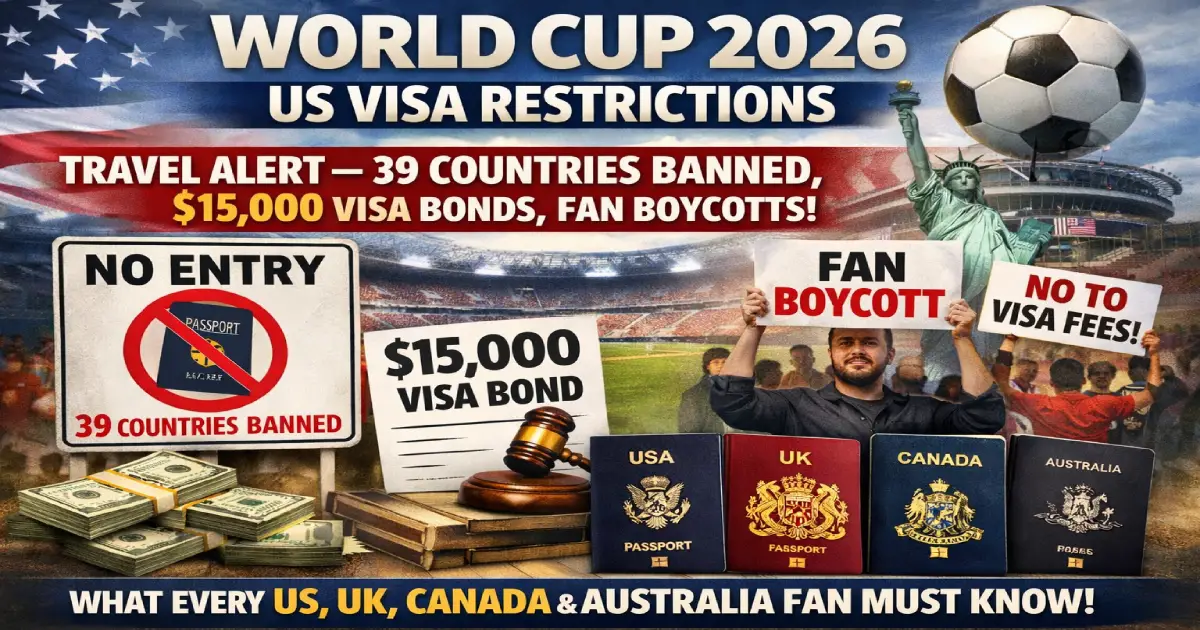
Breaking: The 2026 FIFA World Cup is 71 days away — but millions of football fans around the world may never reach the stadium. The US government has placed 39 countries under visa restrictions, introduced a $15,000 visa bond for fans from 50 nations, proposed a controversial $250 Visa Integrity Fee, and is now considering demands for 5 years of social media history from ESTA applicants. Inbound tourism to the US fell 5.4% in 2025 — and the World Cup’s promise of 1.24 million international visitors is under serious threat. Here is everything US, UK, Canada and Australia fans need to know right now.
Published: April 1, 2026 Tournament Opens: June 11, 2026 — Estadio Azteca, Mexico City Countries Under US Travel Ban: 39 (19 full suspension + 20 partial) Visa Bond Countries: 50 nations — bonds up to $15,000 Qualified Teams Affected by Travel Ban: Haiti, Iran, Senegal, Ivory Coast Visa Bond Countries With Qualified Teams: Algeria, Cape Verde, Ivory Coast, Senegal, Tunisia US Inbound Tourism Decline (2025): -5.4% vs global average growth of +4%
The 2026 FIFA World Cup was supposed to be the tournament that welcomed the world. With 48 teams, 104 matches, and 16 host cities spanning the United States, Canada, and Mexico, it is the largest World Cup in history. FIFA President Gianni Infantino has called it the equivalent of “1,000 years of World Cups at once.”
But behind the record ticket sales and sell-out stadiums, a crisis is quietly building. The United States — host to the most matches and the highest-profile venues — has erected a series of immigration barriers that risk turning the world’s biggest sporting event into the world’s most inaccessible.
The restrictions are not theoretical. They are active, they are escalating, and they are affecting qualified nations whose fans are already holding tickets.
On June 4, 2025, President Trump signed a proclamation restricting nationals of 19 countries from receiving US visitor visas. On December 16, 2025, that list expanded to 39 countries. On January 1, 2026, the expanded restrictions came fully into force.
What the ban means:
Four qualified World Cup teams are directly inside the travel ban:
🇭🇹 Haiti — Qualified for the World Cup for the first time in over 50 years. Under full B1/B2 visa suspension. Haiti’s first match is June 13 against Scotland — played in the US. The Trump administration separately ordered an end to Temporary Protected Status for Haitians, meaning 340,000 Haitians currently in the US face loss of legal protection.
🇮🇷 Iran — Under full visa suspension. Iran’s first match is June 15 against New Zealand — played in the US. FIFA is reportedly negotiating to move some Iran matches to Mexico. Iranian team staff have previously faced US visa denials, raising questions about even player exemptions.
🇸🇳 Senegal — Under visa restrictions. First match June 16 against France — played in the US. Fan groups that traveled to Qatar 2022 and previous tournaments are now being told they cannot enter the country.
🇨🇮 Ivory Coast — Under visa restrictions. First US match June 14 against Ecuador. The Ivory Coast coach referenced the Africa Cup in Morocco as a precedent, saying he believes “things will be sorted out” — but nothing has been confirmed.
For fans from these four nations, the situation is straightforward and devastating: you can buy a ticket, but you cannot enter the stadium.
Separate from the travel ban is a different policy now hitting fans from 50 countries — the US Visa Bond Pilot Program.
Under this scheme, a consular officer processing a B1/B2 visa application can require the applicant to post a refundable bond of $5,000, $10,000, or $15,000 as a condition of visa issuance. The bond is designed to discourage visa overstays — applicants who leave the US on time, as required by their visa, receive the bond back.
Five qualified World Cup nations are inside the visa bond program:
Why this matters for real fans:
The average annual income in Algeria, Senegal, Ivory Coast, Tunisia, and Cape Verde is approximately $5,000 USD. A $15,000 visa bond represents three full years of income. For a family of four wanting to attend one group-stage match, the bond requirement makes World Cup attendance simply impossible — regardless of whether they have tickets.
The bond is refundable in theory. In practice, the refund process has not been fully explained, and travel lawyers warn that recovering the bond requires navigating US bureaucracy from overseas after returning home.
In 2025, Trump signed the “One Big Beautiful Bill,” which includes a $250 Visa Integrity Fee applied to all non-immigrant visa applicants — tourists, students, and workers included.
Current status: The fee exists in law but has not yet been implemented by the US Department of State. As of April 1, 2026, the standard B1/B2 visa fee remains $185.
The US Travel Association has explicitly lobbied the administration not to implement the fee before the World Cup, warning it would further depress inbound tourism at the worst possible moment.
If implemented, the total cost rises to ~$435 for a single US tourist visa — making it one of the most expensive in the world.
The fee is technically refundable if travelers comply with visa terms and depart on time — but the refund mechanism has not been clarified, and industry experts warn confusion alone is deterring bookings.
What this means for fans:
Perhaps the most far-reaching proposal — and the most alarming for UK, Canada, and Australia fans — involves a potential change to the ESTA system itself.
The Trump administration has proposed requiring ESTA applicants to provide 5 years of social media history and 10 years of email addresses when applying for travel authorisation.
Current status: This proposal has not been implemented. ESTA currently operates as it always has.
If implemented, aviation analyst Tom Fitzgerald from TD Cowen described it as a “risk to inbound tourism, especially for the World Cup.” Privacy advocates in the UK and Europe have warned it would deter millions of ordinary tourists who simply do not want their personal social media history shared with US immigration databases.
The US Travel Association is also lobbying against this proposal and asking the administration not to implement it before the tournament.
Bottom line for UK, Canada and Australia fans: ESTA works normally right now. Apply as you normally would. But stay alert to any changes between now and June 11.
The visa restrictions and proposed fees are not happening in isolation. They are compounding an existing slide in US inbound tourism that began before the World Cup became a factor.
Key numbers:
What is driving the decline:
✈️ Visa restrictions hitting major football-watching markets in Africa, South America, and Asia ✈️ Aggressive border enforcement including electronic device searches of Canadian and European travelers — a practice previously associated only with high-risk arrivals ✈️ LGBTQ+ rights rollbacks creating discomfort for international LGBTQ+ travelers ✈️ Rising visa costs creating a price deterrent for budget travelers and families ✈️ Perception shift — surveys show declining intent to visit the US among key European and Canadian markets
The World Cup was supposed to reverse this. Tourism Economics projected the tournament would bring 1.24 million international visitors to the US, with 742,000 of those being incremental trips that would not otherwise have happened — and that nearly one-third of 2026 US tourism growth would be directly attributable to the World Cup.
Whether those projections survive the current visa environment is an open question.
A separate and growing concern is the response from European fans — who are not subject to travel bans, do not need visa bonds, and qualify for ESTA as normal.
A growing number of European supporters are voluntarily choosing not to travel to the US for the World Cup, citing:
Organisations including Amnesty International have warned that without urgent safeguards, the 2026 World Cup risks becoming a human rights concern. Critics note that key US tourism bodies — including Brand USA and the US Travel Association — have remained largely silent on these mounting concerns, creating a communications vacuum that is being filled by negative press coverage in Europe.
FIFA has maintained it expects host nations to facilitate access for all fans — but the governing body has limited leverage over US immigration sovereignty.
The Trump administration has not ignored the problem. At a White House event attended by President Trump, Secretary of State Marco Rubio, Homeland Security Secretary Kristi Noem, and FIFA President Infantino, the administration announced FIFA PASS — a priority visa appointment system for World Cup ticket holders.
What FIFA PASS does:
What FIFA PASS does NOT do:
In addition, over 400 consular officers have been deployed to US embassies around the world specifically to handle World Cup visa interview demand.
Secretary Rubio stated at the White House event: “The United States is offering prioritized appointments so FIFA World Cup fans can complete their visa interviews and show they qualify. The kick-off is coming up, so now is the time to apply.”
No visa issues for matches on US soil. For matches in Canada or Mexico, a valid US passport — not a REAL ID — is required to cross borders. Ensure passport expiry extends beyond July 19, 2026. No action needed for US-based matches.
The UK is part of the US Visa Waiver Programme (VWP). You do not need a B1/B2 visa. You need ESTA — apply at the official US government portal before travel. Most approvals arrive within minutes; apply at least 72 hours before departure. ESTA costs $21, is valid for two years, and covers multiple trips. Every traveller including children needs their own ESTA linked to their specific passport. The $250 fee and social media proposals do not currently affect ESTA applicants.
Canada is also part of the VWP. Canadian citizens attending US matches need ESTA. Apply at the official US government portal ahead of travel. For Canada-hosted matches, no additional documentation is needed beyond a valid passport.
Australia participates in the VWP. Australians traveling to US matches must apply for ESTA before flying. Same 72-hour minimum recommendation applies; most approvals are near-instant. Each family member needs their own ESTA.
42 countries total participate in the VWP. Citizens of these nations use ESTA, not a B1/B2 visa, and are not affected by the travel ban. Check the full VWP country list at travel.state.gov.
Apply immediately. Visa interview wait times exceed 300 days in many countries. Use FIFA PASS (via your FIFA.com ticket account) to access priority interview slots. Be aware that visa bond requirements may apply depending on your country of nationality. A ticket does not guarantee entry — if your visa is denied, FIFA’s standard resale policies apply and you may face financial loss.
B1/B2 tourist visas are suspended or severely restricted. Attending US-based matches is not currently possible unless you hold a pre-ban visa. Consider attending matches in Canada or Mexico, which operate under separate and more accessible visa rules. Check FIFA.com for match location details for your team.
The 2026 FIFA World Cup is 71 days away. Tickets are sold. Flights are booked. Hotels are reserved. And for millions of fans — including those whose teams have qualified for the first time in a generation — the question of whether they can actually enter the country is still unanswered.
The travel ban, the visa bonds, the proposed ESTA changes, and the wider perception shift around US immigration are combining to create the most complex entry environment any World Cup has ever generated. Some of these barriers will be resolved before June 11. Some will not.
For UK, Canada and Australia fans: your path to the US is clear — apply for ESTA now and keep watching for any ESTA policy changes.
For fans from non-VWP countries needing a B1/B2 visa: apply immediately, use FIFA PASS, and have a contingency plan if your visa is denied.
For fans from travel-banned countries: the most realistic alternative is to focus on matches in Canada and Mexico, where your national team may also be playing and where entry requirements are significantly more accessible.
The World Cup is supposed to unite the world. Right now, the United States is asking the world to prove it qualifies first.
For More Resources:
Related Articles:
Posted By : Vinay
This article is provided for general informational purposes only and is based on information available at the time of publication. Travel advisories, airline schedules, airport operations, visa requirements, government regulations, and other travel-related information are subject to change without prior notice. While Travel Tourister makes reasonable efforts to verify information using official announcements, government publications, airline and airport communications, and other reliable sources, we cannot guarantee that all information remains complete, accurate, or up to date at all times. Readers should independently verify any information that may affect their travel plans with the relevant airline, airport authority, government agency, embassy, or other official source before making travel, financial, or other decisions. Travel Tourister shall not be liable for any direct or indirect loss, inconvenience, or damages arising from the use of or reliance on the information contained in this article. Nothing in this publication constitutes legal, immigration, financial, or professional travel advice. If you believe any information in this article is inaccurate or outdated, please contact our editorial team. We review all credible correction requests promptly and update our content whenever appropriate.
Lastest News
2nd Floor, 39, Above Kirti Club, DLF Industrial Area, Kirti Nagar, New Delhi, Delhi 110015



Travel Tourister is a leading Travel portal where we introduce travellers to trusted travel agents to make their journey hasselfree, memorable And happy. Travel Tourister is a platform where travellers get Tour packages ,Hotel packages deals through trusted travel companies And hoteliers who are working with us across the world. We always try to find new and more travel agents and hoteliers from every nook and corners across the world so that you could compare the deals with different travel agents and hoteliers and book your tour or hotel with the one you have chosen according to your taste and budget.
Copyright © Travel Tourister, India. All Rights Reserved

 Call
Call Enquiry