Published on : 20 May 2026
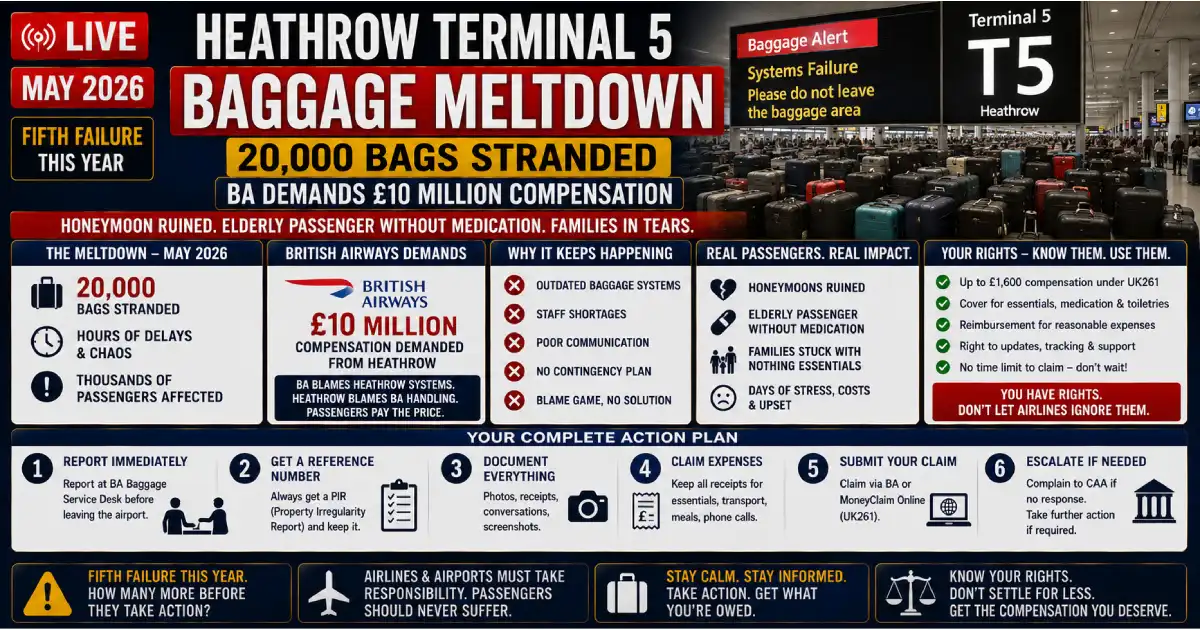
Breaking — May 20, 2026: A catastrophic failure of the automated baggage handling system at London Heathrow Airport’s Terminal 5 on Friday, May 15, 2026 has produced the worst baggage crisis in the UK’s busiest airport this year — and one of the most explosive airline–airport disputes in British aviation history. 20,000 checked bags failed to make it onto their designated flights. Departing passengers arrived at their holiday and business destinations completely without luggage. Arriving passengers found baggage carousels empty and piles of suitcases abandoned in corridors and storage zones across Terminal 5. Heathrow’s automated conveyor belt network — described by Terminal 5 as one of the most sophisticated baggage infrastructures at any major global airport — had failed completely, forcing ground staff into manual sorting that was instantly overwhelmed. British Airways dispatched dozens of flights without a single piece of checked luggage loaded — and told passengers only after they had landed. British Airways chief executive Sean Doyle has contacted Heathrow group chief executive Thomas Woldbye directly, demanding up to £10 million in financial compensation and binding assurances that this cannot happen again. This is the fifth baggage system failure at Heathrow since January 2026. Previous failures hit 7,000 bags during February half-term and 4,000 bags at Easter. As of May 20, passengers may still be separated from their bags — BA’s promised resolution deadline of Thursday May 21 is TOMORROW. Here is every confirmed fact, every passenger story, every legal right, and every step you need to take to get your bag back and your money back.
Published: May 20, 2026 — Wednesday (5 days after failure began) Failure date: Friday, May 15, 2026 Airport: London Heathrow Airport (LHR) — Terminal 5 (T5) — British Airways exclusive home Total bags stranded: ~20,000 BA financial demand: Up to £10 million compensation from Heathrow Airport BA CEO: Sean Doyle — wrote directly to Heathrow CEO Thomas Woldbye Heathrow CEO: Thomas Woldbye — has responded with regret; committed to operational improvements Failure type: Automated baggage handling system (ABHS) — prolonged technical malfunction What failed: Conveyor belt and chute network — check-in desks to aircraft loading zones Manual fallback: Ground crews attempted manual sorting — immediately overwhelmed Flights dispatched without bags: Multiple BA departures — passengers notified only after landing Routes worst affected: Scotland connections (Glasgow) · European leisure routes (Costa del Sol, Algarve, Corfu) · Long-haul international routes Estimated passengers affected: Tens of thousands across outbound and inbound Expected full resolution: Thursday, May 21, 2026 — TOMORROW (BA estimate) BA recovery actions: Courier services deployed · Extra flights reallocated for cargo · Additional staff on baggage tracing Heathrow statement: System has returned to full operation · 99% reliability claimed overall BA statement: “Can’t keep absorbing the consequences of repeated Heathrow system failures” Failure history 2026: 5th incident this year — Feb half-term (7,000 bags) · Easter (4,000 bags) · Three prior incidents UK CAA status: Recently rejected Heathrow’s capital spending plan Heathrow 2026 infrastructure spend: £1.3 billion committed — including new baggage handling system for Terminal 2 (31,000 bags/day capacity) Your rights: UK261 · Montreal Convention · BA Conditions of Carriage Claim deadline: Up to 6 years in England/Wales · Up to 5 years in Scotland
Terminal 5 at London Heathrow is not a normal airport terminal. It was purpose-built for British Airways and opened in 2008 after a £4.3 billion construction project. Underneath the elegant departures concourse lies a subterranean labyrinth of conveyor belts, automated sorting machines, and chute systems that was designed to handle the sheer volume of luggage generated by the busiest international airline hub in the world. At peak operations, this automated baggage handling system is designed to process and route thousands of bags per hour — from the moment a bag is checked in at the desk, to the moment it arrives in the belly of the departing aircraft.
The automated baggage handling network in Terminal Five suffered a prolonged technical malfunction on May 15, 2026, halting the automated movement of checked luggage from check-in desks to aircraft loading zones. What should have been a routine busy Friday — the start of the half-term travel period for many UK families, with Heathrow processing tens of thousands of departures and arrivals — became one of the most chaotic days in the terminal’s 18-year history.
The failure disabled the elaborate network of conveyor belts and chutes that transport checked luggage from bag-drop desks down into the cargo holds of departing aircraft, forcing ground staff to park mountains of suitcases in every available corner of the departures concourse as overwhelmed agents scrambled to maintain a semblance of order.
The cascade was fast and total. Within hours of the system failing, checked bags that could not be sorted manually were simply piling up. Ground handlers who typically oversee automated operations were working manually — a system designed for hundreds of bags per hour, not thousands. Aircraft departure schedules, which Heathrow manages to minute-by-minute precision, could not be held indefinitely. The decision was made to dispatch flights.
The incident forced British Airways to dispatch several flights without checked luggage loaded onboard, leaving passengers unaware of the issue until they reached their destinations.
This is the detail that most enraged passengers — and the detail that most clearly defines the severity of the crisis. The decision to depart without luggage is operationally understandable: an aircraft held on stand for two hours waiting for manually sorted bags creates cascading delays across the entire Heathrow departure schedule. But the decision to tell passengers only after landing — leaving families who had just arrived in Spain, Corfu, or Portugal to discover their bags were still somewhere in Terminal 5 — is what transformed an operational failure into a human crisis.
Before any legal framework, before any compensation figure, before any corporate statement — here is what this baggage failure actually meant for real passengers on real holidays.
One woman’s honeymoon was ruined after she found out her bags were lost after landing in Corfu. She said: “On our honeymoon in Corfu and British Airways have lost our bags. Absolutely devastated, never had this issue in 15 years and it happens on our honeymoon. Poor communication hours of waiting around and no bags arrived.”
@_aggiemay on X said: “1000s of passengers have been flown to their destinations without their checked baggage due to computer failure in T5 Heathrow. My elderly mother on her own without essentials in Spain.” And later: “Over 100 hours and still no luggage for their holidays. 1000s of bags left in T5.”
In one reported case, concern was raised over an elderly passenger whose medication had been placed inside a missing suitcase. Aviation experts have consistently warned that critical medications, medical equipment, and any item whose absence creates a health risk must never be placed in checked luggage. The Terminal 5 failure of May 15 is the most vivid possible demonstration of why that advice is not precautionary — it is essential.
@1Drubsy posted: “@British_Airways customer service is diabolical. Luggage lost since last Friday due to T5 crappy baggage system. Spent over 4 hours on hold over 6 occasions trying to contact BA — no one ever answers the phone numbers provided. Complete crap.”
A third passenger stated: “British Airways really disappointing with arriving back to T5 and total chaos at baggage arrivals. Families waiting hours and told to go home as baggage abandoned all over airport.”
These are not edge cases or outliers. These are the lived experiences of passengers who paid for a British Airways service, trusted that service with their possessions, and discovered that the world’s most expensive airport’s baggage system had completely failed them on one of the most significant days of their year.
British Airways chief executive Sean Doyle is reported to have contacted Heathrow Airport CEO Thomas Woldbye after the luggage systems at Terminal 5 broke down on Friday. Mr Doyle asked the Heathrow boss for compensation and for contingency plans to be drawn up following the incident.
British Airways estimates the latest failure has cost the airline £10 million plus considerable damage to its reputation.
This is not a minor customer service dispute. This is the chief executive of the United Kingdom’s flag carrier writing directly to the chief executive of the country’s busiest airport and demanding a nine-figure compensation payment. To understand why this corporate conflict matters — and why it will shape what happens at Heathrow this summer — you need to understand the structure of the BA–Heathrow relationship.
While Heathrow Airport is responsible for outbound luggage, individual airlines hold responsibility for inbound bags. This is because inbound luggage does not enter an airport’s system and is taken from a flight by an airline’s ground handler and brought to baggage carousels for passengers to collect.
For the May 15 failure, the critical point is this: the automated baggage handling system that failed is Heathrow’s infrastructure. It is Heathrow’s responsibility to maintain it, test it, and ensure it is resilient. British Airways pays Heathrow substantial landing, infrastructure, and per-passenger charges to use Terminal 5 — charges that are among the highest of any airport-airline relationship in the world. When Heathrow’s infrastructure fails, BA’s operations are disrupted, BA’s passengers are stranded without luggage, BA’s reputation is damaged, and BA bears the immediate cost of recovery: extra staff, courier services, additional flights for cargo.
A British Airways source told The Times that the airline “can’t keep absorbing the consequences of repeated Heathrow system failures.” “As decisions are made about the airport’s future, it’s essential that reliability and resilience come first,” they added.
Heathrow Airport issued a statement expressing regret for the inconvenience and frustration caused by the Friday incident. Officials confirmed the system has returned to full operation and confirmed close collaboration with British Airways to reunite owners with their bags. The airport maintains that its baggage processes achieve 99 per cent reliability even while operating at maximum capacity. Management at Heathrow pledged ongoing cooperation with airlines and ground handlers to reduce future risks and explore ways to increase overall baggage performance.
Ninety-nine per cent reliability sounds impressive until you apply it to Terminal 5’s scale. Terminal 5 processes approximately 33 million passengers per year — roughly 90,000 per day at peak. A 1% failure rate across 90,000 daily bags means 900 bags mishandled every single day — under normal operating conditions. A full system collapse is a categorically different event.
Heathrow has committed to a £1.3 billion infrastructure programme for 2026, which includes the construction of a new, dedicated baggage handling system for Terminal 2. This is designed to process up to 31,000 bags per day. Notably, this investment targets Terminal 2 — not Terminal 5, where the May 15 failure occurred. British Airways and the broader aviation industry are watching closely whether the post-failure commitment from Woldbye extends to meaningful Terminal 5 infrastructure investment — or whether the airport’s spending remains focused elsewhere while T5’s ageing automated systems continue to fail.
The May 15 incident cannot be understood as an isolated technical event. This is the fifth baggage system collapse at the airport since January. Earlier problems during the February half-term holiday impacted 7,000 pieces of luggage, and another at Easter affected 4,000.
The pattern of five failures in 19 weeks — targeting the busiest travel periods of the year, February half-term, Easter, and now May half-term — represents a systemic infrastructure problem that Heathrow’s 99% reliability claim does not adequately address. The aviation industry tracks Heathrow’s baggage performance through the IATA Baggage Report, and repeated high-volume failures during peak periods are precisely the scenario that IATA’s infrastructure reliability standards are designed to prevent.
The 2026 Heathrow T5 failure timeline:
| Date | Bags affected | Period | Cause |
|---|---|---|---|
| January 2026 | Undisclosed | Winter travel | T5 automated system fault |
| January 2026 | Undisclosed | Winter travel | T5 automated system fault |
| February 2026 | ~7,000 | February half-term | T5 system failure |
| April 2026 | ~4,000 | Easter holidays | T5 system failure |
| May 15, 2026 | ~20,000 | May half-term | T5 full system collapse |
The escalating scale — 7,000, then 4,000, then 20,000 — is not evidence of a system improving under pressure. It is evidence of a system degrading toward its next, larger failure. The May 15 event is the biggest of the five — and it happened during the first weekend of the May half-term, before the peak summer travel season has even begun.
The operational failure began on May 15, 2026, at London Heathrow Terminal Five, affecting connecting flights from Scotland and onward international routes operated by British Airways. Connecting passengers flying from regional airports in Scotland faced significant delays and personal concerns: Travelers connecting through Heathrow from Scottish airports, including Glasgow, reported missing bags on onward flights.
The Scotland dimension is a critical one for understanding the full passenger impact. For many UK passengers outside London — particularly in Scotland, Northern Ireland, and the North of England — Heathrow is not their departure airport. It is their connection hub. They fly from Glasgow, Edinburgh, Belfast, or Manchester to Heathrow Terminal 5, check their bags through to their final destination (Malaga, Lisbon, New York, Dubai), and trust that the BA system at Terminal 5 will transfer those bags to the onward flight automatically.
When the Terminal 5 ABHS fails, those transfer bags — already checked in at Glasgow or Edinburgh — become part of the stranded 20,000. The passenger has no awareness, no ability to intervene, and no opportunity to reclaim their bag and take it onto their connection manually. They board their flight to Malaga having watched their bag disappear onto a belt in Glasgow, and discover only on landing that it never made it onto the plane at Heathrow.
For connecting passengers, the Montreal Convention’s Article 17(2) provisions on baggage delay apply — and the airline is liable for proven damages up to approximately £1,400 per passenger, regardless of whether the failure originated with the airport infrastructure.
If you are reading this article because your bags did not arrive with you, follow these steps in exact order. Every step you skip reduces your chances of successful reimbursement.
Travelers should file a Property Irregularity Report (PIR) with British Airways before leaving the arrival terminal, keeping the unique tracking code for future reference.
If you have already left the airport without filing a PIR, file one now via ba.com → Baggage → Report Delayed Baggage. You will need your booking reference, flight number, bag tag number, and a description of your luggage. Without a PIR reference number, your claim has no formal starting point.
BA World Tracer bag tracking: ba.com/baggagetracking — enter your PIR reference to track your bag’s current location and delivery status.
BA Baggage contact direct line: 0344 493 0787 — option 3 for baggage. Note: lines have been overwhelmed since May 15. If you cannot get through after 30 minutes, email via ba.com/help and keep a timestamp of all contact attempts.
Under both UK261 and the Montreal Convention, British Airways is required to reimburse you for reasonable essential purchases made necessary by the absence of your checked baggage.
What counts as reasonable essential purchases:
What does NOT count:
The legal standard is “reasonable and necessary.” Keep every single receipt, no matter how small. A €3 toothbrush receipt submitted with your claim demonstrates reasonableness. A €200 designer jacket receipt submitted without justification will be challenged.
Cap on reasonable expenses: Airlines typically expect daily essential clothing claims in the range of £50–£100 per person per day for budget clothing. Premium claims above this level require justification. Business travelers who can demonstrate specific commercial loss (a missed meeting, a cancelled contract signing) may have claims that exceed these amounts significantly.
To support reimbursement claims, passengers are advised to keep emergency purchases reasonable, save all receipts, and submit their claims online along with copies of baggage tags and boarding passes within the airline’s established filing timelines.
Once your bag is returned, submit your expenses claim immediately. Do not wait weeks — submit within 7 days of your bag being returned, while the receipts are still organised and the incident is still fresh in your records.
BA expenses claim portal: ba.com/baggagecompensation
BA’s processing timeline: Allow 4–6 weeks for reimbursement during high-claim periods. If BA rejects or partially pays your claim, do not accept it without escalation — see Step 5.
This is the legal question that confuses most affected passengers and — if you get it wrong — sends you chasing the wrong company.
British Airways owes you: ✅ Return of your bag to your location (not just to Heathrow — to wherever you actually are) ✅ Reimbursement of reasonable essential expenses caused by the delay ✅ Formal acknowledgment via PIR and tracking system ✅ Compensation for proven losses under the Montreal Convention (up to approx. £1,400 per bag)
Heathrow owes you: ❌ Nothing directly — your contract is with British Airways, not with Heathrow Airport.
This is the critical distinction. Heathrow caused the failure by operating a defective baggage system. But you have no direct consumer contract with Heathrow. Your ticket, your bag tag, your PIR — all of these are BA documents. Your claim goes to BA. BA’s separate claim for £10 million goes to Heathrow. Those are two separate legal processes and you should not wait for the BA–Heathrow dispute to resolve before pursuing your own expenses claim through BA’s standard process.
The Montreal Convention is an international treaty governing airline liability for delayed, lost, or damaged luggage. It applies to all international flights. Under Article 19, an airline is liable for damage caused by delay — including the baggage delay caused by the May 15 T5 failure — unless it can prove it took all reasonable measures to avoid the damage.
Maximum liability under the Montreal Convention: Approximately 1,288 Special Drawing Rights per passenger — equivalent to approximately £1,400 at current exchange rates.
This is not an automatic payout. You must prove actual loss — the cost of essential purchases, the cost of replacing medication, the cost of business losses. But if your documented losses reach £1,400 or exceed it, the Montreal Convention is the most powerful tool available to you.
If your outbound flight was delayed (not just your bag), UK261 cash compensation may also be available. A bag failure that causes your departure to be significantly delayed — rather than departing without your bags — would trigger UK261 compensation of £220–£520 depending on flight distance.
If your luggage is delayed, lost, or damaged at Heathrow, report it to the airline or the baggage service desk immediately. You may be eligible for reimbursement of essential purchases made during the delay, depending on airline policy and applicable law.
UK261 claim time limits: UK 261 gives you up to 6 years to claim in England and Wales, and up to 5 years in Scotland. Do not let urgency lapse into inaction — you have time to build a strong claim.
For UK consumers, the Consumer Rights Act 2015 provides an additional layer of protection. Services — including airline services — must be provided with reasonable care and skill. A baggage system failure that is the fifth of its kind in 19 weeks at the same airport terminal is difficult to characterise as an isolated, unforeseeable event. Consumer rights specialists are already examining whether the pattern of T5 failures constitutes a systemic failure of reasonable care.
If British Airways rejects your expenses claim, offers an amount you consider inadequate, or fails to respond within 8 weeks:
Step 6a: Send a formal Letter Before Action to British Airways Legal — registered post to British Airways PLC, Waterside, PO Box 365, Harmondsworth, UB7 0GB — clearly stating the amount you are claiming and a 14-day response deadline.
Step 6b: Escalate to the Civil Aviation Authority (CAA): caa.co.uk/passengers — the CAA can investigate complaints against UK airlines and compel resolution.
Step 6c: Consider Alternative Dispute Resolution (ADR) — BA participates in the CEDR (Centre for Effective Dispute Resolution) scheme, a CAA-approved ADR body.
Step 6d: Consider a no-win-no-fee claims service — AirHelp, AirAdvisor, and Skycop all have experience with Heathrow baggage delay claims and pursue them on a percentage-of-recovery basis with no upfront cost to you.
The May 15 baggage failure does not exist in isolation. It is the latest — and most severe — symptom of a structural tension between Heathrow’s infrastructure capacity and the demands placed on it by the world’s most intensive international aviation hub.
The UK CAA recently rejected Heathrow’s capital spending plan amidst third runway debates. The airport is simultaneously managing the largest capital investment programme in its history, fighting a political and regulatory battle over its proposed third runway, absorbing the consequences of European aviation chaos that has rerouted passengers through Heathrow from Brussels, Helsinki, and the Middle East, and trying to maintain day-to-day operational reliability at an airport that handles approximately 90 million passengers per year.
Major carriers, prominently including British Airways and Virgin Atlantic, are now openly attacking Heathrow’s value proposition, arguing that exorbitant airport costs paired with operational limitations present an unacceptable business environment.
This corporate tension has real consequences for passengers. When BA and Virgin are publicly challenging the airport’s reliability at the same time as they are negotiating infrastructure investment commitments, the pressure on Heathrow to resolve the Terminal 5 baggage system problem before summer peak becomes acute. The May 15 failure — the fifth of the year, the largest by volume, the one that generated a direct £10 million CEO-to-CEO demand — is now the event that defines what Heathrow either does or fails to do before June.
Summer 2026 at Heathrow is forecast to be one of the busiest in the airport’s history. The diversion of passengers from Brussels, Helsinki, and Middle East routes has added unexpected volume. Finnair strikes are pushing UK-Finland-Asia transit passengers through alternative hubs. The EES biometric border system is adding dwell time to every non-EU departure. Against this backdrop, a Terminal 5 baggage system that has failed five times in 19 weeks is not a background concern. It is the operational risk that could define the UK’s summer travel season.
The May 15 failure has resolved — Heathrow confirmed the system returned to full operation on May 18 — but the pattern of five failures in 19 weeks means that every passenger flying through Terminal 5 this summer faces a residual risk that was not present two years ago. Here is how to protect yourself:
✅ Pack a fully functioning 48-hour survival kit in your carry-on, always. Two days’ worth of essential clothing, all prescription medications (with a copy of the prescription), phone charger, important documents, and any irreplaceable personal items should never be in your hold bag at Heathrow Terminal 5 until the baggage system has demonstrated sustained reliability. This is not excessive caution. It is the lesson of 20,000 stranded bags.
✅ Photograph your bags and bag tags before check-in. In the event of loss, a clear photograph of your bag’s exterior — including any distinctive features — accelerates the tracing process. Photograph the bag tag number. This takes 30 seconds and matters enormously if your bag joins a backlog of identically black suitcases.
✅ Use a luggage tracker (AirTag, Tile, Samsung SmartTag). A Bluetooth luggage tracker placed inside your checked bag provides real-time location via your phone. When BA told passengers their bags “didn’t travel,” passengers with AirTags already knew — and knew exactly where in Terminal 5 their bag was sitting. This information is powerful when dealing with BA baggage services.
✅ Check your travel insurance policy covers baggage delay specifically. Many standard travel insurance policies cover baggage delay from 12 or 24 hours. Some premium policies cover from 4 or 6 hours. Read your policy’s specific baggage delay clause before travelling. If your policy does not cover delay, consider upgrading — a single day of essential purchases in Spain, Portugal, or Corfu will cost more than the annual premium difference.
✅ Register for BA flight notifications. BA’s app and email notification system provides proactive alerts about baggage issues before you land — the passengers who were told their bags had not loaded after they had been in the air for three hours received a worse experience than those who had registered for real-time updates.
✅ Do not pack anything in hold baggage that you cannot afford to be without for five days. The May 15 resolution timeline — “some passengers may not be reunited with their bags until Thursday” — means a best-case five-day separation from checked luggage for passengers who flew on Friday. Holiday clothing can be replaced. Prescription medication, medical devices, wedding rings, passports, and irreplaceable items cannot. The luggage hold is the wrong place for any of these.
Posted By : Vinay
This article is provided for general informational purposes only and is based on information available at the time of publication. Travel advisories, airline schedules, airport operations, visa requirements, government regulations, and other travel-related information are subject to change without prior notice. While Travel Tourister makes reasonable efforts to verify information using official announcements, government publications, airline and airport communications, and other reliable sources, we cannot guarantee that all information remains complete, accurate, or up to date at all times. Readers should independently verify any information that may affect their travel plans with the relevant airline, airport authority, government agency, embassy, or other official source before making travel, financial, or other decisions. Travel Tourister shall not be liable for any direct or indirect loss, inconvenience, or damages arising from the use of or reliance on the information contained in this article. Nothing in this publication constitutes legal, immigration, financial, or professional travel advice. If you believe any information in this article is inaccurate or outdated, please contact our editorial team. We review all credible correction requests promptly and update our content whenever appropriate.
Lastest News
2nd Floor, 39, Above Kirti Club, DLF Industrial Area, Kirti Nagar, New Delhi, Delhi 110015



Travel Tourister is a leading Travel portal where we introduce travellers to trusted travel agents to make their journey hasselfree, memorable And happy. Travel Tourister is a platform where travellers get Tour packages ,Hotel packages deals through trusted travel companies And hoteliers who are working with us across the world. We always try to find new and more travel agents and hoteliers from every nook and corners across the world so that you could compare the deals with different travel agents and hoteliers and book your tour or hotel with the one you have chosen according to your taste and budget.
Copyright © Travel Tourister, India. All Rights Reserved

 Call
Call Enquiry