Published on : 09 Apr 2026
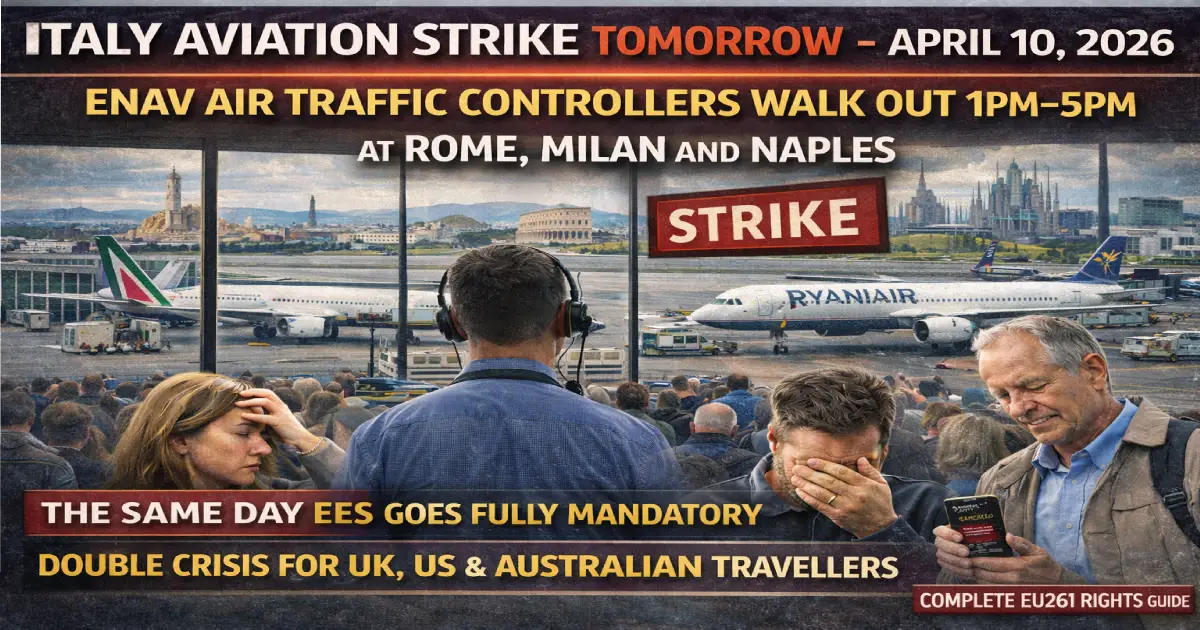
Critical warning for anyone flying through Italy tomorrow: Two separate and independently severe disruptions collide on Friday April 10, 2026 — a day that was already set to be one of the most complex in European aviation this year.
ENAV and Techno Sky air traffic control staff in Italy will walk out from 13:00 to 17:00 CET on Friday, April 10, 2026, grounding or delaying flights at Rome, Milan, Naples, and airports across the country. The four-hour stoppage, called by unions UILT-UIL, UGL-TA, Uiltrasporti, FAST-Confsal, and Astra, stems from a broader labour dispute over staffing levels, overtime limits, inflation-linked pay, and organizational restructuring.
Simultaneously, the EU’s Entry/Exit System goes fully mandatory at all 29 Schengen border crossings from midnight tonight — meaning April 10 is also the first full day that every British, American, Australian and Canadian passenger arriving in Europe must submit fingerprints and a facial scan at passport control.
These two events are not related to each other — but they are landing on the same day, at the same airports, affecting the same passengers. If you are flying to, from, through, or even over Italy tomorrow — act now.
Published: April 9, 2026 Strike Date: TOMORROW — Friday April 10, 2026 Strike Window: 13:00–17:00 CET (1PM–5PM Italian time / 12:00–16:00 UK time) Strike Entities: ENAV (national ATC) + Techno Sky (ATC technical systems) + ADR Security (Rome Fiumicino + Ciampino) easyJet flying crew: 4-hour co-strike 13:00–17:00 (USB Lavoro Privato) Unions: UILT-UIL, UGL-TA, Uiltrasporti, FAST-Confsal, Astra Root Cause: Iran war → jet fuel crisis → ATC workload explosion from diversion requests + pay/staffing disputes Airports Hit: Rome Fiumicino, Rome Ciampino, Milan Malpensa, Milan Linate, Naples Capodichino + all Italian regional airports Protected flight windows: 07:00–10:00 and 18:00–21:00 CET (Italian law ENAC mandate) EES goes mandatory: Midnight tonight — fully live from April 10 at all 29 Schengen borders Deal possible? Italy’s transport ministry held mediation talks April 8 — no deal confirmed. Plan for the strike to proceed. Previous precedent: March 7 ENAV strike disrupted 1,000–1,500 flights across Italy
Most disruption days involve one problem at a time. April 10 involves two.
Problem 1 — Italy ENAV ATC Strike: Air traffic controllers, the people who guide every aircraft taking off and landing across Italian airspace, are walking out for four hours during the busiest window of a Friday afternoon. Italy’s official transport strike board shows a cluster of four-hour walkouts from 13:00 to 17:00 local time involving ENAV staff nationally, Techno Sky nationally, ENAV units tied to Rome and Milan, ENAV staff at Naples airport, and ADR Security staff at Rome’s two main airports.
This is not just about airports. ENAV manages en-route air traffic control as well as approach and departure control at Italian airports. Because ENAV manages en-route air traffic as well as approach and departure control, the impact will not be limited to any single airport but will extend to overflights crossing Italian airspace. Flights passing over Italy between northern Europe and North Africa, the Mediterranean, and the Middle East — without even landing — may face holding patterns, speed reductions, or rerouting.
Problem 2 — EES Goes Fully Mandatory: From midnight tonight, the EU Entry/Exit System requires 100% of non-EU travellers to register fingerprints and a facial scan at every Schengen border crossing. Brussels Airport was already reporting queues of up to two hours under the phased rollout — and from April 10 the option to suspend checks during peak congestion is removed. For travellers this week, the rollout is likely to mean some airport delays, as authorities will no longer be able to suspend the process during travel peak times, as they have done over the past six months.
When a delayed flight caused by the ATC strike delivers passengers late to Rome or Milan — and those passengers then face a 1–2 hour EES biometric registration queue on arrival — the cascading effect on missed connections, cruise embarkations, hotel check-ins and onward travel is severe.
Why this day specifically? The unions say the strike is over workload and staffing concerns made worse by the Hormuz-induced fuel crisis, which is forcing controllers to handle a wave of diversion requests and last-minute flight-plan changes. The Iran war has effectively doubled the workload of Italian ATC staff — aircraft that previously flew straight corridors over the Middle East are now seeking longer alternative routings through European airspace, many of them threading through Italian en-route sectors. ENAV staff are managing a crisis-level workload without crisis-level pay or staffing. This strike is a direct consequence of that.
ENAV company personnel will hold a nationwide 4-hour strike on Friday, April 10, from 13:00 to 17:00. Disruptions to air traffic control services may affect flight operations at multiple airports. ENAV tower staff at Napoli-Capodichino Airport will stop work for 4 hours on April 10 from 13:00 to 17:00. ENAV tower staff at Milano Malpensa Airport will strike for 4 hours on April 10 between 13:00 and 17:00. Airport security personnel of ADR Security at Rome Fiumicino and Ciampino will strike for 4 hours, from 13:00 to 17:00 on April 10.
Additionally confirmed: USB Lavoro Privato has called a 4-hour national strike by easyJet flying crew from 13:00 to 17:00 on the same day — meaning easyJet passengers at Italian airports face both the ATC shutdown and a potential crew walkout simultaneously.
| Entity | Type | Hours | Scope |
|---|---|---|---|
| ENAV (national) | Air traffic control | 13:00–17:00 | All Italian airspace + airports |
| Techno Sky | ATC technical systems | 13:00–17:00 | All Italian ATC infrastructure |
| ENAV Rome ACC | Rome area control | 13:00–17:00 | Rome + central Italy airspace |
| ENAV Milan ACC | Milan area control | 13:00–17:00 | Milan + northern Italy airspace |
| ENAV Naples tower | Naples approach/tower | 13:00–17:00 | Naples Capodichino |
| ENAV Malpensa tower | Milan Malpensa approach | 13:00–17:00 | Milan Malpensa |
| ADR Security | Passenger security | 13:00–17:00 | Rome Fiumicino + Rome Ciampino |
| easyJet crew (USB) | Flying crew | 13:00–17:00 | All Italian easyJet bases |
The ADR Security strike at Rome deserves special attention. It means the bottleneck on April 10 at Rome Fiumicino is not just airspace — it is also passenger screening. Even passengers on flights operating within the protected morning or evening windows could face security queues extending into the disruption window, slowing the entire airport flow.
Every Italian commercial airport is within scope. ENAV manages the entire national airspace, including en-route, approach and tower functions. The airports facing the most severe disruption are:
Italy’s busiest airport and a major intercontinental hub. Rome departures deserve extra caution because a security layer is also involved there. Both the ATC staffing reduction AND the ADR Security walkout hit Rome simultaneously. Affected airlines: ITA Airways, Ryanair, easyJet, British Airways, Alitalia-code flights, Air France, KLM, Lufthansa, United, Delta, American.
Rome’s secondary airport serving Ryanair and low-cost routes. ADR Security also striking here simultaneously. Lower volume but higher proportional impact on the narrow schedule.
Italy’s second-busiest international hub. ENAV Malpensa tower staff walking out 13:00–17:00 directly. Affected airlines: easyJet, Ryanair, British Airways, Lufthansa, ITA Airways.
City-centre business airport. ENAV Milan ACC covers approaches into Linate. Primarily domestic and European short-haul exposure.
ENAV Naples tower staff on strike 13:00–17:00. Heavily exposed for UK, Irish, Australian and American leisure travellers connecting to Amalfi Coast and southern Italy.
Venice Marco Polo, Bologna, Florence, Catania, Palermo, Bari, Cagliari — all fall within Italian airspace managed by ENAV national. En-route disruption will affect overflights and approach routing for all of these airports throughout the 13:00–17:00 window.
Under Italian Law 146/1990 and ENAC (Italy’s Civil Aviation Authority) regulations, two daily windows are legally protected during aviation strikes:
Morning window: 07:00–10:00 CET Evening window: 18:00–21:00 CET
Additionally, ENAC protects:
Flights scheduled within these windows are more likely to operate normally. Additionally, ENAC protects “lifeline” routes to Sardinia, Sicily, and Italy’s smaller islands, as well as all departing and incoming intercontinental flights, and the transport of essential supplies.
Critical caveat — the protection window is not a guarantee: For connections, the decision threshold is simple. Keep the itinerary if your arrival lands in Italy before late morning or your onward departure is after the protected evening band begins. Rework it if the plan depends on a midday connection through Rome, Milan, or Naples, or if a missed onward segment would trigger a cruise miss, a nonrefundable hotel loss, or a same day international misconnect.
Important caveat: A flight inside a protected band is not a guarantee. Aircraft and crew rotations that depend on earlier legs can still cascade delays into these supposedly safer windows.
If your morning flight out of London arrives into Rome at 11:30 and you have a 13:15 connection — you are in the danger zone even though both individual flights fall near the protected windows.
On any other April 10, an ATC strike would be disruptive but manageable with proper planning. What makes April 10 2026 categorically different is the EES simultaneity.
Travellers will most likely need to reach the airport between an hour and a half to two hours earlier than they usually would, to account for EES-specific delays after April 10.
For UK, American, Australian and Canadian passengers arriving into any Italian airport on April 10 — or connecting through an Italian airport — the EES biometric registration adds a mandatory border queue on top of everything else. The EU has confirmed that from today, non-EU travellers such as those from the UK must have their biometric data — fingerprints and facial image — recorded when they enter the Schengen area for the first time.
At Rome Fiumicino on a normal Friday, passport control for long-haul arrivals already takes 30–45 minutes. On April 10 with EES mandatory and ATC delivering flights late into the airport, non-EU passengers should budget:
| Process | Normal | April 10 estimate |
|---|---|---|
| Deplaning + transit to immigration | 10 min | 15–20 min (congestion) |
| EES biometric registration (first time) | 8–12 min per person | 45–90 min queue |
| Baggage reclaim | 20 min | 35–60 min (delayed offload) |
| Total kerb to exit | ~50 min | Up to 3.5 hours |
For connecting passengers, this is a potentially fatal itinerary gap. A flight arriving 40 minutes late at Rome due to the ATC strike, followed by a 90-minute EES queue, followed by a delayed baggage claim means a 2.5-hour slip from your expected landside arrival time — and a missed connection that was booked with a 90-minute layover.
The EES pre-registration workaround: The official “Travel to Europe” EU app allows pre-registration of passport data and a biometric selfie up to 72 hours before travel, potentially shortening your queue at the dedicated kiosk lane. As of April 10, the app is fully live in Portugal and Sweden, and partially rolling out in France, the Netherlands and Italy. If you are travelling tomorrow via Rome or Milan, download the app (Google Play / Apple App Store: “Travel to Europe”) and register tonight.
If your flight departs UK and arrives at Rome, Milan or Naples within the 13:00–17:00 window — your arrival flight is at high risk of delay, diversion or cancellation.
If you arrive outside the window but within 60 minutes of it — your flight will likely be affected by the pre-strike congestion build-up (controllers begin managing the flow-down from 12:00) and the post-strike backlog (which typically runs until 20:00–21:00 as airlines re-sequence).
EES on arrival: This is your first entry into the Schengen Area on this passport? Arrive with extra time. Your first-time EES registration requires fingerprints from all 4 fingers and a facial scan. Use a staffed booth for the first registration — self-service kiosks are faster once you are enrolled but the first visit requires an officer’s supervision.
If your departure is between 13:00 and 17:00 — your flight is in the highest-risk window. Check your airline app from 6AM tomorrow for pre-cancellation notices.
ADR Security at Rome: Even if your flight is in the morning protected window, the ADR Security walkout at Fiumicino means check-in and security queues will be longer earlier in the day as passengers rush the morning window. Arrive at Fiumicino at least 3.5 hours before departure regardless of your scheduled time.
EES on departure: EES also applies on exit from the Schengen Area. Your fingerprint or photo will be scanned at border control as you leave Italy. Allow an additional 20–40 minutes at passport control on departure.
Long-haul flights between the US and Italy are protected under the ENAC guarantee — direct transatlantic services should generally operate. However:
Most Australian passengers route through Europe via Singapore or via the Middle East. If your European routing includes Rome or Milan as a transit hub:
This is the highest-stakes scenario on April 10. A ship does not wait. If your flight arrives late at Rome Fiumicino and you miss your transfer to Civitavecchia port, you will be chasing the ship.
Cruise passengers are also exposed. A flight that lands late into Rome or Naples can still break the day even if the ship sails hours later, because the lost slack usually shows up in baggage delivery, airport exit time, road transfer timing, and check-in cutoff pressure at the port.
If you are embarking a Mediterranean cruise on April 10 from either Civitavecchia or Naples:
Italy is not an isolated aviation market. Since Italy’s airspace serves as a major connector for international flights, disruptions in this region can have far-reaching effects: overflights crossing Italian airspace but not landing in Italy could be delayed due to air traffic congestion or extended air traffic sequencing. This will impact European, Middle Eastern, and Asian flight corridors.
Aircraft flying between northern Europe (Germany, Netherlands, UK, Scandinavia) and North Africa, the eastern Mediterranean, and the Middle East routinely transit Italian airspace at altitude. During the 13:00–17:00 strike window, ENAV’s en-route sector control centres reduce staffing — which forces controllers to widen separation between aircraft, reducing the throughput capacity of Italian airspace. Aircraft that cannot be accommodated in the reduced-capacity Italian en-route sectors will be held at departure, rerouted west over France and Spain, or slowed to increase spacing. This produces knock-on delays at airports well outside Italy that the ATC strike never directly touches.
Specific European routes at risk from Italian airspace congestion:
Do this RIGHT NOW tonight:
✅ Step 1: Open your airline app and check your flight status. Airlines typically pre-cancel or retime affected flights 24–48 hours before a confirmed strike. If your flight has already been retimed or cancelled, act immediately.
✅ Step 2: If your flight falls within 13:00–17:00 CET at any Italian airport — call your airline tonight and request a free rebook. Most carriers operating in Italy issue no-fee date or time changes for confirmed strike days. The earlier you call, the more availability remains on alternative services.
✅ Step 3: If you must travel in the protected windows (07:00–10:00 or 18:00–21:00), arrive at the airport early. Rome Fiumicino: 3.5 hours minimum. Milan Malpensa: 3 hours minimum. Naples: 3 hours minimum.
✅ Step 4: Download the “Travel to Europe” EES app tonight and pre-register your passport if your destination country supports it (Portugal, Sweden currently; Italy partially deploying). Even without the app, look up your biometric passport chip icon (gold camera symbol on the cover) — you will need it for the self-service kiosks.
✅ Step 5: If you are on a cruise itinerary departing April 10 — call your cruise line tonight to understand their disruption policy and nearest alternative embarkation point if your flight is delayed.
✅ Step 6: Confirm your travel insurance covers strike disruption. Policies purchased before the strike was publicly known (the strike was first registered on the Italian transport calendar approximately April 1) should be covered. Policies purchased after that date may exclude this specific event.
If your departure is cancelled:
This is where Italy’s ATC strike differs significantly from the Spain Groundforce and Menzies strikes that disrupted Easter.
ATC strikes are classified differently from ground handling strikes. ATC strikes are generally classified as “extraordinary circumstances” under EU Regulation 261/2004, so airlines are typically not required to pay the standard €250–€600 compensation.
However — and this is critical for UK passengers — there is an important exception:
When an airline’s own crew join the ATC strike (as easyJet’s flying crew are doing via the USB Lavoro Privato action), that portion of the disruption is classified differently. Staff strikes at the airline itself are NOT extraordinary circumstances. Staff strikes are NOT considered extraordinary under EC 261/2004, and cash compensation applies in the case of long delays and/or flight cancellations.
This means:
Duty of care applies universally regardless of cause:
✅ After 2 hours delay: Free meals and refreshments ✅ After 5 hours: Full refund + right to return home flight OR rebooking ✅ Overnight: Hotel + transport — when the overnight stay is caused by the airline’s operational decisions (not weather)
EU261 coverage by passenger type:
| Your situation | EU261 applies? |
|---|---|
| UK resident flying from Italian airport on any airline | ✅ Yes — EU261 covers all departures from EU airports |
| UK resident flying INTO Italy on EU carrier (ITA, easyJet) | ✅ Yes |
| UK resident flying INTO Italy on non-EU carrier (BA, Virgin) | ❌ EU261 does not cover arrivals on non-EU carriers |
| US/Australia resident flying from Italian airport | ✅ Yes — EU261 covers all departures from EU airports regardless of nationality |
| US/Australia resident flying INTO Italy on non-EU carrier | ❌ No EU261 — check airline’s own compensation policy |
UK261: The UK’s retained version of EC 261 mirrors EU261 exactly but is enforced by the UK Civil Aviation Authority. It covers all flights departing UK airports on any airline, and all arrivals into UK airports on UK-licensed carriers.
How to claim:
If rerouting entirely around Italy is an option, these are the cleanest alternatives:
Rome alternatives (arriving/departing Rome area):
Milan alternatives:
For UK-Italy travellers: The Eurostar + high-speed rail combination is viable for southern France and northern Italy if your final destination is Turin, Milan, Florence or Venice. London → Paris (2hrs 16min) → Lyon → Turin (by TGV or Ouigo) bypasses the disruption entirely.
Naples alternatives: There is no practical rail alternative to Naples for a same-day journey from the UK. If your Naples flight is cancelled, the options are rebook for April 11 or route via Rome the following day.
The strike ends at 17:00. Airports do not recover instantly. These disruptions may spill over into the rest of the day despite the strike ending at 05:00 PM.
Based on Italy’s previous ENAV strike on March 7 — which disrupted between 1,000 and 1,500 flights — the evening operations on April 10 will be managing a significant backlog. Expect delays on the 18:00–21:00 protected-window departures as airlines attempt to clear the queue of delayed passengers from the afternoon.
Full recovery of the Italian aviation network from a 4-hour nationwide ATC stoppage typically takes 18–24 hours. Saturday April 11 will see some residual disruption, particularly at Rome Fiumicino where the ADR Security walkout combined with Friday’s delays will have left aircraft and crew out of position.
Related Articles:
Posted By : Vinay
This article is provided for general informational purposes only and is based on information available at the time of publication. Travel advisories, airline schedules, airport operations, visa requirements, government regulations, and other travel-related information are subject to change without prior notice. While Travel Tourister makes reasonable efforts to verify information using official announcements, government publications, airline and airport communications, and other reliable sources, we cannot guarantee that all information remains complete, accurate, or up to date at all times. Readers should independently verify any information that may affect their travel plans with the relevant airline, airport authority, government agency, embassy, or other official source before making travel, financial, or other decisions. Travel Tourister shall not be liable for any direct or indirect loss, inconvenience, or damages arising from the use of or reliance on the information contained in this article. Nothing in this publication constitutes legal, immigration, financial, or professional travel advice. If you believe any information in this article is inaccurate or outdated, please contact our editorial team. We review all credible correction requests promptly and update our content whenever appropriate.
Lastest News
2nd Floor, 39, Above Kirti Club, DLF Industrial Area, Kirti Nagar, New Delhi, Delhi 110015



Travel Tourister is a leading Travel portal where we introduce travellers to trusted travel agents to make their journey hasselfree, memorable And happy. Travel Tourister is a platform where travellers get Tour packages ,Hotel packages deals through trusted travel companies And hoteliers who are working with us across the world. We always try to find new and more travel agents and hoteliers from every nook and corners across the world so that you could compare the deals with different travel agents and hoteliers and book your tour or hotel with the one you have chosen according to your taste and budget.
Copyright © Travel Tourister, India. All Rights Reserved

 Call
Call Enquiry