Published on : 12 Apr 2026
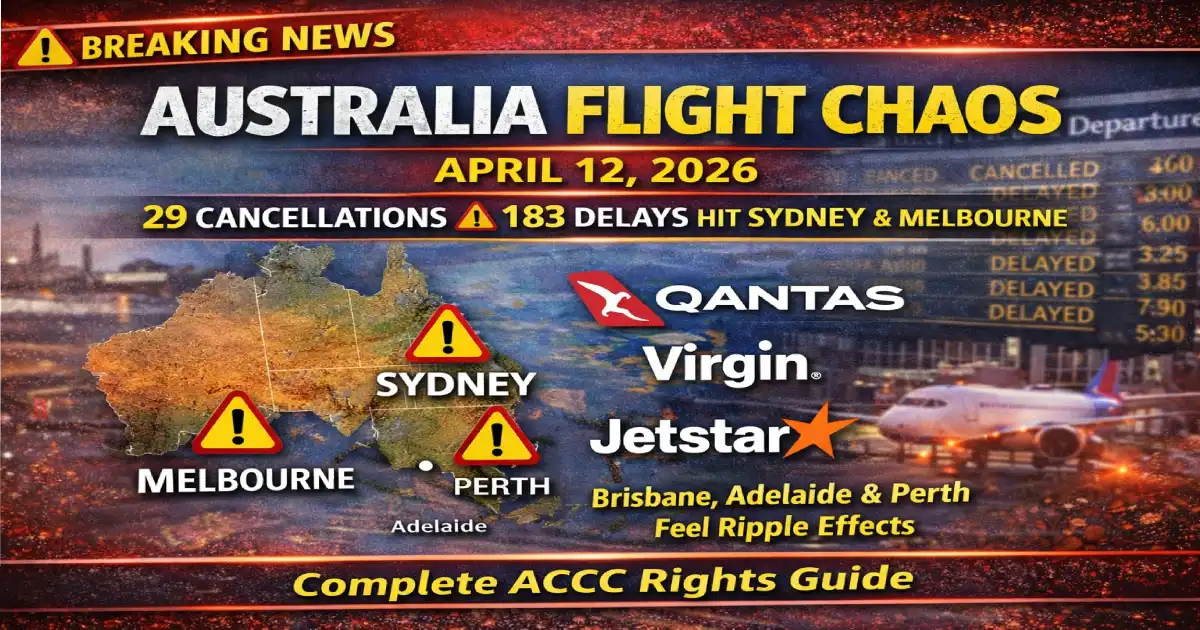
Australia’s two busiest airports have been engulfed in widespread disruption today, Sunday April 12, 2026, with the post-Easter travel surge colliding with adverse weather and air traffic control restrictions to produce the worst domestic flight chaos of the past fortnight. Australia’s major airports descended into widespread disruption on Sunday as 29 flights were cancelled and 183 others delayed across key hubs including Sydney, Melbourne, Brisbane and Perth, leaving thousands of passengers stranded during the busy post-Easter travel period.
If you are at an Australian airport right now, or have a flight today — here is everything you need to know, including your rights, what the airlines owe you, and how to claim.
Published: April 12, 2026 — Sunday Total disruptions: 212 (29 cancellations + 183 delays) Worst airport: Sydney Kingsford Smith (SYD) — heaviest concentration of cancellations and delays Second worst: Melbourne Tullamarine (MEL) — significant delay backlog all day Ripple airports: Brisbane (BNE) 24 delays + 2 cancellations · Perth (PER) 26 delays + 3 cancellations · Adelaide (ADL) secondary effects Airlines hit: Qantas · QantasLink · Virgin Australia · Jetstar · Cathay Pacific · Air New Zealand · Etihad Airways International routes disrupted: Sydney–Los Angeles · Sydney–Christchurch · Melbourne–Kuala Lumpur · Sydney–Canberra feeders Root causes: Adverse weather across coastal southeastern Australia + ATC flow restrictions + post-Easter network strain + constrained spare fleet capacity Compensation regime: Australian Consumer Law (ACL) + Airline Customer Advocate (ACA) + ACCC oversight Jetstar warning: No interline agreements — if cancelled, cannot be rebooked onto Qantas, Virgin or any other carrier
The chaos stemmed primarily from a combination of adverse weather conditions, air traffic control restrictions and operational challenges that overwhelmed ground handling and scheduling at the nation’s busiest gateways. Sydney Kingsford Smith Airport bore the heaviest burden, followed closely by Melbourne Tullamarine and Brisbane, with ripple effects felt in domestic and international connections.
Australia is in its autumn travel season, and the post-Easter Sunday period is one of the highest-demand days of the year as families and travellers return home from Easter holidays. The combination of peak-demand scheduling — airlines running at maximum utilisation with minimal spare capacity — and deteriorating weather across south-eastern Australia created the conditions for a cascade that began in the early morning and compounded through the afternoon.
Aviation experts pointed to a mix of weather-related problems and systemic pressures. Recent days have seen strong winds, heavy rain and lightning in parts of southeastern Australia, forcing ground staff off tarmacs for safety and slowing turnaround times. Lightning strikes prompted temporary halts at Melbourne Airport earlier in the week, with residual effects lingering into weekend operations.
The mechanics of how a Sunday collapse builds are well understood in Australian aviation: A single delayed flight between Sydney and Melbourne ripples through subsequent rotations, affecting aircraft positioning and crew scheduling for hours. High-frequency trunk routes — Sydney to Melbourne, Sydney to Brisbane, and Melbourne to Brisbane — experienced widespread cancellations and extended delays. These corridors represent the backbone of Australia’s domestic network, where Qantas, Jetstar, and Virgin Australia compete with multiple daily services.
There is also a structural factor amplifying today’s disruption. Australian carriers are currently operating with relatively constrained spare aircraft and gate capacity following strong demand recovery throughout 2025–2026. Industry competition monitoring has consistently highlighted how elevated aircraft utilisation reduces recovery capacity when unexpected disruptions occur.
Sydney is today’s epicentre. Sydney Airport recorded the highest concentration of problems, according to aggregated flight-tracking data cited in multiple reports. With its dual role as the country’s primary international gateway and a central domestic hub, schedule disruptions there quickly cascaded across both short-haul and long-haul operations.
Confirmed disruptions at Sydney include cancellations of Qantas services to Melbourne and Brisbane, Jetstar cancellations on Melbourne and Brisbane routes, and QantasLink cancellations on regional feeds. International services are also caught in the cascade: Etihad Airways’ flight to Los Angeles (AAL72) and Philippine Air Lines’ Manila service (PR310) also cancelled.
Sydney is Australia’s only truly global gateway — delays here do not just affect domestic passengers. A late Qantas departure from Sydney ripples forward into inbound connections at Los Angeles, Dallas–Fort Worth, Hong Kong, Singapore, and London. If you are connecting internationally through Sydney today, check your flight status immediately — do not assume your international service is unaffected just because your domestic inbound looks like it is running.
Melbourne is recording the second-highest disruption count. Melbourne, another critical hub for transpacific and Asian services, also experienced a high number of delayed departures and arrivals. Aircraft arriving late into Melbourne often turned around behind schedule, pushing subsequent flights further out of their allocated slots.
Carriers particularly affected at Melbourne: Qantas (including QantasLink regional feeds), Jetstar, and Virgin Australia. Domestic routes most impacted: Melbourne–Sydney, Melbourne–Brisbane, Melbourne–Adelaide. International connections to Kuala Lumpur and Auckland also affected by late-arriving inbound aircraft.
Brisbane is absorbing knock-on disruption as aircraft positioning from Sydney and Melbourne collapses the timing of inbound services. Airlines including Qantas and Virgin Australia saw their Queensland-bound flights delayed by up to 3 hours. Qantas had a number of domestic cancellations, notably for flights from Brisbane to Sydney. Jetstar also had some cancellations, including flights to Melbourne and Sydney.
Important note for Brisbane passengers: the Brisbane Airport rail link remains closed during the 23-day shutdown that began April 3 (running until April 26). With both rail access disrupted and flight delays building, ground transport to and from Brisbane Airport today is under significant pressure. Allow extra time for transfers, and pre-book your taxi, rideshare or bus — do not rely on hailing transport at the kerb.
Perth Airport, located on the far west coast of Australia, is facing its own set of challenges. With 26 delays and 3 cancellations reported, the airport remains a key node in Australia’s aviation system. Several domestic and international routes have been impacted, most notably flights from Perth to Sydney and Melbourne, operated by Qantas and Virgin Australia. Qantas’ flights to Melbourne and Sydney were cancelled, stranding many travellers en route to the east coast. International flights, including services to Auckland by Air New Zealand, were also affected.
Perth’s unique geography amplifies disruption. There is no alternative overland connection between Western Australia and the eastern states — if your Perth flight is cancelled, the only options are a later flight or an overnight stay. Perth passengers should call their airline as soon as they receive a cancellation notification, not wait until they arrive at the airport.
Adelaide is experiencing secondary delay effects from Melbourne and Sydney disruptions rather than a primary local cause. Aircraft that should have positioned into Adelaide from east-coast hubs are arriving late, pushing Adelaide departures behind schedule. Check your specific flight status via your airline app.
Qantas is carrying the largest share of today’s disruptions by volume, as Australia’s flag carrier and the dominant operator on every affected route. Qantas, Australia’s largest carrier, confirmed multiple delays on key routes and urged customers to check flight status via its app or website.
QantasLink — Qantas’s regional subsidiary operating turboprop and regional jet services to smaller communities — is particularly exposed today. When a QantasLink service to regional NSW, Queensland or South Australia is cancelled, there is often no competing airline and no same-day alternative. Affected passengers should call 13 13 13 (within Australia) for immediate rebooking.
Qantas rebooking policy: For disruption-caused cancellations, Qantas will rebook onto the next available service in the same cabin at no charge. If no same-day service is available, Qantas must provide hotel accommodation and meal vouchers if the delay requires an overnight stay caused by operational factors within the airline’s control. Use the Qantas app for fastest rebooking — the 13 13 13 phone queue will be long today.
Jetstar is today’s highest-risk carrier for passengers to understand. The low-cost subsidiary of Qantas operates on extremely tight turnaround margins, meaning disruptions cascade faster and deeper than at full-service carriers.
Critical Jetstar warning: Jetstar has no interline agreements with any other airline. If your Jetstar flight is cancelled, Jetstar cannot place you on a Qantas, Virgin Australia, Air New Zealand or any other carrier’s service. Your options are: (a) rebook on the next available Jetstar flight on the same route, or (b) request a full refund and purchase a new ticket independently. There is no automatic transfer to Qantas, even though Jetstar is a Qantas subsidiary.
Check your flight status at jetstar.com → Check in / Manage Booking, or call 131 538 within Australia. If your Jetstar flight is cancelled, submit your compensation and refund claim directly at jetstar.com → Help → Flight disruption.
Virgin Australia similarly advised passengers of potential changes, particularly on east coast services. Virgin Australia is the second-largest domestic carrier and operates the Sydney–Melbourne–Brisbane triangle at high frequency. Its disruptions today primarily affect these trunk routes and connections to Adelaide and the Gold Coast.
Virgin Australia’s cancellation and rebooking policy: passengers on cancelled services can rebook onto the next available Virgin Australia flight at no charge, or request a full refund. For delays exceeding 3 hours, Virgin will provide meal vouchers when the cause is within airline control. Contact: 13 67 89 within Australia, or virginaustralia.com → Manage Booking.
International flights into and out of Sydney and Melbourne are caught in the cascade. Late-arriving international inbounds are waiting for delayed domestic aircraft to clear gates. Late domestic feeders are missing connections to international services. If you are connecting from a domestic Qantas or Virgin Australia service onto an international departure today at Sydney or Melbourne, contact the international carrier directly as soon as you know your domestic service is delayed — do not wait until after you land.
Australia’s passenger rights framework is governed by the Australian Consumer Law (ACL), overseen by the Australian Competition and Consumer Commission (ACCC), with airline-specific disputes handled by the Airline Customer Advocate (ACA). Unlike the EU’s EU261 system, Australia does not have a fixed statutory cash compensation schedule for delays. What you are entitled to depends on the cause of the disruption and whether it is within the airline’s control.
✅ Accurate information about the reason for your delay or cancellation and an estimated new departure time ✅ Rebooking onto the next available service to your booked destination at no additional cost — when the cancellation is caused by the airline ✅ Full refund if you choose not to travel following a cancellation caused by the airline ✅ Reasonable care — if a delay or cancellation is caused by factors within the airline’s control and you face an extended wait, airlines are expected to provide meal vouchers and, for overnight delays they caused, hotel accommodation and transport
❌ Fixed cash compensation of €250–€600 (that is EU261 — it does not apply in Australia) ❌ Compensation if the disruption is caused by weather, ATC restrictions, or other factors genuinely outside the airline’s control ❌ Automatic rebooking onto a competitor’s aircraft — carriers rebook within their own network only (except where interline agreements exist, which Jetstar does not have)
If an airline refuses to rebook you, refuses to provide care during an extended delay, or provides a service that is significantly worse than what you paid for, your escalation path is:
Under the ACL, if an airline’s cancellation (caused by something within its control) results in you incurring reasonable additional expenses — hotel accommodation, meals, alternative transport — you have a right to seek reimbursement. Keep every receipt. This is not guaranteed but is enforceable under ACL if the cause was within the airline’s control. Weather-related cancellations are generally outside airline control and do not give rise to consequential loss claims.
The ACCC has been conducting enhanced monitoring of Australian domestic airline on-time performance and cancellation practices throughout 2026 as part of the Australian Government’s aviation consumer protection reforms. The ACCC Airline Monitoring Report (published quarterly) tracks Qantas, Jetstar and Virgin Australia on cancellation rates, delay rates, and refund processing times. If you believe an airline has breached its obligation to rebook or refund you, the ACCC consumer complaint form is the appropriate escalation channel after airline-level complaints are exhausted.
Today’s disruption does not stand alone. April 2026 has been a month of sustained aviation pressure across Australia and New Zealand that has gone largely unreported outside of specialist outlets. The picture across the month:
April 1: 521 delays and 46 cancellations across Australia and New Zealand — Brisbane worst with 136 delays, Perth recording a disproportionately high cancellation rate on FIFO routes. The Qantas Perth–London route was already operating via Singapore due to Middle East airspace rerouting.
April 5: 164 disruptions across Sydney, Melbourne, Brisbane and Canberra — Qantas, Air New Zealand, Singapore Airlines and China Airlines all affected. ATC coordination across eastern Australian airspace came under particular scrutiny.
April 6 (Easter Monday): 191 disruptions across Australia — post-Easter return surge with operational strain on all three major east-coast airports simultaneously.
April 8: 460+ delays and 36 cancellations across Sydney, Melbourne, Brisbane and Perth — one of the worst single-day counts of the month.
April 12 (today): 29 cancellations and 183 delays — the first major Sunday disruption of the post-Easter recovery period.
The pattern is clear: Australia’s domestic aviation network has been running without recovery capacity throughout the Easter–post-Easter period, and every adverse weather event or ATC flow restriction has produced outsized disruption because there are no spare aircraft and crews to absorb it.
Sunday’s events form part of a pattern of recurring disruptions in Australian air travel during 2026. Earlier incidents included weather-related cancellations in Adelaide and Melbourne, as well as significant international ripple effects from Middle East conflict in March that forced Virgin Australia flights bound for Doha to turn around mid-journey and left thousands of Europeans and Australians rerouting through longer, more expensive paths via Singapore or the United States.
Step 1 — Do NOT queue at the airport desk first. Open your airline app. Most rebooking happens faster through the app than in the desk queue, which on a day like today may be 60–90 minutes long.
Step 2 — Screenshot your original booking (confirmation email or boarding pass) before any changes are made. This is your evidence for any subsequent claims.
Step 3 — If your flight is cancelled, select rebooking — not a credit. A credit locks your money into that airline. Rebooking onto the next available flight is your right under ACL. If no same-day service exists and you need to travel, ask explicitly: “I am requesting rebooking onto the next available service to [destination] at no additional cost.”
Step 4 — If your delay exceeds 2–3 hours, ask your gate agent for meal vouchers. Qantas and Virgin Australia both have internal policies providing food and beverage vouchers for significant delays. Jetstar’s policy is more restricted — push firmly and keep all receipts regardless.
Step 5 — If your delay causes an overnight stay due to an airline operational cause (not weather), ask for hotel accommodation and transport. The airline is obligated to provide this for disruptions within its control. Get written confirmation (email or app message) that the hotel is being provided by the airline before you check in — this protects your reimbursement claim.
Step 6 — Document everything. Time-stamp screenshots of the departure board, your delay notification, any vouchers offered (or refused), and all expenses incurred.
✅ Check your flight status now: qantas.com, virginaustralia.com, or jetstar.com — all three have live flight status tools ✅ Allow at least 30 extra minutes beyond your normal arrival window today ✅ Travel carry-on only if possible — checked baggage handling is slower on high-disruption days ✅ If connecting to an international flight from a domestic service, call the international carrier now to flag the risk — do not wait until you land domestically
Australian aviation disruptions on a Sunday post-Easter typically take 12–24 hours to fully clear. Today’s cascade began in the morning and will persist through the afternoon and evening peak departures. The last wave of Sunday services — late-night returns from holiday destinations — is likely to see further pushbacks as aircraft and crew who fell behind earlier in the day have not fully recovered.
Smaller airports are also feeling the strain. Travel media reports have highlighted travellers stuck in cities such as Adelaide, Brisbane and Perth after inbound aircraft failed to arrive on time from Sydney or Melbourne. In many cases, limited frequency on certain routes leaves passengers facing long waits for the next available service, particularly on weekends when spare capacity can be tight.
Monday April 13 should see gradual improvement as aircraft and crew return to their home bases overnight and airlines process the accumulated rebooked passenger backlog. However, if the weather system tracking through south-eastern Australia persists into Monday morning, a second day of disruption at Sydney and Melbourne is possible. Check the Bureau of Meteorology forecast for Sydney and Melbourne before your Monday flight.
Related Articles:
Posted By : Vinay
This article is provided for general informational purposes only and is based on information available at the time of publication. Travel advisories, airline schedules, airport operations, visa requirements, government regulations, and other travel-related information are subject to change without prior notice. While Travel Tourister makes reasonable efforts to verify information using official announcements, government publications, airline and airport communications, and other reliable sources, we cannot guarantee that all information remains complete, accurate, or up to date at all times. Readers should independently verify any information that may affect their travel plans with the relevant airline, airport authority, government agency, embassy, or other official source before making travel, financial, or other decisions. Travel Tourister shall not be liable for any direct or indirect loss, inconvenience, or damages arising from the use of or reliance on the information contained in this article. Nothing in this publication constitutes legal, immigration, financial, or professional travel advice. If you believe any information in this article is inaccurate or outdated, please contact our editorial team. We review all credible correction requests promptly and update our content whenever appropriate.
Lastest News
2nd Floor, 39, Above Kirti Club, DLF Industrial Area, Kirti Nagar, New Delhi, Delhi 110015



Travel Tourister is a leading Travel portal where we introduce travellers to trusted travel agents to make their journey hasselfree, memorable And happy. Travel Tourister is a platform where travellers get Tour packages ,Hotel packages deals through trusted travel companies And hoteliers who are working with us across the world. We always try to find new and more travel agents and hoteliers from every nook and corners across the world so that you could compare the deals with different travel agents and hoteliers and book your tour or hotel with the one you have chosen according to your taste and budget.
Copyright © Travel Tourister, India. All Rights Reserved

 Call
Call Enquiry