Published on : 10 Apr 2026
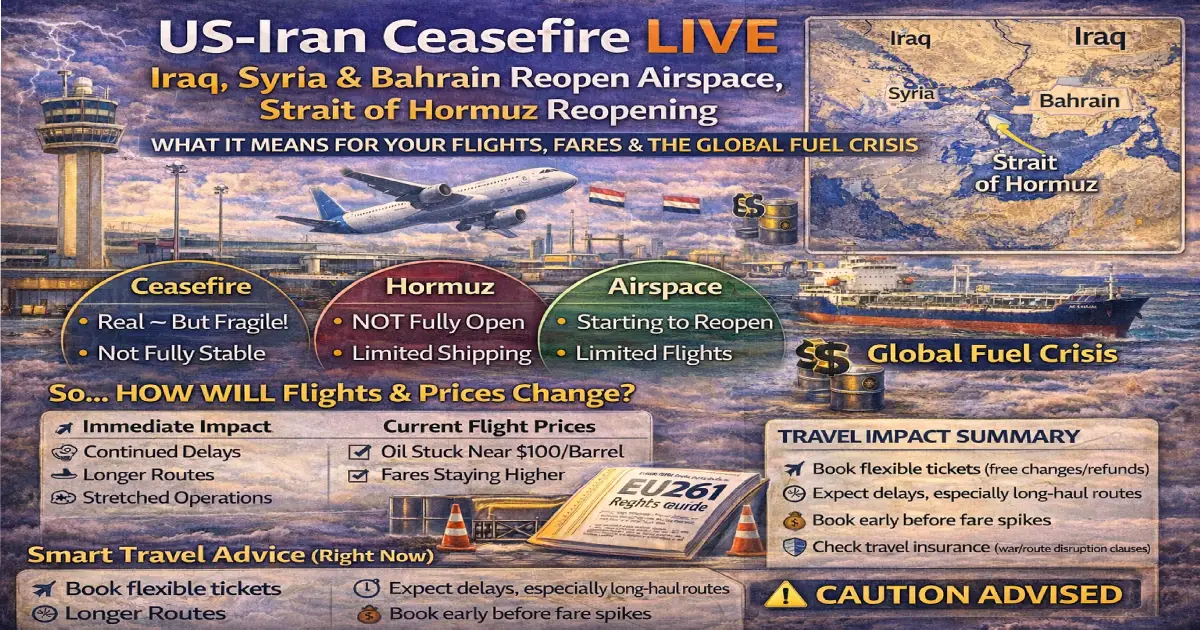
Breaking: The single most consequential travel development of 2026 happened on April 8. The US, Israel, and Iran agreed to a two-week ceasefire, under which Iran would also re-open the Strait of Hormuz. Within hours, three countries reopened their airspace. Jet fuel prices fell sharply. Airline stocks surged. And the fuel crisis that has been grounding flights, stranding passengers, and doubling fares since February 28 began — for the first time — to show signs of easing.
This is not a full resolution. This is a two-week truce that is already under strain, with Iran accusing the US of violations and the Strait of Hormuz still not fully open to oil tankers. But for travellers with flights through the Middle East, bookings on Emirates, Qatar Airways or Etihad, or holidays affected by the fuel surcharge spiral — this is the most important news to understand right now.
Here is everything that has changed, what it means for your specific flights, and what the critical uncertainties still are.
Published: April 9, 2026 Ceasefire Date: April 8, 2026 (announced April 7 US time / April 8 Middle East time) Mediated by: Pakistan (PM Shehbaz Sharif, General Asim Munir) Duration: Two weeks — expiry approximately April 22, 2026 Strait of Hormuz: Technically reopening — in practice still restricted (tolls, limited ships through) Airspaces reopened: Iraq ✅ Syria ✅ Bahrain ✅ Airspaces still restricted: UAE (EASA advisory active), Iran ✅ closed, Jordan (nightly closures 6PM–9AM), Saudi Arabia (contingency routings only) Emirates: ~70% pre-war capacity (150 daily departures from Dubai, ~20 destinations still suspended) Qatar Airways: ~40% capacity (100+ daily flights from Doha, schedule valid to April 15) Etihad: ~65% pre-war capacity (80+ destinations, expanding) Fuel price movement: Brent crude fell 16.4% on April 8 — then partially reversed Thursday (back to ~$96) IATA warning: Jet fuel supply chains may take months to normalise even with Hormuz reopening Ceasefire status today: Under strain — Iran alleges 3 violations. US denies. Negotiations continue in Pakistan this weekend.
The Iran war began on February 28, 2026, when US and Israeli forces launched military strikes on Iranian nuclear and military facilities. Iran retaliated immediately by closing the Strait of Hormuz — the narrow waterway through which approximately one-fifth of the world’s oil and gas supply flows — and launching missile and drone strikes at Gulf states hosting US military assets.
The consequences for global aviation were immediate and severe. The war’s economic impact, described as the world’s largest oil supply disruption since the 1970s energy crisis, includes surges in oil and gas prices, wide disruptions in aviation and tourism, and volatility in financial markets.
Jet fuel prices, which had been running at $85–$90 per barrel before the war, surged to between $150 and $200 per barrel within weeks. Airlines began cancelling thousands of flights. Air New Zealand cut 1,100 flights. SAS cut 1,000 flights. United Airlines announced a 5% network reduction. Every major European carrier rerouted away from the Middle East, adding 2–4 hours to Asia, Australia and India journeys and burning significantly more fuel on longer paths.
Then on April 7 US time — April 8 in the Middle East — Trump announced the deal. The truce, brokered by Pakistan, follows fierce exchanges of air strikes, missile attacks and threats that saw unprecedented strikes on Gulf nations, disrupted global shipping routes and heightened fears of a prolonged confrontation.
On 7 April, Trump announced on Truth Social that he has agreed to a two-week ceasefire with Iran and the proposal by Pakistan, stating that Iran will immediately open the Strait of Hormuz and work on finalizing a peace agreement.
The Iraqi Civil Aviation Authority (ICAA) announced the immediate reopening of the country’s airspace on Wednesday 8 April, ending 40 days of closure. All civilian flights — including overflights, departures, and arrivals — are now permitted to resume. All four commercial airports have reopened: Baghdad, Erbil, Basra, and Najaf.
This is the most significant aviation development in the ceasefire. Iraqi airspace is not just important for flights to Iraq — it is a critical overland corridor for flights between Europe and Asia. Hundreds of daily widebody flights from London, Amsterdam, Paris, Frankfurt and other European hubs to India, Southeast Asia and Australia historically transited Iraqi airspace. When Iraq closed on February 28, every one of those flights had to reroute west over Turkey and the Caucasus or south over Egypt — adding 60–90 minutes and hundreds of litres of extra fuel per flight.
Iraqi Airways has announced the resumption of both domestic and international flights as it begins a phased return to operations, with initial services focusing on domestic routes linking Baghdad, Erbil, Sulaymaniyah and Basra, alongside select international flights to destinations including Istanbul, Cairo and Amman.
The Syrian General Authority of Civil Aviation announced on April 8 the full reopening of all air corridors and the resumption of operations at Damascus International Airport. Syria had partially reopened its northern air corridors toward Turkey on March 3, and Aleppo Airport on March 4. The April 8 announcement completes that reopening.
However, some airlines including flynas have extended their flight suspensions to Damascus until mid-April, taking a cautious wait-and-see approach before recommitting capacity.
Bahrain’s Civil Aviation Affairs announced the full reopening of its airspace on Wednesday April 8. Bahrain became the first Gulf state to fully reopen since the conflict began on February 28.
Gulf Air is gradually resuming operations from Bahrain International Airport following the reopening of the country’s airspace, with services returning in phases. The airline has begun reintroducing international flights, with its network now covering destinations including London, Dubai, Riyadh, Jeddah, Mumbai, Delhi, Nairobi, Dhaka and Lahore.
Despite the ceasefire, large parts of Middle Eastern airspace remain closed or restricted. The situation is complex, volatile, and changing daily. Here is the current status as of April 9:
| Country/Airspace | Status | Airlines affected |
|---|---|---|
| Iran | 🔴 Closed — no civilian flights | All carriers |
| UAE (Dubai/Abu Dhabi) | 🟠 Restricted — EASA advisory active | European carriers avoiding; Emirates/Etihad operating |
| Israel | 🔴 Closed — ongoing conflict | All commercial carriers |
| Lebanon | 🔴 Closed — Israeli strikes continuing | All commercial carriers |
| Jordan | 🟠 Nightly closures 6PM–9AM still active | Partial disruption |
| Saudi Arabia | 🟠 Contingency routings only — Jeddah FIR restricted | Saudia operating limited schedule |
| Kuwait | 🟠 Partial — select routes suspended | Kuwait Airways operating limited |
| Qatar | 🟠 Restricted | Qatar Airways operating ~100+ daily flights |
| Iraq | ✅ Fully reopened April 8 | Iraqi Airways resuming |
| Syria | ✅ Fully reopened April 8 | Limited airline resumption |
| Bahrain | ✅ Fully reopened April 8 | Gulf Air resuming |
The European Union Aviation Safety Agency (EASA) still advises European operators to avoid UAE airspace entirely. This is why KLM, Air France and other European carriers are still not flying to Dubai even though Emirates is operating from there. Until EASA lifts or modifies its advisory, European airlines face liability issues that prevent them from restoring Gulf routes.
Emirates is operating from Dubai with 150 daily departures as of April 7, but roughly 20 destinations remain suspended. Full network restoration depends on what happens with the ceasefire negotiations.
What this means for you: If you have an Emirates booking for the next two weeks, your flight is more likely to operate than it was last week — but Emirates itself cautions that schedules remain subject to change at short notice. Roughly 20 destinations that Emirates served before the war are still not operating. Check your specific route status at emirates.com → Manage Booking. Emirates has an open rebooking waiver for tickets issued before February 28 for travel through April 30 — you can rebook to June 15 or request a full refund.
Qatar Airways is operating over 100 daily flights from Doha as of April 8 — up from approximately 80 earlier in the week. Updated schedule valid until April 15. Targeting 120+ destinations by mid-June.
What this means for you: Qatar Airways is the most cautiously recovering of the three Gulf mega-carriers. Its April 15 schedule validity means the airline will publish an updated schedule within the next 6 days — expect that to extend further and restore more routes if the ceasefire holds. Qatar Airways is offering complimentary rebookings for tickets with travel dates between February 28 and June 15, reschedulable up to October 31.
Etihad Airways has restarted flights from Abu Dhabi and is expanding its schedule, though capacity remains well below pre-conflict levels. Etihad is currently operating between Abu Dhabi and around 80 destinations across the Middle East, Africa, Asia, Australia, Europe and North America.
What this means for you: Etihad’s rebooking waiver covers tickets issued on or before February 28 for travel up to April 15 — rebook free onto Etihad-operated flights up to May 15. Check etihad.com → Manage My Booking for your specific flight status.
European airlines are taking divergent approaches to the Gulf. KLM is keeping its suspension of flights to Dubai, Riyadh and Dammam in place at least until mid-May, citing safety assessments and route planning considerations.
Air France has suspended flights to Dubai, Riyadh and Beirut through at least April 19, while other European carriers have extended suspensions to Dubai and parts of Saudi Arabia into May and beyond.
The EASA advisory is the key bottleneck. Until the European aviation safety regulator modifies its risk assessment for Gulf airspace, European carriers are legally unable to resume. Watch for EASA to publish an updated Conflict Zone Information Bulletin in the coming days.
British Airways has temporarily reduced its flying schedule in the Middle East. It has, however, operated repatriation flights from Muscat to London’s Heathrow as well as additional flights from Singapore and Bangkok to help passengers fly back to the UK. BA’s flights to Iran, Iraq, Lebanon, Qatar, Kuwait are suspended through at least May 30. Flights to Iran remain suspended through August 31.
The ceasefire agreement includes Iran’s commitment to reopen the Strait of Hormuz — the narrow passage through which one-fifth of the world’s oil flows. But the reality on the ground is more complicated.
Despite the agreement to open the Strait of Hormuz, it remains “effectively closed,” with Iran limiting the number of ships that can cross and charging tolls of over $1 million per ship. Only four ships carrying dry cargo — not oil or gas tankers — managed to pass through Hormuz on the first day of the truce.
The MarineTraffic.com ship-tracking organisation said two vessels had transited the Strait of Hormuz since the ceasefire was announced, one Greek-owned and the other flying a Liberian flag. They were bulk cargo vessels, not oil tankers.
This distinction matters enormously for travellers. Oil tankers carrying the crude oil that refineries process into jet fuel are still not transiting freely. The supply chain disruption to aviation fuel — which has been the direct driver of flight cancellations, route cuts and fare spikes since late February — will not resolve simply because the ceasefire was announced. The physics of the oil supply chain mean that even if Hormuz were fully reopened today, it would take weeks for tankers to move crude to refineries and months for refined jet fuel to reach airports at normal prices and volumes.
Willie Walsh, director general of the International Air Transport Association (IATA), told reporters: “It will still take a period of months to get back to where supply needs to be given the disruption to the refining capacity in the Middle East. I don’t think it’s going to happen in weeks.”
The market reaction to the ceasefire was immediate and dramatic. On April 8, US crude oil prices fell 16.4% in a single day — the sharpest single-day drop in years. Airline stocks surged 4–7% in European trading. The Dow Jones had its best day in a year.
But by Thursday April 9, markets had partially reversed. US West Texas Intermediate crude futures rose 2.6% to $96.89 a barrel and Brent crude futures rose 2.1% to $96.75 a barrel. Thursday’s moves are a slight reversal from the initial market reaction to the two-week ceasefire.
This whiplash reflects deep uncertainty about whether the ceasefire will hold. Here is what it means for travellers at each time horizon:
Immediate (next 2 weeks): Fares will not fall significantly. Airlines have hedged fuel, pre-loaded surcharges into existing prices, and will not rush to cut fares on the basis of a two-week truce that is already showing signs of strain. You will not wake up tomorrow to cheap fares to Australia.
Medium term (2–6 months): If the ceasefire leads to a permanent peace agreement and the Strait of Hormuz fully reopens to oil tanker traffic, jet fuel prices will gradually normalise — but IATA’s Walsh was explicit that “months” is the realistic timeline. Expect fares to remain elevated through at least summer 2026.
Long term (2026–2028): War-risk insurance premiums and elevated fuel costs from the Strait of Hormuz disruption are expected to keep prices higher than pre-conflict levels for two to three years, according to IATA and aviation analysts. Even a full resolution of the Iran war will leave a legacy of higher baseline aviation costs, because refinery capacity in the Gulf was damaged during the conflict and rebuilding that capacity takes years, not months.
This is the most important practical point in this entire article.
On April 8, Iran accused the United States of violating the ceasefire. Iran’s parliamentary speaker claimed three parts of Iran’s 10-point ceasefire proposal were violated, specifically continued Israeli attacks on Lebanon, a drone entering Iranian airspace, and the Islamic Republic being denied the right to enrich uranium.
Vice President JD Vance restated that if Iran does not follow through on promises to reopen the Strait of Hormuz, the ceasefire will end.
Iran claimed it has closed the Strait of Hormuz in response to Israel’s attacks on Lebanon, but White House press secretary Karoline Leavitt told reporters those reports are false.
The ceasefire is two weeks old and already generating mutual accusations of violations. The underlying dispute — Iran’s nuclear programme, Israeli attacks on Lebanon, US military presence in the region — has not been resolved. The two-week window is a negotiating pause, not a peace agreement.
Airspace closures could snap back within hours. Countries that have reopened may close again at short notice, and airlines will likely cancel flights immediately — so book flexible tickets and monitor developments closely.
Practical booking guidance:
Despite the ceasefire announcement, several things have NOT changed that directly affect Tier 1 travellers:
Government travel advisories remain in place. The UK FCDO, US State Department, Australian Department of Foreign Affairs and Trade, and Global Affairs Canada have all issued “Do Not Travel” advisories for Iran, Iraq, Israel, Lebanon and several other Middle Eastern destinations. These advisories have NOT been lifted by any of these governments following the ceasefire. Check before you travel: gov.uk/foreign-travel-advice (UK), travel.state.gov (US), smartraveller.gov.au (Australia), travel.gc.ca (Canada).
EASA advisory remains active. European airlines cannot safely operate to or through UAE airspace under the current EASA Conflict Zone Information Bulletin. Until EASA modifies its bulletin, European carriers will remain suspended from Gulf routes regardless of the ceasefire.
Australia/NZ route disruption continues. The longest-haul passengers to Australia and New Zealand have been the most severely affected throughout this crisis — many routes via Dubai, Abu Dhabi or Doha remain disrupted or suspended. While Etihad and Emirates are gradually restoring Australia capacity, full pre-war schedules will take weeks to rebuild even in an optimistic scenario.
Jet fuel surcharges on existing tickets are locked in. Surcharges already loaded into airfare prices are not automatically removed when oil prices fall. Airlines will reduce surcharges on new bookings as competitive pressure builds — but existing tickets retain their current pricing.
The next three days will be decisive for whether this ceasefire holds or collapses. Key developments to monitor:
Pakistan negotiations this weekend: US and Iranian negotiators are scheduled to meet in Islamabad to work toward formalising the truce. A successful meeting would likely extend the ceasefire and trigger broader airspace reopening — including potentially the UAE.
EASA Conflict Zone Bulletin update: EASA publishes updated aviation safety bulletins continuously during conflicts. Watch for a new bulletin that either relaxes or maintains restrictions on UAE/Gulf airspace — this is the trigger that European airlines are waiting for to resume Dubai routes.
Strait of Hormuz oil tanker transit: The key metric is not dry cargo vessels — it is oil tankers. When oil tankers begin transiting Hormuz in numbers approaching pre-war levels, jet fuel prices will begin their structural downward correction. Track at MarineTraffic.com.
Iran ceasefire compliance statement: If Iran’s parliamentary speaker continues to claim violations, the risk of the ceasefire collapsing within the two-week window rises materially. Watch Iranian state media and the White House for daily statements.
KLM/Air France Gulf suspension review: Both carriers have named mid-May as their current suspension extension. If the ceasefire holds and EASA modifies its bulletin, expect KLM and Air France to announce Gulf route resumption with approximately 2–3 weeks’ notice.
You do not need to have flights through the Middle East to be affected by this ceasefire — and you do not need to have flights through the Middle East to have been affected by the war.
Every airline in the world has been paying more for jet fuel since February 28. Every long-haul flight to Australia, New Zealand, Southeast Asia and India has been taking longer and burning more fuel on detour routings. Every carrier that cut routes, added surcharges, or restricted capacity over the past 40 days did so because of the fuel and airspace crisis that began when the Strait of Hormuz closed.
The ceasefire is the first genuine moment of relief in that 40-day crisis. It is fragile, incomplete, and already contested. But it is real — and for the first time since late February, the direction of the global aviation disruption is moving toward recovery rather than deterioration.
The question is not whether recovery will happen. It is how long it takes, and whether this specific two-week ceasefire is the beginning of a durable de-escalation or a brief pause before the conflict resumes.
The honest answer is: nobody knows yet. But for the first time in 40 days, that uncertainty cuts both ways.
Key Links and Resources:
Related Articles:
Posted By : Vinay
This article is provided for general informational purposes only and is based on information available at the time of publication. Travel advisories, airline schedules, airport operations, visa requirements, government regulations, and other travel-related information are subject to change without prior notice. While Travel Tourister makes reasonable efforts to verify information using official announcements, government publications, airline and airport communications, and other reliable sources, we cannot guarantee that all information remains complete, accurate, or up to date at all times. Readers should independently verify any information that may affect their travel plans with the relevant airline, airport authority, government agency, embassy, or other official source before making travel, financial, or other decisions. Travel Tourister shall not be liable for any direct or indirect loss, inconvenience, or damages arising from the use of or reliance on the information contained in this article. Nothing in this publication constitutes legal, immigration, financial, or professional travel advice. If you believe any information in this article is inaccurate or outdated, please contact our editorial team. We review all credible correction requests promptly and update our content whenever appropriate.
Lastest News
2nd Floor, 39, Above Kirti Club, DLF Industrial Area, Kirti Nagar, New Delhi, Delhi 110015



Travel Tourister is a leading Travel portal where we introduce travellers to trusted travel agents to make their journey hasselfree, memorable And happy. Travel Tourister is a platform where travellers get Tour packages ,Hotel packages deals through trusted travel companies And hoteliers who are working with us across the world. We always try to find new and more travel agents and hoteliers from every nook and corners across the world so that you could compare the deals with different travel agents and hoteliers and book your tour or hotel with the one you have chosen according to your taste and budget.
Copyright © Travel Tourister, India. All Rights Reserved

 Call
Call Enquiry