Published on : 01 Apr 2026
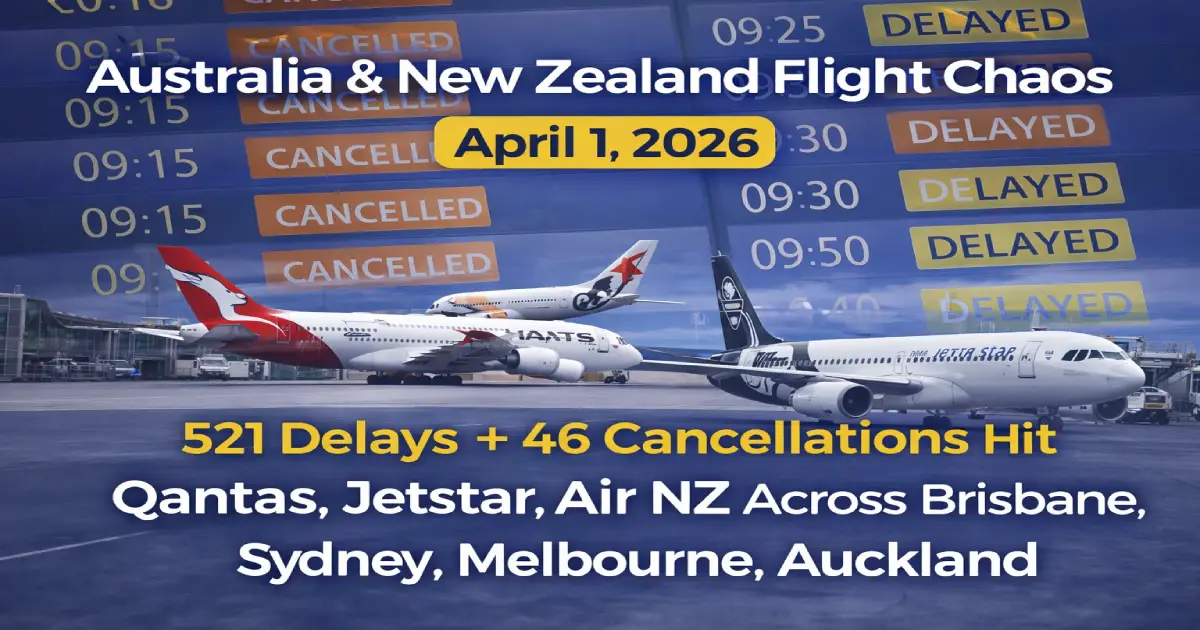
Breaking: Australia and New Zealand aviation is in crisis today. 521 delays and 46 cancellations are hitting Qantas, Jetstar, Air New Zealand, Alliance Airlines, and Network Aviation across every major hub. Brisbane faces a double emergency — a 23-day rail shutdown starts Thursday April 3. Here’s everything you need to know right now.
Published: April 1, 2026 Total Disruptions: 567 (521 delays + 46 cancellations) Passengers Affected: Est. 50,000–70,000 across Australia and New Zealand Worst Airport: Brisbane (136 delays + 6 cancellations) Airlines Hit: Qantas, Jetstar, Air New Zealand, Alliance Airlines, Network Aviation, QantasLink Root Cause: Operational strain, Middle East airspace rerouting, cascading crew and aircraft positioning failures Next Crisis: Brisbane entire rail network shuts down April 3–April 26 (23 days — no trains to airport)
Air travel across Australia and New Zealand has collapsed into widespread disruption today as 567 total flight disruptions — 46 cancellations and 521 delays — are grounding and delaying tens of thousands of passengers across six major airports. Flight information boards at Brisbane, Sydney, Melbourne, Perth, Auckland, and Adelaide are showing cascading delay notices across every terminal. Qantas, Jetstar, Air New Zealand, Alliance Airlines, Network Aviation, and QantasLink are all recording sustained operational failures.
This is not an isolated bad day. Australia’s aviation network has been under compounding pressure throughout 2026 from Middle East airspace closures, fuel price spikes, crew positioning failures, and infrastructure strain — and today’s numbers reflect a system that has no slack left to absorb disruption.
Key Numbers:
✈️ Total disruptions — 567 (521 delays + 46 cancellations) ✈️ Worst airport for delays — Brisbane (136 delays) ✈️ Worst airport for cancellations — Melbourne (11 cancellations) ✈️ Perth — 8 cancellations, high proportional cancellation rate ✈️ Auckland — 72 delays, 4 cancellations on trans-Tasman routes ✈️ Adelaide — 31 delays, 4 cancellations
Brisbane is the hardest-hit airport by delay volume in the entire region today, recording 136 delayed services and 6 cancellations. This is not a surprise. Brisbane is simultaneously dealing with an active Rail, Tram and Bus Union (RTBU) strike — and in 48 hours, the situation dramatically worsens.
The Brisbane double crisis passengers must understand:
Starting Thursday April 3, Brisbane’s entire rail network will shut down for 23 consecutive days until April 26, 2026. The Airtrain — the only direct rail connection to Brisbane Airport — will not operate. Every passenger flying through Brisbane after Thursday must arrange alternative ground transport now.
Rideshare (Uber, Ola), taxis, and private transfers will all experience extreme demand. Surge pricing on rideshare platforms during peak airport windows will be significant. Book your ground transport today — not tomorrow.
If you are flying through Brisbane between April 3–26:
Melbourne recorded the worst cancellation numbers of any airport in Australia today — 11 flights removed from the schedule, plus 95 delays. The combination of high cancellation volume and sustained delays confirms Melbourne is experiencing genuine system-level strain. Passengers connecting through Melbourne to international services, particularly on Qantas’s restructured European routes, face cascading risks if their domestic inbound leg is cancelled.
Carriers most affected at Melbourne today: Qantas, Jetstar, Virgin Australia.
Sydney matches Brisbane’s delay count today, confirming Australia’s two largest airports are both running at or beyond operational capacity. Three cancellations compound the disruption. Sydney is Australia’s most important international gateway — delays here directly cause missed connections for passengers travelling onward to London, Los Angeles, Tokyo, Singapore, and the United States. If you are transiting Sydney today to an international service, check your connection window immediately.
Perth recorded 8 cancellations today despite lower overall traffic volume — a disproportionately high cancellation rate that reflects structural operational pressure on Western Australia’s long-haul and FIFO (fly-in fly-out) services. Perth’s Qantas international services are already operating under a rerouted schedule: the Perth–London route is currently flying via Singapore for a fuel stop due to Middle East airspace adjustments. Passengers on long-haul Qantas services departing Perth must confirm their rerouted itinerary before arriving at the airport.
Auckland recorded 72 delays and 4 cancellations as New Zealand’s primary international gateway and the main trans-Tasman hub. Air New Zealand accounts for the majority of disrupted services. These delays are feeding directly into New Zealand domestic connections — passengers arriving late into Auckland for onward services to Wellington, Christchurch, Queenstown, and regional centres should check connecting flight status now.
Adelaide recorded 31 delays and 4 cancellations today. The disruption confirms that today’s chaos is nationwide — not concentrated at one or two hubs. Adelaide-based passengers connecting to mainland east coast services or international routes through Sydney or Melbourne face cascading delay risk.
As Australia’s flag carrier and the largest operator in the network, Qantas is recording sustained delays across all major hubs today. Qantas is simultaneously managing a major international schedule restructure driven by Middle East airspace disruptions:
Current Qantas international route changes:
Rebooking flexibility: For flights booked on or before April 30, 2026 for travel between February 28 and April 30, 2026, Qantas is offering fee-free date changes through the Qantas App or Manage Booking. Fee-free cancellations require a phone call to 13 13 13 within Australia, or your local Qantas office if calling from overseas.
Jetstar is a leading contributor to today’s delay count and the most cancellation-affected low-cost carrier in the region. Jetstar’s lean operating model — tight turnaround windows, minimal spare aircraft — means disruptions compound faster than at full-service carriers.
Critical warning for Jetstar passengers: Jetstar has no interline agreements. If your Jetstar flight is cancelled, the airline cannot rebook you onto Qantas, Virgin Australia, Air New Zealand, or any other carrier. You must rebook within Jetstar’s network or seek a refund and purchase a new ticket independently. Do not wait at the airport hoping for a rebooking — call Jetstar immediately or use the app.
Jetstar contact: +61 3 9645 5999 (international) | 131 538 (within Australia)
Air New Zealand is recording disruptions across trans-Tasman routes and domestic New Zealand services. Auckland is bearing the heaviest load, with Air New Zealand accounting for the majority of delayed and cancelled services into and out of New Zealand today. Passengers connecting from Australia to New Zealand regional destinations — Queenstown, Wellington, Christchurch, Nelson — should treat any connection schedule as provisional until confirmed via the Air New Zealand app.
Both regional carriers are disrupted today. Alliance Airlines serves Queensland and Northern Australia routes; Network Aviation serves FIFO corridors to resource sector sites in Western Australia. FIFO workers in particular face serious knock-on effects if connections through Perth or Brisbane are delayed — roster implications and relief logistics can cascade for days if flights are cancelled.
QantasLink’s regional feeder operations are under pressure across Sydney, Brisbane, and Melbourne. Regional passengers face the highest cancellation risk in today’s disruption environment. QantasLink operates smaller aircraft on thin routes where a single cancellation strands all passengers — unlike mainline services where airlines can split loads between multiple daily departures.
Australia does not have a statutory compensation framework equivalent to Europe’s EU261. However, your consumer rights remain substantial under Australian Consumer Law (ACL).
If your flight is cancelled:
If your flight is delayed:
For weather-caused disruptions:
For Jetstar passengers specifically:
Step 1 — Check your flight status before you leave home.
Use FlightAware, the Qantas App, the Jetstar App, or the Air New Zealand App. Check again 60 minutes before departure. Do not rely on email or SMS notifications alone — they lag behind real-time gate changes.
Step 2 — Arrive at the airport earlier than usual.
Add 60–90 minutes to your standard arrival time today. Check-in queues are longer, ground handling is slower, and gate changes are more frequent during periods of system-wide disruption.
Step 3 — Brisbane passengers: arrange ground transport immediately.
If your flight departs or arrives at Brisbane Airport between April 3 and April 26, you have no Airtrain access. Book a taxi, Uber, Ola, or private transfer now. Do not leave this until the day of travel — demand will exceed supply and surge pricing will be severe, particularly during morning and afternoon peaks.
Step 4 — Travel with carry-on only if your itinerary allows.
Checked baggage is more vulnerable during ground crew operational strain. Baggage handling is under pressure across all six disrupted airports today. If your trip permits, travel light and retain control of your bags.
Step 5 — Know your rights before you reach the counter.
Screenshot the relevant sections of this article. Know whether your airline is obligated to rebook you, provide meals, or offer accommodation based on whether your disruption is within or outside the airline’s control. Passengers who know their rights get better outcomes at check-in counters and customer service desks.
Today’s disruption reflects structural problems — not a one-day event.
Middle East airspace closures are forcing long-haul routes between Australia and Europe to reroute around closed Iranian and Iraqi airspace. This adds 2–4 hours to already long-haul sectors, increases fuel burn, creates crew positioning failures, and removes the schedule flexibility that allows airlines to absorb day-to-day operational disruptions. Qantas’s decision to reroute Perth–London via Singapore is a direct consequence of airspace geography that has fundamentally changed.
Jet fuel price spikes, also driven by Middle East instability, are squeezing airline margins. Fewer spare aircraft are available in the system because airlines have reduced capacity to manage costs — meaning every disruption compounds harder and recovers more slowly.
Ground transport infrastructure failure is now becoming an aviation issue in its own right. Brisbane’s 23-day rail shutdown, which begins Thursday, will force tens of thousands of passengers onto roads every day through late April. Extended airport access times will increase check-in queue pressure, create security lane congestion, and directly raise departure delay rates. The numbers in today’s disruption data will look worse, not better, by next week.
| Airport | Delays | Cancellations | Status |
|---|---|---|---|
| Brisbane BNE | 136 | 6 | 🔴 Critical |
| Sydney SYD | 136 | 3 | 🔴 Critical |
| Melbourne MEL | 95 | 11 | 🔴 Critical |
| Auckland AKL | 72 | 4 | 🟠 High |
| Perth PER | 47 | 8 | 🟠 High |
| Adelaide ADL | 31 | 4 | 🟡 Moderate |
April 1, 2026 is one of the worst single-day disruption events in Australian and New Zealand aviation this year. 567 total disruptions across six major airports confirm that the regional system is operating beyond its capacity to absorb shocks. Brisbane passengers face an immediate additional crisis with the April 3 rail shutdown — the window to arrange alternative ground transport is closing now, not tomorrow.
Check your flight before you leave home. Arrive early. If you are flying through Brisbane this week, book your car or taxi today. Know your refund and rebooking rights under Australian Consumer Law. And if you do not have travel insurance for upcoming travel, understand that weather-related disruptions will not be covered by the airline.
Australia’s aviation network is under sustained pressure. Build flexibility into every trip through April 2026.
For More Resources:
Related Articles:
Posted By : Vinay
This article is provided for general informational purposes only and is based on information available at the time of publication. Travel advisories, airline schedules, airport operations, visa requirements, government regulations, and other travel-related information are subject to change without prior notice. While Travel Tourister makes reasonable efforts to verify information using official announcements, government publications, airline and airport communications, and other reliable sources, we cannot guarantee that all information remains complete, accurate, or up to date at all times. Readers should independently verify any information that may affect their travel plans with the relevant airline, airport authority, government agency, embassy, or other official source before making travel, financial, or other decisions. Travel Tourister shall not be liable for any direct or indirect loss, inconvenience, or damages arising from the use of or reliance on the information contained in this article. Nothing in this publication constitutes legal, immigration, financial, or professional travel advice. If you believe any information in this article is inaccurate or outdated, please contact our editorial team. We review all credible correction requests promptly and update our content whenever appropriate.
Lastest News
2nd Floor, 39, Above Kirti Club, DLF Industrial Area, Kirti Nagar, New Delhi, Delhi 110015



Travel Tourister is a leading Travel portal where we introduce travellers to trusted travel agents to make their journey hasselfree, memorable And happy. Travel Tourister is a platform where travellers get Tour packages ,Hotel packages deals through trusted travel companies And hoteliers who are working with us across the world. We always try to find new and more travel agents and hoteliers from every nook and corners across the world so that you could compare the deals with different travel agents and hoteliers and book your tour or hotel with the one you have chosen according to your taste and budget.
Copyright © Travel Tourister, India. All Rights Reserved

 Call
Call Enquiry