Published on : 14 Apr 2026
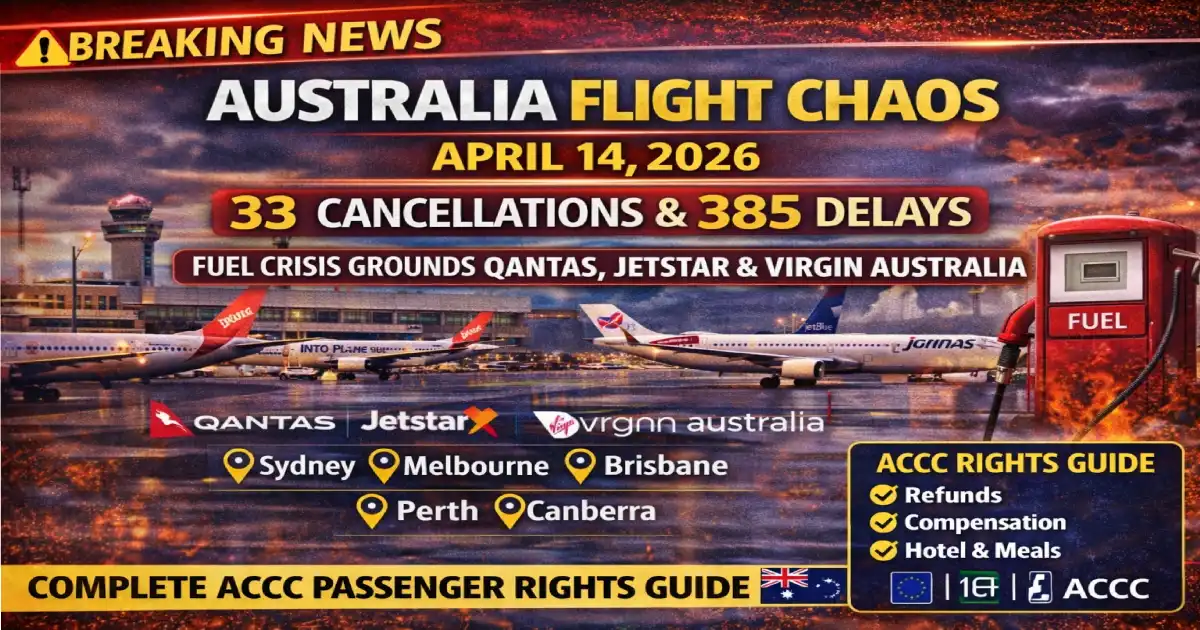
Breaking: Australia is recording its worst aviation disruption of the month on Tuesday, April 14, 2026. A total of 418 flight disruptions — 33 cancellations and 385 delays — are paralysing the nation’s primary airports as a fuel supply crisis stretching from the global Strait of Hormuz disruption hits Qantas Group and Virgin Australia operations simultaneously. Sydney Kingsford Smith Airport bears the heaviest load with 245 delays and 12 cancellations, making it today’s single most disrupted airport in the country. Melbourne Tullamarine follows with 160 delays and 10 cancellations, while Brisbane, Perth, and Canberra are all recording significant disruption numbers. Jetstar is today’s worst-performing carrier with 9 cancellations and 121 delays. Qantas is recording 6 cancellations and 107 delays. QantasLink has 6 cancellations and 57 delays. Virgin Australia is reporting 1 cancellation and 100 delays. International transpacific and Asian routes out of Sydney and Melbourne are absorbing the cascade — passengers connecting onward to Los Angeles, Singapore, and Tokyo face the highest risk of missed connections today. This is not a continuation of April 12’s weather-driven event. Today’s 418 disruptions are fuel-crisis driven — a structurally different cause producing a larger number and a harder recovery window. If you are flying through any Australian airport today, here is every number, every carrier, and exactly what you are owed under Australian law.
Published: April 14, 2026 — Tuesday Airports: Sydney (SYD) · Melbourne (MEL) · Brisbane (BNE) · Perth (PER) · Canberra (CBR) Total Disruptions: 418 (33 cancellations + 385 delays) Disruption Rank: #1 worst aviation day in Australia this month Worst Carrier: Jetstar — 9 cancellations + 121 delays Additional Carriers Affected: Qantas, QantasLink, Virgin Australia, Singapore Airlines, Air New Zealand, United Airlines (international connections) Triggering Event: Jet fuel supply crisis — global fuel shortage compounded by Strait of Hormuz rerouting costs Hardest Hit Routes: Sydney–Melbourne, Sydney–Brisbane, Melbourne–Perth, Sydney–Los Angeles, Melbourne–Singapore, Sydney–Auckland Passengers Affected: Est. 30,000–45,000 across all five airports Primary Cause: Jet fuel rationing and supply shortfall — airlines implementing emergency fuel conservation and selective cancellations National Context: 598 total delays reported across Sydney, Melbourne, Brisbane, Canberra, and Perth combined Sydney Daily Flights: ~1,000 — Australia’s primary international gateway Qantas Group Market Share: ~65% of all domestic Australian capacity Why This Is Different from April 12: April 12’s 212 disruptions were weather and ATC driven. Today’s 418 disruptions are fuel-crisis driven — airlines are proactively cancelling flights to conserve supply, meaning recovery is not weather-dependent and could extend into tomorrow
Australia’s aviation network is recording 418 total disruptions today — 33 cancellations and 385 delays — making April 14, 2026 the worst single-day aviation disruption this month across the country. This is not yesterday’s story. This is a fuel-driven event with a completely different operational profile and a harder recovery path.
A jet fuel supply crisis, rooted in the global supply chain disruption caused by Strait of Hormuz flight rerouting over the past several weeks, has reached Australian tarmacs. Fuel supply to Sydney, Melbourne, Brisbane, Perth, and Canberra airports has been constrained, with Air BP Italia-style supply rationing now confirmed at Australian aviation fuel terminals. Airlines are implementing emergency measures: Qantas Group has activated contingency plans including fuel rationing and selective flight cancellations to conserve resources. Carriers are prioritising which routes receive sufficient fuel to operate and which rotations must be cut — transforming what would ordinarily be a manageable operational constraint into a cascading network failure.
The fuel crisis’s operational impact at Sydney is structurally unlike a weather event. A thunderstorm or ATC restriction clears within hours. A fuel supply shortfall does not clear when the sky brightens. Today’s 245 Sydney delays and 12 cancellations are being driven by airlines actively choosing which aircraft to fill and which rotations to ground — and those choices are rippling forward into tomorrow’s positioning as well.
Three forces are compounding the fuel crisis into today’s total:
🔴 Global jet fuel supply chain disruption — Strait of Hormuz rerouting costs — Australia’s jet fuel supply is tightly connected to global aviation fuel markets. The Strait of Hormuz disruptions of late March and April 2026, which forced carriers to reroute long-haul operations and dramatically increased fuel burn on Asian and Middle Eastern connections into Australia, have elevated the cost and constrained the supply of aviation fuel at Australian terminals. Qantas’s own international rerouting — Perth–London now operating via Singapore fuel stop, Sydney–Paris now routed via Singapore instead of Perth — reflects how the global fuel situation is shaping Australian operations from the top down.
🔴 Jetstar’s ultra-low-cost operating model — zero buffer for fuel rationing — Jetstar’s 9 cancellations today are not a coincidence. As an ultra-low-cost carrier operating on minimum turnaround times, minimum spare aircraft, and maximum aircraft utilisation, Jetstar is structurally the most vulnerable Australian carrier when fuel availability constrains operational choices. A Jetstar aircraft intended to operate five daily rotations cannot complete its day when its third rotation is grounded for fuel conservation — the aircraft is in the wrong city, the crew has exceeded duty time windows, and tomorrow’s first Jetstar departure from that city starts from a positioning deficit. Today’s 121 Jetstar delays are that cascade playing out across every east coast route simultaneously.
🔴 Post-Easter network strain — Day 14 of sustained disruption — April 14 marks the fourteenth consecutive day of above-normal disruption across Australia’s aviation network. Easter Monday (March 30) delivered 806 delays and 45 cancellations across Australia and New Zealand. The weeks since have provided no genuine recovery window — April 1 brought 521 delays and 46 cancellations; April 3 triggered the Brisbane rail shutdown; April 8 delivered 460+ delays and 36 cancellations nationally. Today’s fuel crisis is hitting an aviation network that has been running with reduced spare aircraft, depleted crew positioning buffers, and compressed scheduling flexibility for two straight weeks.
The ripple from Australia today is moving in every direction. Transpacific passengers connecting through Sydney to Los Angeles face missed connections as inbound domestic feeders arrive late. Asian route passengers transiting Melbourne for Singapore and Hong Kong services are caught in the same cascade. And domestically, the Sydney–Melbourne trunk route — Australia’s busiest air corridor by volume — is recording delays on both ends simultaneously, meaning the cascade is self-reinforcing rather than directional.
| Airport | Delays | Cancellations | Total Disruptions |
|---|---|---|---|
| Sydney Kingsford Smith (SYD) | 245 | 12 | 257 |
| Melbourne Tullamarine (MEL) | 160 | 10 | 170 |
| Brisbane (BNE) | 113 | 6 | 119 |
| Perth International (PER) | 59 | 3 | 62 |
| Canberra International (CBR) | 21 | 2 | 23 |
| National Total | 598 (all airports) | 33 | 418+ |
| Passengers Affected | Est. 30,000–45,000 | — | — |
| Root Cause | Jet fuel supply crisis — rationing and selective cancellations | — | — |
| Disruption Type | Proactive + cascade — not weather-cleared | — | — |
| Previous Day (April 12) | 183 delays + 29 cancellations = 212 | — | Separate event |
The fuel supply crisis has hit every carrier at Australian airports today — but the impact is not evenly distributed. Jetstar, with its zero-buffer operating model, is absorbing the worst of today’s disruption in absolute numbers. Qantas and QantasLink are managing the broadest geographic spread of affected routes. Virgin Australia is holding better in cancellation terms but recording 100 delays that span both east coast and interstate services.
Jetstar is today’s story at every Australian airport. Operating as Qantas Group’s ultra-low-cost subsidiary, Jetstar runs one of the highest aircraft utilisation rates in Australian aviation — narrow-body Airbus A320 and A321 aircraft scheduled for four to six sectors per day across the domestic network. That utilisation rate is the foundation of Jetstar’s cost model and the structural reason it is the most disrupted carrier when a system-wide constraint like fuel rationing forces selective cancellations.
Today’s 9 Jetstar cancellations are proactive — meaning Jetstar operations teams selected which rotations to ground based on available fuel supply at each airport, not because aircraft went unserviceable. A proactive cancellation at 6:00 AM removes one rotation from the fuel demand calculation. It also removes the aircraft from its scheduled rotation path — meaning it is not available for its next sector, its sector after that, or its eventual return to base. The 121 Jetstar delays following those 9 cancellations are the mathematical consequence of pulling nine aircraft out of the rotation grid.
Most disrupted Jetstar routes today:
What Jetstar passengers must do right now: ✅ Open the Jetstar app immediately — check your flight status before leaving for the airport ✅ If cancelled: Jetstar has no interline agreements — it cannot rebook you onto Qantas, Virgin, or any other carrier. You are entitled to a full refund to your original payment method or rebooking on the next available Jetstar flight only ✅ If the next available Jetstar flight is 24+ hours away, invoke your Australian Consumer Law (ACL) right to a full refund and book independently ✅ Keep all receipts from the moment disruption is confirmed — meal costs and accommodation may be claimable if the delay was within Jetstar’s control ✅ Call Jetstar: 131 538 (within Australia) or use the Jetstar app for self-service options ✅ Do not accept a travel voucher or credit without first asking whether a full refund is available — under ACL, a refund to your original payment method is your right for cancellations
Qantas is today’s second most disrupted carrier by total count — 113 disruptions across its domestic and international network. As Australia’s flag carrier and largest domestic operator, Qantas absorbs disruption across the broadest geographic footprint: trunk routes between Sydney, Melbourne, Brisbane, and Perth; international services to Los Angeles, London (via Singapore), Tokyo, and Auckland; and regional services through its QantasLink subsidiary (counted separately below).
Today’s 6 Qantas cancellations represent the selective grounding decisions made by Qantas operations teams to manage fuel allocation — with the longest-haul and lowest-load-factor rotations most likely to be cut first. The 107 Qantas delays that follow reflect the cascade from those cuts through a rotation network where each aircraft is scheduled to complete four to six sectors per day.
International Qantas passengers face a specific compounding risk today: Qantas is already operating its European services on rerouted schedules following the Middle East airspace disruption. The Perth–London service is currently routing via Singapore for a fuel stop. The Sydney–Paris service is routing via Singapore instead of Perth from mid-April through mid-July. Today’s domestic fuel-driven delays are hitting a Qantas international network that is already running with extended flight times, tighter fuel margins, and less scheduling buffer than its normal operating configuration.
Most disrupted Qantas routes today:
What Qantas passengers must do: ✅ Use the Qantas App — live flight status and self-service rebooking in one place ✅ Call Qantas: 13 13 13 (within Australia) — Platinum/Gold members use the dedicated elite line ✅ Rebooking flexibility: For flights booked on or before April 30, 2026 for travel through April 30, Qantas is offering fee-free date changes through the Qantas App or Manage Booking — check eligibility before calling ✅ International passengers on disrupted transpacific or Asian services: your Qantas Frequent Flyer status entitles you to priority rebooking — invoke it at check-in or at the service desk ✅ If cancelled: demand a full refund to your original payment method — not a voucher or Qantas Points credit
QantasLink — the regional subsidiary of Qantas Group — is recording 63 total disruptions today, concentrated on routes connecting smaller regional cities to the main east coast hubs. QantasLink operates turboprop and smaller jet equipment on services that typically operate once or twice daily — meaning the route structure has zero frequency buffer, identical to Caribbean routes from Miami. A cancelled QantasLink service from Dubbo or Tamworth to Sydney is not recoverable same-day. The next departure is tomorrow.
What QantasLink passengers must do: ✅ If your once-daily regional service is cancelled, you are entitled to a full refund under Australian Consumer Law — take it and consider ground transport if same-day travel is essential ✅ Call QantasLink through the main Qantas line: 13 13 13 — regional passengers are routed through the same reservation system ✅ If your regional cancellation causes a missed Qantas or international connection, advise Qantas immediately — they have a protocol for through-booking protection on disrupted feeder services
Virgin Australia is today’s relative outlier: a single cancellation but 100 delays — a pattern that reflects Virgin’s decision to maintain operational integrity (keeping aircraft flying) at the cost of schedule accuracy rather than making proactive cancellations. For passengers, this distinction matters. A delay means your flight will operate — eventually. A cancellation means it won’t.
Virgin’s 100 delays today are concentrated on east coast trunk routes — Sydney–Melbourne, Sydney–Brisbane, Melbourne–Brisbane — where its Airbus A320 and Boeing 737 fleets are competing for gate space and fuel allocation alongside Qantas and Jetstar. Virgin’s relatively lower cancellation count should not be read as a better operational day — it is a different operational philosophy in response to the same fuel constraint.
Most disrupted Virgin Australia routes today:
What Virgin Australia passengers must do: ✅ Use the Virgin Australia app for live flight status — updates are pushed in real time ✅ Call Virgin Australia: 13 67 89 (within Australia) ✅ If your delay extends beyond 3 hours on a domestic service, request meal vouchers at the check-in desk ✅ If ultimately cancelled: full refund or rebooking — your choice under Australian Consumer Law
Singapore Airlines (SIN–SYD / SIN–MEL): Singapore Airlines services arriving into Sydney and Melbourne are collecting delays from inbound positioning timing — but the more acute risk is outbound: passengers connecting from disrupted domestic Qantas and Jetstar feeders into Singapore Airlines’ evening departures from Sydney face missed connections if their feeder arrives late. Singapore Airlines is currently operating normally on its own equipment; the risk is entirely on the connecting domestic side.
Air New Zealand (AKL–SYD / AKL–MEL): Trans-Tasman services are experiencing secondary delays linked to Sydney’s 245-delay operational picture. Air New Zealand has no fuel crisis exposure on its own routes — the disruption risk is in connecting through Sydney and Melbourne on disrupted Jetstar or Qantas domestic feeders.
United Airlines (LAX–SYD): United’s transpacific service arrivals into Sydney are running normally — the risk for United passengers today is the domestic connection from Sydney to their final Australian destination on Qantas, Jetstar, or Virgin. If your United arrival is on time but your onward Qantas domestic connection is cancelled, contact Qantas immediately at check-in — through-booking protections may apply depending on how your ticket was purchased.
| City / Route | Airport | Impact Today |
|---|---|---|
| Sydney → Melbourne | SYD–MEL | Australia’s busiest corridor — all three carriers delayed; highest total disruption volume |
| Sydney → Brisbane | SYD–BNE | East coast trunk route — Qantas, Jetstar, Virgin all affected |
| Melbourne → Brisbane | MEL–BNE | East coast triangle third leg — sustained delays both directions |
| Sydney → Perth | SYD–PER | Transcontinental — Qantas and Virgin both delayed; long-haul recovery time |
| Melbourne → Perth | MEL–PER | Jetstar’s longest domestic trunk — critically impacted by fuel conservation cuts |
| Sydney → Los Angeles | SYD–LAX | Qantas transpacific — domestic feeder delays create missed connection risk |
| Sydney → Auckland | SYD–AKL | Qantas and Air New Zealand Tasman service delayed |
| Melbourne → Singapore | MEL–SIN | Asian gateway — delayed from domestic cascade |
| Sydney → Tokyo Narita | SYD–NRT | Qantas Japan corridor at risk |
| Perth → London | PER–LHR | Already rerouted via Singapore fuel stop — today’s disruption adds further complexity |
| Sydney → Canberra | SYD–CBR | QantasLink regional feeder — once-daily frequency means no same-day recovery |
| Brisbane → Regional Queensland | BNE–Regional | QantasLink — multiple once-daily regional services at risk |
The single most important thing Australian passengers need to understand about today’s disruption is that it is not weather-dependent. A thunderstorm that grounds aircraft at Sydney at 7:00 AM typically passes by noon. The delayed flights then begin operating again, and the schedule compresses but recovers across the afternoon. Today’s fuel supply constraint does not work like that. Airlines have made the decision to cancel specific flights based on fuel availability — and that availability does not improve within the same operating day. The 33 cancellations confirmed this morning will not be reversed. The 385 delays will not all recover by evening. The disruption window extends into tomorrow’s positioning.
Every time Australian aviation faces a system-wide constraint — whether weather, ATC, or now fuel — Jetstar is the carrier that shows the disruption numbers first and largest. This is not coincidence and it is not poor management. It is the mathematical outcome of ultra-low-cost operating structure. Jetstar flies maximum sectors per aircraft per day. It holds minimum spare aircraft. It operates minimum crew reserves. When one variable in that equation — today, fuel supply — becomes constrained, the entire timetable for that aircraft’s day collapses simultaneously. Today’s 9 Jetstar cancellations and 121 delays are telling passengers something important: the system-wide stress today is severe.
The Sydney–Melbourne corridor is the busiest air route in Australia and one of the busiest in the world by frequency. Qantas, Jetstar, and Virgin Australia combined operate well over 40 services per day in each direction on this route. When that corridor is running 245 delays at Sydney and 160 at Melbourne simultaneously, the capacity for airlines to absorb displaced passengers from cancellations onto later services collapses. The alternative flights are also full, also delayed, and also competing for the same constrained fuel supply. Passengers who are cancelled off the Sydney–Melbourne route today may face a genuine multi-hour wait even for rebooking onto another delayed service — not because the airline is unresponsive, but because the corridor is physically at capacity.
Sydney Kingsford Smith is Australia’s primary international gateway. On any given Tuesday in April, dozens of international long-haul services depart Sydney for Los Angeles, London, Tokyo, Singapore, and the Middle East. The passengers boarding those services need to arrive via domestic feeder flights from Brisbane, Melbourne, Perth, Adelaide, and regional centres. When today’s fuel crisis cancels or delays those feeder flights by 2–4 hours, passengers miss their international departure. Unlike a missed domestic connection — which can typically be recovered with an afternoon or evening service — a missed Sydney–Los Angeles flight has a 24-hour recovery window at minimum. The next Qantas transpacific departure is not until tomorrow.
✅ Full refund to your original payment method — not a voucher, not a credit — if you choose not to travel ✅ Rebooking on the next available flight at no additional cost — the choice between refund and rebooking is yours, not the airline’s ✅ Meal vouchers if you are waiting at the airport for a rebooking — ask at the check-in desk or gate desk immediately; do not wait to be offered ✅ Hotel accommodation and transport if you are stranded overnight — this applies where the cancellation was within the airline’s control. A proactive cancellation driven by operational fuel management (not extraordinary weather) sits within the airline’s control zone — escalate if denied
The exact words to say at the desk: “My flight has been cancelled. I am requesting a full refund to my original payment method under Australian Consumer Law.”
| Delay Duration | What Airlines Must Provide |
|---|---|
| 2+ hours | Meal vouchers — ask at check-in or gate desk immediately |
| 3+ hours | Right to full refund OR rebooking — your choice |
| Overnight stranding (controllable cause) | Hotel accommodation + transport |
| International departure impacted | Document everything — compensation claim through Airline Customer Advocate |
The ACCC (Australian Competition and Consumer Commission) has been conducting enhanced monitoring of Australian domestic airline on-time performance and cancellation practices throughout 2026 as part of the Australian Government’s aviation consumer protection reforms. If an airline refuses your refund, delays your refund processing beyond a reasonable timeframe, or fails to provide promised meal or accommodation vouchers, you have two escalation options:
✅ Airline Customer Advocate (ACA): Free dispute resolution service for unresolved complaints against Qantas, Jetstar, Virgin Australia, and Rex. File at airlinecustomeradvocate.com.au after completing the airline’s own complaint process ✅ ACCC Consumer Complaint: For systematic refund failures or misleading conduct — file at accc.gov.au/consumers/complaints ✅ Credit card chargeback: If the airline refuses a refund you are entitled to, contact your bank — chargebacks for services not provided are available under Visa, Mastercard, and Amex rules in Australia
Jetstar’s terms of carriage do not include interline agreements. This means: ❌ Jetstar cannot rebook you onto Qantas, Virgin Australia, or any other carrier — even if all Jetstar services for the next 24 hours are also delayed or cancelled ✅ You ARE entitled to a full refund to your original payment method if you choose not to travel on the next available Jetstar service ✅ Keep all receipts from the moment of disruption — meal costs at the airport are claimable under Australian Consumer Law for controllable cancellations
❌ Extraordinary circumstances (genuine act of God weather events) limit hotel accommodation obligations — however, a fuel supply management cancellation is arguably within airline control, not extraordinary circumstance; document and escalate if denied ❌ Travel insurance purchased after the disruption was publicly announced does not cover today’s event ❌ Missed connections caused by your own choice to arrive late to the airport — today’s flight status boards were showing delays from early morning; allow 3 hours minimum
Step 1 — Track your inbound aircraft before you leave for the airport Go to flightaware.com or the FlightAware app now. Search your specific flight number. Find where your aircraft physically is. If it is still airborne inbound or has not departed its origin city, your departure will be late. For Jetstar passengers especially — if the aircraft is not already at your departure airport, your flight will not push back on time regardless of what the departure board says.
Step 2 — Arrive 3 hours early despite knowing your flight is delayed Do not assume a 2-hour delay means you have 2 extra hours at home. Today’s disruption is live and evolving — your flight’s delay estimate could shorten as aircraft are repositioned. Arriving late to an airport already under system stress adds risk you do not need.
Step 3 — If cancelled, begin rebooking immediately on your carrier’s app Do not queue at the check-in desk for rebooking. Every Qantas, Jetstar, and Virgin app allows self-service rebooking on the next available flight. App processing is faster than any airport queue during a national disruption event. Rebooking seats on alternative flights are filling in real time.
Step 4 — International connecting passengers: call your airline before your domestic flight departs If you are connecting through Sydney or Melbourne for an international service and your domestic feeder is showing a 2+ hour delay, call your international carrier now. Do not wait to see whether the delay worsens. Airlines have through-booking protection protocols for connecting passengers — but they require you to identify the connection risk before the international departure closes.
Step 5 — Know your terminal Australia’s major airports operate across multiple terminals:
Sydney (SYD):
Melbourne (MEL):
Brisbane (BNE):
Step 6 — Ask for meal vouchers immediately at the 2-hour mark Do not wait to be offered. Walk to any check-in desk or gate agent and say: “My flight is delayed over two hours. I would like meal vouchers.” Keep all food receipts from the moment of disruption regardless of whether vouchers are provided.
| Carrier | Phone (Australia) | App | Status Page |
|---|---|---|---|
| Qantas | 13 13 13 | Qantas App | qantas.com/travel/airlines/flight-status |
| Jetstar | 131 538 | Jetstar App | jetstar.com/au/en/flight-status |
| Virgin Australia | 13 67 89 | Virgin Australia App | virginaustralia.com/au/en/manage/flight-status |
| QantasLink | 13 13 13 | Qantas App | qantas.com/travel/airlines/flight-status |
| Singapore Airlines | 13 10 11 | Singapore Airlines App | singaporeair.com/flightstatus |
| Air New Zealand | 13 24 76 | Air NZ App | airnewzealand.com.au/flightstatus |
| FlightAware | — | FlightAware App | flightaware.com |
| Sydney Airport Live | — | Sydney Airport App | sydneyairport.com.au |
| Melbourne Airport | — | — | melbourneairport.com.au |
| Brisbane Airport | — | — | bne.com.au |
| ACCC Complaint | — | — | accc.gov.au/consumers/complaints |
| Airline Customer Advocate | — | — | airlinecustomeradvocate.com.au |
Tuesday April 14, 2026 across Australian aviation means 418 total disruptions — 33 cancellations and 385 delayed flights — making today the worst single aviation day this month across the country. This is not yesterday’s event. April 12’s 212 disruptions were weather and ATC driven. Today’s 418 disruptions are fuel-crisis driven — airlines proactively grounding and delaying flights to manage a jet fuel supply shortfall connected to the global Strait of Hormuz disruption. Jetstar is the worst carrier with 9 cancellations and 121 delays. Qantas records 6 cancellations and 107 delays. QantasLink adds 6 cancellations and 57 delays. Virgin Australia records 1 cancellation and 100 delays. Sydney is the worst airport — 245 delays and 12 cancellations. Melbourne follows with 160 delays and 10 cancellations. Brisbane, Perth, and Canberra are all recording disruption. The Sydney–Melbourne trunk route, the Sydney–Los Angeles transpacific service, and all Asia-connecting flights out of Sydney and Melbourne face the highest cascade risk today.
If you are at an Australian airport right now:
Sources: FlightAware, Australian Competition and Consumer Commission (ACCC), Airline Customer Advocate (ACA), Qantas Newsroom, Sydney Airport Operations, Melbourne Airport Operations — April 14, 2026
Posted By : Vinay
This article is provided for general informational purposes only and is based on information available at the time of publication. Travel advisories, airline schedules, airport operations, visa requirements, government regulations, and other travel-related information are subject to change without prior notice. While Travel Tourister makes reasonable efforts to verify information using official announcements, government publications, airline and airport communications, and other reliable sources, we cannot guarantee that all information remains complete, accurate, or up to date at all times. Readers should independently verify any information that may affect their travel plans with the relevant airline, airport authority, government agency, embassy, or other official source before making travel, financial, or other decisions. Travel Tourister shall not be liable for any direct or indirect loss, inconvenience, or damages arising from the use of or reliance on the information contained in this article. Nothing in this publication constitutes legal, immigration, financial, or professional travel advice. If you believe any information in this article is inaccurate or outdated, please contact our editorial team. We review all credible correction requests promptly and update our content whenever appropriate.
Lastest News
2nd Floor, 39, Above Kirti Club, DLF Industrial Area, Kirti Nagar, New Delhi, Delhi 110015



Travel Tourister is a leading Travel portal where we introduce travellers to trusted travel agents to make their journey hasselfree, memorable And happy. Travel Tourister is a platform where travellers get Tour packages ,Hotel packages deals through trusted travel companies And hoteliers who are working with us across the world. We always try to find new and more travel agents and hoteliers from every nook and corners across the world so that you could compare the deals with different travel agents and hoteliers and book your tour or hotel with the one you have chosen according to your taste and budget.
Copyright © Travel Tourister, India. All Rights Reserved

 Call
Call Enquiry