Published on : 28 Apr 2026
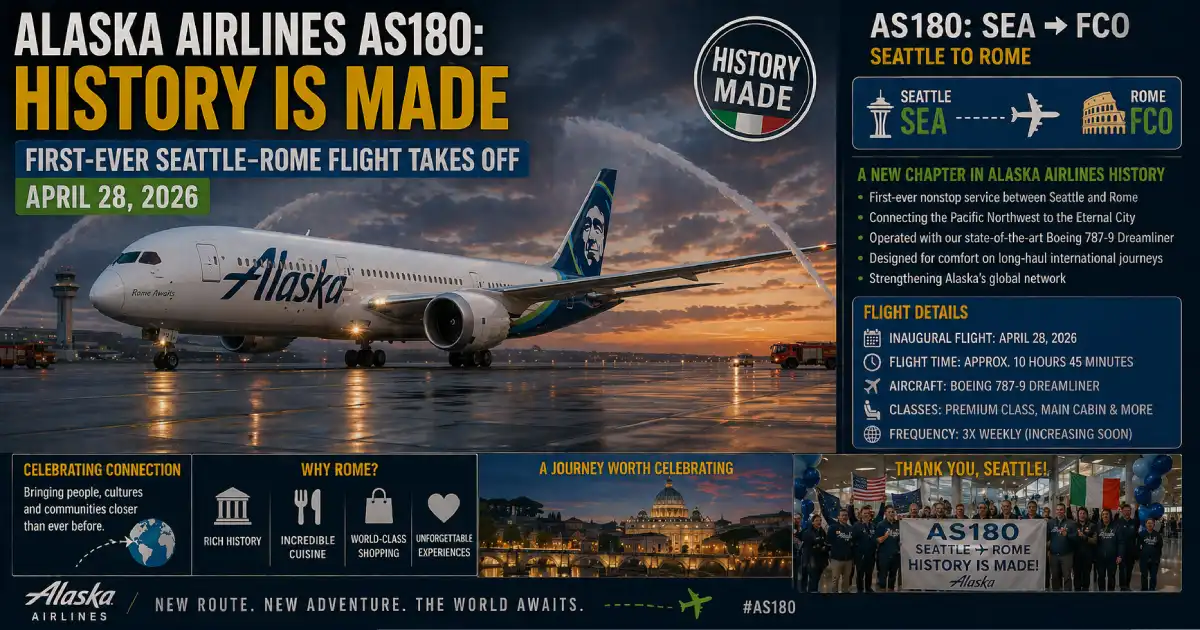
Breaking: At 5:30 PM Pacific time today, Alaska Airlines Flight AS180 pushes back from the gate at Seattle-Tacoma International Airport — and for the first time in 93 years of flying, Alaska Airlines crosses the Atlantic. A Boeing 787-9 Dreamliner bearing the Alaska livery is tonight streaking east-northeast over Canada, Greenland, Iceland, and the North Atlantic toward Rome’s Leonardo da Vinci Fiumicino Airport, where it will touch down at 1:15 PM local time tomorrow. This flight was never supposed to happen. Alaska built its entire identity around the Pacific Northwest, Alaska, and Hawaii. But the 2024 acquisition of Hawaiian Airlines brought widebody Boeing 787 Dreamliners into the fleet — and with them, the ability to do what this carrier has never done: fly to Europe. Tonight, 93 years of American aviation history turns a corner at 35,000 feet somewhere over the North Atlantic. Here is everything you need to know about the moment Alaska Airlines made history.
Published: April 28, 2026 Flight: AS180 — Seattle-Tacoma International (SEA) → Rome Leonardo da Vinci Fiumicino (FCO) Departure: 5:30 PM Pacific time, April 28, 2026 Arrival: 1:15 PM local time, April 29, 2026 (+1 day) Aircraft: Boeing 787-9 Dreamliner — 300 seats (34 Business Class + 79 International Premium Class + 187 Main Cabin) Flight Duration: 10 hours 45 minutes eastbound / 11 hours 20 minutes westbound Distance: 5,688 miles (9,154 km) Return Flight: AS181 — Departs Rome FCO 3:25 PM, arrives Seattle 5:45 PM Historic Significance: First-ever nonstop transatlantic flight in Alaska Airlines’ 93-year history Season: Daily through October 23, 2026 — 176 total rotations Standby Passengers: 1,150+ Alaska employees on standby — potentially a world record for most standby passengers on a single flight CEO: Ben Minicucci — Italian-American whose parents emigrated from Italy — “Andiamo — let’s go!” Next European routes: Seattle–London Heathrow (daily, year-round, May 21) · Seattle–Reykjavik (daily seasonal, May 28) Competition: Delta Air Lines launches SEA–FCO May 6, 4× weekly — Alaska is daily and has an 8-day first-mover advantage Book: alaskaair.com
Alaska Airlines was founded in 1932. For 93 years, its routes were defined by geography — the Pacific Northwest, coastal Alaska, California, Hawaii. The airline built itself into one of America’s most beloved carriers without ever pointing a nose toward Europe. Other airlines expanded transatlantically in the 1960s, 1970s, 1980s. Alaska stayed in its lane. Its identity was the Pacific. Its home was Seattle.
Then, in 2024, Alaska acquired Hawaiian Airlines — and the deal came with something that changed everything: a fleet of Boeing 787-9 Dreamliners. Widebody aircraft capable of flying 10+ hours nonstop. Aircraft that could, for the first time, reach London, Rome, and Reykjavik from Seattle without stopping.
Alaska CEO Ben Minicucci wasted no time. In June 2025, he announced the carrier’s first-ever European route — Seattle to Rome — with a quote that told the whole story: “Serving Rome nonstop from Seattle is a dream come true. As an Italian American whose parents emigrated from Italy, this is a particularly meaningful addition to our network. Andiamo — let’s go!”
And tonight, he made good on that promise. AS180 is airborne.
5:30 PM — Pushback from Gate N The 787-9 pushes back from Seattle’s Concourse N international gate. Alaska staff line the windows. Passengers in the 34 Business Class suites settle into their enclosed lie-flat pods. Economy passengers settle into the 3-3-3 rows with their Filson blankets already distributed. The standby passengers who won a seat — a lottery among the 1,150+ Alaska employees who wanted to be on this specific flight — are pinching themselves.
6:00 PM — Airborne over Puget Sound AS180 climbs northeast over the Olympic Peninsula and begins tracking the great-circle route that takes it up through British Columbia, across northern Canada, over Greenland, past Iceland, and down toward the Italian peninsula. This is Alaska Airlines’ third long-haul route — after Seoul Incheon and Tokyo Narita — but the first to cross the Atlantic.
7:30 PM Pacific / 10:30 PM Eastern — Dinner Service Begins In Business Class, the first chapter of Alaska’s new international dining story opens. Flight attendants roll out the welcome service — Pacific Northwest cheese and charcuterie, West Coast wines, Stumptown Coffee. The multi-course dinner follows, including the signature route-specific option: roasted chicken with pasta carbonara, timed for a flight to Rome. And then, the moment every aviation enthusiast has been reading about for months: the Salt & Straw ice cream dessert cart. For the first time in history, a Salt & Straw sundae cart rolls down an Alaska Airlines aisle somewhere over the North Atlantic.
2:00 AM Pacific — Over Greenland The cabin is dark. Most passengers are asleep on lie-flat beds in Business Class or under Filson blankets in Premium and Economy. The 787-9’s electrochromic windows dim automatically. Outside, the Greenland ice sheet passes below at 35,000 feet.
Pre-arrival — Morning Pacific time / Midday Rome time Pre-arrival breakfast service. The Italian coast appears below. The 787-9 begins its descent toward Rome. In the cockpit, the crew prepares for their first-ever approach into Fiumicino. At 1:15 PM local Rome time, AS180 touches down. History complete.
Here is the aviation story within the aviation story. When Alaska Airlines opened its employee standby list for AS180, the initial response was enthusiastic — but nobody anticipated what happened next. By late January, more than 1,150 Alaska Airlines employees had placed themselves on standby for the inaugural flight. That number is nearly four times the capacity of the 300-seat Boeing 787-9.
For context: the unofficial world record for standby passengers on a single flight was approximately 1,500, set when Southwest Airlines launched its first Hawaii service from Oakland in March 2019. Alaska’s inaugural Rome flight is in genuine contention for the record.
Alaska’s social media team had to issue a plea asking employees to remove themselves from the standby list if they weren’t committed to travelling: “We love the enthusiasm, but please cancel your listing if you are unsure about your plans. Be kind to your co-workers, and only list if you are serious about traveling on the inaugural flight to Rome.”
It had little effect. Numbers only grew.
The standby list tells you something important about what this moment means inside Alaska Airlines. This isn’t just a route launch. For an airline that has spent 93 years defining itself by its Pacific identity, flying to Rome is a statement about what Alaska Airlines is becoming.
Alaska didn’t choose Rome arbitrarily. The airline identified it as the single most-requested European destination among its Mileage Plan members — the most popular city in Europe with no nonstop service from Seattle.
The geography works in Alaska’s favour too. Seattle sits further north than Los Angeles or San Francisco, which means the great-circle route from SEA to Rome is meaningfully shorter than from California. Alaska has calculated a 10% distance advantage over LAX and SFO on flights to Rome. When that 10% gap compounds over 5,688 miles, it translates to less fuel burn, lower operating costs, and competitive fares.
The numbers confirmed the choice: Alaska originally planned to operate Seattle–Rome just four times a week. Demand was so strong when tickets went on sale in November 2025 that the airline upgraded to daily service before the first passenger had even booked. That is a remarkable demand signal for a brand-new route from a carrier that had never flown to Europe.
Key Seattle route geography facts:
The Boeing 787-9 Dreamliner that is carrying AS180’s passengers tonight was not built for Alaska Airlines. It came to the carrier through the Hawaiian Airlines merger — one of the widebody jets that made this entire European expansion possible. Alaska now has four 787-9s in its fleet, with a fifth due before year-end and plans for up to 17 Dreamliners deployed across its network by 2030.
Why the 787-9 is the right aircraft for a 10h45m transatlantic flight:
The Dreamliner is built from carbon composite materials — not aluminium — which allows it to maintain higher cabin pressure (equivalent to 6,000 feet altitude vs the 8,000 feet typical on older jets). Passengers arrive less fatigued and less dehydrated. The windows are 30% larger than conventional aircraft windows and use electrochromic dimming technology — five levels of tint without physical shades. The cabin air is 100% fresh outside air with higher humidity levels than older narrow-body aircraft.
The 787-9 is also noticeably quieter than its predecessors. The distinctive chevron noise-reducer on the engine nacelles reduces cabin noise at cruise altitude, making overnight flights more conducive to sleep.
AS180 cabin configuration:
| Class | Seats | Layout | Bed? |
|---|---|---|---|
| Business Class (International Suites) | 34 | 1-2-1 | ✅ Fully flat |
| International Premium Class | 79 | 2-3-2 | ❌ Recline only |
| Main Cabin | 187 | 3-3-3 | ❌ Recline only |
| Total | 300 | — | — |
Alaska’s new International Business Class product — launched specifically for the European routes — is the most significant premium cabin the airline has ever operated.
The Suite: Every Business Class seat is a fully enclosed lie-flat suite with a sliding privacy door and direct aisle access. The 1-2-1 layout means every passenger has direct aisle access — no climbing over anyone. The bed converts from an angled-lounge position to a fully flat sleeping surface with a wide Filson mattress pad, duvet, and multiple pillows.
Filson — the legendary Seattle outdoor brand, founded in 1897 — supplies the bedding and blankets across all cabin classes on the 787-9. It’s a signature Pacific Northwest touch on an aircraft that now connects the Pacific Northwest to the world.
Tonight’s Dinner Service (Seattle → Rome):
The Amenity Kit: Salt & Stone skincare products (cleanser, moisturiser, lip balm) in a reusable bag. A custom PATH Water reusable bottle. Noise-reducing headphones. An 18-inch HD touchscreen with 1,500+ entertainment options.
This matters because it’s better than most transatlantic economy products:
The $599 roundtrip introductory fare that Alaska launched in November has since risen for peak summer dates — but Alaska’s Main Cabin product on this route remains genuinely better than the standard transatlantic economy experience on most legacy carriers.
Tonight’s AS180 departure is the first chapter of a story Alaska CEO Ben Minicucci has been telling since the Hawaiian Airlines acquisition closed. Seattle, he argues, is positioned to become the West Coast’s premier global gateway — and Europe is the piece that was missing.
Alaska’s 2026 European expansion from Seattle:
| Route | Launch Date | Frequency | Aircraft |
|---|---|---|---|
| Seattle → Rome FCO | April 28 (TODAY) | Daily (seasonal to Oct 23) | 787-9 |
| Seattle → London LHR | May 21 | Daily (year-round) | 787-9 |
| Seattle → Reykjavik KEF | May 28 | Daily (seasonal to Sep 7) | 737 MAX 8 |
London Heathrow — Alaska’s only year-round European destination — will make SEA one of the few US airports with daily year-round nonstop service to the UK. Reykjavik adds a leisure destination that has become one of the fastest-growing European routes from North America.
Alaska’s long-term ambition: At least 12 intercontinental destinations from Seattle by 2030. Paris CDG, Madrid, Frankfurt, Amsterdam, and Singapore are frequently named by analysts as likely future additions.
Who this unlocks: Alaska has already shown that the SEA hub serves not just Seattle passengers, but the entire US West Coast and Hawaii. Portland, San Francisco, Los Angeles, San Diego, Honolulu, and Maui all have easy connections through Seattle. A West Coast traveller who previously needed to fly to JFK or LAX to access transatlantic routes can now connect through SEA on Alaska metal, earning Atmos Rewards points on every leg.
Alaska’s April 28 departure is already prompting direct competitive response from Delta Air Lines. Delta counter-launched a matching SEA–FCO route from May 6 — just eight days after Alaska’s inaugural.
The comparison every Rome-bound passenger needs to know:
| Feature | Alaska AS180 | Delta SEA–FCO |
|---|---|---|
| Launch date | April 28 (TODAY) | May 6 |
| Frequency | Daily | 4× weekly |
| Aircraft | Boeing 787-9 | Airbus A330-900neo |
| Business Class | Fully enclosed suites, 1-2-1 | Delta One Suites |
| Loyalty programme | Atmos Rewards (oneworld) | SkyMiles (SkyTeam) |
| Titanium upgrade perk | ✅ Complimentary lie-flat day-of | ❌ No equivalent |
| Intro fares | From $599 roundtrip | Similar pricing |
| Daily frequency edge | ✅ Alaska — daily vs 4×/week | — |
Alaska’s decisive advantages: Daily service means more booking flexibility, fewer sold-out dates, and a wider range of connection options for West Coast travellers. The Atmos Titanium complimentary lie-flat upgrade on intercontinental routes is unique in US aviation — no other major airline loyalty programme offers this perk. And Alaska’s oneworld membership means connecting passengers from British Airways, American Airlines, Cathay Pacific, and Japan Airlines can access the route seamlessly.
Delta’s advantages: SkyMiles loyalists will prefer the alliance fit. Delta’s A330-900neo Premium Select (premium economy) is a slightly stronger hard product than Alaska’s International Premium Class for some travellers.
Tonight’s AS180 passengers are earning Atmos Rewards points on Alaska’s most significant flight. Here is how the earning breaks down:
oneworld partner earning: British Airways Executive Club, American AAdvantage, Cathay Pacific Asia Miles, and Japan Airlines Mileage Bank members can earn miles on AS180 through partner earning arrangements. Check your programme’s Alaska earn rates before booking.
The inaugural AS180 tonight may be sold out — but the remaining 175 rotations of the summer season are still available. Here is what to know before booking:
Fares as of late April 2026:
The booking tip: If you are considering any date in May or June 2026, book today — demand has been running well ahead of Alaska’s initial projections since November. The fact that Alaska upgraded from 4× weekly to daily before a single seat was sold tells you everything about where demand is heading.
Book at: alaskaair.com
AS180 tonight is the beginning of Alaska’s European chapter — not the whole story.
May 6: Delta launches SEA–FCO (4× weekly, A330-900neo) — creating real competition on the Pacific Northwest–Italy corridor for the first time. For consumers, two competing daily/near-daily nonstop options from the same airport creates pricing pressure and scheduling flexibility that was unimaginable twelve months ago.
May 21: Alaska launches Seattle–London Heathrow — daily, year-round, 787-9. This will be Alaska’s first year-round transatlantic route and the one that cements Seattle’s position as a genuine transatlantic hub alongside JFK, LAX, and Newark.
May 28: Alaska launches Seattle–Reykjavik — daily seasonal through September 7, Boeing 737 MAX 8. Iceland has become one of the fastest-growing European destinations from the US West Coast, and Alaska’s entry with a 737 MAX (capable of transatlantic operations) is the most direct option available.
Summer 2026: With Rome, London, and Reykjavik all operating, plus existing Seoul Incheon and Tokyo Narita services, Seattle-Tacoma International Airport will be serving nonstop destinations on four continents — a transformation that has taken less than two years from the Hawaiian Airlines acquisition.
Tonight, at 5:30 PM Pacific time, Alaska Airlines Flight AS180 departed Seattle-Tacoma International Airport for Rome — and 93 years of Pacific-only history ended.
The 787-9 Dreamliner carrying tonight’s passengers is more than a widebody aircraft on a new route. It is the physical proof that the Hawaiian Airlines acquisition has delivered on its transformative promise. It is the culmination of a CEO’s personal dream — Ben Minicucci, Italian-American, whose parents crossed the Atlantic the slow way, watching tonight as his airline does it in 10 hours 45 minutes. It is the beginning of Seattle’s identity as a global gateway rather than a regional hub.
The key facts:
For the 1,150 Alaska employees on standby tonight: we hope you get a seat. For the passengers already on board: you are part of aviation history. Andiamo.
Book your SEA–FCO flight at: alaskaair.com
For More Resources:
Related Articles:
Posted By : Vinay
This article is provided for general informational purposes only and is based on information available at the time of publication. Travel advisories, airline schedules, airport operations, visa requirements, government regulations, and other travel-related information are subject to change without prior notice. While Travel Tourister makes reasonable efforts to verify information using official announcements, government publications, airline and airport communications, and other reliable sources, we cannot guarantee that all information remains complete, accurate, or up to date at all times. Readers should independently verify any information that may affect their travel plans with the relevant airline, airport authority, government agency, embassy, or other official source before making travel, financial, or other decisions. Travel Tourister shall not be liable for any direct or indirect loss, inconvenience, or damages arising from the use of or reliance on the information contained in this article. Nothing in this publication constitutes legal, immigration, financial, or professional travel advice. If you believe any information in this article is inaccurate or outdated, please contact our editorial team. We review all credible correction requests promptly and update our content whenever appropriate.
Lastest News
2nd Floor, 39, Above Kirti Club, DLF Industrial Area, Kirti Nagar, New Delhi, Delhi 110015



Travel Tourister is a leading Travel portal where we introduce travellers to trusted travel agents to make their journey hasselfree, memorable And happy. Travel Tourister is a platform where travellers get Tour packages ,Hotel packages deals through trusted travel companies And hoteliers who are working with us across the world. We always try to find new and more travel agents and hoteliers from every nook and corners across the world so that you could compare the deals with different travel agents and hoteliers and book your tour or hotel with the one you have chosen according to your taste and budget.
Copyright © Travel Tourister, India. All Rights Reserved

 Call
Call Enquiry