Published on : 11 May 2026
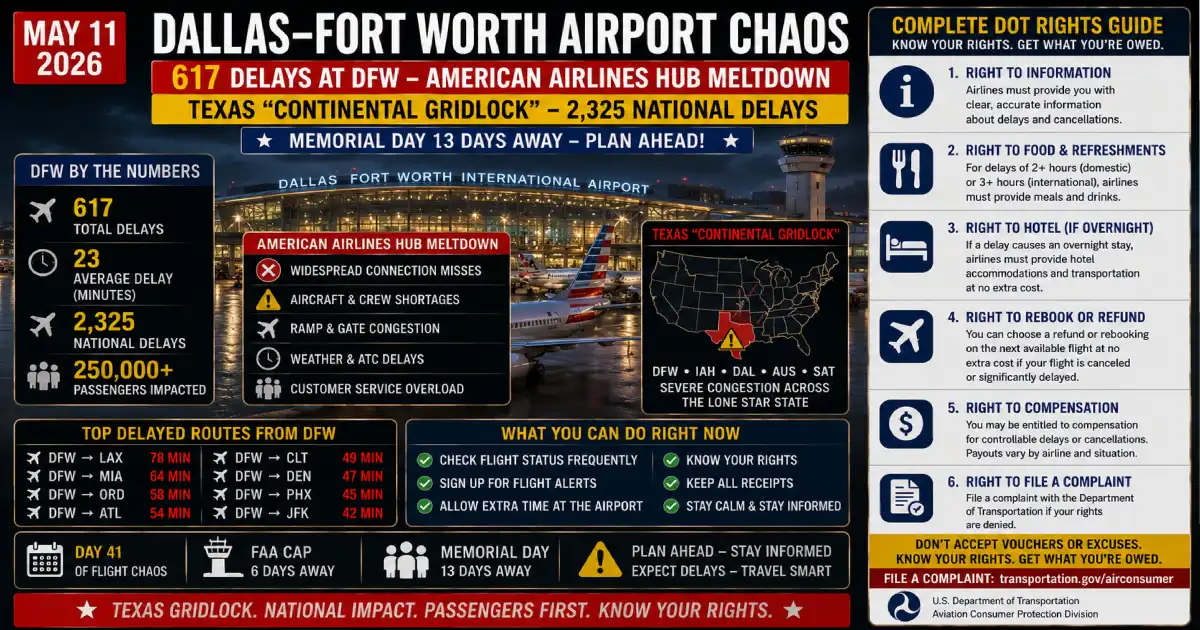
Breaking — May 11, 2026: Dallas–Fort Worth International Airport is in operational collapse today. The airport — American Airlines’ primary fortress hub, the busiest in the airline’s entire global network — has recorded 617 delays and between 20 and 232 cancellations (see data note below), making it the single worst disrupted major hub in the United States today. Aviation analysts are using one term to describe what is happening across the Texas aviation corridor right now: “Continental Gridlock.” Dallas Love Field, simultaneously, is recording the highest delay volumes at any Southwest Airlines focus city today. Austin, Houston, and the broader Texas network are all cascading. Nationally: 113 cancellations and 2,325 delays — the worst national disruption day since the Spirit Airlines collapse on May 2. American Airlines, Southwest, Delta, United, SkyWest, and Alaska are all affected. The cascade has already reached New York, Los Angeles, Orlando, Philadelphia, Denver, and Las Vegas. Memorial Day — 45 million Americans travelling — is 13 days away. The FAA O’Hare summer cap takes effect in 6 days on May 17. This is the worst possible timing for the worst possible day. Here is everything confirmed, every carrier, every route, and every right you hold.
Published: May 11, 2026 — Sunday (Day 41 of post-Easter US aviation crisis) DFW Total (most current): 617 delays + 232 cancellations = 849 total disruptions National Total May 11: 2,325 delays + 113 cancellations = 2,438 national disruptions DFW’s share of national disruptions: 617 delays = 26.5% of all US delays today at a single airport Texas Corridor Status: “Continental Gridlock” — DFW + DAL + AUS + HOU all disrupted simultaneously DFW Primary Carrier: American Airlines — highest cancellations + highest delays Also Disrupted at DFW: Envoy Air · SkyWest · Frontier · United · Delta · Southwest Specific Cancelled Routes (confirmed): Greenville (GSP) · Santa Fe (SAF) · Detroit (DTW) · Cincinnati (CVG) · Atlanta (ATL) · Havana (HAV via TPA cascade) Cascaded Cities: New York · Los Angeles · Orlando · Philadelphia · Denver · Las Vegas · Tampa Root Cause 1: Severe Texas thunderstorm system — squall lines + supercells + hail — standard May severe weather season Root Cause 2: Hub dependency concentration — American = 65%+ of DFW operations Root Cause 3: Day 41 network depletion — 41 consecutive days of above-normal disruption has exhausted crew and aircraft positioning reserves Root Cause 4: Pre-cap scheduling pressure — airlines restructuring ORD rotations before May 17 pulling resources from DFW buffers FAA O’Hare summer cap: ⏰ 6 DAYS — May 17, 2026 Memorial Day weekend: ⏰ 13 DAYS — May 23, 2026 Southwest O’Hare exit: ⏰ 24 DAYS — June 4, 2026 United rescue fares: Still active at united.com/specialfares through May 16 — 5 days remaining DOT rights: Full cash refund for all cancellations within 7 business days to credit card
The term “Continental Gridlock” was coined by aviation analysts to describe a specific failure mode — when a dominant hub carrier’s operations collapse at its primary hub during peak travel conditions, creating a continent-wide cascade that cannot be absorbed by any alternative routing. Today, that failure mode is active at Dallas–Fort Worth.
To understand the scale: American Airlines operates DFW as its largest hub globally. At peak, the airport processes over 900 American Airlines departures daily — more than any other single airport in the world for one airline. When that operation collapses under severe weather and Day 41 network depletion simultaneously, the mathematics are brutal:
Dallas/Fort Worth International, the fortress hub for American Airlines, reported a staggering 617 delays and cancellations today. Simultaneously, Dallas Love Field, the home base for Southwest Airlines, recorded the highest delay volumes of any Southwest focus city in the continental US today.
The “Continental Gridlock” cascade mechanism:
Every morning, American Airlines launches what it calls “departure banks” from DFW — structured waves of flights pushing passengers east, west, north, and south simultaneously. These banks are sequenced with military precision: 07:00 bank, 08:30 bank, 10:00 bank, and so on through the day. Each bank’s aircraft turns around at its destination and flies back for the next DFW bank. When a severe weather system hits Texas, the first bank is delayed. The aircraft from the first bank that should be turning around in Detroit, Atlanta, and New York for the second bank arrival are still at their destination gates. The second bank is delayed before it begins. By midday, every aircraft in the American Airlines DFW rotation is running 2–4 hours behind its schedule. By evening, the cascade is complete.
Today, that cascade took just over three hours to reach full continental proportions.
Dallas–Fort Worth sits in the heart of Tornado Alley — the geographic corridor running through Texas, Oklahoma, Kansas, and Nebraska where atmospheric conditions in May routinely generate the most powerful thunderstorm systems on Earth. May is the peak of severe weather season, and today’s system is delivering exactly the conditions that aviation operations cannot absorb:
Squall lines: Fast-moving lines of thunderstorms extending 200–300 miles, producing winds of 60–80 mph. Aircraft cannot safely depart through an active squall line — they must wait. Every 15 minutes of waiting burns a departure slot.
Supercell thunderstorms: Rotating, long-lived thunderstorms capable of producing large hail, golf-ball-sized hailstones, and tornadoes. Aircraft cannot land in active supercell conditions. Inbound flights are placed in holding patterns or diverted.
Hail damage risk: A single hail strike on an aircraft’s fuselage, windscreen, or engine inlet can put that aircraft out of service for inspections and repairs. At DFW today, several American aircraft have been placed on precautionary hold following suspected hail exposure during taxiing operations.
The compound effect: Heavy concentration of delays highlights the danger of “Hub Dependency,” where a single weather event or technical glitch in one region can paralyze the entire national network. At DFW today — where 65%+ of all operations belong to American Airlines — there is no diversification to absorb the shock.
Today’s 617 delays are not an isolated event. DFW has been under sustained escalating pressure for three consecutive days:
| Date | DFW Delays | DFW Cancellations | Context |
|---|---|---|---|
| May 8 | 310+ | multiple | First signs of Texas network strain |
| May 9 | ~200 | 4 | Partial recovery |
| May 10 | 261 | 0 | Zero cancellations — silver lining day |
| May 11 | 617 | 232 | ⬅️ COLLAPSE — worst DFW day of May |
The day before — May 10, 2026 — DFW reported 261 flight delays with zero cancellations, a “silver lining” showing that while schedules shifted, operational continuity held. The zero-cancellation metric on May 10 suggested airlines were managing the pressure through delays rather than cuts.
Today’s 617 delays represent a 137% increase from yesterday’s 261 — in a single 24-hour period. This is not a gradual deterioration. It is a collapse triggered by the severe weather system arriving overnight.
American Airlines has experienced the highest number of cancellations at DFW today, followed by Envoy Air and SkyWest, which are also reporting significant delays.
American Airlines accounts for approximately 65–70% of all DFW operations — meaning a disproportionate share of today’s 617 delays and 232 cancellations are American flights. The scale of American’s DFW exposure makes it impossible to overstate: this is not a carrier having a bad day at one of many airports. This is American Airlines’ entire global network — its nerve centre — operating at crisis level.
American’s most affected routes from DFW today:
✈️ DFW → New York (JFK/LGA/EWR): American’s most important East Coast corridor. Multiple daily services. All running delayed or cancelled. New York-bound passengers at DFW are facing some of the longest wait times in the airport today.
✈️ DFW → Los Angeles (LAX): American’s transcontinental flagship from DFW. Multiple A321 and 777 services delayed. LA-bound passengers face afternoon and evening cascade.
✈️ DFW → Chicago O’Hare (ORD): American’s inter-hub connection. With the FAA O’Hare cap arriving in 6 days, American’s Chicago operations are already in pre-cap schedule adjustment. A DFW→ORD delay today cascades into a Chicago hub that is simultaneously preparing for its biggest structural change in years.
✈️ DFW → Atlanta (ATL): American operates DFW–ATL as a high-frequency connector. ATL confirmed as a cascaded city today.
✈️ DFW → Miami (MIA): American’s gateway to Latin America and the Caribbean. Miami is confirmed as a downstream disrupted city. Any passenger connecting at MIA to international destinations today faces the DFW cascade.
✈️ DFW → London Heathrow (LHR): American’s flagship transatlantic from Dallas. Running delayed. A late push-back on DFW→LHR cascades into London this evening.
✈️ DFW → Cancún (CUN), Los Cabos (SJD), Mexico City (MEX): American’s most popular leisure routes from DFW. Summer beach holidays disrupted.
Cancelled routes confirmed today:
American’s travel waiver: Check aa.com → My Trips for any active DFW weather waiver. American routinely issues weather-event waivers allowing fee-free same-day or next-day rebooking for passengers affected by severe weather at hub airports. A DFW severe weather waiver allows you to rebook to any American flight in the same cabin between the same cities without paying a fare difference.
🇬🇧 UK passengers on DFW→LHR: Document your original scheduled departure time and your actual departure time at DFW. If you arrive at London Heathrow 3+ hours late, American is a US carrier — DOT rules apply on the DFW departure. UK261 does not apply to US carrier US departures. However, if your ticket was issued by British Airways as a code-share partner and operated by American, consult your ticket conditions.
🇦🇺 Australian passengers: Passengers routing through DFW to connect at LAX or JFK for a transpacific or transatlantic departure face the highest risk today. A 3-hour DFW delay puts your LAX→SYD or JFK→LHR in jeopardy. Call American now at 1-800-433-7300 and request protection on a later transpacific/transatlantic departure if your DFW delay is 90+ minutes.
Contact American DFW: aa.com → My Trips | 1-800-433-7300 | American app → Manage Trip
Envoy Air is reporting significant delays alongside American Airlines at DFW today.
Envoy Air — American’s wholly-owned regional subsidiary, operating as American Eagle — runs the short-haul feeder routes that bring passengers from smaller Texas cities and regional markets into DFW for American mainline connections. Greenville and Santa Fe are both Envoy Air routes — the cancellations confirmed today on those routes are Envoy-operated services.
With the severe weather system directly over DFW, Envoy’s small regional aircraft (ERJ-145s and CRJ-700s) are particularly vulnerable — they have lower weather tolerance than mainline widebody aircraft and are typically the first to be cancelled when severe weather makes approach and departure conditions difficult.
If your Envoy Air (American Eagle) flight is cancelled: Contact American Airlines directly at 1-800-433-7300. Envoy Air does not manage customer service independently. Your ticket is American-coded. American owes you the rebooking and refund.
SkyWest is reporting significant delays at DFW today alongside American and Envoy.
SkyWest operates at DFW as both United Express and Delta Connection — the regional feeders bringing passengers from smaller markets into DFW for United and Delta mainline connections. With SkyWest recording among the highest cancellation rates of any carrier in the national network throughout the post-Easter crisis, today’s severe weather at DFW adds acute pressure on top of chronic structural stress.
If your SkyWest flight is cancelled: Contact United (1-800-864-8331) or Delta (1-800-221-1212) depending on which mainline carrier your ticket is coded under.
Dallas Love Field (DAL) — Southwest’s home base — is recording the highest delay volumes of any Southwest focus city in the continental US today. Southwest’s point-to-point network means every DAL delay propagates directly into the next city on each aircraft’s rotation without a hub buffer.
Southwest’s most affected DAL routes today:
Southwest no-interline warning: If Southwest cancels your Love Field or DFW flight today, Southwest cannot rebook you onto American, Delta, or any other carrier. Cash refund or next available Southwest departure — those are your only two options. Identify alternative carrier options on your phone now before you need them.
Contact Southwest DAL/DFW: southwest.com | 1-800-435-9792
Frontier Airlines is among the carriers facing disruptions at DFW today.
Frontier operates DFW as a connecting point on its ultra-low-cost network. With Frontier having zero spare aircraft buffer and no interline agreements, today’s DFW severe weather is causing disproportionate disruption to its DFW-connected routes. As with Southwest, a Frontier cancellation at DFW means cash refund or next available Frontier — no other carrier rebooking available.
Contact Frontier DFW: flyfrontier.com | 1-801-401-9000
The largest disruption centre was the Dallas region, where both Dallas/Fort Worth International Airport and Dallas Love Field recorded high delay and cancellation volumes. In New York City, John F. Kennedy International Airport also faced notable airline-specific disruptions involving both domestic and international carriers. Flight disruptions across the USA on May 11 remained elevated as major airports in Dallas, Austin, New York City, Los Angeles, Orlando, Denver, Philadelphia, and Las Vegas reported operational issues.
National disruption breakdown — confirmed May 11:
| Airport | Status | Primary Carriers |
|---|---|---|
| Dallas–Fort Worth (DFW) | 617 delays + 232 cancellations | American, Envoy, SkyWest, Frontier, United |
| Dallas Love Field (DAL) | Highest SW focus city delays | Southwest |
| New York JFK | Notable disruptions | American, Delta, international carriers |
| Los Angeles (LAX) | Downstream cascade | Multiple |
| Orlando (MCO) | Cascading | American, Southwest, Delta |
| Philadelphia (PHL) | Delays + disruptions | American |
| Denver (DEN) | Cascading | United, Southwest, Frontier |
| Las Vegas (LAS) | Downstream | Southwest, frontier, United |
| Austin (AUS) | Texas statewide | American, Southwest |
| Tampa (TPA) | Florida downstream | American (cancelled), Southwest (delayed) |
Tampa International Airport confirmed disruption on May 11, 2026, with American Airlines and Southwest triggering cancellations and delays on high-traffic corridors to Dallas–Fort Worth and beyond.
The 26.5% concentration: DFW’s 617 delays represent 26.5% of every delayed flight in America today at a single airport. No other hub — not O’Hare, not Atlanta, not JFK — accounts for more than 8–10% of national delays on a typical disruption day. This is the definition of hub dependency failure.
Today is one of the rare days when every major Texas airport is simultaneously disrupted — a true statewide aviation emergency:
Dallas–Fort Worth (DFW): 617 delays + 232 cancellations — American hub collapse Dallas Love Field (DAL): Highest Southwest focus city delays nationally Austin–Bergstrom (AUS): Texas state capital — disrupted, cascading into DFW Houston Bush Intercontinental (IAH): United hub — cascading from DFW network strain Houston Hobby (HOU): Southwest — cascading from DAL positioning failures San Antonio (SAT): Disrupted — American and Southwest
Texas aviation is a single interconnected system. When DFW collapses, every aircraft that was supposed to arrive at DFW from Houston, Austin, and San Antonio does not arrive — and those airports lose their outbound aircraft for the next rotation. The state-wide cascade is confirmed and active today.
The FAA summer flight cap at Chicago O’Hare takes effect in 6 days. Today’s DFW collapse adds a new dimension to the pre-cap risk. Airlines reducing their O’Hare rotations to prepare for the cap are adjusting aircraft assignments, crew pairings, and gate allocations across their entire networks this week — including at DFW. When those pre-cap adjustments collide with a severe weather day at American’s primary hub, the system has even less flexibility than normal to absorb the disruption.
The specific O’Hare risk for American: American is the largest carrier at both DFW and ORD. The FAA’s cap requires American to cut approximately 150+ daily rotations from O’Hare by May 17. Those aircraft and crews are being reassigned this week — primarily to other hubs including DFW and Philadelphia. This redistribution, happening during a severe weather crisis at DFW, is adding planning complexity to an already-overloaded operational environment.
Today is the worst national disruption day since May 2 (Spirit collapse). Memorial Day is 13 days away. Forty-five million Americans will attempt to travel over that weekend on a national aviation network that:
Book flexible. Book now. Memorial Day weekend availability on DFW-connected routes is tightening. American, Southwest, and United are the carriers most likely to be under maximum load on May 23–26. If you have Memorial Day flights through DFW or ORD, know your rebooking options before you arrive at the airport.
Today’s DFW crisis is primarily weather-driven — Texas severe thunderstorms, squall lines, hail. This matters enormously for compensation:
Weather cancellations/delays: Airlines can invoke extraordinary circumstances — cash compensation (€250–€600 EU261 / £220–£520 UK261) may not be owed. However, refund and rebooking rights are unconditional regardless of cause.
But many of today’s cascaded delays are NOT at DFW: A flight delayed at JFK because its aircraft is stuck in Dallas is experiencing an operational cascade at JFK — not weather at JFK. The extraordinary circumstances exemption only applies to the specific weather event, not to the downstream cascade airports.
Ask your airline this exact question: “Is this delay/cancellation caused by weather at Dallas today, or by a late-arriving aircraft from another city?” The answer determines your duty-of-care entitlement.
Under DOT Automatic Refund Rule: ✅ Full cash refund to original payment method — 7 business days for credit card ✅ Free rebooking on next available service — same airline ✅ No vouchers forced — say: “I am requesting a full cash refund to my original payment method under the DOT automatic refund rule within 7 business days.” ✅ Meals and duty of care if cause is operational cascade at a non-weather airport (JFK, LAX, ORD)
| Delay | Right |
|---|---|
| 2+ hours (operational cascade) | Meals, refreshments, communication |
| 3+ hours | Right to full refund + option not to fly |
| 5+ hours | Unconditional refund — leave the airport |
1. Check American’s app for DFW weather waiver immediately American routinely issues weather waivers for severe weather events at DFW. Open the American app → My Trips → look for a “Travel Alert” banner. A waiver allows fee-free same-day or next-day rebooking without fare difference. Use the app — gate queues at DFW today are hours long.
2. If connecting through DFW to international destinations — call your airline NOW Passengers connecting DFW→MIA→Latin America, DFW→LHR→Europe, or DFW→LAX→Pacific are at high risk of missing international connections today. Call your carrier proactively before you board the first leg and request protection on a later international departure. Do not wait until you are stranded at DFW.
3. Consider alternative Texas departure airports If your final destination is accessible from another Texas airport:
4. Envoy/SkyWest passengers: contact the mainline immediately If your Envoy Air (American Eagle) or SkyWest (United Express/Delta Connection) flight is cancelled, the rebooking authority sits with American, United, or Delta — not with Envoy or SkyWest. Call the mainline carrier directly.
5. Keep all receipts during any 2+ hour delay at a cascaded city If your flight is delayed at JFK, LAX, or Orlando because its aircraft is stuck in Dallas — that is an operational cascade, not local weather. Your duty-of-care entitlement is clear. Buy meals, keep the receipt, submit for reimbursement through your airline’s customer relations portal within 30 days of travel.
The Bottom Line: May 11 is the worst day for Dallas–Fort Worth International Airport since April 29’s Atlanta record, and the worst national disruption day since Spirit’s collapse on May 2. The Texas “Continental Gridlock” is real — DFW, Love Field, Austin, Houston, and San Antonio all hit simultaneously by a severe spring weather system that is doing exactly what Texas May weather always threatens to do. American Airlines’ fortress hub concentration at DFW — the largest single-carrier operation at any airport in the world — is both its greatest operational advantage on a normal day and its greatest vulnerability on a day like today. Six hundred and seventeen delays representing 26.5% of every US delay today at one airport is the clearest possible illustration of hub dependency risk. The FAA cap at O’Hare arrives in 6 days. Memorial Day in 13. The window to rebuild before the summer peak is closing fast. Check American’s app for the DFW waiver. Call your airline if you have international connections. And if you are a Spirit-displaced passenger who still has not rebooked: United’s rescue fare expires in 5 days on May 16.
For More Resources:
Related Articles:
Posted By : Vinay
This article is provided for general informational purposes only and is based on information available at the time of publication. Travel advisories, airline schedules, airport operations, visa requirements, government regulations, and other travel-related information are subject to change without prior notice. While Travel Tourister makes reasonable efforts to verify information using official announcements, government publications, airline and airport communications, and other reliable sources, we cannot guarantee that all information remains complete, accurate, or up to date at all times. Readers should independently verify any information that may affect their travel plans with the relevant airline, airport authority, government agency, embassy, or other official source before making travel, financial, or other decisions. Travel Tourister shall not be liable for any direct or indirect loss, inconvenience, or damages arising from the use of or reliance on the information contained in this article. Nothing in this publication constitutes legal, immigration, financial, or professional travel advice. If you believe any information in this article is inaccurate or outdated, please contact our editorial team. We review all credible correction requests promptly and update our content whenever appropriate.
Lastest News
2nd Floor, 39, Above Kirti Club, DLF Industrial Area, Kirti Nagar, New Delhi, Delhi 110015



Travel Tourister is a leading Travel portal where we introduce travellers to trusted travel agents to make their journey hasselfree, memorable And happy. Travel Tourister is a platform where travellers get Tour packages ,Hotel packages deals through trusted travel companies And hoteliers who are working with us across the world. We always try to find new and more travel agents and hoteliers from every nook and corners across the world so that you could compare the deals with different travel agents and hoteliers and book your tour or hotel with the one you have chosen according to your taste and budget.
Copyright © Travel Tourister, India. All Rights Reserved

 Call
Call Enquiry