Published on : 09 May 2026
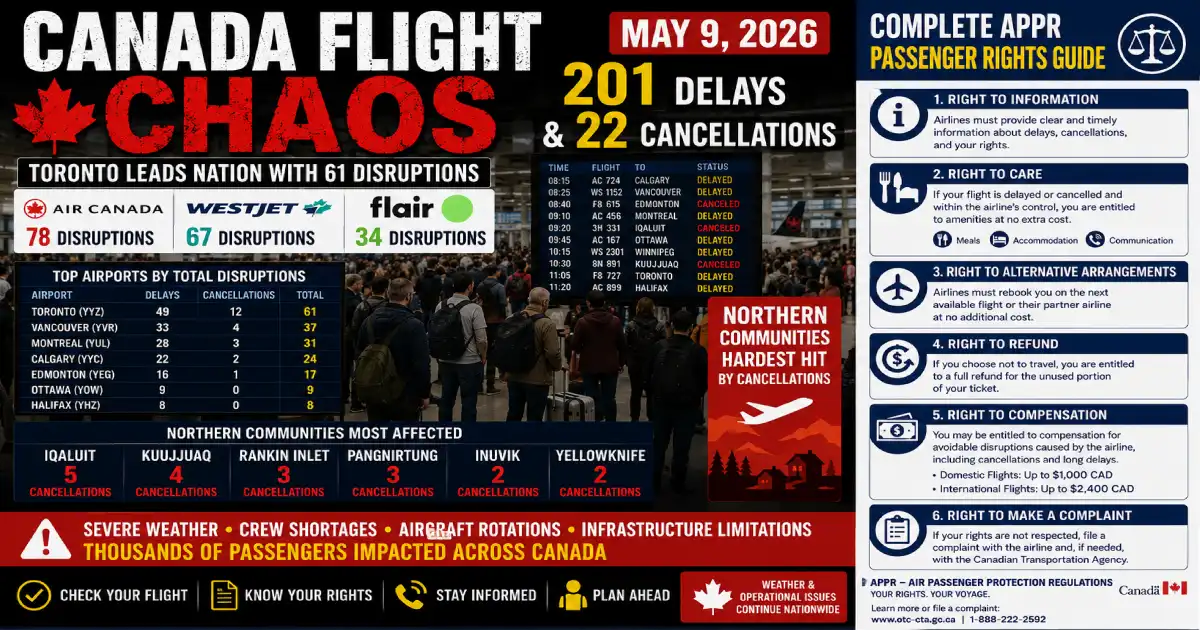
Canada’s aviation system has now recorded elevated disruption on every single day since April 30 — nine consecutive days without a normal operating baseline across the country’s six primary hubs.
Hundreds of travelers faced disruptions in Canada today as flight disruptions led to 201 delays and 22 cancellations across multiple Canadian airports. Airports reporting the highest operational impact include Toronto Pearson (57 delays, 4 cancellations), Vancouver (52 delays, 2 cancellations), Calgary (40 delays, 3 cancellations), and Montreal-Trudeau (36 delays, 2 cancellations), alongside regional airports such as Kangirsuk, Puvirnituq, La Grande Rivière, St. John’s, and St. Anthony. The most affected airlines include Air Canada (40 delays), WestJet (36 delays), Flair Airlines (19 delays), Jazz Aviation (16 delays, 3 cancellations), Air Canada Rouge (14 delays, 4 cancellations), and Air Inuit (10 cancellations, 8 delays).
Today’s 223 total Canadian disruptions represent a meaningful improvement from the crisis peaks of May 5 (1,099 disruptions — Canada’s worst day since Easter) and the 390-disruption day on May 2. But 223 is still approximately twice the pre-crisis Canadian daily baseline of 100–120 disruptions. The Canadian aviation network is in partial recovery — not full recovery. And today’s most alarming numbers are not in Toronto or Vancouver. They are in Kangirsuk, Puvirnituq, La Grande Rivière, and the other remote northern communities where Air Inuit’s 10 cancellations are not an inconvenience — they are a complete severance of the only air connection those communities have.
Today’s Canada flight chaos is three stories in one: the ongoing major-hub pressure at Toronto, Vancouver, Calgary, and Montreal; the continuing structural strain on Air Canada and WestJet from Day 39 of the North American crisis; and a northern Canada cancellation crisis at Air Inuit and PAL Airlines that is cutting off remote communities from essential services and supplies. This is every airport, every carrier, and every right you hold as a Canadian passenger today.
Published: May 9, 2026 — Saturday National Total: 223 (201 delays + 22 cancellations) vs. May 5 Peak: 1,099 disruptions — today is 80% lower than Canada’s worst day vs. Pre-Crisis Baseline: 100–120 normal daily disruptions — today still 85–120% above baseline Worst Hub by Total Disruptions: Toronto Pearson (YYZ) — 61 (57 delays + 4 cancellations) Second: Vancouver International (YVR) — 54 (52 delays + 2 cancellations) Third: Calgary International (YYC) — 43 (40 delays + 3 cancellations) Fourth: Montreal-Trudeau (YUL) — 38 (36 delays + 2 cancellations) Worst by Cancellations: Air Inuit — 10 cancellations — northern community routes Worst by Delays: Air Canada — 40 delays Other Carriers Hit: WestJet (36 delays) · Flair Airlines (19 delays) · Jazz/Air Canada Express (16 delays + 3 cancellations) · Air Canada Rouge (14 delays + 4 cancellations) · PAL Airlines (10 delays + 3 cancellations) · Air Transat (5 delays) · Porter Airlines (3 delays) · Air Saint Pierre (1 delay) Northern Communities Affected: Kangirsuk · Puvirnituq · La Grande Rivière · St. Anthony · Natuashish — Air Inuit routes severely disrupted Root Causes: Day 39 North American positioning debt · Crew crewing imbalances at Air Canada and WestJet · Weather systems in northern Quebec and Labrador affecting Air Inuit · Fuel cost pressure on Flair Airlines APPR Rights Active: ✅ Full rebooking or refund for all cancellations · ✅ Meals at 2+ hour controllable delay · ✅ Up to $1,000 CAD compensation for controllable disruptions Passengers Affected: Est. 25,000–35,000 across Canada today
Canada entered May 2026 having absorbed the downstream consequences of America’s post-Easter aviation crisis for 30 consecutive days. Every US delay that cascaded into a transborder flight affected Toronto Pearson, Vancouver, Montreal, and Calgary. Every Spirit Airlines displacement passenger who booked onto Air Canada or WestJet transborder services added demand pressure to Canadian schedules designed before Spirit existed as a consideration. And every day of elevated US disruption produced another round of crew positioning failures, aircraft displacement, and connection chaos that took 24–48 hours to work through the Canadian system.
Today, May 9, that cycle is visibly easing — but it has not broken. Toronto saw the highest disruption with 134 delays and 9 cancellations on April 12 — that pattern has moderated significantly by May 9, but Toronto remains Canada’s most consistently disrupted hub.
The specific causes driving today’s 223 Canadian disruptions:
Cause 1 — Day 39 North American Positioning Debt: Both Air Canada and WestJet have reported “temporary crewing imbalances” where flight crews were unable to reach their assigned aircraft due to delays on earlier inbound sectors. On Day 39, those crewing imbalances are structural — not weather-related, not extraordinary. They are the accumulated consequence of 39 consecutive days of cross-border disruption flowing into the Canadian network.
Cause 2 — Flair Airlines Fuel Pressure: Flair Airlines — Canada’s primary ultra-low-cost carrier and the closest Canadian equivalent to Spirit Airlines — is under significant fuel cost pressure at $4.88/gallon jet fuel. Flair’s 19 delays today are disproportionate to its network size, suggesting operational tightening consistent with the fuel economics pressures that collapsed Spirit in the US. Monitor Flair’s situation carefully — it is the canary in the Canadian aviation coal mine.
Cause 3 — Northern Weather and Air Inuit Operational Crisis: Air Inuit’s 10 cancellations today are not caused by the same factors driving delays at Toronto and Vancouver. Northern Quebec and Labrador experience late-spring weather systems — freezing rain, low ceilings, crosswinds at remote strips — that ground small aircraft at rates that never affect mainline operations. Those 10 Air Inuit cancellations affect communities where there are no roads, no railways, and no alternative way in or out.
Updated today: 201 delays and 22 cancellations recorded across key Canadian airports. Air Canada leads delays with 40 flights impacted, followed by WestJet with 36. Air Inuit dominates cancellations with 10 total, primarily in regional airports.
| Airport | Code | Delays | Cancellations | Total | Primary Carriers |
|---|---|---|---|---|---|
| Toronto Pearson | YYZ | 57 | 4 | 61 | Air Canada · Jazz · Porter · WestJet |
| Vancouver International | YVR | 52 | 2 | 54 | Air Canada · WestJet · Jazz · Flair |
| Calgary International | YYC | 40 | 3 | 43 | WestJet · Air Canada · Flair |
| Montréal-Trudeau | YUL | 36 | 2 | 38 | Air Canada · Jazz · Air Transat · Air Inuit |
| St. John’s International | YYT | 7 | 1 | 8 | PAL Airlines · WestJet · Air Saint Pierre |
| Kangirsuk | AKV | 4 | 3 | 7 | Air Inuit — Complete service disruption |
| Puvirnituq | YPX | 3 | 3 | 6 | Air Inuit — Complete service disruption |
| La Grande Rivière | YGL | — | 2 | 2 | Air Inuit — Northern Quebec |
| St. Anthony | YAY | 2 | 2 | 4 | PAL Airlines — Newfoundland |
| NATIONAL TOTAL | 201 | 22 | 223 |
Toronto Pearson International Airport records 57 delays and 4 cancellations today — its ninth consecutive disrupted day and the highest single-hub total in Canada for May 9. Air Canada accounts for the vast majority of the cancellations today, with its short-haul “shuttle” services to the Northeastern US being particularly hard hit. Both Air Canada and WestJet have reported “temporary crewing imbalances” where flight crews were unable to reach their assigned aircraft due to delays on earlier inbound sectors.
Toronto Pearson is Canada’s aviation system in miniature — everything that goes wrong in the Canadian network is most visible at YYZ. Air Canada operates its largest global hub at Pearson, running approximately 400 daily departures across domestic, transborder, and international routes. When Air Canada records 40 national delays — the highest of any carrier today — the majority of those delays originate or cascade through Pearson.
Air Canada at YYZ today: 40 total Air Canada delays nationally — concentrated at Toronto. Air Canada’s most delayed services today: the transborder shuttle routes (YYZ–LGA, YYZ–BOS, YYZ–EWR, YYZ–ORD) that feed into the still-recovering US hub system. Washington Dulles’s ATC equipment failure this evening (see the companion article) will cascade into Air Canada’s overnight YYZ connections — any Air Canada passenger with an evening YYZ–IAD service should monitor their flight status closely.
Jazz Aviation (Air Canada Express) at YYZ: 16 delays and 3 cancellations nationally — Jazz operates the regional connection bank at Pearson, feeding Air Canada mainline from smaller Ontario and Quebec cities. Jazz cancellations at YYZ cut off communities like Sault Ste. Marie, Sudbury, North Bay, and Timmins from their Toronto connection.
Porter Airlines at YYZ: 3 delays — Porter continues to be the most resilient Canadian carrier of the May crisis. Porter’s Billy Bishop City Airport base (YTZ) and its disciplined network management have kept disruption rates below every other major Canadian operator.
WestJet at YYZ: WestJet’s Toronto operation is a secondary hub — its primary base is Calgary. Today’s WestJet delays at Pearson are driven by the positioning consequences of Calgary’s 40-delay situation feeding into aircraft and crews that needed to be at Toronto.
International routes at YYZ today: Air Canada’s transatlantic services from Toronto — YYZ–LHR (London Heathrow), YYZ–CDG (Paris), YYZ–FRA (Frankfurt), YYZ–LGW (London Gatwick) — are all at elevated delay risk given today’s crewing imbalances. Routes disrupted include international services to London, New York, and Dubai. EU261 applies to Air France-operated codeshares; UK261 applies to British Airways codeshare segments. For pure Air Canada transatlantic disruptions, Canadian APPR applies — see rights section below.
Vancouver International Airport records 52 delays and 2 cancellations today — making YVR Canada’s second most disrupted hub for the eighth consecutive day.
Air Canada and Air Canada Rouge together report delays, while WestJet Encore is seeing an 11% delay rate. The impact on passengers ranges from missed connections to increased costs and time lost. Travelers bound for Williams Lake and Quesnel within British Columbia, as well as international destinations like Taipei and Zurich, face significant disruptions.
Vancouver is the only Canadian airport with a significant Asia-Pacific schedule — Air Canada operates daily services to Tokyo (NRT), Tokyo Haneda (HND), Seoul (ICN), Hong Kong (HKG), and Sydney (SYD) from YVR. Any YVR delay today that cascades into the transpacific bank creates a 24-hour stranding event for Asia-bound passengers — the next Japan or Korea service is a full day away.
WestJet’s Vancouver operation: WestJet operates Vancouver as its western gateway — connecting British Columbia to its Calgary hub and through to the US and international destinations. WestJet’s 36 national delays today are primarily concentrated between Calgary and Vancouver on the trans-mountain routes.
Flair Airlines at Vancouver: Flair Airlines operates Vancouver as one of its primary western hubs. Flair Airlines experienced a notable number of delays across multiple airports, especially in Calgary and Vancouver, indicating operational strain across its routes. Flair’s ultra-low-cost model — tight turnarounds, minimal spare capacity, high load factors — makes it structurally the most vulnerable to delay cascades. Monitor Flair’s situation closely. If Spirit Airlines was America’s canary in the coal mine, Flair is Canada’s equivalent.
Calgary records 40 delays and 3 cancellations today — the third-highest hub total in Canada. Calgary is WestJet’s primary global hub — the carrier through which Alberta’s oil industry, ski tourism, and prairie agricultural sector connects to the world.
Calgary experienced moderate delays largely linked to WestJet and WestJet Encore, with additional involvement from Air Canada. WestJet saw significant delay volumes, particularly in Calgary and Vancouver, making it one of the most impacted carriers among major Canadian airlines.
WestJet’s Calgary delays today are structurally driven — 39 consecutive days of the North American crisis have left WestJet with aircraft and crew in non-standard positions across its entire network. Calgary is where those positioning failures are most visible because it is the hub through which WestJet tries to organise every daily recovery.
The Alberta FIFO connection: Calgary is the primary departure airport for Alberta’s fly-in/fly-out (FIFO) oil and gas workers — the sector that flies crews to Fort McMurray, Norman Wells, Yellowknife, and remote northern sites on fixed roster cycles. A 3-cancellation day at Calgary may hit 3 regular leisure travellers — or it may hit 3 oil patch rotations, each carrying 100+ workers who now miss their site start and trigger roster penalties that companies absorb at thousands of dollars per missed shift. Check your airline app before leaving home.
Montreal records 36 delays and 2 cancellations today — driven primarily by Air Canada and Jazz operations, with Air Transat and Air Inuit adding to the total.
Montreal disruptions were dominated by Air Canada and Jazz, with supporting delays from Air Transat and Air Inuit. Air Transat — Canada’s primary leisure airline for Europe — is recording its typical elevated disruption pattern as it manages fuel cost pressure on its transatlantic routes. Air Transat’s Montreal-based European services (YUL–LIS, YUL–BCN, YUL–CDG, YUL–DUB) are all at elevated delay risk today.
For French-speaking Quebeckers flying to France: Air France also operates the YUL–CDG route. EU261 applies to Air France flights — up to €600 per person for 3+ hour delays at Paris caused by controllable airline positioning.
Air Inuit recorded the highest number of cancellations, primarily affecting remote airports such as Kangirsuk, Puvirnituq, and La Grande Rivière. Kangirsuk’s disruptions were entirely dominated by Air Inuit operations. Puvirnituq also saw all disruptions linked to Air Inuit services.
This is the May 9 Canada story that the national media is not covering. Kangirsuk. Puvirnituq. La Grande Rivière. These are Nunavik communities in northern Quebec — above the 55th parallel — accessible only by air. There are no roads. There are no railways. There is no alternative transport. When Air Inuit cancels 3 flights to Kangirsuk and 3 flights to Puvirnituq on the same day, those communities are cut off.
Air Inuit is a regional carrier based in Kuujjuaq, operating Twin Otters, ATR 42s, and Dash 8s across the northern Quebec Inuit homeland. It is the lifeline for 14 communities that cannot receive medical supplies, fresh food, mail, or essential services by any other means when aircraft don’t fly.
Today’s 10 Air Inuit cancellations are the consequence of a combination of northern weather (late-season freezing rain and low ceilings at strip airports that require visual approaches), crew availability in a carrier with no reserve capacity, and the ongoing fuel cost pressure that makes every marginal flight financially painful to operate.
PAL Airlines in Newfoundland: PAL Airlines records 10 delays and 3 cancellations — primarily affecting St. John’s and St. Anthony in Newfoundland and Labrador. PAL serves the same essential air link function in Labrador that Air Inuit serves in Nunavik — remote communities with no ground transport alternatives. The St. Anthony cancellations today affect the Great Northern Peninsula, where road access is seasonal and air is the primary year-round link.
Flair Airlines experienced a notable number of delays across multiple airports, especially in Calgary and Toronto, indicating operational strain across its routes.
19 Flair Airlines delays on a day when the total national disruption is only 223 is a disproportionate result. Flair operates approximately 30–40 daily flights nationally — 19 delays represents a 50%+ delay rate on a single day. That is not positioning debt from the national crisis. That is an airline operating at or beyond its operational capacity.
Flair Airlines Canada’s financial position has been under scrutiny throughout 2026 as jet fuel costs — now $4.88/gallon nationally — have made the ultra-low-cost model structurally unviable on many routes. Flair has been Canada’s equivalent of Spirit Airlines in terms of its role in the market — keeping fares low on routes where Air Canada and WestJet might otherwise charge premium prices. If Flair follows Spirit’s path, Canada loses its primary ultra-low-cost competitor — and Canadian domestic fares on affected routes will rise significantly.
Flair passengers today — the critical warning: Flair Airlines has no interline agreements. A cancelled Flair flight means rebooking on Flair only — or a full APPR refund. There is no automatic transfer to Air Canada, WestJet, or Porter. If your Flair flight is cancelled today and the next Flair service to your destination is 12+ hours away, take the refund and book independently, then file a travel insurance claim for the cost difference.
Flair contact: flyflair.com → My Trips · Phone: 1-833-711-2333
Canada’s Air Passenger Protection Regulations (APPR) provide some of the strongest passenger protections in North America. Here is exactly what you are entitled to today.
For all cancellations within the airline’s control (crew imbalances, maintenance, scheduling — NOT weather-caused cancellations):
Rebooking: The airline must rebook you on the next available flight to your destination. If the cancellation is within the airline’s control and they cannot rebook you within 9 hours on their own flights, they may be required to book you on a competing carrier at their expense.
Full refund: If you choose not to travel, you are entitled to a full refund to your original payment method. Not a voucher. Not a credit. Cash.
Cash compensation: For cancellations within the airline’s control and not required for safety:
The key distinction today: Today’s delays at Air Canada and WestJet are crewing-imbalance driven — within airline control. Air Inuit’s northern community cancellations are weather/operational driven — potentially extraordinary circumstances. Document your specific cause from the airline’s notification.
The exact words for any Canadian airline desk or app today: “My flight [number] has been cancelled. Under Canada’s Air Passenger Protection Regulations I am requesting a full cash refund to my original payment method. Alternatively, please rebook me on the next available service to [destination] at no additional charge.”
For delays within the airline’s control:
Communication requirement: Airlines must provide status updates every 30 minutes from the moment a delay is announced until a new departure time is confirmed. If your airline is not providing updates, demand them.
Remote community passengers on Air Inuit and PAL Airlines face a specific challenge: the “extraordinary circumstances” vs. controllable cause distinction. Northern weather-caused cancellations are genuinely extraordinary circumstances — airlines are not required to pay cash compensation. However, the refund/rebooking obligation remains absolute regardless of cause. And if Air Inuit cannot rebook you within a reasonable timeframe (which in remote communities may be days rather than hours), document everything for a Canadian Transportation Agency (CTA) complaint.
CTA complaint: otc-cta.gc.ca/eng/air-travel-complaints — the CTA is Canada’s aviation consumer regulator.
Unlike US carriers, Air Canada and WestJet have full interline agreements — meaning if one cannot rebook you on its own services within the required timeframe, it may be required under APPR to rebook you on a competing carrier. This is a significantly stronger right than US DOT rules provide. If Air Canada cannot get you to your destination within 9 hours of a controllable cancellation, ask explicitly: “Under APPR, can you rebook me on WestJet or another carrier?”
| Date | Delays | Cancellations | Total | Worst Airport |
|---|---|---|---|---|
| April 30 | 203 | 16 | 219 | Toronto 97 delays |
| May 2 | 355 | 35 | 390 | Toronto (highest vol) |
| May 4 | 221 | 64 | 285 | Toronto 66 delays + 13 cancels |
| May 5 | 1,030 | 69 | 1,099 | Toronto 461 delays — worst day |
| May 6 | Elevated | Elevated | TBC | Improving |
| May 7 | Elevated | Moderate | TBC | Vancouver leading |
| May 9 (today) | 201 | 22 | 223 | Toronto 61 — recovery visible |
Today’s 223 is the second-lowest disruption total Canada has recorded since the crisis began — behind only April 30’s 219. The trend is genuine improvement. But at 223 disruptions — nearly double the pre-crisis baseline — Canada’s aviation system has not recovered. It has stabilised at an elevated level that remains structurally stressed by fuel costs, crew imbalances, and the ongoing US cascade.
| Action | Contact / Link |
|---|---|
| Air Canada rebooking | aircanada.com → My Bookings · 1-888-247-2262 |
| WestJet rebooking | westjet.com → Manage Flights · 1-888-937-8538 |
| Porter Airlines rebooking | flyporter.com → Manage Booking · 1-888-619-8622 |
| Flair Airlines rebooking | flyflair.com → My Trips · 1-833-711-2333 |
| Jazz Air Canada Express | Contact Air Canada (same booking reference) |
| Air Inuit | airinuit.com · 1-800-361-2965 |
| PAL Airlines | palairlines.ca · 1-800-563-2800 |
| Air Transat | airtransat.com → Manage My Booking · 1-877-872-6728 |
| Toronto Pearson live status | torontopearson.com |
| Vancouver Airport live status | yvr.ca |
| Calgary Airport live status | yyc.com |
| Montreal-Trudeau live status | admtl.com |
| FlightAware — YYZ live | flightaware.com/live/airport/CYYZ |
| FlightAware — YVR live | flightaware.com/live/airport/CYVR |
| Canadian Transportation Agency (complaint) | otc-cta.gc.ca/eng/air-travel-complaints |
| APPR passenger rights guide | otc-cta.gc.ca/eng/air-passenger-protection |
| Air Passenger Protection Regulations (full text) | laws-lois.justice.gc.ca |
Canada recorded 201 delays and 22 cancellations today, May 9, 2026. Toronto Pearson leads with 57 delays and 4 cancellations. Vancouver follows with 52 delays and 2 cancellations. Calgary records 40 delays and 3 cancellations. Montreal sees 36 delays and 2 cancellations. Air Canada leads delays nationally with 40 disruptions. Air Inuit dominates cancellations with 10 — primarily affecting remote northern communities including Kangirsuk, Puvirnituq, and La Grande Rivière. Flair Airlines records 19 delays — a disproportionate figure that warrants monitoring. Today’s 223 total is the second-lowest Canada has recorded in nine consecutive disruption days — genuine improvement visible. But at nearly double the pre-crisis baseline, this is stabilisation, not recovery. Air Inuit’s northern community cancellations remain the most operationally severe disruptions in today’s data — 10 cancellations that don’t make headlines but cut off essential services from communities with no alternatives. Flair Airlines’ disproportionate delay rate is the developing story to watch.
Your five-point action plan as a Canadian passenger today:
Related Articles:
Posted By : Vinay
This article is provided for general informational purposes only and is based on information available at the time of publication. Travel advisories, airline schedules, airport operations, visa requirements, government regulations, and other travel-related information are subject to change without prior notice. While Travel Tourister makes reasonable efforts to verify information using official announcements, government publications, airline and airport communications, and other reliable sources, we cannot guarantee that all information remains complete, accurate, or up to date at all times. Readers should independently verify any information that may affect their travel plans with the relevant airline, airport authority, government agency, embassy, or other official source before making travel, financial, or other decisions. Travel Tourister shall not be liable for any direct or indirect loss, inconvenience, or damages arising from the use of or reliance on the information contained in this article. Nothing in this publication constitutes legal, immigration, financial, or professional travel advice. If you believe any information in this article is inaccurate or outdated, please contact our editorial team. We review all credible correction requests promptly and update our content whenever appropriate.
Lastest News
2nd Floor, 39, Above Kirti Club, DLF Industrial Area, Kirti Nagar, New Delhi, Delhi 110015



Travel Tourister is a leading Travel portal where we introduce travellers to trusted travel agents to make their journey hasselfree, memorable And happy. Travel Tourister is a platform where travellers get Tour packages ,Hotel packages deals through trusted travel companies And hoteliers who are working with us across the world. We always try to find new and more travel agents and hoteliers from every nook and corners across the world so that you could compare the deals with different travel agents and hoteliers and book your tour or hotel with the one you have chosen according to your taste and budget.
Copyright © Travel Tourister, India. All Rights Reserved

 Call
Call Enquiry