Published on : 09 May 2026
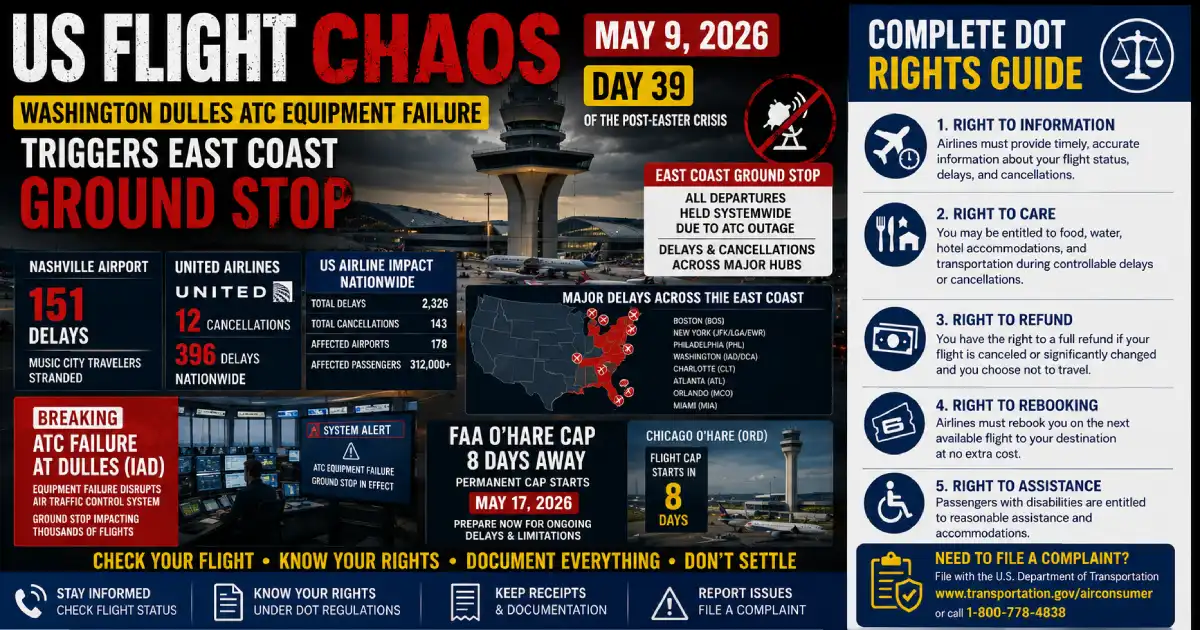
Breaking — May 9, 2026: Day 39 of the post-Easter US aviation crisis began as a recovery day — and then Washington Dulles intervened. A critical air traffic control equipment malfunction struck Washington Dulles International Airport today, triggering a complete ground stop during which no flights could depart from Dulles for approximately 90 minutes. The outage simultaneously affected Ronald Reagan Washington National Airport and Baltimore/Washington International — paralyzing all three Washington-area airports at once and sending upstream hold instructions to major hubs including Atlanta, Dallas–Fort Worth, Denver, and Chicago. By the time technicians restored the system, 106 flights had been delayed and 3 cancelled at Dulles alone — with cascade effects spreading across the East Coast for hours. In Nashville, an entirely separate operational strain produced 151 flight delays and zero cancellations — the largest delay-only disruption event at BNA this month. Across United Airlines’ entire network today: 12 cancellations and 396 delays, touching Newark, San Francisco, Dulles, O’Hare, Houston, Boston, Zurich, Lisbon, Accra, and Hong Kong. Day 39. FAA O’Hare summer cap in 8 days. Memorial Day in 15 days. The system is stabilising — but today’s ATC failure at Dulles is a reminder that stabilisation and safety are two different things.
Published: May 9, 2026 — Saturday (Day 39 of post-Easter US aviation crisis) Headline Event: Washington Dulles ATC equipment malfunction — 90-minute complete ground stop Three airports simultaneously affected: Washington Dulles (IAD) · Reagan National (DCA) · Baltimore/Washington (BWI) Dulles total disruptions: 106 delays + 3 cancellations = 109 total Nashville total: 151 delays + 0 cancellations = 151 total United Airlines network total (today): 12 cancellations + 396 delays United’s most affected hubs: Newark (EWR) · San Francisco (SFO) · Washington Dulles (IAD) · Chicago O’Hare (ORD) · Houston (IAH) · Boston (BOS) International routes cancelled on United: Lisbon (LIS) · Accra (ACC) · Zurich (ZRH) · Hong Kong (HKG) Dulles primary carrier hit: United Airlines (dominant hub carrier at IAD) Also disrupted at Dulles: American Airlines · Delta Air Lines · Mesa Airlines · Lufthansa Nashville carriers hit: Southwest Airlines · Delta Air Lines · American Airlines · United Airlines Nashville routes broken: New York · Chicago · Atlanta · Dallas · Miami · Los Angeles · Denver Upstream airports held during Dulles ground stop: Atlanta (ATL) · Dallas–Fort Worth (DFW) · Denver (DEN) · Chicago O’Hare (ORD) Dulles ground stop duration: Approximately 90 minutes — complete cessation of departures Peak departure delays at Dulles: Exceeding 3 hours on some routes during ground stop recovery ATC outage cause: Equipment malfunction — FAA systems failure (not weather) FAA response: Emergency protocols activated · degraded systems during repairs · graduated restrictions post-restoration Overnight cascade: Aircraft that completed one rotation on May 9 instead of three — affecting May 10 early morning departures FAA O’Hare summer cap: ⏰ 8 DAYS — May 17, 2026 Memorial Day weekend: ⏰ 15 DAYS — May 23, 2026 United rescue fares: Still available until May 16 at united.com/specialfares DOT rights: Full cash refund for cancellations within 7 business days to credit card
This is not a standard hub disruption article. Washington Dulles’ May 9 chaos is in a different category from the weather cascades and Spirit displacement surges that defined the previous 38 days of this crisis. Today’s Dulles disruption was caused by something more alarming — a failure of the ATC infrastructure itself.
During peak Saturday travel hours, a critical air traffic control equipment malfunction struck the facility managing Washington Dulles airspace. The technical failure demonstrated how single-point infrastructure failures in the National Airspace System can ripple through interconnected airports and airline networks within minutes.
During the initial 90 minutes of the outage, no flights could depart from Dulles for destinations across the United States. Controllers worked from degraded systems while engineers worked to restore full functionality. The ground stop remained in effect until technicians completed repairs, after which controllers began working through the accumulated backlog of delayed flights.
The Washington area manages some of the most restricted and complex airspace in the United States due to national security requirements. The three Washington-area airports — Dulles (IAD), Reagan National (DCA), and Baltimore/Washington (BWI) — share overlapping airspace controlled from the same regional facility. When the equipment failure struck, all three airports were simultaneously affected:
The ground stop did not stay in Washington. Ground controllers at en route centres nationwide received instructions to hold departures destined for the Washington region. This created upstream delays at major hubs including Atlanta, Dallas–Fort Worth, Denver, and Chicago, as aircraft waiting for departure slots consumed gate space and crew time.
This is the mechanism that makes a local ATC failure a national crisis: every aircraft at Atlanta scheduled to land at Dulles is now sitting at the Atlanta gate, consuming the gate, the crew, and the time. That crew, if it was supposed to fly ATL→IAD→ORD after the Dulles landing, is now also delayed into Chicago. A 90-minute Dulles ground stop generates 90-minute delays at four major hubs simultaneously.
The damage to May 9 extended well past the point of system restoration. The tight scheduling of modern aviation meant that delays originating in early evening operations extended their impact well into the overnight and next morning schedule. Aircraft that should have completed three rotations on May 9 had only finished one by midnight, forcing them into recovery positions on May 10.
Early morning flights on May 10 are already affected. A 5:45 AM departure to Los Angeles found its scheduled aircraft still in maintenance after arriving from a delayed overnight rotation. Passengers booked on Dulles early morning departures on May 10 should check their flight status tonight before bed.
United Airlines maintains a significant hub operation at Washington Dulles, and bore the heaviest impact from Saturday’s disruption. United’s hub operations at Dulles make it particularly sensitive: the tight connection patterns that make United’s hub operations efficient also amplify disruption when schedules slip.
United services most disrupted at Dulles today:
✈️ IAD → Chicago O’Hare (ORD): Services to United’s primary Chicago hub experienced both late departures and late arrivals during the ground stop recovery. Chicago’s role as a major national transfer point meant that delays on Washington–Chicago flights propagated westbound, affecting connections to Midwest and West Coast destinations.
✈️ IAD → New York (JFK/EWR): New York-bound flights from Washington Dulles attracted particular attention from flight trackers, as these high-frequency corridors serve critical business markets and feed major transatlantic gateways. Multiple services posted revised departure times, with several flights showing delays approaching or exceeding 90 minutes.
✈️ IAD → Los Angeles (LAX): Transcontinental services delayed. The Los Angeles flight that found its aircraft in maintenance after a delayed overnight rotation is one of multiple IAD→LAX services affected today.
International United cancellations confirmed today:
United Flight UAL3896 — Boeing 787-10 from Newark (EWR) to Lisbon (LIS): Cancelled. A transatlantic widebody cancellation affecting passengers crossing to Portugal.
United Flight UAL997 — Boeing 787-8 from Accra, Ghana (ACC) to Washington Dulles (IAD): Cancelled. West Africa to US capital route — diaspora passengers and diplomatic travellers most affected.
United Flight UAL3912 — from Zurich (ZRH) to Boston Logan (BOS): Cancelled — with the connecting domestic segment from Boston to Chicago O’Hare also cancelled as a result.
United Flight UAL1297 — Toronto Pearson (YYZ) to Chicago O’Hare (ORD): Cancelled.
Transatlantic passenger note: If your flight to Europe from Dulles has been cancelled, demand that the airline rebooks you on any available carrier, including those outside of the Star Alliance (such as British Airways via London or Air France via Paris). During major Dulles disruptions, IAD passenger protection protocols may include rebooking on non-Star Alliance carriers.
🇬🇧 UK passengers on IAD→LHR connections: If your itinerary routes through Dulles for a transatlantic departure tonight, the ATC outage and its overnight cascade are directly affecting your departure. Contact United at 1-800-864-8331 now and request protection on a tomorrow-morning departure if tonight’s service shows delays exceeding 90 minutes.
🇦🇺 Australian passengers: Dulles–Zurich, Dulles–Frankfurt connections feeding into Europe–Australia routings are affected today. If you are routing IAD→ZRH→SYD or IAD→FRA→MEL, the Zurich cancellation specifically threatens your onward connection.
Contact United IAD: united.com → My Trips | 1-800-864-8331 | United app → Manage Reservations
American Airlines and Delta Air Lines, operating smaller but still substantial schedules at Dulles, reported delayed services on select domestic routes. The three canceled flights were distributed across multiple carriers.
American’s primary Dulles connections to Charlotte Douglas (CLT) and Dallas–Fort Worth (DFW) are running delayed as cascade from the ground stop propagates through the afternoon. For passengers connecting Charlotte to Philadelphia, Boston, or New York — the Dulles-originating delay is the critical first link.
Contact American IAD: aa.com | 1-800-433-7300
Mesa Airlines, operating as United Express at Dulles, had flights grounded today. Mesa operates United’s regional feeder routes — short-haul CRJ and ERJ aircraft connecting smaller mid-Atlantic and Midwest cities into Dulles for United’s mainline connections. When the ground stop hit, Mesa’s inbound feeders were held at their origin cities, further depleting the aircraft available for Dulles outbound departures.
Lufthansa’s Star Alliance partnership with United means Lufthansa-coded services connecting through Dulles are also experiencing disruption. For passengers on Lufthansa tickets routing through Washington Dulles on code-share services, the EU261 framework applies to the Lufthansa-operated segments.
EU261 note for Lufthansa passengers: If your Lufthansa-coded flight arrives at a European airport 3+ hours late, you may be entitled to up to €600 per person — even if the delay originated in an ATC failure at Dulles. ATC failures caused by equipment malfunction (not weather) occupy a legally contested space under EU261’s extraordinary circumstances exemption — some successful claims have been upheld against airlines for technology-based ATC failures. File the claim and escalate if rejected.
Nashville International Airport’s May 9 disruption profile is unusual in one critical respect: 151 delays and zero cancellations. This is not common. Most disruption days produce a ratio of approximately 5–10% cancellations among total disruptions. Nashville today has a 0% cancellation rate — meaning every disrupted passenger is still on their flight, but waiting.
Nashville International Airport recorded 151 flight delays and no cancellations, creating long waits, missed connections, and mounting frustration for travelers attempting to reach destinations across the United States.
The zero-cancellation profile reflects a deliberate airline strategy: when disruption at a secondary airport is driven by cascading positioning failures rather than a hard constraint (like a ground stop or severe weather), airlines prefer to absorb delays rather than cancel. A cancellation requires full rebooking with no guarantee of next-day availability at Nashville. A 2-hour delay still gets the passenger to their destination today. For a city experiencing Nashville’s tourism and convention growth — families beginning vacations, concert-goers, conference attendees — cancellations produce vastly more disruption per passenger than delays.
Nashville’s growing popularity has amplified the airport’s vulnerability during periods of operational strain. Passenger demand at BNA has surged over the last several years as the city strengthened its position as a tourism, entertainment, and convention destination. Expanded airline schedules and new routes have increased the number of daily aircraft movements — making smooth coordination between airlines and air traffic control even more critical.
On a normal day, that growth is an asset. On a Day 39 cascade day, it means more flights competing for the same gate slots, ground crews, and ATC sequencing windows.
Carriers hit at Nashville today:
✈️ Southwest Airlines: Point-to-point network — dense BNA scheduling — most exposed to cascade ✈️ Delta Air Lines: Atlanta hub connection — ATL→BNA→ATL cycle disrupted ✈️ American Airlines: Dallas and Charlotte connections ✈️ United Airlines: Chicago O’Hare connection
Nashville routes most disrupted:
Connections through Nashville today face the highest missed-connection risk of any secondary airport in the southeastern US. Business travelers should build 3–4 hour connection buffers on critical itineraries and monitor FlightAware status pages proactively. The normal 45-minute domestic minimum connection is not operational today. If your itinerary routes through Nashville with less than 2 hours of connection time: call your airline now and request rebooking to a later connecting departure.
Contact Southwest BNA: 1-800-435-9792 | southwest.com Contact Delta BNA: 1-800-221-1212 | delta.com Contact American BNA: 1-800-433-7300 | aa.com Contact United BNA: 1-800-864-8331 | united.com
Today’s United Airlines disruption is the most geographically dispersed of any carrier this week. United faced widespread operational disruptions after 12 flights were cancelled and 396 others were delayed across its domestic and international network, affecting passengers traveling through several major hubs in the United States, Europe, Africa, and Asia.
The hubs under pressure:
| Hub | Disruption Type | Key Affected Routes |
|---|---|---|
| Newark (EWR) | Cancellations + delays | Lisbon (cancelled) · London · Paris |
| San Francisco (SFO) | Delays + cancellations | Las Vegas→SFO cancelled · Tokyo · Seoul · Sydney |
| Washington Dulles (IAD) | ATC outage cascade | Chicago · New York · Zurich (cancelled) |
| Chicago O’Hare (ORD) | Positioning cascade | Multiple domestic + Toronto→ORD cancelled |
| Houston (IAH) | Delays | Dallas→Houston + Miami→Houston cancelled |
| Boston (BOS) | Cascading | Zurich→BOS cancelled |
The international cancellation consequence:
The combination of international and domestic cancellations created cascading complications for travelers connecting through United’s major hubs. Several of the cancelled services involved major long-haul international routes connecting the United States with Europe, Asia, and Africa.
For any passenger whose United international flight has been cancelled today — regardless of destination: ✅ Full cash refund to original payment method within 7 business days (credit card) ✅ Free rebooking on the next available United service to the same destination ✅ Right to request rebooking on any carrier (including non-Star Alliance) if United cannot provide a timely alternative ✅ Meals and accommodation if the cancellation results in an overnight delay
Contact United (all hubs): 1-800-864-8331 | united.com → My Trips → check travel alerts
The FAA summer flight cap at Chicago O’Hare takes effect in 8 days, reducing peak operations by approximately 300 movements per day. Today’s Dulles ATC equipment failure adds a new dimension to the pre-cap urgency: it demonstrates that the US aviation system’s technology infrastructure is failing at the exact moment the FAA is trying to impose a major structural change at its busiest hub.
The FAA has been under intense pressure to modernise its ATC technology. Transportation Secretary Sean Duffy has visited control facilities and called for an all-new air traffic control system. Today’s Dulles outage — affecting three airports simultaneously, grounding departures for 90 minutes, and cascading delays into Atlanta, Dallas, Denver, and Chicago — is the most dramatic single illustration yet of why that modernisation is urgent.
For passengers with O’Hare connections between now and May 24: Build 90-minute minimum connections. Book morning departures where possible. The FAA cap transition period (May 17–24) combined with Memorial Day demand is the single highest-risk one-week window in US aviation in 2026.
Approximately 45 million Americans will travel over Memorial Day weekend — the first major holiday since Spirit Airlines ceased operations on May 2. Spirit’s absence means:
Book today if you don’t have Memorial Day flights: Memorial Day weekend availability is tightening. The window to book at reasonable prices without O’Hare connection risk is narrowing fast.
The broader national picture on Day 39 shows genuine improvement from the crisis peaks of April 18 (4,651 disruptions), April 29 (4,662), and May 2 (4,652 Spirit shutdown). Today’s disruption is concentrated at specific airports — Dulles, Nashville, United’s network — rather than the simultaneous multi-hub collapse that defined the worst days.
What “stabilising” means in practice:
✅ O’Hare is not in a full ground stop today ✅ Dallas is not recording 283 cancellations today ✅ Atlanta is not recording Delta 1,093 delays today ✅ Spirit ghost flights are fully cleared ✅ National disruption total is far below the 4,000+ peaks
What “not stable” means in practice:
⚠️ A single ATC equipment failure at Dulles can still trigger a 90-minute complete ground stop affecting three airports simultaneously ⚠️ United’s international network is still recording 12 cancellations and 396 delays on a Day 39 “recovery” day ⚠️ Nashville’s 151 delays show that secondary airports are not recovering as fast as primary hubs ⚠️ The FAA technology infrastructure that failed today at Dulles is the same infrastructure managing every other US airport
Day 39 is better than Day 18. It is not finished.
Today’s Dulles disruption was caused by an equipment malfunction — not weather. This is significant for compensation purposes:
Weather delays: Classified as extraordinary circumstances — airlines may be exempt from duty-of-care obligations.
ATC equipment failure: More legally complex. Equipment failures can be classified as extraordinary circumstances under US DOT rules if they are genuinely unforeseeable and beyond the airline’s control. However, there is an argument — particularly for EU261 claims on European carriers — that systematic ATC technology failures at Dulles were foreseeable given the documented infrastructure problems, and therefore should not qualify as extraordinary circumstances.
File the claim regardless: Whether or not the extraordinary circumstances exemption applies, refund and rebooking rights are unconditional for all cancellations. For delay compensation: file it, let the airline reject it, then escalate to the DOT or CAA.
Under DOT Automatic Refund Rules: ✅ Full cash refund — 7 business days to credit card, 20 calendar days to other payment ✅ Free rebooking on next available service ✅ No vouchers forced — say: “Under the DOT automatic refund rule I am requesting a full cash refund to my original payment method within 7 business days.”
EU261 applies if your Dulles disruption is on a European carrier (Lufthansa, Air France, KLM, British Airways, SAS, etc.) and you are arriving 3+ hours late at a European destination:
EU261 does NOT apply to United, American, or Delta departures from Dulles, regardless of destination.
| Delay | Right |
|---|---|
| 2+ hours (operational) | Meals, refreshments, communication |
| 3+ hours | Right to full refund + not to fly |
| 5+ hours | Unconditional refund — leave airport |
1. If you are at Dulles: check whether your delay is pre- or post-ATC restoration Flights delayed before the system was restored are cascade victims of the outage — operational cause, not weather. Flights delayed after restoration may involve weather or positioning factors. The cause determines your duty-of-care entitlement.
2. Nashville passengers with New York or Chicago connections: call now The 151 delays at Nashville are cascading into New York and Chicago. If you have a BNA→ORD or BNA→JFK connection with less than 2 hours of buffer, call your airline now and request proactive rebooking onto a later departure at your final destination.
3. United international passengers: document every cancelled flight number The Lisbon, Accra, Zurich, and Toronto United cancellations today affect passengers with onward connections in Europe and Africa. Document your original flight number, the cancellation notification timestamp, and your rebooked itinerary. This documentation is essential for claiming meals, accommodation, and EU261 compensation where applicable.
4. Check your May 10 morning flight if routing through Dulles The overnight cascade means aircraft that should have completed three May 9 rotations completed only one. Early morning May 10 Dulles departures are at elevated disruption risk. Check your flight status tonight before bed at flightaware.com or your airline’s app.
5. United rescue fares: last 7 days United’s Spirit rescue fare ($199 one-way) expires May 16 — 7 days from today. If you are a Spirit-displaced passenger who has not yet rebooked: go to united.com/specialfares today.
The Bottom Line: Day 39 delivered a crisis within a recovery — a 90-minute complete ground stop at Washington Dulles caused by an ATC equipment failure that simultaneously paralyzed Reagan National and Baltimore/Washington, held departures at Atlanta, Dallas, Denver, and Chicago, and cascaded delays into United’s international network across four continents. Nashville added 151 delays independently, driven by positioning failures and the tourism-driven traffic surge that has made BNA one of America’s most disruption-vulnerable secondary airports. United’s full-network picture — 12 cancellations, 396 delays, hubs from Newark to Hong Kong — shows that the national system is recovering but the recovery is uneven and fragile. The FAA cap at O’Hare in 8 days and Memorial Day in 15 days are the twin countdowns that will define whether this recovery holds. The Dulles ATC failure today is a warning: the technology infrastructure underpinning the world’s busiest aviation system is failing at the exact moment the system most needs it to work.
For More Resources:
Related Articles:
Posted By : Vinay
This article is provided for general informational purposes only and is based on information available at the time of publication. Travel advisories, airline schedules, airport operations, visa requirements, government regulations, and other travel-related information are subject to change without prior notice. While Travel Tourister makes reasonable efforts to verify information using official announcements, government publications, airline and airport communications, and other reliable sources, we cannot guarantee that all information remains complete, accurate, or up to date at all times. Readers should independently verify any information that may affect their travel plans with the relevant airline, airport authority, government agency, embassy, or other official source before making travel, financial, or other decisions. Travel Tourister shall not be liable for any direct or indirect loss, inconvenience, or damages arising from the use of or reliance on the information contained in this article. Nothing in this publication constitutes legal, immigration, financial, or professional travel advice. If you believe any information in this article is inaccurate or outdated, please contact our editorial team. We review all credible correction requests promptly and update our content whenever appropriate.
Lastest News
2nd Floor, 39, Above Kirti Club, DLF Industrial Area, Kirti Nagar, New Delhi, Delhi 110015



Travel Tourister is a leading Travel portal where we introduce travellers to trusted travel agents to make their journey hasselfree, memorable And happy. Travel Tourister is a platform where travellers get Tour packages ,Hotel packages deals through trusted travel companies And hoteliers who are working with us across the world. We always try to find new and more travel agents and hoteliers from every nook and corners across the world so that you could compare the deals with different travel agents and hoteliers and book your tour or hotel with the one you have chosen according to your taste and budget.
Copyright © Travel Tourister, India. All Rights Reserved

 Call
Call Enquiry