Published on : 13 May 2026
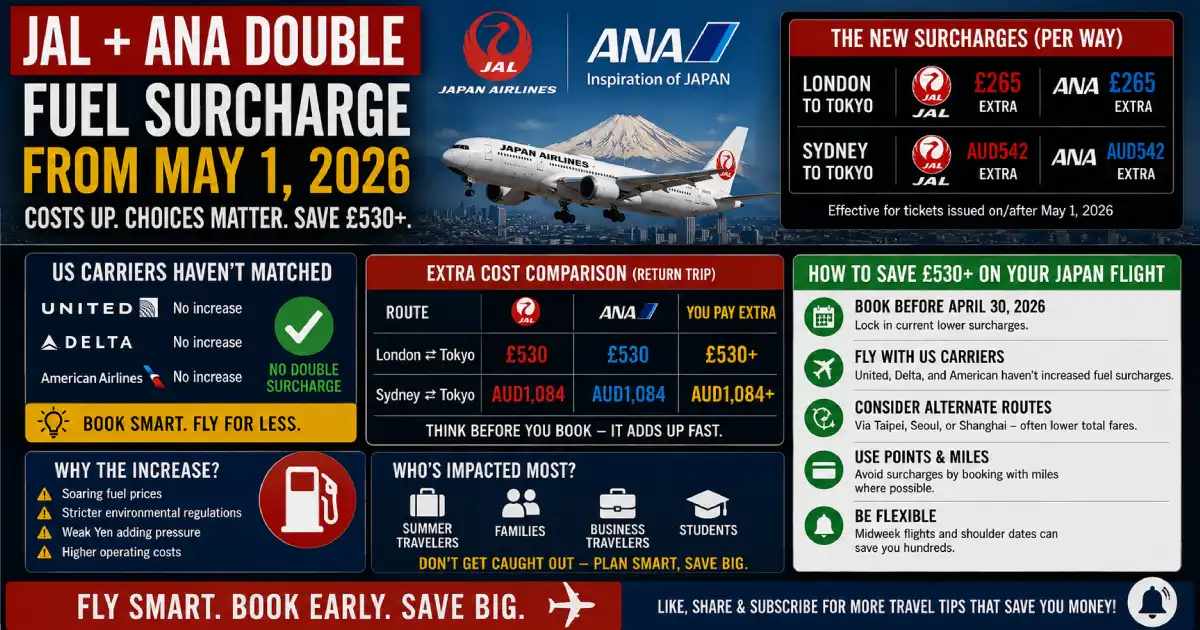
The most expensive hidden fee in aviation just doubled. And most Japan-bound passengers from the UK, Australia, and the US have no idea.
Japan Airlines (JAL) and All Nippon Airways (ANA) have announced they will double their fuel surcharges for international flights booked in May and June, due to soaring aviation fuel prices amid tensions in the Middle East. The two major Japanese airlines initially planned to raise the surcharges in June but moved up the increases to May 1. For flights from Japan to North America and Europe, JAL will increase its surcharge from ¥29,000 to ¥56,000, and ANA will raise its surcharge from ¥31,900 to ¥56,000.
In pound sterling, that means: GBP265 per sector for itineraries originating in the UK — for JAL codeshare flights within Europe operated by British Airways, Finnair, or Iberia. In Australian dollars: AUD542 per sector for itineraries originating in Australia. Long-haul travellers heading to London, Paris, or New York from Japan will face a round-trip surcharge of up to 112,000 yen per person — approximately £1,050 in surcharges alone on a return ticket.
But here is the story most travel sites are not telling: Competing US carriers — United, American, Delta — have not announced matching increases. United operates five weekly flights from San Francisco to Tokyo Narita, American runs three weekly services from Los Angeles to Narita, and Delta flies twice weekly from Detroit to Narita. None of these carriers have announced fuel surcharge increases for May or June. This creates a significant pricing advantage for US carriers on Japan routes through at least June 30.
If you are flying London–Tokyo this summer, the carrier you choose could cost or save you £530 per return ticket. This is everything you need to know.
Published: May 13, 2026 Effective Date: May 1, 2026 — applies to all tickets ISSUED on or after May 1, 2026 Expiry (current schedule): June 30, 2026 — rates reviewed every two months JAL Surcharge (Japan → North America/Europe): ¥56,000 per segment (was ¥29,000) — 93% increase ANA Surcharge (Japan → North America/Europe): ¥56,000 per segment (was ¥31,900) — 76% increase UK passengers (JAL codeshares): GBP 265 per sector — up from approximately GBP 138 Australian passengers (JAL): AUD 542 per sector — up from approximately AUD 287 US passengers (JAL/ANA): ~$350 one-way — up from ~$180 (JAL); up from ~$197 (ANA) Round-trip London–Tokyo surcharge: Approximately £530 (two sectors at £265) Round-trip Sydney–Tokyo surcharge: Approximately AUD 1,084 (two sectors at AUD 542) Round-trip LA–Tokyo surcharge: Approximately $700 (two sectors at ~$350) US carriers (United/American/Delta): ❌ NO matching surcharge increase — significant pricing advantage Japanese government subsidy: ✅ Active — ANA confirms surcharges are ONE LEVEL BELOW maximum allowed Award tickets affected? ✅ YES — JMB and AMC mileage redemptions pay surcharges in cash Partner programme awards affected? ✅ YES — Aeroplan, Alaska Mileage Plan, British Airways Avios all face same surcharges on JAL/ANA-operated flights Keyword hook: “Fuel surcharge” is separate from the base ticket price — it appears as a line item in your booking summary
Most passengers booking a Japan flight see a single total fare. But that total is composed of three distinct elements: the base airfare, government taxes and airport fees, and the fuel surcharge. The fuel surcharge is the variable element — the line item that airlines use to pass on jet fuel cost changes without repricing the base fare.
The fuel surcharge is not part of the base ticket price. Instead, it is a variable fee airlines apply to reflect fuel cost changes. When buying an airline ticket, the price is usually divided into: the base fare (the basic cost of the seat), taxes and fees (money that goes to governments or airports), and the fuel surcharge (an extra fee added by the airline to cover the cost of jet fuel).
The critical rule that JAL and ANA passengers must understand: A very important rule to remember is that the fuel surcharge is based on the ticket issue date, not the flight date. If you buy your ticket on April 25 for a flight in August, you pay the lower current rate. If you wait until May 2 to buy a ticket for that same flight in August, you will pay the higher rate.
This means the May 1 surcharge increase affected not only May and June travel — it affected any ticket for any future Japan flight issued after May 1, regardless of when the flight actually departs. Anyone who bought a JAL or ANA ticket for a summer Japan holiday on or after May 1 is paying the doubled surcharge. Anyone who booked before April 30 locked in the lower rate.
JAL and ANA doubled surcharges because fuel prices rose faster than their usual calculation window could absorb. Japanese carriers normally set surcharges using fuel prices from three to four months earlier, but the March spike from the US-Iran conflict forced both airlines to move the hike up by one month, according to Asahi Shimbun reporting.
JAL and JTA set fuel surcharge levels based on the two-month average price of Singapore kerosene-type jet fuel. The price of Singapore kerosene-type jet fuel during the two-month period of February and March 2026 averaged USD 146.99 per barrel, which corresponds to JPY 23,076 based on the average exchange rate of JPY/USD 156.99 during the same period.
The Iran war, which began February 28, 2026, drove jet fuel prices from $2.50 per gallon to $4.88 nationally and pushed Singapore kerosene to levels not seen since the 2008 oil price shock. East Asia is structurally more exposed to Middle East fuel supply disruption than any other region: Supplies to East Asia are at a particular premium because there is such dependence on the Gulf for fuel in the region. Aviation industry commentators note that while airlines globally have been reluctant to use fuel surcharges in recent years, sustained high jet fuel prices have compelled a return to this pricing mechanism.
The Japanese government response: ANA’s official page confirms: “Fuel surcharges will be reduced for tickets purchased between May 1 and June 30, 2026. This adjustment follows the Japanese government’s measures to mitigate rising fuel costs linked to the situation in the Middle East.” This is significant: the surcharges you see today are ONE LEVEL BELOW what JAL and ANA would otherwise have charged. Despite the market price benchmark, both airlines have decided to apply a surcharge one level below the highest available surcharge, with the expectation that the government’s emergency financial support for jet fuel will help stabilise costs. Without government intervention, UK passengers would be paying more than £265 per sector.
For flights from Japan to North America and Europe, JAL will increase its surcharge from ¥29,000 to ¥56,000, and ANA will raise its surcharge from ¥31,900 to ¥56,000. For flights to South Korea, both carriers will more than double their surcharges.
| Origin | Destination | Old Surcharge | New Surcharge | Increase |
|---|---|---|---|---|
| UK | Japan | ~GBP 138/sector | GBP 265/sector | +92% |
| Australia | Japan | ~AUD 287/sector | AUD 542/sector | +89% |
| Europe (except UK) | Japan | ~EUR 160/sector | EUR 307/sector | +92% |
| USA/Canada | Japan | ~$180/sector | ~$350/sector | +94% |
| Japan | North America/Europe | ¥29,000/sector | ¥56,000/sector | +93% |
| Japan | South Korea | ~¥3,200/sector | ¥6,500-6,700/sector | +103% |
| Japan | Hawaii | ~¥18,500/sector | Rising sharply | +60%+ |
| Japan | Southeast Asia | ~¥15,500/sector | Rising sharply | +50%+ |
| Origin | Destination | Old Surcharge | New Surcharge | Increase |
|---|---|---|---|---|
| Japan | North America/Europe | ¥31,900/sector | ¥56,000/sector | +76% |
| Japan | South Korea | ~¥3,300/sector | ¥6,500/sector | +97% |
| Canada | Japan | CAD 197/sector | Rising sharply | +50%+ |
Source: JAL official surcharge page (updated April 30, 2026) · ANA official surcharge page · Japan Times ·
| Route | Old Round-Trip Surcharge | New Round-Trip Surcharge | Additional Cost |
|---|---|---|---|
| London–Tokyo return | ~£276 | ~£530 | +£254 |
| Sydney–Tokyo return | ~AUD 574 | ~AUD 1,084 | +AUD 510 |
| LA–Tokyo return | ~$360 | ~$700 | +$340 |
| New York–Tokyo return | ~$360 | ~$700 | +$340 |
| Family of 4, London–Tokyo | ~£1,104 | ~£2,120 | +£1,016 |
This is the most valuable section of this article.
Competing US carriers — United, American, Delta — have not announced matching increases, creating a significant pricing advantage for US carriers on Japan routes through at least June 30. United Airlines operates five weekly flights from San Francisco to Tokyo Narita using the 787-10. American Airlines runs three weekly services from Los Angeles to Narita with the 787-9. Delta Air Lines flies twice weekly from Detroit to Narita on the 767-400ER. None of these carriers have announced fuel surcharge increases for May or June.
What this means for UK passengers:
A UK passenger flying British Airways from London Heathrow to Tokyo Narita pays the JAL codeshare fuel surcharge of £265 per sector (BA operates some Japan routes as JAL codeshares). But a UK passenger flying United from London Heathrow to Tokyo via San Francisco or New York is NOT paying the JAL/ANA surcharge — they are paying United’s surcharge, which has not increased.
The carrier comparison matrix for Japan travel:
| Carrier | LHR–NRT Surcharge | Surcharge Increased? | Routing |
|---|---|---|---|
| JAL (direct) | £265/sector | ✅ YES — +93% | LHR–NRT direct |
| ANA (direct) | £265/sector equivalent | ✅ YES — +76% | LHR–NRT direct |
| British Airways (JAL codeshare) | £265/sector | ✅ YES — via JAL metal | LHR–NRT via BA/JAL |
| Finnair (JAL codeshare) | £265/sector | ✅ YES — via JAL metal | LHR–NRT via HEL |
| United Airlines | Lower surcharge | ❌ NO increase | LHR–EWR–NRT |
| Air France | Lower surcharge | ❌ NO matching increase | LHR–CDG–NRT |
| Korean Air | Own schedule | Check KE website | LHR–ICN–NRT |
| Singapore Airlines | Own schedule | Check SQ website | LHR–SIN–NRT |
| Cathay Pacific | Own schedule | Check CX website | LHR–HKG–NRT |
For UK passengers: The saving by routing via a non-JAL/ANA metal carrier can be £265–£530 per return ticket per person. For a family of four, that is £1,060–£2,120 in surcharge savings on a single Japan holiday.
For Australian passengers: The saving is even more dramatic — AUD 542 per sector, or AUD 1,084 per return. Routing through Singapore Airlines (SQ), Cathay Pacific (CX), or other carriers that have not matched the JAL/ANA increase saves over AUD 1,000 per person per return.
The important caveat: Carrier choice is not always available. JAL and ANA operate the most frequent non-stop services from London, Sydney, Melbourne, and other key markets to Tokyo. If you specifically need direct flights, the surcharge may be unavoidable. But for passengers willing to connect, the arbitrage is real.
A round-trip Tokyo–San Francisco business-class award on ANA or JAL from May will therefore cost the same miles as before, but roughly ¥112,000 more in cash surcharges alone. If you were sitting on a big JMB or AMC balance and planning to burn miles this year, ticketing before May 1 locks in today’s lower surcharge — assuming award space exists on your dates.
The surcharge increase applies identically to award tickets as to paid tickets. This is the element that catches the most miles-savvy travellers off guard: you pay the surcharge in cash regardless of how you pay the base fare. No matter how you book — whether through partner programs like Aeroplan or Alaska’s Atmos Rewards or directly with JAL Mileage Bank or ANA Mileage Club — you’ll still be on the hook for the higher surcharges starting May 1.
Partner programme impact — the specific programmes most affected:
British Airways Avios on JAL: BA Avios holders who book Japan flights on JAL metal pay JAL’s fuel surcharges. From May 1, that is £265 per sector — £530 per return — ON TOP of the Avios cost. If you were planning an Avios Japan redemption, the cash outlay for a return ticket has jumped from approximately £300 in total charges (surcharge + taxes) to approximately £580.
Aeroplan on JAL/ANA: Air Canada’s Aeroplan programme is heavily used for Japan bookings. Partner program members (Aeroplan, Alaska Airlines Mileage Plan) face identical surcharge increases on JAL/ANA awards — consider redeeming on non-Japanese carriers to avoid the increase.
Alaska Airlines Mileage Plan: Alaska’s partnership with JAL is one of the most popular Japan redemptions in its network. Same surcharge applies.
The workaround: Redeem your miles on United, American, or Delta operated Japan flights instead. US carriers have not announced fuel surcharge increases for May or June — so an Aeroplan redemption on United SFO–NRT carries significantly lower cash surcharges than the same Aeroplan redemption on JAL.
The refund rule: ANA’s conditions state that the balance is not adjusted if the ticket is not changed. If you reissue a wholly unused ticket, the new surcharge applies. Partially used tickets are not adjusted.
JAL and ANA review their fuel surcharges every two months. The cycle works like this: February–March fuel prices determine surcharges for May–June. April–May fuel prices determine surcharges for July–August. June–July fuel prices determine surcharges for September–October. If global oil prices decrease substantially in April and May, surcharge reductions could begin again on July 1. However, ongoing global events and economic patterns indicate that fuel prices are likely to stay elevated for the near future.
One important detail: this pricing is temporary and currently scheduled to run through June 30, 2026. If fuel and insurance costs ease, there’s a chance surcharges could return to more modest levels later on.
The Iran war ceasefire, which was extended by Trump in April, remains fragile. If tensions persist or further disruptions occur, fuel prices could continue to rise, potentially leading to additional increases in fuel surcharges for airlines. Conversely, if the geopolitical situation stabilises and oil prices decrease, the surcharges may be adjusted accordingly.
The practical outlook for travellers planning Japan trips:
AUD542 per sector for itineraries originating in Australia — this applies to JAL codeshare flights operated by British Airways, Finnair, or Iberia from Australian departure cities.
Sydney–Tokyo is already one of the longest and most expensive long-haul routes in the Asia-Pacific. At AUD 542 per sector, the fuel surcharge alone on a Sydney–Tokyo return is AUD 1,084 per person — on top of whatever the base fare is. For a family of four Australians flying JAL or ANA to Japan this summer, the fuel surcharge component of their tickets is AUD 4,336. That is before a single base fare, airport tax, or booking fee is added.
Australian alternatives to JAL/ANA:
Qantas Points holders: Qantas Frequent Flyer members redeeming points on JAL flights from Australia pay JAL’s fuel surcharges — now AUD 542 per sector in cash. If you are planning a Qantas Points Japan redemption, the cash outlay has approximately doubled.
This move is expected to significantly impact the summer holiday season, as higher surcharges could increase overall travel costs and influence travel demand, particularly for international flights. Travel experts are concerned that the increase in surcharges could dampen demand, especially among leisure travellers who may be more sensitive to price increases.
Japan had been experiencing a remarkable tourism recovery through 2024 and 2025 — record inbound visitor numbers, a weaker yen making the country excellent value, and a surge in Western tourists following the COVID reopening. The doubled fuel surcharge is the first significant structural barrier to that recovery. For a UK family of four, a Japan holiday now costs £1,016 more just in surcharges before any other price element is considered. That is the equivalent of two nights in a Tokyo hotel added to the cost of existing bookings.
The competitive pressure on JAL and ANA from US carriers not matching the increase creates a specific risk: UK and Australian passengers who were planning JAL/ANA bookings may switch to United, American, or Delta routings — reducing Japanese carrier revenue precisely when fuel costs are highest.
Your surcharge is LOCKED at the lower rate. Anything issued earlier still uses the current February–March benchmark. Do not change or reissue your ticket unless absolutely necessary. If you reissue the ticket, the new higher surcharge applies to the entire ticket. If your plans change and you need to modify the routing or dates — consider the surcharge cost of reissuing before making any changes.
You are already paying the new higher surcharge. Check your booking confirmation for the “fuel surcharge” or “YQ” line item. Consider whether switching to a US carrier (United, American, Delta) for the same Japan dates would save money after accounting for connection times and any fare difference.
Book United SFO–NRT, American LAX–NRT, or Delta DTW–NRT to avoid surcharge increases entirely. None of these carriers have announced fuel surcharge increases for May or June — creating a significant pricing advantage for US carriers on Japan routes through at least June 30.
For UK passengers specifically: check United’s LHR–SFO–NRT or LHR–EWR–NRT routing against JAL’s direct LHR–NRT. The £265 per sector saving may be worth a connection, depending on your time flexibility.
For Australian passengers: check Singapore Airlines SYD–SIN–NRT and Cathay Pacific SYD–HKG–NRT for current surcharge levels compared to JAL’s AUD 542.
| Action | Link |
|---|---|
| JAL official fuel surcharge table | jal.co.jp/jp/en/inter/fare/fuel/detail_overseas.html |
| ANA official fuel surcharge page | ana.co.jp/en/jp/guide/plan/charge/fuelsurcharge/ |
| United Airlines Japan routes | united.com → search SFO–NRT, LAX–NRT, EWR–NRT |
| American Airlines Japan routes | aa.com → search LAX–NRT |
| Delta Air Lines Japan routes | delta.com → search DTW–NRT, LAX–NRT |
| Singapore Airlines SYD–NRT | singaporeair.com → search SYD–NRT |
| Cathay Pacific SYD–NRT | cathaypacific.com → search SYD–NRT |
| Korean Air ICN–NRT | koreanair.com |
| Google Flights Japan comparison | flights.google.com → search all carriers |
| JAL contact (US) | 1-800-525-3663 |
| ANA contact (US) | 1-800-235-9262 |
| JAL contact (UK) | 0344 856 0995 |
| ANA contact (UK) | 0207 025 5000 |
| JAL contact (Australia) | 1300 525 287 |
Japan Airlines and All Nippon Airways have doubled their fuel surcharges for international flights booked in May and June, due to soaring aviation fuel prices amid tensions in the Middle East. For flights from Japan to North America and Europe, JAL has increased its surcharge from ¥29,000 to ¥56,000, and ANA from ¥31,900 to ¥56,000. UK passengers pay GBP 265 per sector — AUD 542 per sector for Australian passengers. Long-haul travellers heading to London, Paris, or New York face a round-trip surcharge of up to 112,000 yen per person — approximately £1,050 in surcharges alone. But competing US carriers — United, American, Delta — have not announced matching increases, creating a significant pricing advantage for US carriers on Japan routes through at least June 30. The Japanese government has mitigated the increase by one tier — without government intervention, surcharges would be even higher. This pricing is temporary and currently scheduled to run through June 30, 2026 — if fuel costs ease, surcharges could reduce from July 1.
Your five-point Japan flight action plan:
Related Articles:
Posted By : Vinay
This article is provided for general informational purposes only and is based on information available at the time of publication. Travel advisories, airline schedules, airport operations, visa requirements, government regulations, and other travel-related information are subject to change without prior notice. While Travel Tourister makes reasonable efforts to verify information using official announcements, government publications, airline and airport communications, and other reliable sources, we cannot guarantee that all information remains complete, accurate, or up to date at all times. Readers should independently verify any information that may affect their travel plans with the relevant airline, airport authority, government agency, embassy, or other official source before making travel, financial, or other decisions. Travel Tourister shall not be liable for any direct or indirect loss, inconvenience, or damages arising from the use of or reliance on the information contained in this article. Nothing in this publication constitutes legal, immigration, financial, or professional travel advice. If you believe any information in this article is inaccurate or outdated, please contact our editorial team. We review all credible correction requests promptly and update our content whenever appropriate.
Lastest News
2nd Floor, 39, Above Kirti Club, DLF Industrial Area, Kirti Nagar, New Delhi, Delhi 110015



Travel Tourister is a leading Travel portal where we introduce travellers to trusted travel agents to make their journey hasselfree, memorable And happy. Travel Tourister is a platform where travellers get Tour packages ,Hotel packages deals through trusted travel companies And hoteliers who are working with us across the world. We always try to find new and more travel agents and hoteliers from every nook and corners across the world so that you could compare the deals with different travel agents and hoteliers and book your tour or hotel with the one you have chosen according to your taste and budget.
Copyright © Travel Tourister, India. All Rights Reserved

 Call
Call Enquiry