Published on : 18 May 2026
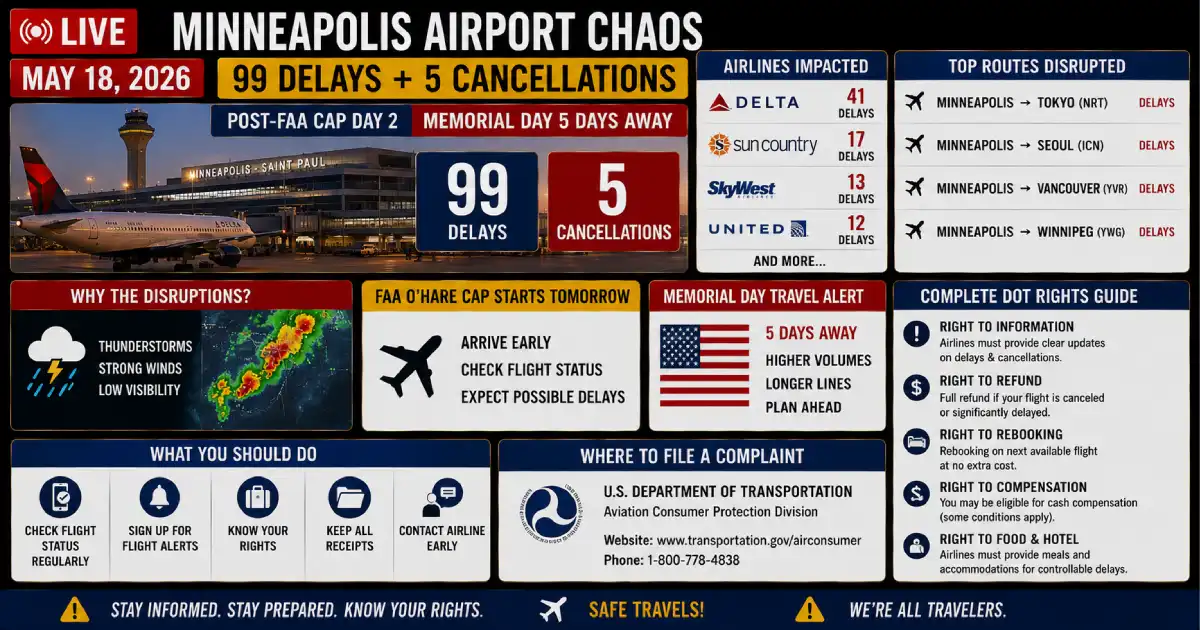
Breaking — May 18, 2026: Minneapolis–St. Paul International Airport has plunged into severe travel chaos today, with 99 flight delays and 5 cancellations creating a total of 104 disruptions that aviation monitors are calling the worst “Upper Midwest Gridlock” of the post-FAA cap era. Delta Air Lines — MSP’s fortress hub carrier — is recording the highest delay count with 41 delayed flights, while Sun Country Airlines, SkyWest, United Airlines, Southwest Airlines, and Endeavor Air are all contributing to a disruption profile that extends across domestic US corridors, Canadian transborder routes, and international services to Tokyo, Seoul (Incheon), Vancouver, and Winnipeg. Today is Day 2 of the FAA O’Hare summer cap — the structural schedule reduction that took effect yesterday — and Minneapolis is one of the first secondary hubs to show visible cascading stress from the Chicago restructuring. Memorial Day weekend is 5 days away. Here is every confirmed number, every affected carrier, every disrupted route, and every right you hold.
Published: May 18, 2026 — (Day 2 of FAA O’Hare summer cap · Day 48 of post-Easter crisis) Airport: Minneapolis–St. Paul International Airport (MSP/KMSP) — Minneapolis–St. Paul, Minnesota Today’s Total: 99 delays + 5 cancellations = 104 total disruptions ⚠️ Data note: cancellations most current figure of 5. Worst Carrier by Delays: Delta Air Lines — 41 delays All Carriers Disrupted: Delta Air Lines · Sun Country Airlines · Southwest Airlines · SkyWest Airlines · United Airlines · Endeavor Air (Delta Connection) Primary Cause: Post-FAA O’Hare cap cascade (Day 2) + national network positioning debt (Day 48) + ongoing jet fuel operational constraints Secondary Cause: Metropolitan Airports Commission (MAC) ongoing runway safety improvements at MSP — reducing peak slot capacity Domestic Routes Broken: Chicago O’Hare (ORD) · Atlanta (ATL) · Dallas–Fort Worth (DFW) · Los Angeles (LAX) · Denver (DEN) · Philadelphia (PHL) · Tampa (TPA) · Washington D.C. (DCA/IAD) · Kansas City (MCI) · New Orleans (MSY) · Orlando (MCO) · Seattle (SEA) International Routes Broken: Tokyo (NRT) · Seoul Incheon (ICN) · Vancouver (YVR) · Winnipeg (YWG) Regional Midwest Gateways Hit: Fargo (FAR) · Hibbing (HIB) · Cedar Rapids (CID) · Sioux Falls (FSD) · Marquette (MQT) — some reporting near-total operational halts MSP Daily Movements: ~1,000 — Near capacity on peak Sunday travel day FAA O’Hare cap status: Day 2 — 372 fewer daily ORD movements — cascade reaching MSP Memorial Day weekend: ⏰ 5 DAYS AWAY — May 23–26, 2026 DOT rights: Full cash refund for all cancellations within 7 business days to credit card
Minneapolis–St. Paul International Airport is not simply a large domestic hub. It is the geographic nerve centre of Upper Midwest aviation — the airport through which passengers from Minnesota, the Dakotas, Iowa, Wisconsin, and Nebraska flow to connect to the national and international network. When MSP experiences disruption, it ripples in every direction simultaneously: north into Canada, west across the Mountain West, south toward Texas and Florida, east to New York and the transatlantic gateway, and internationally across the Pacific.
Today’s disruptions highlight the highly integrated nature of Minneapolis’s airspace. Delayed arrivals from domestic feeder airports are preventing crew members from meeting downstream schedules, resulting in secondary cancellations. The wide geographic reach of this operational backlog illustrates how delays at MSP can ripple across the United States, Canada, and Europe.
Today’s three-layer disruption cause:
The FAA summer flight cap at Chicago O’Hare — which reduced daily peak operations by 372 movements starting yesterday May 17 — is producing its first visible downstream consequences at Minneapolis today. Here is how a Chicago schedule cut becomes a Minneapolis delay:
United Airlines and American Airlines reduced their ORD rotations yesterday under the cap. Aircraft that previously flew Chicago–Minneapolis multiple times per day are now flying fewer rotations. The Minneapolis-bound United service that previously had four daily ORD–MSP sectors now has three. That missing sector removes one aircraft from the Minneapolis–Chicago circuit — an aircraft that MSP’s ground operation was counting on for its own outbound departures.
The cap’s effects were always going to be felt most acutely in the first 72 hours — as airlines work through the transition from their old scheduling model to the cap-compliant model. Minneapolis, as a major United and Delta connection hub for Chicago-bound traffic, is absorbing Day 2 of that transition today.
Today is Day 48 of the post-Easter US aviation crisis. Forty-eight consecutive days of above-normal disruption have created a chronic aircraft and crew positioning deficit across the national network. Aircraft that ended Saturday night in the wrong city begin Sunday morning late. Crews that hit duty limits yesterday are unavailable for their Sunday first sectors. Minneapolis’s ~1,000 daily movements leave no room to absorb late-arriving inbound aircraft without pushing departures behind.
The Metropolitan Airports Commission (MAC) attributes periodic vulnerabilities to ongoing runway safety improvements and high operational volume at MSP — nearly 1,000 daily movements. These improvements are reducing peak slot capacity, meaning airlines have fewer available runway windows per hour to recover from even modest delays.
Delta Air Lines is the dominant carrier at Minneapolis–St. Paul, operating MSP as one of its three major domestic hubs alongside Atlanta and Detroit. Delta’s MSP presence gives it enormous national network exposure — but also maximum vulnerability when the hub experiences disruption.
Delta Air Lines is handling the bulk of the delays, with a massive 41 flights reporting delayed departures and arrivals at MSP today.
Delta’s most affected MSP routes today:
✈️ MSP → Atlanta (ATL): Delta’s primary inter-hub connection — the spine of its domestic network. Atlanta itself has been one of the most consistently disrupted US airports since April. A Delta MSP→ATL delay cascades into Delta’s ATL morning departure bank.
✈️ MSP → Los Angeles (LAX): Delta’s transcontinental MSP corridor. Multiple daily services running delayed.
✈️ MSP → New York (JFK): Delta’s East Coast connection from the Upper Midwest. Passengers connecting at JFK to transatlantic departures face elevated missed-connection risk.
✈️ MSP → Denver (DEN): Delta’s Mountain West connection — cascading into Denver’s own elevated disruption environment.
✈️ MSP → Philadelphia (PHL): American Airlines hub connection — delays cascading both ways.
✈️ MSP → Tokyo Narita (NRT): Delta operates MSP–NRT as a direct transpacific service — one of the few direct Japan connections from the Upper Midwest. Today’s delays on this service are the most internationally significant disruptions at MSP today. A delayed MSP→NRT push-back can cascade into Tokyo connections to Southeast Asia, domestic Japan, and onwards to Australia.
✈️ MSP → Seoul Incheon (ICN): Delta’s transpacific Korea service. Running delayed. Seoul connections to East Asian and Southeast Asian destinations affected.
🇦🇺 Australian passengers routing MSP→NRT/ICN→AUS: Today’s MSP transpacific delays affect passengers connecting to Australia via Tokyo or Seoul. If your MSP→NRT or MSP→ICN is delayed 90+ minutes, your onward Japan or Korean Air connection to Sydney, Melbourne, or Brisbane is at elevated risk. Call Delta (1-800-221-1212) now if your MSP departure shows a 60+ minute delay.
🇬🇧 UK passengers on Delta MSP→JFK→LHR connections: A delayed MSP→JFK arrival cascades directly into JFK’s transatlantic departure banks. If your JFK→LHR is an evening departure, a 90-minute MSP delay may still allow sufficient time — but if your JFK connection is under 90 minutes, call Delta now for proactive protection on a later transatlantic departure.
🇨🇦 Canadian passengers: Delta’s MSP→Vancouver (YVR) and MSP→Winnipeg (YWG) transborder services are disrupted today. Winnipeg specifically is one of the closest international cities to Minneapolis — passengers routing from the upper Midwest into Western Canada via MSP are directly affected.
Delta travel waiver: Check the Fly Delta app → My Trips → Travel Alerts for any active MSP weather or operational waiver. Delta frequently issues hub-specific waivers allowing fee-free date changes during significant disruption days.
Contact Delta MSP: delta.com → My Trips | 1-800-221-1212 | Fly Delta app
Sun Country Airlines is Minneapolis’s own homegrown low-cost carrier — the only major US airline headquartered in the Twin Cities. Sun Country operates primarily from MSP on leisure routes to Florida, the Southwest, and Mexico, as well as charter operations.
Today’s Sun Country disruption reflects the same positioning pressures hitting Delta — but with fewer recovery options. Sun Country has a smaller fleet than Delta, fewer spare aircraft, and a route network concentrated at MSP with less geographic diversification. When MSP is disrupted, Sun Country has nowhere to reroute its operations.
Sun Country’s most affected routes today:
Sun Country passenger note: Sun Country has limited interline agreements compared to Delta. If Sun Country cancels your flight, your options are limited to rebooking within Sun Country’s own network or a full cash refund. Unlike United or Delta, Sun Country cannot as easily rebook you onto a competing carrier’s service.
Contact Sun Country: suncountry.com | 1-651-905-2737
SkyWest operates at MSP as both Delta Connection and United Express — the regional feeders that bring passengers from smaller Upper Midwest cities into the hub for mainline connections. Today’s SkyWest disruption at MSP is the most disproportionate in terms of passenger impact:
Midwest cities like Fargo, Hibbing, Cedar Rapids, and Sioux Falls are seeing critical delays as the flow of aircraft from MSP remains restricted. Some regional gateways are reporting near-total operational halts.
These are the communities most acutely affected by today’s MSP gridlock — smaller cities with 2–4 daily flights to Minneapolis. When MSP’s capacity is reduced, the regional feeders from these cities are the first to be held or cancelled. A cancelled Fargo–Minneapolis service may mean the next available departure is tomorrow morning.
If your SkyWest (Delta Connection / United Express) flight is cancelled: Contact Delta (1-800-221-1212) or United (1-800-864-8331) directly. SkyWest does not manage customer rebooking independently — the mainline carrier holds all rebooking authority.
Southwest operates from MSP on its point-to-point network, with routes to Chicago Midway (MDW), Denver, Las Vegas, Phoenix, and other Midwest and West destinations. Today’s Southwest disruptions at MSP reflect the same national positioning debt affecting all of Southwest’s operations on Day 48.
Southwest’s ORD–MDW dynamic is particularly relevant today: with United and American cutting ORD rotations under the FAA cap, Southwest’s MDW operation is absorbing some displaced demand — which increases loads on MDW services including those to Minneapolis.
Southwest no-interline warning: A Southwest MSP cancellation means rebooking within Southwest’s network only — no competitor carrier option.
Contact Southwest MSP: southwest.com | 1-800-435-9792
United Airlines operates MSP primarily on routes to its hub airports — Chicago O’Hare (ORD), Denver (DEN), and Newark (EWR). Today’s United delays at MSP are the most directly connected to the FAA cap: United’s ORD rotations were reduced yesterday under the cap, and that reduction is now showing as delayed or missing inbound aircraft at Minneapolis.
United routes most disrupted:
Contact United MSP: united.com | 1-800-864-8331
Endeavor Air — Delta’s wholly-owned regional subsidiary — is recording cancellations at MSP today. Endeavor operates short-haul feeder routes into Delta’s hub that are among the most cancellation-vulnerable in the system — small aircraft, tight turnarounds, no spare capacity. When MSP’s runway slot availability is reduced by the MAC’s safety improvements, Endeavor’s small regional aircraft are the first casualty.
Contact for Endeavor passengers: Delta Air Lines directly — 1-800-221-1212.
Delta’s MSP–NRT direct service is one of the most operationally important international routes from any US non-coastal hub. It provides direct Japan access to the entire Upper Midwest population without requiring a connection through a coastal gateway. Today’s delay on this service means:
Delta’s MSP→ICN service provides Upper Midwest passengers direct access to Incheon’s massive hub connectivity — Korean Air and Asiana both operate from ICN to Southeast Asia, South Asia, and Australia. A delayed MSP→ICN push-back today means missed ICN connections throughout the afternoon arrival bank.
International disruptions have extended into key global corridors, with delays or cancellations reported for flights destined for Vancouver and Winnipeg.
Vancouver is a critical Canadian connection for MSP passengers — YVR offers further connections to Victoria, Kelowna, and domestic BC, plus international services to Asia. Winnipeg is the closest Canadian city to Minneapolis and serves as the gateway for Manitoba and Western Canada traffic.
🇨🇦 Canadian passengers: If your MSP→YVR or MSP→YWG is disrupted today, APPR rights apply on Air Canada and WestJet-operated Canadian legs. For Delta-operated transborder services from MSP, DOT rules apply on the US side; APPR applies once in Canadian airspace.
Today is the second day of the FAA’s summer flight cap at Chicago O’Hare — the structural reduction that limits daily peak operations to 2,708 (down from the previously planned 3,080). The cap was designed to reduce the chronic cascade failures that made O’Hare the most disruptive airport in America throughout April and early May 2026.
The transition paradox: Reducing O’Hare’s schedule should ultimately reduce cascade disruption nationally. But in the first week of implementation, as airlines reroute aircraft, reassign crews, and renegotiate gate allocations, the transition itself generates new cascade disruptions at secondary hubs like Minneapolis. Today’s MSP gridlock is partly a transition pain — the system absorbing the structural change.
The Memorial Day timing risk: The cap transition coincides exactly with Memorial Day weekend — 5 days away. Airlines are restructuring their O’Hare operations this week, then immediately face the heaviest domestic travel weekend of the year. The combination of transition disruption and peak demand is the most adverse possible timing.
For passengers with Memorial Day MSP connections: Build 90-minute minimum connection buffers at MSP through May 26. The FAA cap transition period is not complete, and the hub’s ~1,000 daily movements leave no margin for recovery. Any MSP connection under 60 minutes during Memorial Day weekend carries very high missed-connection risk.
Today’s 104 disruptions continue a pattern that has made Minneapolis one of the most consistently disrupted secondary hubs of the 2026 post-Easter crisis:
| Date | MSP Disruptions | Context |
|---|---|---|
| April 14 | 122 | 116 delays + 6 cancellations |
| May 4 | 17 cancellations | Delta 12 cancellations |
| May 8 | 68 delays | Zero cancellations |
| May 18 | 104 | 99 delays + 5 cancellations |
The May 18 figure of 104 total is the highest since April 14’s 122 — and the specific combination of international routes affected (Tokyo, Seoul) makes today’s disruption the most globally significant MSP event of the entire crisis period.
Today’s MSP disruption has two primary legal origins:
FAA cap cascade (Day 2): Delays caused by the FAA-mandated O’Hare schedule reduction are a government-imposed extraordinary circumstance. Airlines may argue this exempts them from duty-of-care obligations. However, Day 2 of the cap is not “unforeseeable” — airlines knew this was coming. The extraordinary circumstances defence is legally contested for foreseeable regulatory changes.
Day 48 network positioning failures: Delays caused by aircraft not arriving from their previous cities due to the 48-day disruption streak are operational cascade — within the airline’s operational framework, not weather at MSP today.
The key question to ask your airline: “Is this delay caused by FAA restrictions at another airport, or by a late-arriving aircraft from another city?” The answer determines your duty-of-care entitlement.
Under DOT Automatic Refund Rule: ✅ Full cash refund — 7 business days to credit card, 20 calendar days to other payment ✅ Free rebooking on next available service — same airline ✅ No vouchers forced — “I am requesting a full cash refund to my original payment method under the DOT automatic refund rule within 7 business days.” ✅ Meals and duty of care if cause is operational cascade (not pure weather/ATC)
| Delay | Right |
|---|---|
| 2+ hours (operational) | Meals, refreshments, communication |
| 3+ hours | Right to full refund + option not to fly |
| 5+ hours | Unconditional refund — leave airport |
1. Check FlightAware for your inbound aircraft before leaving home Go to flightaware.com → search your flight number → click the aircraft tail number. If your inbound aircraft is still at Atlanta, Chicago, or Denver and hasn’t departed yet — that delay is coming to Minneapolis. Know before you drive.
2. Delta and Sun Country passengers: check travel waivers in the app NOW Delta frequently issues MSP-specific operational waivers. Open Fly Delta app → My Trips → look for a Travel Alert banner. If a waiver is active, you can rebook fee-free to a later date. Sun Country: check suncountry.com → Manage Booking for any active waiver.
3. SkyWest/Endeavor passengers from regional Midwest cities: call the mainline immediately If you are flying from Fargo, Hibbing, Cedar Rapids, or Sioux Falls into MSP and your SkyWest feeder is cancelled, call Delta (1-800-221-1212) or United (1-800-864-8331) right now. The next regional departure from your city may not be until tomorrow. Rebooking at MSP itself is far more complex than rebooking over the phone before you travel.
4. Build 90-minute minimum connections at MSP today MSP’s official minimum domestic connection is 30–45 minutes. Today, with 99 delays across the airport and the FAA cap transition actively disrupting inbound schedules, any connection under 90 minutes at MSP is at elevated missed-connection risk. If your connection is shorter, call your airline now and request protection on the next available departure at your final destination.
5. Memorial Day booking check: if your holiday departs through MSP next weekend The FAA cap transition period runs through this week. Memorial Day weekend begins in 5 days. If you have a Memorial Day departure through Minneapolis, check your flight’s current on-time performance trend on FlightAware (search your flight number → click “History” to see recent performance on that specific route). If the route has been running 60+ minutes late consistently this week, plan your airport arrival accordingly.
The Bottom Line: Minneapolis–St. Paul’s 104 disruptions today are the visible consequence of two structural events colliding simultaneously — the FAA O’Hare summer cap entering its second day of transition, and the 48-day national positioning debt that has left every US hub with less recovery capacity than it needs. Delta’s 41 delays make this primarily a Delta story — and the international dimension (Tokyo, Seoul, Vancouver, Winnipeg) makes it a story that extends well beyond the Upper Midwest. Regional Midwest communities including Fargo, Hibbing, and Cedar Rapids are experiencing near-total operational halts as MSP’s capacity constraints prevent feeder aircraft from cycling through. Memorial Day is 5 days away. The FAA cap transition is not complete. Build your connections to 90 minutes, check FlightAware before you leave home, and if you are on SkyWest from a regional Midwest city — call Delta now before you discover your feeder is cancelled at a small airport with one flight per day.
For More Resources:
Related Articles:
Posted By : Vinay
This article is provided for general informational purposes only and is based on information available at the time of publication. Travel advisories, airline schedules, airport operations, visa requirements, government regulations, and other travel-related information are subject to change without prior notice. While Travel Tourister makes reasonable efforts to verify information using official announcements, government publications, airline and airport communications, and other reliable sources, we cannot guarantee that all information remains complete, accurate, or up to date at all times. Readers should independently verify any information that may affect their travel plans with the relevant airline, airport authority, government agency, embassy, or other official source before making travel, financial, or other decisions. Travel Tourister shall not be liable for any direct or indirect loss, inconvenience, or damages arising from the use of or reliance on the information contained in this article. Nothing in this publication constitutes legal, immigration, financial, or professional travel advice. If you believe any information in this article is inaccurate or outdated, please contact our editorial team. We review all credible correction requests promptly and update our content whenever appropriate.
Lastest News
2nd Floor, 39, Above Kirti Club, DLF Industrial Area, Kirti Nagar, New Delhi, Delhi 110015



Travel Tourister is a leading Travel portal where we introduce travellers to trusted travel agents to make their journey hasselfree, memorable And happy. Travel Tourister is a platform where travellers get Tour packages ,Hotel packages deals through trusted travel companies And hoteliers who are working with us across the world. We always try to find new and more travel agents and hoteliers from every nook and corners across the world so that you could compare the deals with different travel agents and hoteliers and book your tour or hotel with the one you have chosen according to your taste and budget.
Copyright © Travel Tourister, India. All Rights Reserved

 Call
Call Enquiry