Published on : 20 May 2026
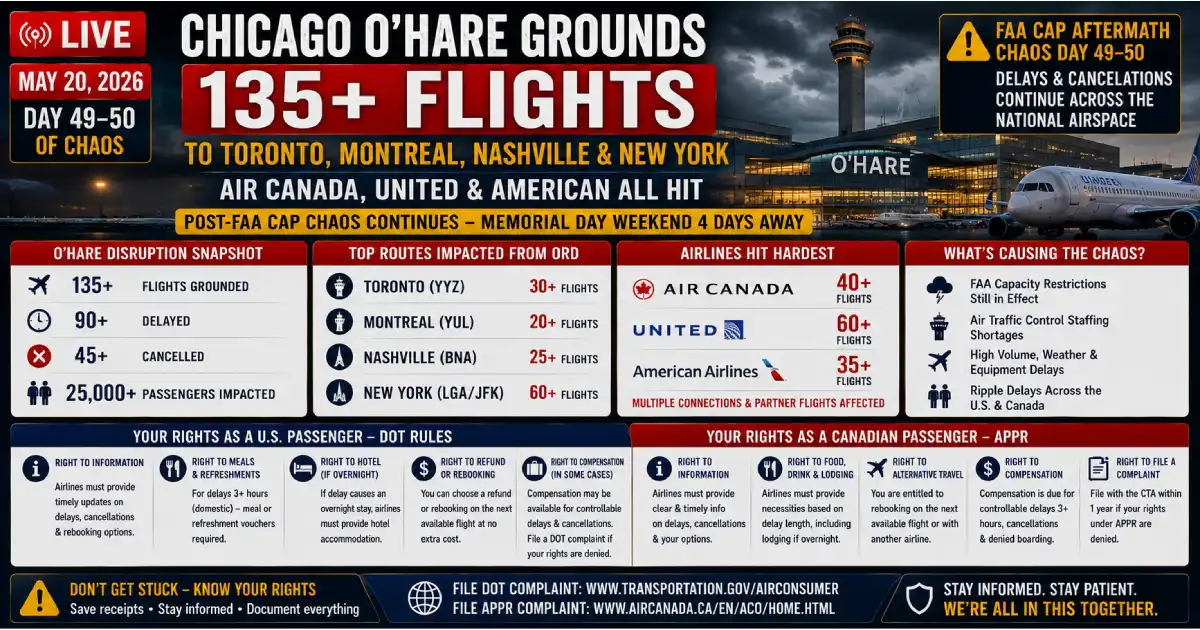
Chicago O’Hare International Airport is experiencing its worst post-cap disruption since the FAA summer limit activated on May 17 — and the crisis is escalating, not resolving. A sweeping series of passenger service suspensions grounded over 135 flights and triggered extensive delays at Chicago O’Hare International Airport, severely impacting regional and mainline carriers including Air Canada, United Airlines, and American Airlines and generating widespread travel chaos for thousands of transiting passengers across the United States and Canada. Direct corridors connecting Chicago with Toronto, Montreal, Nashville, Indianapolis, St. Louis, Cincinnati, Cleveland, and New York were grounded. Then on Day 50 — today — the disruption deepened further: Chicago O’Hare recorded 459 delayed flights and 53 cancellations, with disruptions linked to weather-related reroutes and an FAA ATC ground delay program, spreading impact to Dallas, San Francisco, Detroit, Boston, New York, Denver, Nashville, Houston, and Toronto, with international routes to Canada, Mexico, the UK, Spain, France, Qatar, the UAE, Greece, Japan, and Hong Kong all experiencing operational interruptions.
The FAA summer cap was supposed to make O’Hare better. Three days in, it is producing its worst disruption sequence of the entire 50-day crisis. Here is every number, every route, every carrier, and every right you hold.
Published: May 20, 2026 🔴 ACTIVE DISRUPTION — Wednesday (Day 50) Airport: Chicago O’Hare International Airport (ORD) May 19 (Day 49): 135+ flights cancelled or delayed — Air Canada, United, American — Toronto, Montreal, Nashville, Indianapolis, New York, St. Louis, Cincinnati, Cleveland May 20 (Today — Day 50): 459 delays + 53 cancellations = 512 total disruptions — ATC ground delay program active — FAA weather reroutes FAA Cap Status: Day 4 of 2,708 maximum daily movement limit — transition period highest-disruption window Carriers Hit: Air Canada · United Airlines · American Airlines · Delta Air Lines · SkyWest · GoJet · Republic Airways · Southwest Airlines Routes Cut (May 19–20):
The FAA summer cap at Chicago O’Hare was specifically designed to reduce disruption. It limits daily operations to 2,708 — down from the pre-cap planned 3,080, cutting approximately 372 flights per day. The logic is sound: fewer scheduled flights means less overscheduling, means fewer cascades, means better on-time performance.
So why are Days 1–4 of the cap producing O’Hare’s worst disruption sequence of the entire 50-day crisis?
The disruptions at Chicago were linked to weather-related reroutes and an FAA ATC ground delay program — a combination that overwhelmed even the reduced cap-era schedule.
The answer is the transition period paradox. When an airport undergoes a major scheduling change — gate reassignments, new crew pairings, new slot sequences, revised rotation patterns — the 10–14 days immediately following activation are historically the most disruption-prone. Airlines have restructured their O’Hare operations on paper. Those paper plans are now meeting their first real-world stress tests under post-Memorial Day return volume combined with late-May Central US weather.
Three specific cap-transition failure mechanisms are driving this week’s chaos:
Mechanism 1 — Crew mispairing. When United cut 1,909 May O’Hare flights and American cut 787, both airlines completely restructured their crew assignment rosters for Chicago. Crews who used to cover certain rotation patterns are now on new assignments. New assignments mean less familiarity, higher probability of duty-time miscalculations, and more crew calls requiring replacement. Replacement crew scheduling is the single most common cause of controllable cancellations at major hubs — and O’Hare is running maximum replacement-crew scheduling right now.
Mechanism 2 — Aircraft positioning gaps. The pre-cap schedule had aircraft positioned at O’Hare overnight in specific numbers and types for the morning bank. The post-cap schedule requires different numbers and types overnight. In the first week of the new schedule, those overnight positioning plans have not yet stabilised — the wrong aircraft type arrives at the wrong gate at the wrong time, requiring manual intervention, gate changes, and delay cascades.
Mechanism 3 — Regional feeder mismatch. The 135-flight cancellation event on May 19 was concentrated on regional jets — Embraer E170/175 and CRJ aircraft — operated by SkyWest, GoJet, and Republic on United Express and American Eagle service. The regional feeder schedule was restructured to align with the new cap. But regional carriers — with their tight rotations and minimal spare aircraft — are the most vulnerable to transition-period cascades. When O’Hare’s regional feeders collapse, the Toronto, Montreal, Nashville, and Indianapolis connections disappear first, because those are predominantly regional-jet routes.
Air Canada + United — transborder suspended
Direct corridors connecting Chicago with Toronto were severely affected — passengers encountered extended gate delays, ticket counter congestion, and rebooking complications.
The ORD–YYZ route is one of the highest-frequency transborder corridors in North America. Air Canada operates multiple daily CRJ and Embraer services between O’Hare and Pearson — these are the flights that disappeared on May 19. United operates ORD–YYZ as United Express via regional partners.
For Toronto passengers specifically: The ORD–YYZ disruption on May 19 coincides with the busiest week of the Canadian–US business travel calendar post-Victoria Day. Tuesday–Wednesday business travellers from Toronto to Chicago connections are exactly the demographic most exposed.
APPR rights for Canadian passengers (Air Canada ORD–YYZ): ✅ CAD $400 — delay 3–6 hours within airline control ✅ CAD $700 — delay 6–9 hours ✅ CAD $1,000 — delay 9+ hours ✅ Full rebooking at no cost or cash refund for cancellations ✅ Meals, hotel, and transportation for overnight controllable delays
The Air Canada app processes APPR compensation claims directly — no call required. Navigate to: My Bookings → select disrupted flight → Compensation Claim.
Contact Air Canada: aircanada.com | 1-888-247-2262 | Aeroplan app
Air Canada transborder · Quebec business and leisure market
Montreal corridors were among those severely affected on May 19, with Air Canada services grounded on the Chicago–Montreal transborder route.
The ORD–YUL connection is Air Canada’s primary gateway from Chicago to Francophone Canada — serving Quebec City onward connections, Ottawa government travel, and Montreal’s financial sector. The disruption falls in the post-Victoria Day business travel peak.
APPR rights for Montreal passengers: Same thresholds as Toronto (CAD $400–$1,000). File at: airpassengerprotection.ca (free, Canadian Transportation Agency administered).
Contact Air Canada (Montreal): aircanada.com | 1-888-247-2262
United Express · American Eagle · Southwest — all disrupted
Nashville was among the primary destinations experiencing significant service disruption on May 19. Nashville International Airport reported delayed services linked to Chicago traffic flow issues on May 20.
Nashville is one of the fastest-growing aviation markets in the United States — and it is served from O’Hare primarily by regional jets on United Express and American Eagle. The regional feeder collapse on May 19 hit Nashville disproportionately: CRJ and E175 aircraft that were grounded at O’Hare were supposed to continue to BNA, and the BNA passengers found themselves with no aircraft.
Nashville passengers have no alternative routing: Nashville is not served by major connecting hubs that can easily absorb O’Hare cancellations. The practical options are rebooking on the next available direct service (potentially the following day) or driving Nashville–Chicago (approximately 4.5 hours by I-65).
Contact United (Nashville): united.com | 1-800-864-8331 Contact American (Nashville): aa.com | 1-800-433-7300
All major carriers — O’Hare to New York flights cascading into O’Hare-from-New York
New York corridors were severely affected — creating ripple effects across multiple airline networks operating between Chicago and the Northeast.
New York–Chicago is America’s second-busiest domestic air corridor after Los Angeles–San Francisco. The ORD–JFK, ORD–LGA, and ORD–EWR routes are each operated by multiple carriers at high daily frequency. When O’Hare cancels 135 flights on a Monday, a significant share of those cancellations falls on New York-bound services — and the cascade works both ways: New York aircraft that were supposed to position to Chicago for the return service never arrive, creating a second wave of cancellations on the New York-bound evening flights.
For UK passengers transiting through ORD to New York for transatlantic connections: If your itinerary includes an ORD connection to JFK or EWR for an onward transatlantic departure — and the ORD segment was cancelled or significantly delayed — you must contact your carrier immediately to be protected on the next available transatlantic service. Demand through-check rebooking to your final destination.
Regional jet markets — total service suspension during cancellation event
Indianapolis, St. Louis, Cincinnati, and Cleveland were all grounded as regional and mainline carriers struggled with mounting scheduling pressures — with cancellations involving CRJ and Embraer regional jets.
These four markets share a common characteristic: they are served from O’Hare almost exclusively by regional jets on United Express and American Eagle. When regional jet operations at O’Hare collapse — as they did on May 19 — these four cities effectively lose all air connectivity to Chicago simultaneously. No widebody backup. No Southwest alternative at ORD (Southwest exits O’Hare June 4). No fast rebooking onto another carrier.
Passengers from these cities who missed critical O’Hare connections to international flights — London, Frankfurt, Tokyo, Mexico City — have the most complex rebooking situations of any ORD-affected passenger today.
The May 19 135-cancellation story is serious. What today (May 20) has revealed is that it is getting worse, not better.
On May 20, 2026, Chicago O’Hare recorded 459 delayed flights and 53 cancellations across arriving and departing services. The disruptions were linked to weather-related reroutes and an FAA ATC ground delay program. The impact extended beyond Chicago to airports including Dallas-Fort Worth International Airport, San Francisco International Airport, Detroit Metropolitan Wayne County Airport, LaGuardia Airport, Boston Logan International Airport, Nashville International Airport, Toronto Pearson International Airport, and London Heathrow Airport. International routes involving airports in Canada, Mexico, the United Kingdom, Spain, France, Qatar, the UAE, Greece, Japan, and Hong Kong also experienced operational interruptions.
512 total disruptions at O’Hare today — 459 delays + 53 cancellations — represent a significant escalation from yesterday’s 135-cancellation event. The 53 cancellations today are more targeted (fewer but deliberate groundings) while the delay count has quadrupled. This is the signature pattern of an airport in sustained crisis: airlines have moved from large-scale cancellation events (May 19) to widespread delay accumulation (May 20) as they attempt to operate as many flights as possible while absorbing the ATC ground delay program.
Today’s O’Hare international cascade confirmed:
| Destination | Region | Carriers | Rights Applicable |
|---|---|---|---|
| London Heathrow (LHR) | 🇬🇧 UK | United, American, British Airways | UK261 |
| Toronto Pearson (YYZ) | 🇨🇦 Canada | Air Canada, United | APPR |
| Montreal-Trudeau (YUL) | 🇨🇦 Canada | Air Canada | APPR |
| Vancouver (YVR) | 🇨🇦 Canada | Air Canada | APPR |
| Doha (DOH) | 🇶🇦 Qatar | Qatar Airways | EU/UK261 (EU departure) |
| Dubai (DXB) | 🇦🇪 UAE | Emirates, United | — |
| Madrid (MAD) | 🇪🇸 Spain | Iberia, United | EU261 |
| Paris CDG (CDG) | 🇫🇷 France | Air France, United | EU261 |
| Athens (ATH) | 🇬🇷 Greece | United, Aegean | EU261 |
| Tokyo (NRT/HND) | 🇯🇵 Japan | United, ANA | — |
| Hong Kong (HKG) | 🇭🇰 HK | Cathay Pacific, United | — |
Toronto + Montreal transborder severed · APPR rights apply
Air Canada’s entire Chicago O’Hare transborder operation — serving Toronto Pearson, Montreal-Trudeau, and Vancouver — was disrupted across both May 19 and May 20. Air Canada operates its ORD services primarily on Embraer E175 aircraft through its Jazz and Sky Regional partners — the exact aircraft types at the centre of the regional jet collapse.
The APPR compensation structure for Air Canada passengers today:
✅ Controllable delays of 3–6 hours: CAD $400 per person ✅ Controllable delays of 6–9 hours: CAD $700 per person ✅ Controllable delays of 9+ hours: CAD $1,000 per person ✅ Cancellations: Full cash refund or rerouting at no cost
The controllability question: Today’s ORD disruption has both weather-caused (ATC ground delay = weather-adjacent) and controllable components (crew mispairing during cap transition = controllable). File your APPR claim regardless — the Canadian Transportation Agency will assess the actual cause.
File APPR claims: airpassengerprotection.ca | Air Canada app → My Bookings → Compensation Contact Air Canada: aircanada.com | 1-888-247-2262 | Air Canada app (fastest)
Most total disruptions at ORD · United Express regional collapse driving cancellation events
United Airlines operates O’Hare as its second-largest global hub — behind Newark — and cut 1,909 May O’Hare flights ahead of the cap. Despite those pre-emptive cuts, United is recording the highest delay volume of any carrier at O’Hare today, driven by:
United’s most disrupted ORD routes today:
United weather waiver: Check united.com — if active, fee-free rebooking applies for today’s disruption window.
Contact United: united.com | United app (fastest) | 1-800-864-8331
787 May flights pre-cut · American Eagle E175/CRJ hardest hit
American Airlines cut 787 May O’Hare flights ahead of the cap. Despite those cuts, American Eagle’s regional operations — operated by SkyWest and Envoy Air on CRJ and E175 aircraft — are the source of most American cancellations at O’Hare in the May 19 135-flight event.
American’s most disrupted ORD routes today:
American Airlines travel waiver: Check aa.com/travelinfo for current active waivers.
Contact American: aa.com | American Airlines app | 1-800-433-7300
United Express + American Eagle operations — May 19 collapse epicentre
SkyWest is the dominant regional operator at O’Hare on behalf of both United (United Express) and American (American Eagle). The May 19 135-flight event was primarily a SkyWest CRJ/E175 fleet positioning collapse — when weather and ATC restrictions trapped SkyWest’s regional jets at their origin airports, the O’Hare inbound schedule fell apart, leaving outbound gates with no aircraft to operate.
SkyWest passengers: Your ticket shows a UA or AA flight number. All rebooking, refund, and DOT compensation requests go through United (1-800-864-8331) or American (1-800-433-7300) — not SkyWest directly.
If your ORD flight is CANCELLED (regardless of cause): ✅ Full cash refund to original payment method within 7 business days — federal law ✅ Rebooking on next available service at no additional cost ✅ Rerouting on partner carrier if airline has interline agreements (United does; Southwest and Frontier do not)
If your ORD flight is DELAYED 3+ hours (controllable cause): ✅ Meal vouchers — ask explicitly at the United or American service desk ✅ Hotel accommodation if overnight delay is within airline control — demand written confirmation
File DOT complaints: transportation.gov/airconsumer | aviation.consumer.complaints@dot.gov
The APPR applies to Air Canada and United Airlines on transborder routes:
| Delay Duration | Large Carrier Compensation |
|---|---|
| 3–6 hours (controllable) | CAD $400 per person |
| 6–9 hours (controllable) | CAD $700 per person |
| 9+ hours (controllable) | CAD $1,000 per person |
✅ Full rebooking or refund for cancellations ✅ Meals after 2 hours waiting, hotel overnight if controllable
File APPR claims: airpassengerprotection.ca | Canadian Transportation Agency
UK261 applies at UK departure airports. If today’s O’Hare cascade delays your connecting transatlantic departure from a UK airport:
✅ £220 per person — routes under 1,500km ✅ £350 per person — routes 1,500–3,500km ✅ £520 per person — routes over 3,500km (all transatlantic qualifies) ✅ Full duty of care regardless of cause
File UK261 claims: aviationadr.org.uk (free) | resolver.co.uk
EU261 applies at EU departure airports (Frankfurt, Paris CDG, Amsterdam, Madrid, Athens, etc.). If your ORD cascade reaches a European hub:
✅ €250–€600 per person based on route distance (controllable delays 3+ hours) ✅ Full duty of care regardless of cause
File EU261 claims: ec.europa.eu/transport/themes/passengers/air | Direct airline portals
Step 1 — Check your specific flight on FlightAware immediately. Go to flightaware.com and search your ORD flight number. Find where the aircraft that is supposed to operate your route is right now. If it is still in Nashville, Indianapolis, or Toronto — it has not yet arrived at O’Hare and your departure is delayed regardless of what the board shows.
Step 2 — Use the United or American app — not the phone. United’s 1-800-864-8331 and American’s 1-800-433-7300 are both running 60–90 minute hold times. The apps rebook in minutes, show real-time gate assignments, and push notifications for status changes. Download before leaving for the airport.
Step 3 — Canadian passengers on Air Canada: file your APPR claim the moment your delay exceeds 3 hours. Do not wait until after travel is complete. Open the Air Canada app → My Bookings → your affected flight → Compensation. The earlier you file, the faster the processing.
Step 4 — If your international connection is at risk — call the airline’s international service line, not the domestic line. United’s international desk (1-800-538-2929) typically has shorter wait times than the domestic line on days of ORD domestic chaos. Air Canada’s international service line routes through the same 1-888-247-2262 number — press 2 for international services.
Step 5 — If you are rebooking through Midway (MDW) as an alternative — verify your carrier operates from MDW. O’Hare’s terminal guidance sometimes directs passengers toward Chicago Midway as an alternative. United and American do NOT operate from MDW. Southwest, the primary MDW carrier, exits O’Hare June 4 but still operates from Midway — if Southwest serves your destination from MDW, that is a genuinely viable alternative.
Chicago O’Hare grounded 135+ flights on May 19 — targeting Toronto, Montreal, Nashville, Indianapolis, St. Louis, Cincinnati, Cleveland, and New York — as Air Canada, United, and American Airlines’ regional feeder networks collapsed under the combined pressure of FAA cap transition chaos and ATC ground delay programs. Today, Day 50, the disruption has escalated to 459 delays and 53 cancellations — with international cascade confirmed to London Heathrow, Toronto, Montreal, Qatar, UAE, Spain, France, Greece, Japan, and Hong Kong. The FAA summer cap that was designed to reduce O’Hare disruption has created a 10–14 day transition period that is producing the airport’s worst disruption run of the entire 50-day crisis. The controllable elements — crew mispairing during cap transition, regional feeder positioning failures — entitle US passengers to DOT cash refunds, Canadian passengers to APPR compensation of up to CAD $1,000, and UK/EU-departing passengers to UK261/EU261 compensation of up to £520/€600. Use airline apps. File compensation claims now. Check Monday’s inbound aircraft on FlightAware before leaving for the airport.
When O’Hare slows down, the world feels it. Today, the world is feeling it from London to Hong Kong.
Posted By : Vinay
This article is provided for general informational purposes only and is based on information available at the time of publication. Travel advisories, airline schedules, airport operations, visa requirements, government regulations, and other travel-related information are subject to change without prior notice. While Travel Tourister makes reasonable efforts to verify information using official announcements, government publications, airline and airport communications, and other reliable sources, we cannot guarantee that all information remains complete, accurate, or up to date at all times. Readers should independently verify any information that may affect their travel plans with the relevant airline, airport authority, government agency, embassy, or other official source before making travel, financial, or other decisions. Travel Tourister shall not be liable for any direct or indirect loss, inconvenience, or damages arising from the use of or reliance on the information contained in this article. Nothing in this publication constitutes legal, immigration, financial, or professional travel advice. If you believe any information in this article is inaccurate or outdated, please contact our editorial team. We review all credible correction requests promptly and update our content whenever appropriate.
Lastest News
2nd Floor, 39, Above Kirti Club, DLF Industrial Area, Kirti Nagar, New Delhi, Delhi 110015



Travel Tourister is a leading Travel portal where we introduce travellers to trusted travel agents to make their journey hasselfree, memorable And happy. Travel Tourister is a platform where travellers get Tour packages ,Hotel packages deals through trusted travel companies And hoteliers who are working with us across the world. We always try to find new and more travel agents and hoteliers from every nook and corners across the world so that you could compare the deals with different travel agents and hoteliers and book your tour or hotel with the one you have chosen according to your taste and budget.
Copyright © Travel Tourister, India. All Rights Reserved

 Call
Call Enquiry