Published on : 20 May 2026
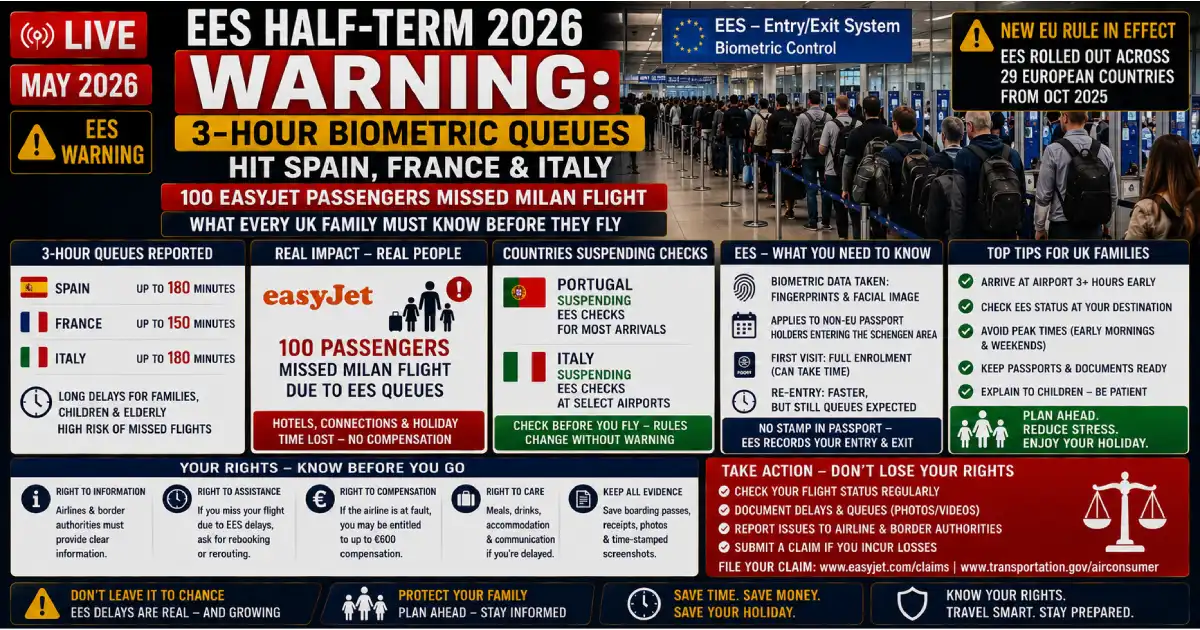
Warning — May 2026: The EU’s new Entry/Exit System biometric border checks are creating queues of up to three hours at European airports during peak periods — and UK May half-term holidays begin this week, bringing hundreds of thousands of British families directly into the worst of it. In April, more than 100 easyJet passengers missed their flight from Milan Linate to Manchester after getting stuck in passport control queues that the airline itself described as “unacceptable.” Airports Council International Europe confirms that border processing times have increased by up to 70% at airports where EES is operational. Aviation industry leaders have written directly to EU Commissioner Magnus Brunner warning of “persistent excessive waiting times of up to two hours” — even at the current partial rollout of 35% of passengers. And the summer full rollout — when 100% of UK travellers will face biometric registration — is still coming. But here is the plot twist that changes everything for your half-term holiday: Portugal and Italy are quietly suspending biometric checks when queues get too long. Greece stopped enforcing EES entirely on April 18. France and Croatia are reportedly considering the same. The rules are the same across every country — but how strictly they are being enforced is now different at every airport. This is your complete, country-by-country, airport-by-airport guide to what EES actually means for your half-term trip this week.
Published: May 20, 2026 — Wednesday (UK May half-term begins this week) EES launch date: April 10, 2026 (originally planned October 2025, delayed April 2026) EES coverage: 29 Schengen Area countries — NOT Ireland, NOT Cyprus Who is affected: All non-EU/non-Schengen nationals — including ALL UK citizens post-Brexit What EES does: Records facial recognition data + fingerprints + passport details at every Schengen entry and exit — stored digitally for 3 years Current rollout level: 35% of eligible travellers must register biometric data — NOT yet 100% Queue times confirmed: Up to 3 hours at peak periods — ACI Europe + multiple passenger reports Processing time increase: Up to 70% longer than pre-EES passport control — ACI Europe Milan Linate incident (April 2026): 100+ easyJet passengers missed Manchester flight stuck in EES passport queues Airlines affected: Ryanair + easyJet both reporting delays at Milan Linate and Milan Bergamo specifically ACI Europe letter to EU Commissioner: “Persistent excessive waiting times of up to two hours” even at 35% rollout Expert warning (travel expert Simon Calder): “Five to six hour queues” possible if flexibility to pause EES is not maintained over summer Greece: Unilaterally STOPPED collecting biometric data from UK visitors — April 18, 2026 Portugal: Informally suspending biometric capture when queues exceed 15 minutes Italy: Expected to revert to passport stamps for UK arrivals until September 2026 France: Considering suspension — Parafe e-gates still do NOT process UK passports Spain: Hybrid model — both biometric kiosks AND manual passport stamping during peak periods Brussels response: European Commission says no formal permission granted for suspensions — compliance expected Not subject to EES: Ireland · Cyprus · UK domestic travel Practical implication: EES enforcement varies enormously by airport and by day — no guarantee of which you face Half-term risk airports: Malaga (AGP) · Alicante (ALC) · Palma de Mallorca (PMI) · Lanzarote (ACE) · Fuerteventura (FUE) · Faro (FAO) · Milan Linate (LIN) · Milan Bergamo (BGY) · Paris CDG (CDG) · Barcelona El Prat (BCN)
The EU Entry/Exit System (EES) is the most significant change to European border control since the Schengen Agreement itself. Launched on April 10, 2026, it replaces the traditional blue ink passport stamp — still one of the most recognisable symbols of international travel — with a digital biometric record that stores:
The system covers all 29 Schengen Area countries and applies to every non-EU, non-Schengen national — including, crucially, every British passport holder since Brexit removed UK citizens from EU free movement rights.
Why was it introduced? The EU designed EES to enforce the 90-day-in-180-day Schengen stay limit more rigorously, replacing the paper stamp system that was easy to falsify and difficult to monitor. It also integrates with the forthcoming ETIAS pre-travel authorisation system.
Why is it causing chaos? The mathematics of biometric registration at a busy airport is unforgiving. Each first-time EES registration takes approximately 60–90 seconds per passenger — fingerprints, facial scan, passport scan, data verification. At an airport like Malaga handling 400 arriving UK passengers per hour, that means 400–600 minutes of processing time per hour at the biometric kiosks — when the kiosks can only process one passenger simultaneously. The result is the three-hour queues that ACI Europe has confirmed and the Milan Linate incident has illustrated.
The 70% processing time increase: ACI Europe — which represents European airports — found that border control processing times have increased by up to 70% at airports where EES is fully operational. For a passport control queue that previously took 20 minutes, that means 34 minutes. For a queue that previously took 45 minutes, that means 76 minutes. At peak arrivals on a busy Saturday morning at Palma or Faro, these numbers translate directly into missed flights, missed transfers, and ruined holiday starts.
The incident that most clearly illustrates the human cost of EES is the one that happened at Milan Linate Airport in April 2026. More than 100 easyJet passengers missed their flight from Milan Linate to Manchester after getting stuck in passport control queues. easyJet described the queues as “unacceptable.”
This was not a freak event. It was a predictable consequence of EES implementation at an airport that had not yet deployed sufficient biometric kiosks to process the volume of departing non-EU passengers. Linate is a compact, central-city airport — it cannot easily expand its border control facilities the way a larger airport might. When the EES went live and every UK passenger departing needed to be biometrically processed, the queues built faster than any gate-hold decision could compensate for.
Ryanair and easyJet have both reported significant delays at airports including Milan Linate and Milan Bergamo — two of the busiest UK–Italy routes operated by both carriers. For UK families flying to northern Italy this half-term: the Milan airports are among the highest-risk EES queue locations on the European network right now.
What easyJet’s position means for you: When easyJet calls queues “unacceptable” and passengers miss flights because of EES delays, the legal question immediately arises: whose fault is it, and who compensates whom? The answer is genuinely complex. See the rights section below.
This is the most important section of this article for anyone flying to Europe this half-term — because the EES situation is dramatically different at every destination.
Practical status: You will NOT face biometric registration in Greece
On April 18, 2026, Greek authorities unilaterally stopped collecting biometric data from British visitors. The decision was made by the Greek government, which cited the pressure on its small island airports during the busy season and the disproportionate queue impact on its tourism-dependent economy.
Travel expert Simon Calder wrote: “It’s over two weeks since the Greek Government said, ‘Ah, we’re not going to bother with all those biometric things for the British holidaymakers who are coming over… I thought, ‘Well, they’ll never get away with that.’ But it seems they have, and I think that will encourage other governments.”
The European Commission’s response: The Commission said it is “in contact with Greece to clarify the situation and recall the existing rules” — but has not imposed any formal sanction. Greece’s defiance appears to be holding.
For UK half-term travellers to Greece: Crete, Rhodes, Corfu, Santorini, Mykonos — you should expect standard passport stamping, not biometric registration, at Greek border control this half-term. The EES queue risk at Greek airports is currently minimal.
Practical status: Variable — may or may not face biometric checks
Portugal has adopted an informal policy of suspending biometric capture when queues exceed 15 minutes. This is not a formal exemption — the European Commission has not approved it. But the practical effect is that at busy periods (Saturday morning arrivals at Faro, Lisbon, Porto), Portuguese border officers are waving UK passengers through with a passport stamp rather than a full biometric registration.
The uncertainty: Because this is an informal, discretionary policy, you cannot guarantee it will apply on your specific day and time of arrival. If you arrive at Faro on a quiet Tuesday afternoon when queues are short, you may face full EES biometric registration. If you arrive on a busy Saturday morning, you may be waved through.
Faro Airport (FAO) specifically: Faro is the Algarve’s primary gateway — one of the busiest UK–Portugal routes. It is explicitly flagged as a concern airport by travel industry experts for half-term queue pressure. The informal Portuguese suspension policy should help — but confirm your own status at the border on arrival.
For UK half-term travellers to Portugal/Algarve: Allow extra time at border control. The 3-hour minimum recommended arrival (see below) applies. Do not rely on Portugal’s informal suspension policy as a guarantee.
Practical status: Passport stamps expected — biometric registration minimised
Italy is expected to revert to a simple passport stamp for UK arrivals until September 2026. This follows the chaos at Milan Linate (the 100+ easyJet passenger incident) and lobbying from Italian tourism boards who argued that holiday spending was at risk.
However — Brussels has blocked Italy: The European Commission has not granted formal permission for Italy’s suspension. T&TW reported that the Commission is “blocking Italy and Portugal from suspending EES for UK travelers.” This creates a confused situation: Italy wants to suspend, Brussels says it cannot formally suspend, but in practice enforcement is being relaxed.
The practical Italian airport situation:
For UK half-term travellers to Italy: Allow a minimum 3 hours at the airport for any departure with a border control exit check (particularly at Linate and Bergamo). Keep your boarding pass accessible and inform airline staff if the queue is threatening your departure time — easyJet and Ryanair have gate-hold authority and have used it during EES delays.
Practical status: Variable — depends on airport and time of day
Spain has adopted a hybrid model, using both biometric kiosks and manual passport stamping during peak periods. This is the most nuanced EES implementation in Europe — and for UK tourists, it means you may face the full biometric process OR just a passport stamp, depending entirely on how busy the border control area is when you arrive.
The highest-risk Spanish airports for EES queues this half-term:
The inconsistency problem in Spain: Some travellers passing through Spanish airports have described “inconsistent procedures, with biometric checks being applied irregularly or repeated on return trips.” This means even passengers who have already been registered in the EES database may be asked to repeat the process on a return journey.
Practical status: Full EES biometric checks potentially required — but variable
France is reportedly considering suspending biometric checks during peak periods — but as of this article’s publication, France has not formally suspended EES enforcement. The complicating factor in France is particularly acute:
The Parafe gate problem: France’s Parafe e-gates — which use facial recognition to process passengers quickly — still do not process UK or US passports. This means UK passengers at Charles de Gaulle, Nice, Marseille, and other French airports cannot use the automated fast-track lanes that European passport holders use. All UK passengers must go through the staffed biometric kiosks — creating the queue imbalance.
France also demands medical insurance: Border officers at French entry points may ask UK passengers for proof of medical insurance as well as evidence of financial resources and proof of return travel. These additional checks compound the biometric queue time.
For UK half-term travellers to France: Paris (CDG, Orly), Nice (NCE), Lyon, Bordeaux — allow 3+ hours at border control. The Parafe gate issue means there is no fast-track option for UK passports. If your connection at CDG is under 2 hours, it is at risk.
The European Commission’s official position is consistent: EES is operating “largely without issues.” A Commission spokesperson said it has “not received reports confirming widespread three-hour waits caused directly by the new checks.”
However, the Commission’s data is based on formal member state reports — not the real-time queue experience at Linate, Faro, or Malaga on a Saturday morning.
The formal position: No member state has received formal EU permission to suspend EES. Compliance with the system is expected. The Commission is “in contact with Greece to clarify the situation.”
The practical reality: Greece has stopped enforcing EES for UK tourists and nothing has happened. Portugal is suspending informally and nothing has happened. Italy is reverting to stamps and Brussels is “blocking” it — but the enforcement mechanism is unclear. Spain is operating a hybrid model and France is not using its own e-gates.
What Simon Calder described as Greece “getting away with it” appears to be the emerging template: member states with heavily tourism-dependent economies are finding that informal non-enforcement is more practical than the queue chaos that full enforcement creates.
The implication for your holiday: The EES experience you have this half-term will depend more on which specific airport you land at and what day/time you arrive than on any consistent EU-wide rule.
Under normal pre-EES conditions, the standard advice was to arrive 2 hours before your flight for international departures from UK airports, and to allow 60–90 minutes for passport control on arrival in Europe.
Those times are no longer sufficient. Here is the revised guidance for UK half-term 2026:
Your UK departure is NOT affected by EES — the biometric checks happen on entry to Schengen countries, not departure from the UK. Your UK airport arrival time guidance is unchanged: 2 hours for short-haul. The EES queue happens at your European destination.
If this is your first Schengen entry since April 10, 2026, you will need to be registered in the EES system. This is the queue that is causing 3-hour waits at peak periods.
Revised arrival guidance for EES-affected airports:
| Airport | Risk Level | Recommended Arrival Ahead of Departure |
|---|---|---|
| Milan Linate (LIN) | 🔴 Very High | 3.5 hours |
| Milan Bergamo (BGY) | 🔴 Very High | 3.5 hours |
| Malaga (AGP) | 🔴 High | 3 hours |
| Alicante (ALC) | 🔴 High | 3 hours |
| Palma de Mallorca (PMI) | 🔴 High | 3 hours |
| Lanzarote (ACE) | 🔴 High | 3 hours |
| Fuerteventura (FUE) | 🔴 High | 3 hours |
| Faro (FAO) | 🟠 Medium-High | 2.5–3 hours |
| Paris CDG (CDG) | 🟠 Medium-High | 2.5–3 hours |
| Barcelona (BCN) | 🟡 Medium | 2.5 hours |
| Rome Fiumicino (FCO) | 🟡 Medium | 2.5 hours |
| Athens (ATH) | 🟢 Low (suspended) | Standard 2 hours |
| Crete/Rhodes/Corfu | 🟢 Low (suspended) | Standard 2 hours |
For departures from European airports back to the UK: The exit biometric check (recording that you are leaving the Schengen Area) is also part of EES. At airports with full enforcement, this adds the same 60–90 seconds per passenger delay at the departure passport control.
This is the most legally complex passenger rights question of 2026. When EES queues cause UK passengers to miss their flights — as happened at Milan Linate in April — the question of responsibility and compensation involves three parties: the airport, the border authority, and the airline.
Short answer: Probably not — but it depends on exactly what happened.
EU261/UK261 requires passengers to arrive at the gate on time. If you arrive at the airport with insufficient time to clear EES and reach the gate, the airline is not responsible for your missed flight — regardless of why the queue was long. Airlines have a duty to inform passengers of border check requirements, but they have consistently argued that EES processing time is beyond their operational control.
The exception: If the queue is so extreme that even passengers who arrived at the airport with 3+ hours to spare missed their flight — as appears to have happened at Linate — then an argument exists that the airport’s failure to process passengers through EES within a reasonable time constitutes an extraordinary circumstance beyond the passenger’s control. In this scenario, the airline cannot simply cancel your missed boarding and charge you for a new ticket — it should rebook you on its next available service to your destination.
easyJet’s position on the Linate incident: easyJet described the queues as “unacceptable” — but “unacceptable” from easyJet’s perspective means EES is causing them operational problems (gate holds, delayed departures). It does not necessarily mean easyJet is offering compensation. The missed passengers were likely treated as “no shows” — losing their ticket value unless they had travel insurance with missed departure cover.
If EES causes you to miss your flight this half-term, your best financial protection is travel insurance with missed departure cover. Specifically:
✅ Look for policies that cover “missed departure due to border control delays” — not all do ✅ Many standard travel insurance policies cover missed departures only if caused by a vehicle breakdown, public transport failure, or accident — not border queue delays ✅ Call your insurer before travelling and ask specifically: “Does my policy cover missed flights caused by EU Entry/Exit System biometric queue delays?” Get the answer in writing or recorded in your policy
For packages booked through UK tour operators (ATOL protected): If your entire holiday package includes flights and accommodation and you miss the flight due to EES queues, contact your tour operator (TUI, Jet2 Holidays, Tui, easyJet Holidays) immediately. Package Travel Regulations 2018 may give you a right to alternative transport to your destination.
If an airline rebooks you because you missed your flight due to EES queues that were longer than any reasonable passenger could have anticipated: ✅ Request a written acknowledgement from the airline that the missed flight was due to EES queue delays at the border — not due to your late arrival at the airport ✅ Keep all evidence: airport arrival time (your boarding pass scan at security), taxi/parking receipts showing arrival time, photographs of the queue ✅ If the airline refuses to rebook and charges you for a new ticket: file a complaint with the CAA (caa.co.uk/passengers) citing the EES queue as an extraordinary circumstance beyond your control
1. Arrive earlier than you think you need to The 3-hour minimum applies to all EES-affected airports. Do not plan to arrive 2 hours before — the pre-EES standard is no longer adequate. If your airport has high EES risk (see table above), 3–3.5 hours is the new minimum.
2. Check whether your destination airport has suspended or relaxed EES Before travelling: check the UK government’s EES travel advisory (gov.uk → travel → EES) and your destination’s tourism board website. Greece is currently suspended. Portugal is informal. Italy is reverting to stamps. If your destination has suspended biometric checks, your border control experience will be much quicker.
3. Check gov.uk travel advice for your destination the day before you fly The EES situation is changing country-by-country, sometimes overnight. What is true on Tuesday may be different on Saturday. The UK government updates its foreign travel advice regularly. Search “[destination] travel advice” on gov.uk the day before you travel.
4. Have your biometric registration documents ready if this is your first Schengen entry since April 10 If you have not entered any Schengen country since April 10, 2026, you will need to be registered in EES on arrival. You cannot pre-register independently — the biometric data must be collected at the physical border. Make sure your passport has at least two blank pages (for manual stamps where EES is suspended) and that your passport is valid for the duration of your trip.
5. Tell your children what to expect at border control Children under 12 are currently exempt from EES fingerprint requirements in most countries — but this varies by implementation. Prepare children over 12 for the biometric kiosk process — it takes 60–90 seconds and involves looking into a camera and placing fingers on a scanner. Knowing what to expect reduces the time and anxiety at the kiosk.
6. Have proof of travel return and financial resources France specifically, and some Spanish border officers, are asking UK passengers to prove they will leave within 90 days and have sufficient funds. A return flight booking on your phone is sufficient proof of return. A bank card is sufficient for financial resources — but have it accessible.
7. Download the ‘Travel to Europe’ app if your airline offers it A pre-enrolment app is available at some airports (Portugal and Sweden have been running pilots). If you can complete any pre-registration steps in advance, this reduces kiosk time. Check whether your airline (easyJet, Ryanair, BA) has any EES pre-boarding guidance.
8. Do NOT check in any bags if you can avoid it If your flight is at risk of departure before you clear EES, checked bags create a two-stage problem: you miss the flight AND your bags go without you. Travelling cabin-baggage only means that if you miss the flight, at least all your belongings are with you.
9. If you are in a queue that is threatening your departure — speak to airport staff immediately Many airports have protocols for passengers who declare they are at risk of missing a flight due to EES queues. Staff may be able to expedite you through the queue. Do not wait silently. Ask loudly and clearly: “My flight departs in [X minutes]. I am at risk of missing it. Can I be expedited?”
10. Buy travel insurance with missed departure cover before you fly The one protection that specifically covers EES queue delays is travel insurance with missed departure cover. Buy it now — before you travel — and confirm it covers EES queue scenarios.
The Bottom Line: The EU Entry/Exit System has been operational since April 10, 2026, and it has been causing chaos almost from day one. ACI Europe confirms 70% longer processing times. Three-hour queues are documented. More than 100 easyJet passengers missed a real flight at a real airport in April. And yet the system is being enforced inconsistently across Europe — Greece has stopped enforcing it entirely, Portugal is suspending informally, Italy is reverting to stamps, and France’s own e-gates don’t work for British passports. This half-term, UK families flying to Spain, Portugal, France, and Italy face an EES experience that could range from a seamless 30-second passport stamp to a 3-hour biometric queue depending on the specific airport, the time of day, and the discretion of the border officer on duty. The best advice is simple: arrive earlier, travel light, and buy travel insurance. The EES has arrived whether Europe was ready or not — and this half-term, British families will find out exactly what that means in practice.
For More Resources:
Related Articles:
Posted By : Vinay
This article is provided for general informational purposes only and is based on information available at the time of publication. Travel advisories, airline schedules, airport operations, visa requirements, government regulations, and other travel-related information are subject to change without prior notice. While Travel Tourister makes reasonable efforts to verify information using official announcements, government publications, airline and airport communications, and other reliable sources, we cannot guarantee that all information remains complete, accurate, or up to date at all times. Readers should independently verify any information that may affect their travel plans with the relevant airline, airport authority, government agency, embassy, or other official source before making travel, financial, or other decisions. Travel Tourister shall not be liable for any direct or indirect loss, inconvenience, or damages arising from the use of or reliance on the information contained in this article. Nothing in this publication constitutes legal, immigration, financial, or professional travel advice. If you believe any information in this article is inaccurate or outdated, please contact our editorial team. We review all credible correction requests promptly and update our content whenever appropriate.
Lastest News
2nd Floor, 39, Above Kirti Club, DLF Industrial Area, Kirti Nagar, New Delhi, Delhi 110015



Travel Tourister is a leading Travel portal where we introduce travellers to trusted travel agents to make their journey hasselfree, memorable And happy. Travel Tourister is a platform where travellers get Tour packages ,Hotel packages deals through trusted travel companies And hoteliers who are working with us across the world. We always try to find new and more travel agents and hoteliers from every nook and corners across the world so that you could compare the deals with different travel agents and hoteliers and book your tour or hotel with the one you have chosen according to your taste and budget.
Copyright © Travel Tourister, India. All Rights Reserved

 Call
Call Enquiry