Published on : 03 Jun 2026
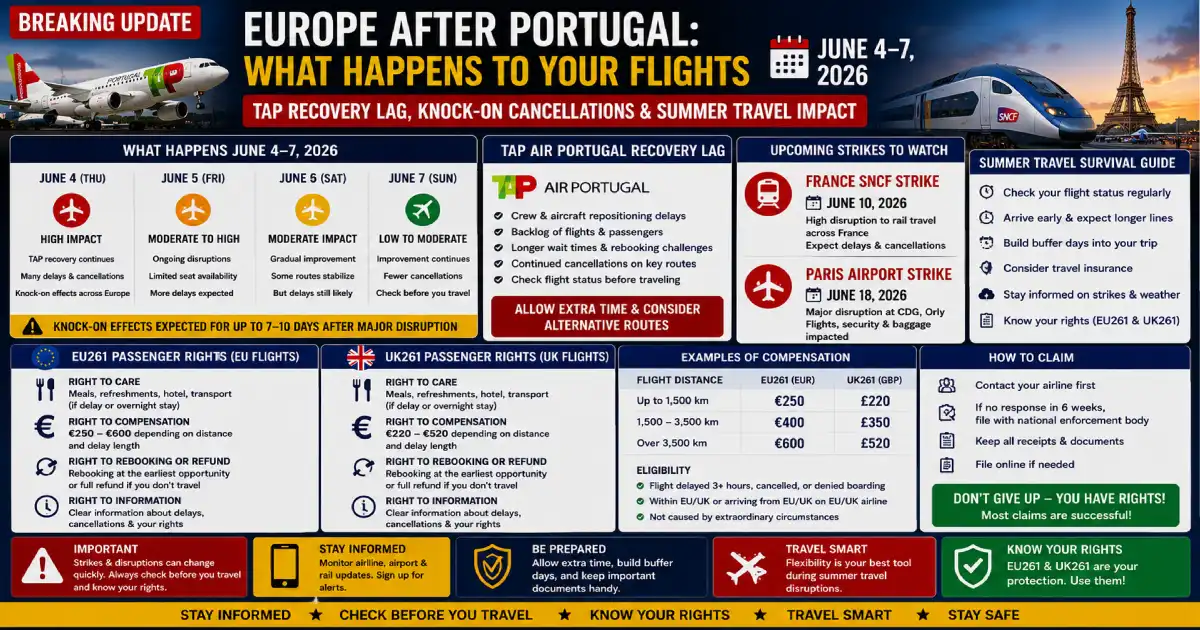
The Portugal general strike ends at midnight tonight. But if you think June 4 is safe — you need to read this first.
Recovery from a 500-flight cancellation day does not happen instantly. Aircraft and crews that were supposed to operate June 3 services are out of position. June 4 and 5 will carry elevated disruption as the Portuguese aviation network returns to normal rotation. For passengers who looked at the calendar, saw that the strike was listed as a single-day event on June 3, and booked June 4 travel thinking they were safely clear — that assumption needs to be stress-tested tonight.
And Portugal is only the beginning of what this summer looks like for European travellers. A four-union SNCF rail strike is confirmed for June 10, 2026, with CGT-Cheminots, Sud-Rail, Unsa-Ferroviaire, and CFDT-Cheminots all filing strike notices together — the first time all four major French rail unions have acted jointly in 2026. And on June 18, the joint union of employees at Roissy-Charles-de-Gaulle Airport — CGT, CFDT, Unsa and Sud Aérien — is calling a strike at all three Paris airports including CDG, Orly and Le Bourget.
This is your complete forward-looking guide to what European travel looks like from tonight through to mid-July 2026 — what is at risk, when, and exactly what to do.
Published: June 3, 2026 — Wednesday (Portugal Strike Day · Day 63 of European Aviation Crisis) Portugal strike: June 3, 2026 — 24-hour — now ending at midnight TAP recovery lag: June 4–5 elevated disruption risk — aircraft and crews out of position easyJet Portuguese base disruption: Lisbon, Porto, Faro — 800 cabin crew affected — recovery 48–72 hours France SNCF strike: June 10, 2026 — all four major rail unions — TGV + Intercités + TER all at risk Paris airports strike: June 18, 2026 — CDG + Orly + Le Bourget — CGT, CFDT, Unsa, Sud Aérien Belgium rail (ongoing): SNCB industrial action pattern continuing — Eurostar cross-border services at risk Confirmed TAP rebooking window: June 4–11, 2026 — no change fees — tap.com → Manage Booking EU261/UK261 compensation: Up to €600/£520 per passenger for controllable cancellations departing EU/UK airports Refund right: ✅ Unconditional within 7 days for all cancellations
The mechanics of strike recovery in aviation are not intuitive. Most passengers assume that once a strike ends, the system resets — flights resume, everything goes back to normal. The reality is that a 500-flight cancellation day leaves a deep, compounding positioning debt that takes 48 to 72 hours to clear, not 8 hours overnight.
Here is what actually happened across the Portuguese aviation network on June 3:
Every TAP aircraft that was supposed to fly from Lisbon to London, to Frankfurt, to New York, to São Paulo, to Luanda — and to return — did not make that journey. Every one of those aircraft is now in the wrong airport. An aircraft that should have completed a Lisbon–London–Lisbon round trip on June 3 is sitting in Lisbon unflown, or was repositioned pre-emptively to another European hub before the strike window opened. Either way, the rotation debt is identical: the aircraft was not where it was supposed to be by 23:59 on June 3, and the June 4 schedule was built on the assumption that it would be.
Although the strike itself lasts for only 24 hours, aviation experts warn that operational recovery can take several days. Aircraft, crew, and passengers need to be repositioned, which may extend delays and cancellations well beyond the strike date.
The crew picture is more complex still. TAP Air Portugal may have cut up to 300 services on June 3, with Lisbon Humberto Delgado Airport hardest hit and Porto, Faro, Funchal and Ponta Delgada all affected. Crews that were rostered to operate those 300 services hit their duty hour limits at different points across the day — some mid-morning, some mid-afternoon — and entered mandatory rest windows at those points. Those rest windows do not end at midnight. A crew that hit its duty limit at 14:00 on June 3 is not legally available to fly again until at least 02:00 on June 4, minimum, and in many cases the mandatory rest window is longer. The June 4 morning schedule at Lisbon will be operating with reduced crew availability regardless of what the clock says.
TAP is offering full flexibility for tickets issued prior to May 20 — passengers can rebook to fly from June 4 to 11 without additional charges. That rebooking window is significant in two ways. First, it confirms that TAP itself expects June 4 to carry residual disruption — otherwise a rebooking window opening the day after the strike would serve no purpose. Second, it gives passengers with June 4 and 5 bookings a concrete, actionable option right now.
If you are booked on TAP on June 4 or 5:
Go to tap.com → Manage Booking tonight. You have the option to move your flight to any date between June 4 and June 11 at no cost. If June 4 disruption materialises — and the probability is meaningful — you will be in a queue of thousands trying to rebook at the same time. Moving proactively now, if your travel dates have any flexibility at all, is significantly easier than managing a cancellation notification tomorrow morning at 04:00.
easyJet employs approximately 800 cabin crew across its Portuguese bases in Lisbon, Porto and Faro, and has pledged to contact affected customers directly with available options. easyJet’s recovery timeline from its Portuguese bases is independent of TAP’s — but the underlying mechanics are the same. 800 crew members, spread across three Portuguese bases, who participated in the June 3 walkout or were rostered on cancelled services, are entering a rest and recovery cycle that does not align neatly with the overnight clock.
easyJet’s June 4 schedule from Lisbon, Porto and Faro should be treated as elevated-risk rather than confirmed until the airline issues specific operational clearance for those services. Check easyjet.com → Manage Bookings for any active waiver or advisory on your specific flight.
The highest-risk routes for knock-on disruption on June 4 and 5 are those that either originate in Portugal or involve a Portuguese-routed aircraft that was displaced during June 3. Routes operating at the highest disruption risk in the 48-hour recovery window:
| Route | Carrier | Risk level |
|---|---|---|
| Lisbon (LIS) → London Heathrow | TAP / British Airways | 🔴 High |
| Lisbon (LIS) → Frankfurt | TAP / Lufthansa | 🔴 High |
| Lisbon (LIS) → Paris CDG | TAP / Air France | 🔴 High |
| Porto (OPO) → London Gatwick | easyJet | 🔴 High |
| Faro (FAO) → Manchester | easyJet / Ryanair | 🟡 Elevated |
| Lisbon (LIS) → New York JFK | TAP | 🟡 Elevated |
| Funchal (FNC) → London Heathrow | TAP | 🟡 Elevated |
| Madrid (MAD) → Lisbon (LIS) | Iberia / TAP | 🟡 Elevated |
Routes that were insulated from the strike — services that operate entirely outside Portugal with no Portuguese aircraft or crew in the rotation — carry normal risk only.
On June 10, 2026, the four railway unions — CGT-Cheminots, Sud-Rail, Unsa-Ferroviaire, and CFDT-Cheminots — have jointly filed a strike notice at SNCF, protesting against organisational restructuring measures they say are harming employees’ mental and physical well-being, alongside ongoing cost-of-living and purchasing power concerns.
This is the second national rail strike of 2026 but the first to be backed by all four major unions — a strike in January 2026 caused little disruption and saw only SUD-Rail and the CGT file motions. The significance of four-union joint action cannot be understated. When unions that normally disagree on tactics and end-goals unite behind a single date, the participation rate among staff is substantially higher than a single-union action. This is France’s highest-risk train strike date of the year so far.
The June 10 strike covers the full SNCF network:
TGV high-speed services: Paris to Lyon, Marseille, Bordeaux, Toulouse, Nantes, Strasbourg, Brussels, London (via Eurostar, Lille connection), and the full TGV international network. TGV services typically operate a reduced schedule on strike days — the SNCF publishes a strike-day timetable the evening before (by 17:00 on June 9) showing which services will run.
Intercités long-distance services: The slower inter-regional network connecting Paris to cities not served by TGV. These services typically see more severe reduction than TGV on strike days.
TER regional services: Local and regional trains across France. Disruption level varies by region — some regions are more affected than others depending on local union participation rates.
Transilien (Paris commuter rail): Paris suburban lines managed by SNCF — typically heavily disrupted on national strike days.
Over the summer, with workers giving short notice, it may be harder for the SNCF to organise replacements. Strike action of this nature can impact both high-speed TGV, Intercités, and regional rail services, although may focus on the former due to the number of passengers travelling for summer holidays. In all cases, disruption to train schedules will be publicised the evening before at around 17:00, detailing changes to the schedule for the following day via SNCF Connect or the SNCF website.
Eurostar services between London St Pancras and Paris Gare du Nord use the SNCF-managed high-speed line south of Lille. A French national rail strike on June 10 directly threatens the reliability of Eurostar’s Paris services — not because Eurostar staff are striking, but because the infrastructure through which Paris-bound trains operate is staffed by SNCF workers.
Practical action for June 10 Eurostar Paris travellers: Check eurostar.com from June 8 onwards for any service advisory. In the event of significant disruption, Eurostar typically offers free date changes within a defined window. Do not assume your booking is unaffected until Eurostar issues a specific June 10 operational clearance.
Thalys and TGV international services: Brussels–Paris, Amsterdam–Paris, and Frankfurt–Paris TGV services face the same infrastructure risk on June 10. Passengers on cross-border services should monitor their carrier’s communications directly from June 8.
French law requires SNCF to allow free cancellations and refunds on days when strike action causes significant disruption to the network. On June 10, if the strike causes your specific service to be cancelled or significantly delayed:
Full refund directly at sncf-connect.com or the SNCF Connect app. Exchange for another date free of charge. For cross-border journeys involving SNCF infrastructure: the international carrier (Eurostar, Thalys, DB) handles refunds for their own ticket types — check each carrier’s policy.
Book flexibility now: If you have a June 10 Paris or France train booking, check whether your ticket includes the exchange/refund option before that date. Non-refundable TGV fares can often be upgraded to flexible fares for a modest fee — consider whether that upgrade cost is worthwhile given the strike risk on that specific date.
On June 18, 2026, the joint union of employees at Roissy-Charles-de-Gaulle Airport — CGT, CFDT, Unsa and Sud Aérien — is calling a strike at all three Paris airports: Roissy-Charles-de-Gaulle, Orly and Le Bourget. The action is a protest against tougher security clearance rules that threaten workers’ access badges.
A Paris airport staff strike is categorically different from a rail strike in its immediate passenger impact. When airport workers strike — ground handlers, baggage handlers, security staff, check-in agents — flights do not merely run less frequently. They can be cancelled outright, regardless of whether the airline itself is involved in the dispute. The access-badge issue at the heart of this dispute is serious: workers whose security clearances are affected cannot enter the airside zones of CDG and Orly without those badges, which means ground operations can be reduced or suspended even with a relatively modest participation rate.
CDG is Europe’s second-busiest airport and the primary hub for Air France’s long-haul network to North America, Africa, Asia and the Middle East. A significant strike at CDG on June 18 affects not just Paris-bound travellers but every passenger transiting through Paris on a long-haul connection.
If you have flights connecting through CDG on June 18: Watch for Air France and CDG operational advisories from June 15 onwards. Air France typically issues travel flexibility notices for Paris-connected services when an airport staff strike is confirmed to have a material impact. Check airfrance.com → Travel Advisories from June 16.
How to protect yourself now: If your June 18 routing can avoid CDG — via Amsterdam, Frankfurt, London Heathrow, or Madrid — and the fare difference or connection quality is comparable, seriously consider a proactive change. The cost of a voluntary rebooking now is almost always lower than the cost of a stranded-passenger day at CDG.
Belgium’s rail dispute runs deeper than a single strike date. The core of the dispute is the Belgian government’s plan to phase out civil-service status for new recruits at passenger operator SNCB/NMBS and infrastructure manager Infrabel from June 2026 — a move unions claim will erode job security, pensions and bargaining power. The structural nature of this dispute means that it is generating recurring strike actions rather than a single climactic walkout.
The pattern of SNCB rail strikes in 2026 has involved multi-day actions with limited but operational alternative train services running based on available staff — and every action has directly impacted cross-border international train services including Eurostar, TGV, and ICE services operating through Belgium.
For summer 2026 travellers transiting Belgium by rail:
The Brussels–London Eurostar corridor is the most exposed — any Belgian rail industrial action affects the Brussels-Midi station services that feed the Eurostar network. The Brussels–Paris TGV and Brussels–Amsterdam services also route through SNCB infrastructure.
Monitor the SNCB disruptions page at b-europe.com/EN/Disruptions for specific strike notices affecting June and July services. Check the Rail Europe bulletin board at help.raileurope.com for cross-border train cancellation announcements — typically published 48 hours before each action.
Understanding which disruptions trigger compensation and which don’t is the difference between recovering your costs and absorbing them. The legal position is nuanced — and deliberately so, because airlines have a strong financial incentive to classify every disruption as an “extraordinary circumstance.”
The most important distinction for summer 2026 is between an airline strike (cabin crew, pilots, or ground handlers employed by the airline itself striking) and an external strike (a national general strike, airport workers employed by a third party, or air traffic controllers employed by the state).
Airline staff strike (e.g., TAP cabin crew striking against TAP directly): This is generally classified as an extraordinary circumstance — compensation does NOT apply. Refund and rebooking rights apply but not cash compensation.
National general strike (e.g., Portugal’s June 3 Trabalho XXI general strike): Because this was a wider national strike involving airport staff and cabin crew, whether compensation applies under EU261 may depend on the circumstances of your specific flight. Passengers should still be offered rerouting or a refund, plus care such as meals, accommodation, and assistance if they’re left waiting at the airport.
Post-strike knock-on cancellations (June 4 and 5): This is where the legal landscape becomes significantly more passenger-favourable. Once the strike has ended, the airline can no longer cite the external strike as the cause of a cancellation on June 4 or 5. A June 4 TAP cancellation caused by aircraft being out of position is an airline operational failure — and is therefore a controllable disruption. EU261 cash compensation of up to €600 per passenger applies to controllable June 4 and 5 cancellations attributable to positioning debt from the June 3 strike.
This is the single most important legal point in this article. If TAP, easyJet, or any other carrier cancels your June 4 or 5 flight citing the Portugal strike — challenge that classification. The strike ended June 3. A June 4 cancellation is an operational failure, not an extraordinary circumstance.
| Route distance | Delay/cancellation type | EU261 compensation |
|---|---|---|
| Up to 1,500km | Controllable — 3+ hour delay or cancellation | €250 per passenger |
| 1,500km–3,500km | Controllable — 3+ hour delay or cancellation | €400 per passenger |
| Over 3,500km + 4hr+ delay | Controllable — long-haul | €600 per passenger |
Applies to: all flights departing EU airports on any carrier, and all flights arriving at EU airports on EU carriers.
| Route distance | Compensation |
|---|---|
| Up to 1,500km | £220 per passenger |
| 1,500km–3,500km | £350 per passenger |
| Over 3,500km | £520 per passenger |
Applies to: all flights departing UK airports on any carrier.
Every cancelled flight under EU261 and UK261 — regardless of cause — entitles you to a full cash refund within 7 days to your original payment method. Airlines cannot substitute a voucher. Refund right is unconditional whether the cause is a strike, weather, or operational failure.
Meals, hotel accommodation, and ground transport apply for overnight cancellations regardless of cause — including genuine extraordinary circumstances. An airline cannot cite a strike to avoid its duty of care obligations.
TAP Air Portugal: flytap.com → Customer Support → EU261 Claim easyJet: easyjet.com → Help → Compensation Claims Air France: airfrance.com → Help → Claim Compensation Eurostar: eurostar.com → Help → Delay Repay UK261 escalation: caa.co.uk/passengers EU261 escalation: aviationadr.org.uk (UK) or your national enforcement body Assisted claims: airhelp.com, flightright.eu (no-win-no-fee, EU and UK)
Time limits: 2 years from disruption (UK) / 3 years in most EU jurisdictions
| Date | Disruption | Risk level | Who is affected |
|---|---|---|---|
| Jun 3 | Portugal general strike — 500+ flights | 🔴 CRITICAL | Lisbon, Porto, Faro, Funchal, Ponta Delgada |
| Jun 4 | TAP/easyJet positioning debt | 🔴 HIGH | Portuguese routes, UK, Germany, France connections |
| Jun 5 | TAP recovery tail | 🟡 ELEVATED | Portuguese routes — reduced risk vs Jun 4 |
| Jun 6–7 | Normal summer disruption baseline | 🟢 NORMAL | Standard Day 63+ aviation crisis background |
| Jun 10 | France SNCF — 4-union strike | 🔴 HIGH | Paris TGV, Intercités, TER, Eurostar, Thalys |
| Jun 18 | Paris CDG + Orly airports strike | 🔴 HIGH | Air France long-haul + all CDG connections |
| Jun 22 | EES border processing peak | 🟡 ELEVATED | All Schengen entry points — UK, Australian, US passports |
| Jun 27 – Jul 23 | German rail engineering works — Aachen–Cologne | 🟡 ELEVATED | ICE trains Belgium–Germany + Nightjet services |
| Jul 4 | US Independence Day — LAX/JFK/ORD peak | 🟡 ELEVATED | Transatlantic US arrivals |
Tonight (June 3): Check your June 4 or 5 TAP booking at flytap.com → Manage Booking. If your itinerary has any flexibility, consider the free rebooking window to June 5–11. Do not assume the June 4 schedule is clean.
At the airport June 4: Arrive at Lisbon, Porto or Faro at least three hours early. Ground services will be at reduced staffing — check-in queues, baggage processing, and security will be slower than a normal June Wednesday even after the strike has formally ended.
If cancelled June 4 or 5: Request the stated reason in writing. If the airline cites the June 3 strike — challenge it. The strike ended at midnight June 3. A June 4 cancellation is a controllable operational failure and EU261 cash compensation applies.
June 8: Check your June 10 train and flight bookings. SNCF publishes its strike-day timetable by 17:00 on the evening before — so the June 10 picture will be clear by 17:00 on June 9. If you need to make a decision about rebooking, the SNCF Connect app and sncf-connect.com have the most current information.
If your Eurostar is affected: Eurostar typically issues flexible rebooking for Paris services when a French rail strike materially impacts its schedule. Check eurostar.com from June 8 for any specific advisory on June 10 services.
Alternative options June 10: London to Paris by Eurostar is the obvious route but not the only one. London to Brussels by Eurostar (Eurostar-operated infrastructure into Brussels-Midi is less exposed than the Paris line during a French strike) plus Brussels to Paris by Thalys (when running) is a viable same-day alternative. London to Amsterdam by Eurostar + Amsterdam to Paris by TGV (if running) is another.
From June 15: Monitor airfrance.com → Travel Advisories and cdgairport.com → News for June 18 operational advisories. If Air France issues a travel flexibility notice, take it — rebooking onto a June 17 or 19 service is far preferable to a cancelled or severely disrupted June 18 long-haul departure.
Backup routing for CDG-dependent connections: If your June 18 connection routes through CDG to a long-haul destination, and the connection buffer is less than three hours, consider the disruption risk carefully. CDG is not an airport where a missed connection can usually be resolved with a short taxi ride to an alternative terminal.
| Carrier / Operator | Website | Customer Service |
|---|---|---|
| TAP Air Portugal | flytap.com → Manage Booking | +351 211 234 408 |
| easyJet | easyjet.com → Manage Bookings | 0330 365 5000 (UK) |
| Ryanair | ryanair.com → Manage Flights | ryanair.com chat |
| Air France | airfrance.com → Travel Advisories | 0207 660 0337 (UK) |
| Eurostar | eurostar.com → Manage Booking | 03432 186 186 (UK) |
| SNCF (France) | sncf-connect.com | SNCF Connect app |
| SNCB (Belgium) | belgiantrain.be | b-europe.com/EN/Disruptions |
| AirHelp (EU261 claims) | airhelp.com | Claim submission online |
| UK CAA | caa.co.uk/passengers | Complaint portal online |
Related Articles:
Posted By : Vinay
This article is provided for general informational purposes only and is based on information available at the time of publication. Travel advisories, airline schedules, airport operations, visa requirements, government regulations, and other travel-related information are subject to change without prior notice. While Travel Tourister makes reasonable efforts to verify information using official announcements, government publications, airline and airport communications, and other reliable sources, we cannot guarantee that all information remains complete, accurate, or up to date at all times. Readers should independently verify any information that may affect their travel plans with the relevant airline, airport authority, government agency, embassy, or other official source before making travel, financial, or other decisions. Travel Tourister shall not be liable for any direct or indirect loss, inconvenience, or damages arising from the use of or reliance on the information contained in this article. Nothing in this publication constitutes legal, immigration, financial, or professional travel advice. If you believe any information in this article is inaccurate or outdated, please contact our editorial team. We review all credible correction requests promptly and update our content whenever appropriate.
Lastest News
2nd Floor, 39, Above Kirti Club, DLF Industrial Area, Kirti Nagar, New Delhi, Delhi 110015



Travel Tourister is a leading Travel portal where we introduce travellers to trusted travel agents to make their journey hasselfree, memorable And happy. Travel Tourister is a platform where travellers get Tour packages ,Hotel packages deals through trusted travel companies And hoteliers who are working with us across the world. We always try to find new and more travel agents and hoteliers from every nook and corners across the world so that you could compare the deals with different travel agents and hoteliers and book your tour or hotel with the one you have chosen according to your taste and budget.
Copyright © Travel Tourister, India. All Rights Reserved

 Call
Call Enquiry