Published on : 19 Oct 2026
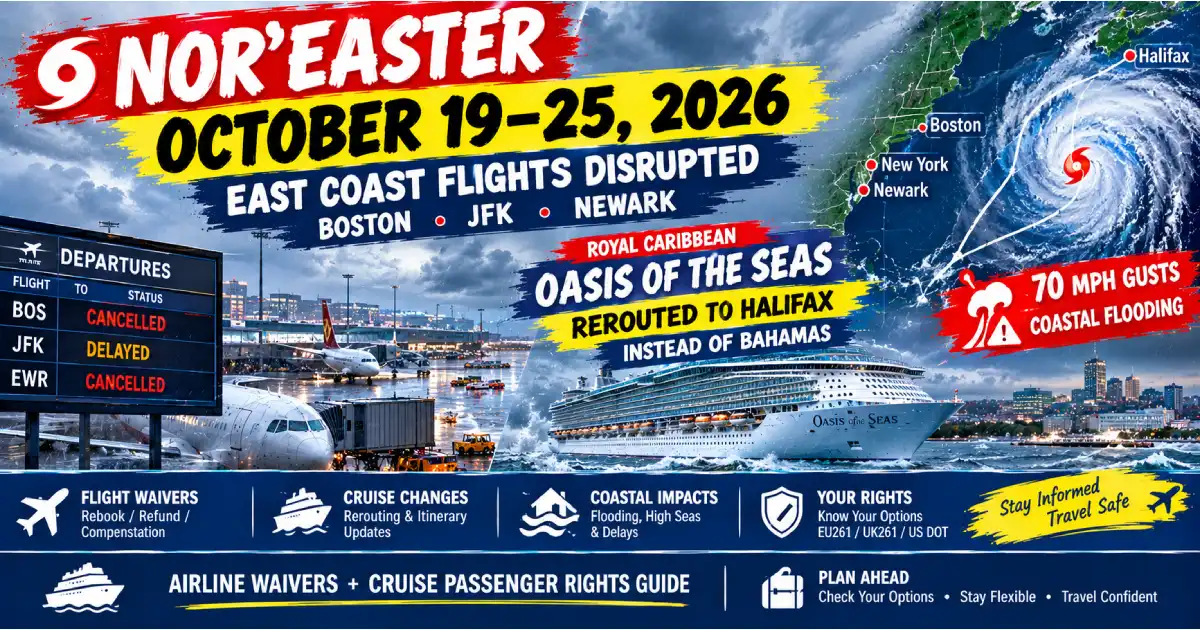
A powerful nor’easter that developed October 17–18 and is intensifying today is battering the US East Coast and is forecast to linger through October 25 — making this one of the most sustained autumn storm systems to hit the Northeast this decade. Wind gusts of up to 113 km/h (70 mph) are expected in the worst-affected coastal areas of Virginia, North Carolina, Maryland, Delaware, and New England. Offshore waves of 4.6–7.6 metres are building. Coastal flooding 0.6–1.8 metres above normal tide levels is being recorded across the Virginia and North Carolina Outer Banks, and NC Highway 12 — the primary road connection through the Outer Banks — is expected to be closed by ocean overwash. Every major Northeast US airport is at elevated disruption risk: Boston Logan, John F. Kennedy, LaGuardia, Newark Liberty, Philadelphia International, Reagan National, and Charlotte Douglas are all in or adjacent to the storm’s impact zone.
And in one of the most dramatic single decisions of the 2026 cruise season, Royal Caribbean has rerouted the Oasis of the Seas — one of the world’s largest cruise ships, carrying 5,734 passengers on an October 18–25 sailing — away from its planned Caribbean itinerary to Halifax, Nova Scotia, in Canada. CocoCay, Nassau, and Port Canaveral port calls have all been cancelled. The ship will arrive in Halifax on October 20 at 6:00 PM and depart October 21 at 8:00 AM. Every passenger on the Oasis of the Seas this week is waking up this morning to the news that their Bahamas holiday has become a Nova Scotia autumn experience — with Royal Caribbean offering $200–$600 onboard credit (stateroom-dependent) and a 50% future cruise credit by November 1. A second Royal Caribbean vessel — Vision of the Seas — is also rerouting a nine-night Canada and New England sailing southbound to avoid the worst of the storm.
For context on what this storm can do to aviation: a separate September nor’easter (September 25–27, 2026) produced 8,300 delays and 587 cancellations across the Northeast. Today’s system is expected to be less severe but will persist for nearly a week, producing sustained disruption rather than a single peak event. Airlines are expected to issue travel waivers for Northeast airports — check American, United, Delta, and JetBlue travel alerts portals immediately.
Published: October 19, 2026 — Monday Storm: Nor’easter — developed October 17–18, intensifying today Duration: October 19–25, 2026 (7 days) Peak Winds: Up to 113 km/h (70 mph) in coastal areas Wave Heights: 4.6–7.6 metres offshore Coastal Flooding: 0.6–1.8 metres above normal — Virginia, North Carolina Outer Banks, Maryland, Delaware Road Closures: NC Highway 12 (Outer Banks) — expected closed by ocean overwash Airports at Risk: BOS | JFK | LGA | EWR | PHL | DCA | CLT September Comparison: Separate Sep 25–27 nor’easter produced 8,300 delays + 587 cancellations — this storm expected less severe but longer-lasting Royal Caribbean Oasis of the Seas:
Nor’easters derive their name from the direction of the winds that drive them — northeast — and their ability to stall or move slowly along the Eastern Seaboard makes them uniquely damaging for sustained periods. While a typical winter snowstorm might hit a city for 12–24 hours, a stalled nor’easter can park itself over the Northeast for days, producing continuous precipitation, gale-force winds, heavy surf, and coastal flooding that compounds with each tidal cycle.
This nor’easter developed in the Atlantic off the Carolina coast on October 17–18 and is intensifying today as it draws energy from the contrast between the still-warm Gulf Stream waters and the cold Canadian air mass descending from the north. The forecast track keeps the storm’s centre just off the coast for most of the October 19–25 period, meaning the heaviest impacts — wind, waves, and coastal flooding — will fall on the most exposed coastal areas of the Mid-Atlantic and New England, while simultaneously reaching far enough inland to disrupt airport operations across the entire Northeast corridor.
Coastal flooding of 0.6–1.8 metres above normal tide levels is being recorded and forecast across Virginia, North Carolina’s Outer Banks, Maryland, and Delaware. The Outer Banks — the narrow barrier island chain off North Carolina’s coast — are among the most vulnerable stretches of coastline in the contiguous United States, and NC Highway 12, the primary road connection through the islands, is expected to be closed by ocean overwash during the storm’s peak periods. Residents and tourists in Outer Banks communities including Hatteras, Avon, Buxton, and Ocracoke should prepare for road closures and potential temporary isolation.
The storm surge and coastal flooding are not merely local news stories. They are the physical drivers of the aviation disruption. Airport approach corridors that cross coastal terrain are affected by wind shear. Tidal flooding can reach airport access roads and car parks. Ground crew operating in 70 mph gusts face safety limits that reduce ramp operations. These are the mechanisms that translate a coastal storm into flight disruptions at airports that may be 50–100 miles inland.
Boston Logan is the Northeast airport most consistently and most severely affected by nor’easters. Its location on a peninsula in Boston Harbor means it is directly exposed to northeast winds and accompanying wave action. Both of Logan’s primary runway orientations — 09/27 and 04R/22L — have approach paths over water, making them particularly sensitive to wind shear and wave-generated turbulence.
During the September 25–27 nor’easter, Boston Logan was among the most disrupted airports nationally, with hundreds of delays and dozens of cancellations. Today’s storm is already generating FAA-attributed ground delay programs at Logan. The construction-related EMAS project on runway 9-27 — active since September 2, now in its final weeks — further reduces Logan’s available runway capacity and means it has less ability to absorb storm-related operational disruption.
Logan passengers this week: Allow 90 minutes extra for morning and evening peak departures. JetBlue, American, Delta, and United are all significantly exposed at Logan. JetBlue — Boston’s largest carrier — has its transatlantic BOS–LHR service operational but at elevated delay risk.
New York’s three primary airports are all at risk from the nor’easter, with the storm’s orientation making sustained northeast winds the dominant aviation hazard. JFK and LaGuardia both sit at low elevations close to Jamaica Bay and the East River respectively — both are exposed to coastal weather in ways that inland airports are not.
During the September nor’easter: LaGuardia recorded 641 delays. JFK, Newark, and Philadelphia all recorded elevated disruption. The October storm’s 7-day duration means that even if individual days are less severe, the cumulative impact on aircraft positioning and crew rest cycles will be significant.
JFK passengers: United, American, Delta, JetBlue, and all transatlantic carriers. Allow extra time for connections — minimum 3 hours for any JFK connection this week.
Newark passengers: United’s dominant hub. EWR is already operating under extended FAA schedule caps (36 arrivals/departures per hour) — a storm event on a capped airport produces faster cascades. United travel waiver status: check united.com/travel-alerts.
LaGuardia passengers: Delta’s primary New York hub. LGA’s compact footprint and close proximity to the East River make it one of the most weather-sensitive airports in the system. Delta’s LaGuardia operations carry the highest individual disruption risk of the three New York airports.
Philadelphia is both an American Airlines hub and a major Delta connection point. PHL sits on the Delaware River — its approach paths cross tidal water — and northeast storms regularly produce crosswind conditions that require runway reconfiguration and reduce hourly movement capacity. American Airlines passengers connecting at Philadelphia to transatlantic flights should build a minimum 3-hour connection buffer this week.
Reagan National’s location immediately alongside the Potomac River and its restricted airspace make it particularly sensitive to wind conditions. During nor’easters, Reagan typically operates with reduced visual approach visibility and crosswind-limited runway configurations. Dulles is less weather-exposed but absorbs significant overflow traffic when Reagan is disrupted.
Charlotte Douglas is the furthest south of the major airports at elevated nor’easter risk, but American Airlines’ dominant hub at CLT means that storm disruption to Northeast operations cascades rapidly to Charlotte. If American’s operations at BOS, JFK, EWR, and PHL are all disrupted simultaneously, Charlotte’s connecting banks — which feed passengers from the Northeast to the Southeast, the Gulf Coast, and Latin America — absorb the downstream effect within hours.
The most dramatic single decision of the nor’easter’s first day is Royal Caribbean’s diversion of Oasis of the Seas — at 236,857 gross tonnes, one of the largest cruise ships ever built — away from its planned Caribbean itinerary and north to Halifax, Nova Scotia. The October 18–25 sailing was scheduled to visit Port Canaveral (Florida), CocoCay (Royal Caribbean’s private island in the Bahamas), and Nassau (Bahamas) before returning to its home port.
Instead, every one of those port calls has been cancelled. The ship is sailing north to Halifax, Nova Scotia — arriving October 20 at 6:00 PM local time and departing October 21 at 8:00 AM. This is not a minor itinerary tweak. It is a complete reversal of the voyage’s direction and purpose. Passengers who booked a Caribbean beach holiday are getting an October morning in Halifax, Nova Scotia.
Halifax is one of Canada’s most historically significant port cities — home to a rich maritime heritage, the Canadian Museum of Immigration at Pier 21, vibrant seafood restaurants, and the famous Citadel Hill overlooking the harbour. In late October, Halifax’s average temperature is approximately 7–12°C (44–53°F) — significantly cooler than the 27–30°C (80–86°F) of the Bahamas. The city is scenic and welcoming, but it requires a completely different wardrobe, activity mindset, and expectation than a Caribbean sailing.
What to do in Halifax (one morning, October 21):
Temperature advisory for October 20–21 in Halifax: Pack layers — a light jacket at minimum, warm outer layer recommended for deck activities and shore excursions. Halifax in October is beautiful but brisk.
This is the most practically urgent point for any Oasis of the Seas passenger who was expecting a Bahamas itinerary: Halifax, Nova Scotia is in Canada. Canada has different entry requirements from the Bahamas. Every passenger on board needs to verify their entry status for Canada immediately.
For US citizens: A US passport (or passport card) is required for re-entry to the United States from Canada. If you travelled with only a birth certificate + driver’s licence (acceptable for some Caribbean cruise itineraries), you may have difficulty re-entering the US from Halifax. Contact Royal Caribbean’s guest services desk on board immediately.
For UK citizens: UK nationals do not require a visa to visit Canada as tourists — but they do require an eTA (Electronic Travel Authorisation) if arriving by air. Cruise passengers arriving by sea from the US may be exempt from eTA requirements — confirm with Royal Caribbean’s guest services desk.
For Australian, Canadian, New Zealand citizens: Similar to UK — no tourist visa required for Canada, but verify eTA requirements for cruise passengers.
For citizens of countries that require a Canadian visa: This is the most urgent situation. Nationals of many countries — including India, China, Pakistan, Mexico, Brazil, and many others — require a Canadian visa (or eTA where eligible) to enter Canada. If you are on the Oasis of the Seas and are a national of a country that requires a Canadian visa, contact Royal Caribbean’s guest services desk today. Royal Caribbean will need to manage the situation with Canadian Border Services Agency (CBSA) for affected passengers. Passengers without valid Canadian entry documents may be required to remain on the ship during the Halifax call.
Royal Caribbean has confirmed the following compensation for the Oasis of the Seas itinerary diversion:
✅ $200–$600 onboard credit — amount varies by stateroom category (inside/oceanview/balcony/suite) ✅ 50% future cruise credit — to be applied to a future Royal Caribbean sailing — issued by November 1, 2026 ✅ Port fees and taxes — refunded for cancelled port calls (CocoCay, Nassau, Port Canaveral)
What you need to know about the future cruise credit:
If you believe you are entitled to more: Passengers who suffered significant consequential losses — pre-booked excursions in the Bahamas, non-refundable flights to Nassau or CocoCay, travel insurance claims — should document everything and contact Royal Caribbean’s customer relations team: royalcaribbean.com/contactus
Royal Caribbean’s Vision of the Seas, operating a nine-night Canada and New England sailing, has been rerouted southbound to avoid the worst of the nor’easter. This is the opposite diversion direction from Oasis of the Seas — a Canada sailing going south to avoid the same storm that sent a Caribbean sailing north to Canada. Both diversions demonstrate the scale and reach of this nor’easter’s impact on maritime operations.
| Metric | September 25–27 Nor’easter | October 19–25 Nor’easter (forecast) |
|---|---|---|
| Duration | 3 days | 7 days |
| Peak wind gusts | 80–90 mph | Up to 70 mph (slightly less intense) |
| Total US delays | 8,300 | Forecast: 4,000–6,000 (lower peak, longer duration) |
| Total US cancellations | 587 | Forecast: 300–500 |
| Cruise diversions | Multiple | Oasis of the Seas + Vision of the Seas confirmed |
| Coastal flooding | Moderate | 0.6–1.8m above normal — significant |
| Expected total disruption | Single peak event | Sustained multi-day cascade |
Airlines are expected to issue or have already issued travel waivers for Northeast airports for the October 19–25 period. Check each airline’s travel alerts page:
| Airline | Travel Alerts Page | Phone |
|---|---|---|
| American Airlines | aa.com/travelalerts | 1-800-433-7300 |
| United Airlines | united.com/travel-alerts | 1-800-864-8331 |
| Delta Air Lines | delta.com/us/en/travel-disruptions | 1-800-221-1212 |
| JetBlue | jetblue.com/travel-info | 1-800-538-2583 |
| Southwest Airlines | southwest.com/travel-disruptions | 1-800-435-9792 |
| Alaska Airlines | alaskaair.com | 1-800-252-7522 |
What a waiver typically allows: Free rebooking on an alternative flight date (usually within 7–14 days of original travel), same cabin class, same origin and destination cities, no change fee, no fare difference.
Regardless of weather waivers:
| Situation | Your Right |
|---|---|
| Flight cancelled — weather included | Full cash refund to original payment — mandatory |
| Domestic delay 3+ hours — you choose not to travel | Full cash refund right |
| International delay 6+ hours | Full cash refund right |
Exact phrase: “Under the DOT’s April 2024 Automatic Refund Rule, I am requesting a full cash refund to my original payment method. I do not accept a travel credit.”
If you have travel insurance that covers trip interruption or cruise itinerary changes, document your claim using:
✅ Royal Caribbean’s official diversion notification letter — request this from guest services on board ✅ Your original booking confirmation showing the cancelled port calls ✅ Receipts for any non-refundable shore excursion bookings in Nassau or CocoCay ✅ Any additional expenses incurred as a result of the diversion (unexpected clothing purchases for Halifax weather, etc.)
The ship’s official communication is the critical document. It establishes the reason for the itinerary change (the nor’easter) as an insurable event under most “trip interruption” and “travel delay” policy clauses.
Step 1 — Check fly.faa.gov daily through October 25 Ground stops and ground delay programs at BOS, JFK, LGA, EWR, and PHL will be posted in real time. Check before leaving for any Northeast airport this week.
Step 2 — Check your airline’s waiver portal TODAY Waivers issued early in a storm event fill up fastest. If you have Northeast travel this week and your airline has issued a waiver, rebooking onto pre-storm or post-storm dates now is better than scrambling during peak disruption.
Step 3 — Allow 90–120 extra minutes for Northeast airports all week This is not a single-day event. The storm lingers through October 25 — every day this week carries elevated disruption risk at Boston, New York, and Philadelphia.
Step 4 — Oasis of the Seas passengers: check your passport documents immediately Canadian entry requirements differ from Bahamian. If you have any doubt about your entry documentation for Canada, go to Royal Caribbean’s guest services desk today — not October 20 when you are approaching Halifax.
Step 5 — If you have non-refundable Nassau or CocoCay excursions booked Contact the excursion provider directly for refund — most reputable Bahamas shore excursion operators will refund for cruise-cancelled port calls. Retain all communication. File your travel insurance claim using the Royal Caribbean diversion letter.
Step 6 — Pack for Halifax if on Oasis of the Seas Halifax in October: 7–12°C (44–53°F), likely overcast, possible light rain. You will need: a warm jacket, light layers, comfortable walking shoes. The ship’s shops will stock some warmer clothing but at premium prices — buy at the onboard boutiques if you genuinely packed only for the Bahamas.
| Resource | Contact / Link |
|---|---|
| FAA Ground Stop Status | fly.faa.gov |
| FlightAware Live Tracking | flightaware.com |
| National Hurricane Center (NWS) | weather.gov |
| Royal Caribbean Guest Services | royalcaribbean.com/contactus |
| Royal Caribbean UK | 0344 493 4005 |
| Royal Caribbean US | 1-800-256-6649 |
| American Airlines Waivers | aa.com/travelalerts |
| United Airlines Waivers | united.com/travel-alerts |
| Delta Waivers | delta.com/us/en/travel-disruptions |
| JetBlue Waivers | jetblue.com/travel-info |
| Southwest Waivers | southwest.com/travel-disruptions |
| Boston Logan Airport | massport.com/logan |
| Canadian eTA (UK/AU/NZ) | canada.ca/eta |
| CBSA Canada Border | cbsa-asfc.gc.ca |
| Halifax Tourism | discoverhalifaxns.com |
| DOT Consumer Protection | airconsumer.dot.gov |
A powerful nor’easter is battering the US East Coast today and will persist through October 25 — seven days of sustained storm conditions generating wind gusts to 70 mph, 7-metre offshore waves, and coastal flooding 1.8 metres above normal in the worst-affected areas. Every major Northeast US airport is at elevated disruption risk through the week. Royal Caribbean has made one of its most dramatic routing decisions of 2026 — diverting the 5,734-passenger Oasis of the Seas from its Bahamas itinerary to Halifax, Nova Scotia, cancelling CocoCay, Nassau, and Port Canaveral port calls entirely. Passengers receive $200–$600 onboard credit and a 50% future cruise credit by November 1. The September 25–27 nor’easter produced 8,300 delays and 587 cancellations — today’s storm is less intense at peak but will sustain disruption for nearly twice as long.
The six things every affected passenger must do right now:
For More Resources:
Related Articles:
Posted By : Vinay
This article is provided for general informational purposes only and is based on information available at the time of publication. Travel advisories, airline schedules, airport operations, visa requirements, government regulations, and other travel-related information are subject to change without prior notice. While Travel Tourister makes reasonable efforts to verify information using official announcements, government publications, airline and airport communications, and other reliable sources, we cannot guarantee that all information remains complete, accurate, or up to date at all times. Readers should independently verify any information that may affect their travel plans with the relevant airline, airport authority, government agency, embassy, or other official source before making travel, financial, or other decisions. Travel Tourister shall not be liable for any direct or indirect loss, inconvenience, or damages arising from the use of or reliance on the information contained in this article. Nothing in this publication constitutes legal, immigration, financial, or professional travel advice. If you believe any information in this article is inaccurate or outdated, please contact our editorial team. We review all credible correction requests promptly and update our content whenever appropriate.
Lastest News
2nd Floor, 39, Above Kirti Club, DLF Industrial Area, Kirti Nagar, New Delhi, Delhi 110015



Travel Tourister is a leading Travel portal where we introduce travellers to trusted travel agents to make their journey hasselfree, memorable And happy. Travel Tourister is a platform where travellers get Tour packages ,Hotel packages deals through trusted travel companies And hoteliers who are working with us across the world. We always try to find new and more travel agents and hoteliers from every nook and corners across the world so that you could compare the deals with different travel agents and hoteliers and book your tour or hotel with the one you have chosen according to your taste and budget.
Copyright © Travel Tourister, India. All Rights Reserved

 Call
 Enquiry