Published on : 16 Oct 2026
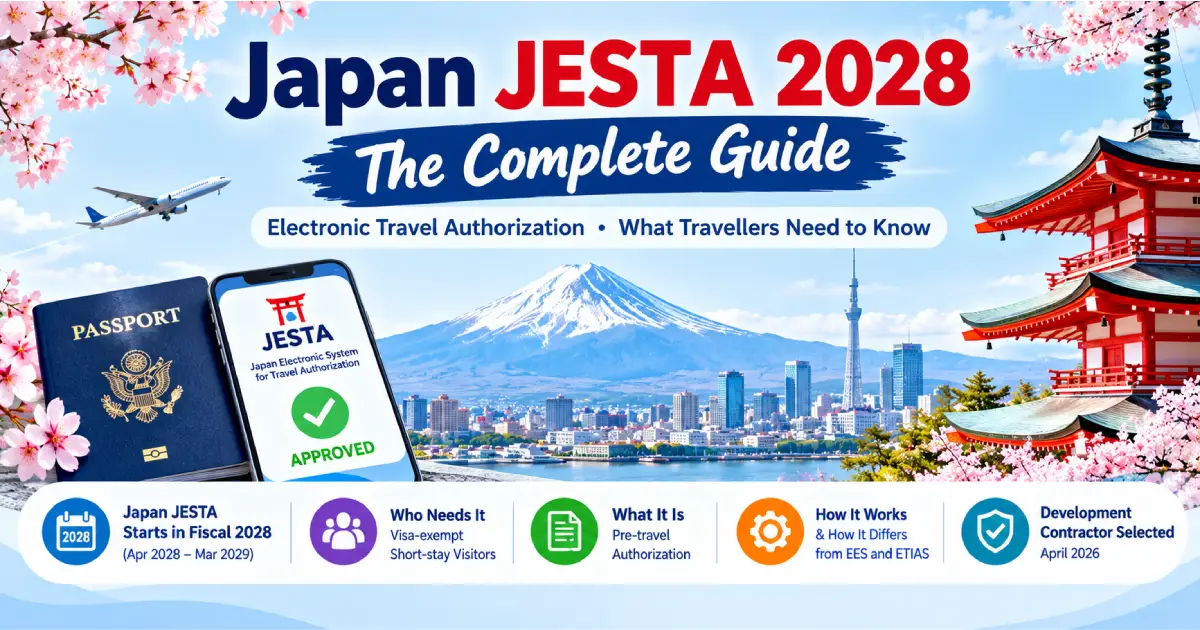
Published: October 16, 2026 — Friday (JESTA bill: approved Japanese Cabinet March 2025 · Name confirmed: Justice Minister Keisuke Suzuki May 2025 · Developer selected: April 2026 · Launch: Fiscal 2028 (April 2028–March 2029) · Sources: Japanese Immigration Services Agency · Japanese Ministry of Justice · Time Out Tokyo · PassportIndex · CIBT Visas / Newland Chase — all verified)
If you are planning a trip to Japan in 2028 or beyond, a new mandatory pre-travel step is coming.
Japan’s government has formally approved the creation of the Japan Electronic System for Travel Authorization — JESTA — a digital pre-screening requirement that will apply to travellers from 71 to 74 visa-exempt countries, including the United States, the United Kingdom, Australia, Canada, New Zealand, and the European Union, before they board any flight to Japan.
JESTA is confirmed. The bill was passed. The name was officially announced by Justice Minister Keisuke Suzuki on May 23, 2025. The development contractor was selected in April 2026. The launch target is fiscal year 2028 — meaning between April 2028 and March 2029. Japan’s Parliament has held detailed hearings on the system’s scope, costs, and technical safeguards.
Currently, approximately 80 percent of all short-term visitors to Japan — tourists, business travellers, transit passengers — enter under visa-exemption arrangements that require nothing beyond a valid passport. From fiscal 2028, that changes. Every visitor from a visa-exempt country will need a valid JESTA authorisation before they are allowed to board their flight.
Here is everything confirmed — what JESTA is, exactly who needs it, what information it will require, how much it will cost, how long it will take, and what the global context of this trend means for travellers who visit not just Japan but multiple countries.
Published: October 16, 2026 System name: JESTA — Japan Electronic System for Travel Authorization Japanese name: 電子渡航認証システム (Denshi Tokō Ninsho Shisutemu) Bill approval: Japanese Cabinet — March 2025 Official name confirmed: Justice Minister Keisuke Suzuki — May 23, 2025 Legal basis: Amendment to Immigration Control and Refugee Recognition Act — approved Development contractor: Selected — April 2026 (contractor identity not publicly disclosed) Testing period: Approximately 8 months of system testing required before launch Launch target: Fiscal 2028 — April 2028 → March 2029 (could start anytime in this window) Previously planned: Originally 2030 — accelerated to fiscal 2028 by Japanese government Who needs JESTA: All nationals of 71–74 visa-exempt countries — including US, UK, Australia, Canada, NZ, EU Who does NOT need JESTA: Japanese nationals · existing Japanese visa holders · Japanese resident permit holders Countries covered: 71–74 (final count TBC at launch — likely aligns with Japan’s current visa-waiver list) 80%: Proportion of current Japan visitors who enter under visa exemption — and will need JESTA Fee: NOT YET CONFIRMED — government stated it will set fees “based on levels charged by other countries” (US ESTA = USD 21 / UK ETA = £10 / Australia ETA = AUD 20) Expected fee range: Approximately ¥2,000–¥3,000 (USD 13–20 / £10–16 / AUD 22–32) — estimate based on comparable systems Validity: NOT YET CONFIRMED — expected 1–3 years based on comparable systems Information required: Name · Passport details · Nationality · Purpose of visit · Accommodation address · Contact details (phone, email) · Travel details Processing time: Majority expected to be automatic — minutes (similar to US ESTA) · Some applications may require manual review (days) Airlines: REQUIRED to deny boarding to passengers without valid JESTA Transit passengers: Some transit passengers subject to JESTA — final scope TBC Official updates: moj.go.jp (Ministry of Justice) · moj.go.jp/isa (Immigration Services Agency) Current Japan entry (until JESTA launches): Passport only — no change — continue to travel as normal
Japan received a record 42.6 million international visitors in 2025. Approximately 80 percent of those — over 34 million people — entered under visa-exemption arrangements that require no advance approval from Japanese authorities. A visitor from the UK, US, Australia, or Canada books a flight, packs a bag, and turns up at the airport. Japanese immigration has no advance information about them until their passport is scanned at the border.
JESTA changes that. By requiring travellers to submit personal information, travel purpose, and accommodation details online before departure, JESTA creates a pre-screening layer that allows Japanese immigration authorities to flag potential issues before a traveller is already on Japanese soil — or, in some cases, already on the aircraft.
The Japanese Immigration Services Agency described the purpose plainly: “This pre-screening system allows Japan to identify potential immigration issues before travelers reach the country, reducing problems at airports.”
This is not a uniquely Japanese approach. Japan is joining a growing list of countries that have implemented or are implementing electronic travel authorisation systems:
Japan’s JESTA completes the picture for the G7 major economies. With the US, UK, Canada, Australia, and soon the EU all operating pre-screening systems, Japan’s adoption is a natural convergence toward a global norm rather than an outlier policy.
Japanese Justice Minister Suzuki framed it explicitly: “JESTA will work similarly to the equivalent ESTA system used by the United States, allowing immigration authorities to screen passengers before arrival.”
JESTA will apply to nationals of all countries that currently enjoy visa-free entry to Japan for short-term stays. Japan currently maintains visa-exemption arrangements with 71 to 74 countries and territories — the exact number varies slightly depending on the counting methodology. The final JESTA eligibility list will be confirmed closer to launch.
The countries whose nationals will need JESTA include every major Western travel market. The confirmed or expected inclusions:
Tier 1 travel market countries — all confirmed in scope:
🇺🇸 United States · 🇬🇧 United Kingdom · 🇦🇺 Australia · 🇨🇦 Canada · 🇳🇿 New Zealand · 🇩🇪 Germany · 🇫🇷 France · 🇮🇹 Italy · 🇪🇸 Spain · 🇳🇱 Netherlands · 🇧🇪 Belgium · 🇵🇹 Portugal · 🇬🇷 Greece · 🇦🇹 Austria · 🇨🇭 Switzerland · 🇸🇪 Sweden · 🇩🇰 Denmark · 🇳🇴 Norway · 🇫🇮 Finland · 🇮🇪 Ireland
Asia-Pacific visa-waiver countries:
🇸🇬 Singapore · 🇰🇷 South Korea · 🇭🇰 Hong Kong · 🇲🇾 Malaysia · 🇹🇭 Thailand · 🇶🇦 Qatar · 🇦🇪 UAE · 🇮🇱 Israel · 🇯🇴 Jordan · 🇧🇷 Brazil · 🇦🇷 Argentina · 🇲🇽 Mexico
Who does NOT need JESTA:
Japanese nationals are entirely exempt — they enter Japan on their own passport without any authorisation.
Foreign nationals holding a valid Japanese visa (for stays requiring a visa) do not need JESTA — their visa already serves as the advance authorisation.
Foreign nationals holding a Japanese Residence Card (zairyu card) — students, workers, long-term residents — do not need JESTA for return trips to Japan.
Foreign nationals with certain diplomatic or official status may be exempt — final scope TBC.
Japan’s Parliament has confirmed the categories of information JESTA will collect. The system is designed as both a security screening tool and an immigration management mechanism — hence the requirement for accommodation details, which no other major travel authorisation system currently collects at this level of specificity.
Confirmed required information:
The accommodation address requirement — why this matters:
Japan’s JESTA goes beyond US ESTA and UK ETA in requiring applicants to provide their specific accommodation address in Japan. This is the system’s primary immigration management feature: Japanese authorities can cross-reference the addresses provided against known problem accommodation types, flag inconsistencies between stated purpose (tourism) and accommodation type (long-term rental), and verify that visitors have confirmed bookings.
For travellers whose first accommodation is flexible — “I’ll find somewhere when I arrive” — JESTA will require a specific address. Travellers planning to visit multiple cities in Japan may need to provide the first night’s accommodation. The exact requirement (first night only, or full itinerary) has not been confirmed but the Japanese Immigration Services Agency confirmed that “intended place of stay in Japan” is a required field.
Important for business travellers:
Business travellers visiting Japan — for meetings, conferences, or short-term assignments — will need to declare “business” as their purpose of entry on JESTA. The system will allow business purpose declarations and Japanese immigration authorities will cross-reference these against the visitor’s declared accommodation. Business travellers staying in company-provided accommodation or client accommodation should note that address in their JESTA application.
One of the most practically significant and least-discussed aspects of JESTA is its application to transit passengers.
Japan’s Narita International Airport (NRT) and Tokyo Haneda Airport (HND) are significant transit hubs — particularly for passengers routing between North America and Southeast Asia, Australia, and other Pacific destinations. Currently, transit passengers spending a few hours in a Japanese airport airside (without passing through immigration) do not require any advance authorisation.
JESTA introduces a more complex picture. Japanese authorities confirmed in Parliament that some transit passengers could be subject to JESTA — but the scope is based on “migration risk factors tied to specific nationalities or territories rather than applying the requirement universally.” This means not all transit passengers through Japanese airports will need JESTA — but some will, depending on nationality.
The precise scope of JESTA’s transit application has not been finalised. The Japanese government explicitly declined to confirm universal transit application in parliamentary hearings, stating that the final scope would be determined based on risk assessment criteria developed during the system’s testing phase.
Practical guidance for transit passengers planning Japan connections:
Monitor moj.go.jp/isa for any specific transit guidance as the 2028 launch approaches. As a precaution, travellers from visa-exempt countries transiting through Japan with a layover long enough to require clearing immigration (typically any layover over 24 hours, or one involving exiting the airport) should assume JESTA may apply and check the guidance as it is published.
The JESTA fee has not been officially confirmed. The Japanese government stated in Parliament that it will set the fee “based on levels charged by other countries” — making the comparable systems the best guide to what to expect.
Comparable system fees (for context):
| System | Country | Fee | Validity |
|---|---|---|---|
| ESTA | United States | USD 21 | 2 years |
| ETA | Australia | AUD 20 | Multiple entries / 12 months |
| eTA | Canada | CAD 7 | 5 years |
| ETA | United Kingdom | £10 | 2 years |
| NZeTA | New Zealand | NZD 17 | 2 years |
| K-ETA | South Korea | KRW 10,000 (approx. USD 7.50) | 3 years |
| ETIAS | EU (forthcoming) | €7 | 3 years |
Based on this range, the JESTA fee is most likely to fall in the ¥1,500–¥3,000 range (approximately USD 10–20 / £8–16 / AUD 16–32) per person per application. The Japanese government’s revenue model for JESTA — funding the development and operation costs from application fees — suggests it will not be set at the lower end of the global range.
Critically: the fee is per person, per application, for the duration of the JESTA’s validity period. A family of four applying for a two-week Japan holiday in 2029 would each need a valid JESTA — potentially four application fees. The total cost of JESTA for a family trip will depend on the final fee and validity period.
Who may be exempt from the JESTA fee:
The Japanese Cabinet bill confirmed that some categories of travellers may be eligible for fee waivers — specifically “foreigners in financial difficulty.” The exact criteria for fee exemption will be published closer to launch. Diplomatic passport holders are also likely to be exempt based on standard international practice.
The critical detail about JESTA’s launch date is that “fiscal 2028” is not the same as “calendar year 2028.”
Japan’s fiscal year runs from April 1 to March 31. Fiscal 2028 means the year beginning April 1, 2028 and ending March 31, 2029. JESTA could launch on any day within that 12-month window.
Passport Index confirmed that the development company for JESTA was selected in April 2026 and that the system requires approximately 8 months of testing before launch. Working backward from March 2029: 8 months of testing beginning approximately July 2028 would allow a late 2028 or early 2029 launch. Working forward from the April 2028 fiscal year start: 8 months of testing beginning April 2028 would allow a December 2028 launch.
The most likely single launch date — based on the 8-month testing requirement and standard Japanese government IT project management — is late 2028 to early 2029. Travellers planning Japan trips in 2028 (before December) are probably safe without JESTA. Travellers planning Japan trips in 2029 and beyond should anticipate JESTA being required.
Japanese Parliament lawmakers pressed government officials on whether an earlier launch was possible. Authorities were direct in declining: “The system must be fully stable and secure before going live. We will not commit to an earlier launch date.”
JESTA does not arrive in isolation. Japan has made several significant changes to its entry framework over 2025 and 2026:
October 2025: Japan raised its tourist tax (sightseeing tax) at several municipalities including Kyoto, which increased from ¥200 to ¥500 per night per guest at premium accommodation.
July 1, 2026: Japan raised its visa fees fivefold for nationals of countries requiring a visa — single-entry visas rose from ¥3,000 to ¥15,000. This affected over 100 countries including China, India, Vietnam, the Philippines, and Indonesia.
Fiscal 2028 (projected): JESTA requires all visa-exempt nationals to obtain pre-travel authorisation.
Proposed October 2026: Japan proposed raising its permanent residence application fee from ¥10,000 to ¥200,000 (a 1,900% increase) — this remains under parliamentary review.
The cumulative picture is a Japan that is managing record international visitor volumes by adding layers of screening, cost recovery, and entry management across all visitor categories. JESTA is the capstone of this framework for short-term visa-exempt visitors — bringing Japan into line with the global standard of pre-travel screening while maintaining visa-free access for the 71–74 countries already on the list.
If you are travelling to Japan in 2026 or 2027:
Nothing changes for you. JESTA does not exist yet. Japan entry remains exactly as it has always been: a valid passport is sufficient for visa-exempt nationals for stays up to 90 days. No advance registration, no application, no fee. Continue to plan and book as normal.
If you are travelling to Japan in 2028:
Monitor the Japanese Ministry of Justice website (moj.go.jp) and Immigration Services Agency (moj.go.jp/isa) from early 2028. If JESTA launches in mid-to-late fiscal 2028, trips in the first half of calendar 2028 (January–June) are likely unaffected. Trips in the second half of 2028 may be affected. Check closer to your travel date.
If you are travelling to Japan in 2029 or later:
Plan for JESTA as a mandatory step. The application process will be online through the official Japanese government portal — the domain has not yet been published but will be on the moj.go.jp or mofa.go.jp domain structure. Apply at least 72 hours before departure, though most applications are expected to process in minutes.
For travel businesses, tour operators, and OTAs:
JESTA will need to be incorporated into Japan booking flows from late 2028 — similarly to how ESTA, eTA, and UK ETA are now standard steps in US, Canada, and UK booking journeys. Prepare your customer communications and booking system prompts now.
| Feature | Japan JESTA | US ESTA | UK ETA | EU ETIAS | Australia ETA |
|---|---|---|---|---|---|
| Status | Building — fiscal 2028 | ✅ Operational | ✅ Operational | Not yet launched | ✅ Operational |
| Who needs it | 71–74 visa-exempt nationals | 42 visa-waiver nationals | Non-British travellers | Visa-exempt non-EU nationals | Select nationalities |
| Fee | TBC — est. ¥1,500–3,000 | USD 21 | £10 | €7 | AUD 20 |
| Validity | TBC — est. 1–3 years | 2 years | 2 years | 3 years | Multiple/12 months |
| Processing | Mainly automatic — minutes | Mainly automatic — minutes | Mainly automatic — minutes | Mainly automatic | Online/app — instant |
| Accommodation required | ✅ YES | ❌ No | ❌ No | ✅ YES (planned) | ❌ No |
| Airlines enforce | ✅ Yes — deny boarding | ✅ Yes | ✅ Yes | ✅ Yes (planned) | ✅ Yes |
| Official domain | moj.go.jp/isa (updates) | esta.cbp.dhs.gov | gov.uk/apply-uk-visa | travel-europe.europa.eu/etias | immi.homeaffairs.gov.au |
| Resource | Website | What For |
|---|---|---|
| Japan Immigration Services Agency | moj.go.jp/isa | Official JESTA updates — bookmark this |
| Japan Ministry of Justice | moj.go.jp | Official policy announcements |
| Japan Ministry of Foreign Affairs | mofa.go.jp/j_info/visit/visa | Visa exemption list — check your country |
| Visit Japan Web (current system) | web.visit-japan.jp | Current digital arrival card — use today |
| Japan JNTO (tourism) | jnto.go.jp | Japan travel information |
| UK FCDO Japan advice | gov.uk/foreign-travel-advice/japan | Current UK travel advisory |
| DFAT Australia Japan | smartraveller.gov.au | Current Australian travel advisory |
Related Articles:
Posted By : Vinay
This article is provided for general informational purposes only and is based on information available at the time of publication. Travel advisories, airline schedules, airport operations, visa requirements, government regulations, and other travel-related information are subject to change without prior notice. While Travel Tourister makes reasonable efforts to verify information using official announcements, government publications, airline and airport communications, and other reliable sources, we cannot guarantee that all information remains complete, accurate, or up to date at all times. Readers should independently verify any information that may affect their travel plans with the relevant airline, airport authority, government agency, embassy, or other official source before making travel, financial, or other decisions. Travel Tourister shall not be liable for any direct or indirect loss, inconvenience, or damages arising from the use of or reliance on the information contained in this article. Nothing in this publication constitutes legal, immigration, financial, or professional travel advice. If you believe any information in this article is inaccurate or outdated, please contact our editorial team. We review all credible correction requests promptly and update our content whenever appropriate.
Lastest News
2nd Floor, 39, Above Kirti Club, DLF Industrial Area, Kirti Nagar, New Delhi, Delhi 110015



Travel Tourister is a leading Travel portal where we introduce travellers to trusted travel agents to make their journey hasselfree, memorable And happy. Travel Tourister is a platform where travellers get Tour packages ,Hotel packages deals through trusted travel companies And hoteliers who are working with us across the world. We always try to find new and more travel agents and hoteliers from every nook and corners across the world so that you could compare the deals with different travel agents and hoteliers and book your tour or hotel with the one you have chosen according to your taste and budget.
Copyright © Travel Tourister, India. All Rights Reserved

 Call
Call Enquiry