Published on : 06 Jun 2026
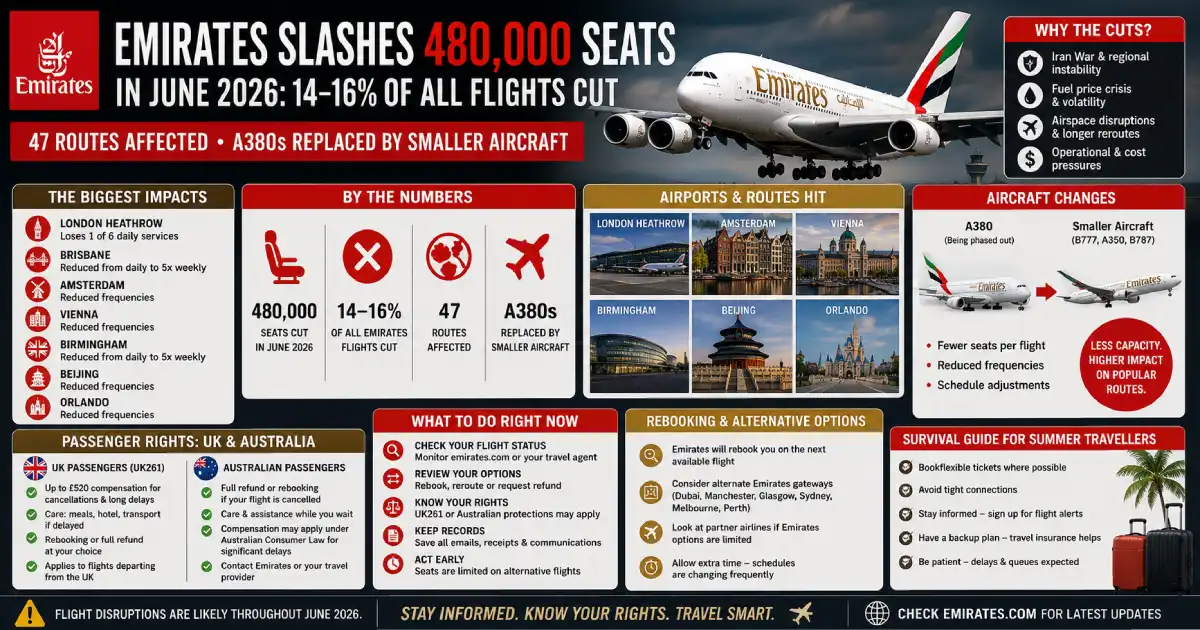
Emirates has removed approximately 480,000 seats from its June 2026 schedule — slashing 14–16% of its entire global operation in what aviation analytics firm Cirium confirms is one of the most significant single-month capacity reductions by any major long-haul carrier in recent history. London Heathrow — Emirates’ single busiest destination by frequency — loses one of its six daily services. London Gatwick loses its planned fourth daily service until at least July. London Stansted’s second daily flight is pushed back to July. Brisbane (Australia) is cut. Amsterdam, Vienna, Birmingham, Beijing, Malé, and Orlando are all reduced. 286 planned Airbus A380 flights have been reassigned to smaller Boeing 777 or Airbus A350 aircraft. 47 destinations show reductions of 17% or more for June. The cause: the ongoing Iran war, which has disrupted Gulf airspace, forced rerouting that burns more fuel, reduced connecting traffic between Europe and Asia, and caused Middle East passenger demand to fall 48% year-on-year. If you hold an Emirates ticket for June — or were planning to book one — you need to read this now.
Emirates enters June 2026 carrying a paradox: its strongest-ever financial year (AED 19.7 billion net profit for the year ended 31 March 2026, on the back of 53.2 million passengers) and simultaneously its most operationally constrained summer in a decade. The cuts confirmed by Cirium, Arabian Business, Simple Flying, and multiple aviation analytics platforms reveal a carrier that is choosing sustainability over scale — reducing frequency to protect yields, cutting the routes most exposed to Iranian airspace rerouting costs, and preserving capital at a moment when jet fuel prices remain at historically elevated levels following the early April peak of US$1,838 per tonne.
For passengers in the United Kingdom and Australia — Emirates’ two largest non-Gulf markets — the June 2026 schedule cuts represent the most significant reduction in available seat capacity on the London–Dubai and Australian hub–Dubai corridors since the early days of COVID. The difference this time is that the reduction is not a temporary operational halt — it is a strategic, planned pullback from a carrier that remains financially strong but is choosing not to operate routes that, when Iranian airspace rerouting costs are factored in, do not meet its yield requirements.
Published: Saturday 6 June 2026 Data source: Cirium aviation analytics · Arabian Business · Simple Flying · Aviation A2Z · AGBI · ConnectingTravel — confirmed 2–6 June 2026 Seats removed from June schedule: ~480,000 Flights removed: 7,116 planned → 6,007 operated = 1,109 fewer departures from Dubai in June Daily departure reduction: ~37 fewer Emirates departures per day from DXB in June vs planned Year-on-year reduction: 14% fewer flights than June 2025 Total Emirates destinations: 138 — 4 fewer than pre-conflict levels Pre-war departure level: Emirates currently operating at approximately 80% of pre-war departure volumes Routes SUSPENDED entirely: DXB–Algiers (suspended since February 28, 2026) · DXB–Malé to Colombo tag-route (suspended) Iran war outbreak: February 28, 2026 — US/Israel–Iran conflict — UAE airspace disrupted UAE airspace status: Restored and operational — but Iranian overflights still avoided — forcing longer routing Jet fuel price: Peaked at US$1,838/tonne early April 2026 · Currently approximately US$1,560/tonne · Pre-war: US$831/tonne — still nearly double A380 downgrades: 286 planned A380 flights reassigned to Boeing 777 or A350 for June London impact (all 3 airports):
To understand why Emirates is removing 480,000 seats from June, you need to understand what happened on February 28, 2026. On that date, the United States and Israel initiated military action against Iran in what has since become the defining geopolitical disruption to global aviation in 2026 — surpassing in airline impact even the prolonged Russia-Ukraine airspace closure that began in 2022.
The immediate aviation consequence was the closure of Iranian airspace — one of the world’s most heavily used overflights, routing an enormous volume of Europe–Asia long-haul traffic between the Gulf region and the Indian subcontinent, East Asia, and Southeast Asia. The closure of Iranian airspace forces aircraft to take significantly longer routing alternatives — adding flight time, burning more fuel, and creating crew duty-time challenges on routes where previously efficient Iranian overflights kept sector lengths manageable.
For Emirates specifically, the exposure is acute. Aviation consultant Linus Bauer, founder of BAA & Partners, explained the mechanism precisely: “Kuwait, and suspended destinations such as Algiers, are directly linked to the conflict and changes in traveller sentiment. At the same time, long-haul routes to Europe and Asia have been affected by Iranian airspace rerouting, which increases flight times, fuel burn and operating costs. Emirates’ network is particularly exposed to connecting traffic flows between Europe and Asia that have been disrupted by the conflict.”
The secondary impact is demand destruction. Middle East airlines recorded a 48% decline in passenger demand in April 2026 compared with April 2025, according to IATA. Dubai International Airport handled 18.6 million passengers in Q1 2026 — down 20.6% year-on-year. March traffic fell 65.7% year-on-year to just 2.5 million passengers. These numbers represent a demand collapse that no airline can absorb through pricing alone. The only rational response is capacity reduction.
The tertiary impact is fuel cost. Jet fuel prices rose from US$831 per tonne before the war to a peak of US$1,838 per tonne in early April 2026 — a 121% increase in weeks. Even as prices have eased to approximately US$1,560 per tonne, they remain 88% above pre-war levels. On an Emirates A380 route between Dubai and London, which burns approximately 100,000 litres of fuel per flight, the additional fuel cost per trip at current prices versus pre-war prices is approximately US$95,000 — before passenger revenues are even factored in.
Emirates has chosen the rational response: cut the routes where the combination of demand softness, longer rerouting, and elevated fuel costs makes profitable operation impossible at current pricing. The 47 routes showing the deepest cuts are, almost without exception, those most exposed to connecting traffic disruption, fuel cost sensitivity, or Iranian airspace rerouting costs.
| Airport | Pre-Cut Frequency | June 2026 Frequency | Reduction | Flight Numbers Removed |
|---|---|---|---|---|
| London Heathrow (LHR) | 6 daily | 5 daily | –1 daily service | EK31/EK32 removed |
| London Gatwick (LGW) | 4 daily (planned) | 3 daily | Planned 4th postponed to July+ | — |
| London Stansted (STN) | 2 daily (planned) | 1 daily | Planned 2nd postponed to July+ | — |
| Birmingham (BHX) | Previous frequency | Reduced | 17%+ cut | — |
| Manchester (MAN) | A380 service | A380 removed → smaller aircraft | Capacity downgrade | 286 planned A380s globally reassigned |
The Heathrow impact in numbers: Heathrow is Emirates’ most-served destination globally — the busiest point on its entire network by frequency. Five daily departures will now exist in June, down from six in May and the six that were originally scheduled for June. EK31 (the removed Dubai–Heathrow service) and EK32 (the return Heathrow–Dubai service) have been taken off the June schedule. This is not a one-day cancellation — it is a month-long frequency reduction affecting every single day of June.
For UK passengers, the practical consequence is twofold: reduced seat availability on the DXB–LHR corridor (putting upward pressure on fares as the same demand chases fewer seats) and reduced flexibility for passengers connecting through Dubai to destinations across Australia, East Africa, South Asia, Southeast Asia, and the Indian subcontinent.
| City | Frequency Change | Notes |
|---|---|---|
| Brisbane (BNE) | Reduced | Some routes cut by over 50% frequency |
| Sydney (SYD) | Review current schedule | Check emiratescom directly for June schedule |
| Melbourne (MEL) | Review current schedule | Check emirates.com directly for June schedule |
| Perth (PER) | Review current schedule | Iran war rerouting particularly affects Perth routing via Middle East |
For Australian passengers, Emirates is typically the primary or only direct connection between Australian cities and Dubai — a hub that then connects to the UK, Europe, Africa, and the Indian subcontinent. The Brisbane reduction is confirmed. Sydney, Melbourne, and Perth passengers should check their June bookings directly at emirates.com, as schedule adjustments may have been made without proactive individual passenger notification.
The Australia–UK connection: Thousands of Australian passengers route through Dubai on Emirates’ DXB hub to reach London. The combination of reduced Australian frequency and reduced Heathrow frequency in June 2026 means fewer available seat combinations on the Australia–Dubai–London corridor — one of the most important long-haul itineraries globally.
Aviation A2Z’s analysis of Cirium data confirms that 47 destinations across Emirates’ global network show flight reductions of 17% or more for June. The following categories are the most affected:
| Category | Key Cities | Impact Level |
|---|---|---|
| UK — all three London airports | LHR · LGW · STN | Heavy — LHR –1 daily, LGW/STN growth postponed |
| UK — regional | Birmingham (BHX) · Manchester (MAN) | BHX reduced · MAN A380 removed |
| Europe | Amsterdam (AMS) · Vienna (VIE) · Copenhagen (CPH) · Munich (MUC) | Frequency reduced · Copenhagen A380 removed · Munich major capacity downgrade |
| Asia-Pacific | Brisbane (BNE) · Osaka Kansai (KIX) · Beijing Capital (PEK) | BNE reduced · KIX reduced widebody · PEK reduced |
| North America | Orlando (MCO) · Washington Dulles (IAD) | MCO reduced · IAD A380 suspended |
| Gulf / suspended | Algiers (ALG) · Kuwait (KWI) | Algiers fully suspended since Feb 28 · Kuwait heavily reduced |
| Indian Ocean | Malé (MLE) | Malé–Colombo tag-route suspended |
The A380 downgrade phenomenon: 286 planned A380 flights for June have been reassigned to Boeing 777 or Airbus A350 aircraft. This is significant beyond just seat numbers — the A380 offers a different, typically superior cabin experience (including Emirates’ A380-exclusive First Class suites with sliding doors) that passengers may have specifically booked and paid a premium for. Routes affected by A380 removal include Copenhagen, Osaka, Washington Dulles, Munich, Manchester, and London Gatwick.
Emirates’ June cuts are the most visible element of a broader Gulf aviation restructuring that is affecting multiple carriers:
| Carrier | June 2026 Status | UK/Australia Impact |
|---|---|---|
| Emirates | 14–16% cut — 480K seats removed | LHR –1 daily · LGW/STN growth postponed · BNE reduced |
| Qatar Airways | 19% fewer flights year-on-year | UK/Australian connections via DOH reduced |
| Etihad Airways | INCREASING — counter-programming | AUH hub gaining connecting traffic as EK/QR cut |
| flydubai | Operating normally | Shorter-haul only — less Iran war exposure |
| Swiss International Air Lines | Extended Dubai (DXB) suspension | UK passengers connecting through ZRH affected |
| KLM Royal Dutch Airlines | Selective Gulf-route cancellations | AMS–DXB and connecting routes reduced |
| Cathay Pacific | Reduced Gulf-route schedule | HKG–DXB passengers affected |
The counter-programming by Etihad Airways (Abu Dhabi) is notable — with Emirates and Qatar cutting, Etihad has seen an opportunity to pick up connecting traffic through Abu Dhabi and has been increasing rather than reducing frequency. UK and Australian passengers who need a June Gulf connection may find better availability through Etihad’s AUH hub than through Emirates’ DXB or Qatar’s DOH.
Under UK261 (for UK-origin passengers) and EU261 (for EU-origin passengers), you are entitled to:
Unconditional rights (regardless of cause):
Emirates cannot refuse these rights. The cause (Iran war, fuel crisis) does not affect your refund or rerouting entitlement.
Duty of care while stranded:
Additional cash compensation (£520/€600 for long-haul) may apply if the cancellation or 3+ hour delay was caused by circumstances within the airline’s control. The Iran war airspace disruption and fuel cost crisis are more likely to be classified as extraordinary circumstances by airlines and courts — meaning Emirates’ financial compensation obligation for these specific schedule reductions may be reduced or eliminated. However, refund and rerouting rights remain unconditional.
What to do: Claim your refund or rerouting first (these are guaranteed). If Emirates disputes financial compensation citing extraordinary circumstances, file with the Civil Aviation Authority (CAA) for UK passengers — the CAA will assess whether extraordinary circumstances genuinely apply. Do not let Emirates dismiss both your refund AND compensation claims simultaneously.
If your ticket was sold as an A380 service and Emirates has reassigned it to a Boeing 777 or A350:
If Emirates has not cancelled your flight but the reduced schedule no longer suits your connection or itinerary:
If your Emirates A380 service has been replaced by a Boeing 777 or A350 and this results in a cabin downgrade:
If you hold travel insurance and Emirates’ schedule cuts have disrupted your holiday plans, check your policy for:
Emirates and multiple aviation analysts have indicated that the June cuts are a transitional adjustment, not a permanent restructuring. Several positive signals for the summer recovery:
Positive signals:
Warning signals:
For UK and Australian passengers planning July, August, and September Emirates bookings: The airline has signalled intent to restore some postponed June services from July. But given the fuel cost and airspace environment, do not assume July will fully restore pre-war frequency levels. Book with flexibility — and consider travel insurance with schedule-change and airline-failure coverage.
With Emirates cutting frequencies and Qatar cutting even deeper (19% year-on-year), Etihad Airways’ Abu Dhabi hub (AUH) is emerging as the most reliable Gulf connection option in June and July 2026.
Etihad is the only major Gulf carrier actively increasing capacity — counter-programming against Emirates and Qatar’s cuts to pick up stranded connecting traffic. UK passengers connecting to Australia, India, Southeast Asia, or East Africa through a Gulf hub should compare Etihad availability at etihad.com alongside Emirates options.
Key Etihad routes for UK passengers:
Step 1: Check your booking NOW. Log in to emirates.com → Manage Your Booking. If your flight has been cancelled or rescheduled, the change will be visible here. Do not wait for Emirates to contact you — proactively check.
Step 2: If your flight is cancelled — choose refund or rerouting. Decide whether you want a full cash refund or to be rerouted to your destination on an alternative schedule. State your choice clearly when contacting Emirates — do not let the conversation default to voucher credit.
Step 3: If your A380 has been swapped for a 777/A350 — check your cabin. If your cabin class is still available on the replacement aircraft, your journey can continue. If your specific product (e.g., A380 First Class) no longer exists on the replacement aircraft, you are entitled to a refund for the difference.
Step 4: If travelling UK–Australia in June — consider alternatives now. Qantas (via Singapore or direct Perth–London), British Airways (via Singapore), Singapore Airlines (via Singapore), and Etihad (via Abu Dhabi) all offer June capacity on the Australia–UK corridor.
| Action | Contact / Link |
|---|---|
| Emirates flight status + Manage Booking | emirates.com → Manage Your Booking |
| Emirates UK contact centre | 0344 800 2777 (UK) |
| Emirates Australia contact | 1300 303 777 (Australia) |
| Emirates US contact | 1-800-777-3999 |
| UK261 refund claim (CAA) | caa.co.uk → Passenger rights |
| EU261 refund claim | airhelp.com |
| Civil Aviation Authority complaint | caa.co.uk/our-work/contact-us |
| Etihad (Abu Dhabi alternative) | etihad.com |
| Qantas UK–Australia alternative | qantas.com |
| Singapore Airlines alternative | singaporeair.com |
| British Airways alternative | britishairways.com |
| Cirium aviation analytics | cirium.com |
| Flight schedule checker | flightaware.com |
Emirates has removed approximately 480,000 seats from its June 2026 schedule — a 14–16% reduction in its entire global operation confirmed by Cirium aviation analytics and multiple industry sources. London Heathrow loses one of its six daily services (EK31/EK32 removed). Gatwick and Stansted expansion plans postponed to July at earliest. Brisbane is cut. Amsterdam, Vienna, Birmingham, Beijing, and Orlando are all reduced. 286 planned A380 flights have been replaced by smaller Boeing 777 or A350 aircraft. 47 destinations show reductions of 17% or more for June. The root cause is the Iran war: Iranian airspace disruption forces longer routing, burning more fuel; Gulf passenger demand fell 48% year-on-year in April; jet fuel remains at US$1,560/tonne — 88% above pre-war levels. Qatar Airways is down 19% year-on-year. Swiss International has extended its Dubai suspension. KLM and Cathay Pacific are maintaining Gulf-route reductions. Etihad Airways is the one Gulf carrier increasing capacity — and may be the most reliable June connection option for UK and Australian passengers. If you hold an Emirates June booking, check your flight status at emirates.com now. If your flight has been cancelled, you are entitled to a full cash refund or rerouting — unconditionally, regardless of extraordinary circumstances. If your A380 has been replaced by a smaller aircraft resulting in a cabin downgrade, you are entitled to 75% of your one-way ticket price in compensation under UK261.
Your five-point action plan — Emirates June 2026 schedule cuts:
Related Articles:
Posted By : Vinay
This article is provided for general informational purposes only and is based on information available at the time of publication. Travel advisories, airline schedules, airport operations, visa requirements, government regulations, and other travel-related information are subject to change without prior notice. While Travel Tourister makes reasonable efforts to verify information using official announcements, government publications, airline and airport communications, and other reliable sources, we cannot guarantee that all information remains complete, accurate, or up to date at all times. Readers should independently verify any information that may affect their travel plans with the relevant airline, airport authority, government agency, embassy, or other official source before making travel, financial, or other decisions. Travel Tourister shall not be liable for any direct or indirect loss, inconvenience, or damages arising from the use of or reliance on the information contained in this article. Nothing in this publication constitutes legal, immigration, financial, or professional travel advice. If you believe any information in this article is inaccurate or outdated, please contact our editorial team. We review all credible correction requests promptly and update our content whenever appropriate.
Lastest News
2nd Floor, 39, Above Kirti Club, DLF Industrial Area, Kirti Nagar, New Delhi, Delhi 110015



Travel Tourister is a leading Travel portal where we introduce travellers to trusted travel agents to make their journey hasselfree, memorable And happy. Travel Tourister is a platform where travellers get Tour packages ,Hotel packages deals through trusted travel companies And hoteliers who are working with us across the world. We always try to find new and more travel agents and hoteliers from every nook and corners across the world so that you could compare the deals with different travel agents and hoteliers and book your tour or hotel with the one you have chosen according to your taste and budget.
Copyright © Travel Tourister, India. All Rights Reserved

 Call
Call Enquiry