Published on : 05 Jun 2026
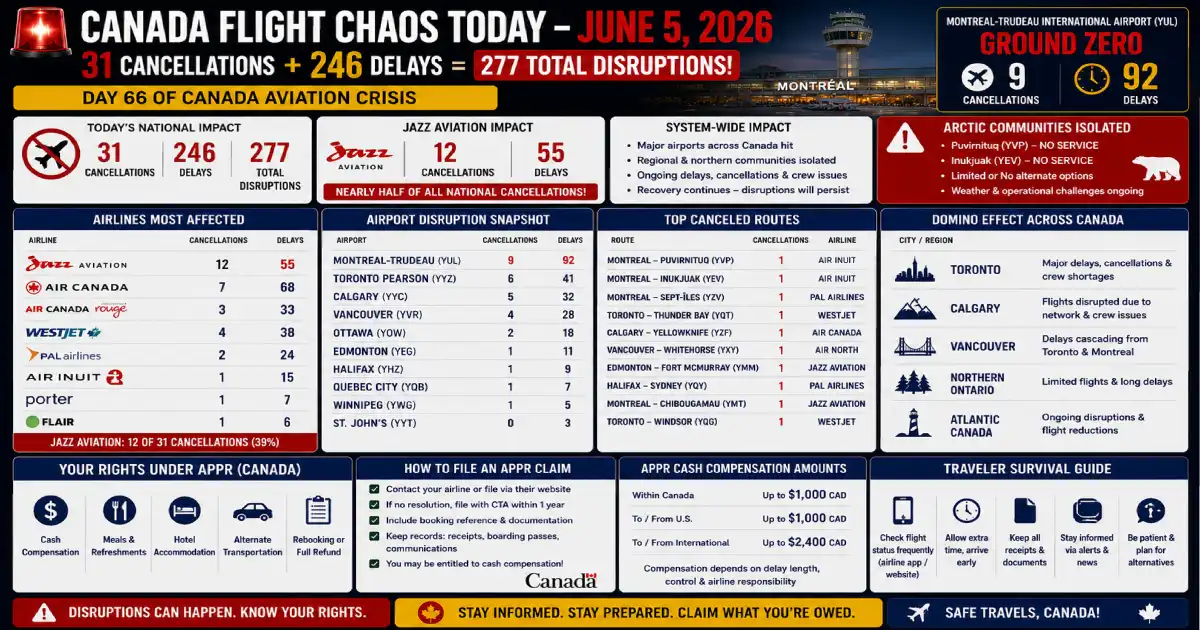
On Day 66 of Canada’s unbroken aviation crisis, something has shifted. For 65 consecutive days, Toronto Pearson dominated every national disruption report — Canada’s biggest airport absorbing the most cancellations, the most delays, the most passenger distress. Today, June 5, 2026, the epicentre has moved east. Montreal-Trudeau International Airport has become ground zero for Canada’s aviation crisis — recording 9 cancellations and 92 delays that represent by far the most severe concentration of disruption anywhere in Eastern Canada today.
Canada’s aviation sector descended into chaos on June 5, 2026, as Jazz, Air Canada, Air Canada Rouge, WestJet, PAL Airlines, Air Inuit, and other carriers executed a staggering 31 flight cancellations and 246 delays in a single day. The cascading operational collapse rippled through every major Canadian hub — from Montreal-Trudeau and Toronto Pearson to Calgary International, plus remote northern airports serving communities in Puvirnituq and Inukjuak.
Jazz (ACA), Air Canada’s regional feeder airline, suffered the worst single-airline disruption of the day with 12 cancellations and 55 delays — nearly half of all cancellations nationwide. For isolated Arctic communities dependent on limited weekly flight frequencies, the suspensions threatened supply chains and essential passenger connections.
The Montreal shift matters. In every previous Day 60+ crisis report, the disruption story has been a Toronto Pearson story. Today it is a Montreal-Trudeau story — and the implications for Eastern Canadian connectivity, transatlantic route reliability, and the hub-and-spoke network that feeds Air Canada’s intercontinental services from Quebec are substantially different. When Toronto breaks, Ontario breaks. When Montreal breaks, Eastern Canada and the entire Quebec-connected international network break with it.
Published: June 5, 2026 — (Day 66 · Canada Aviation Crisis · Summer Peak Week 1) Canada national total: 31 cancellations + 246 delays = 277 disruptions Montreal-Trudeau (YUL): 9 cancellations + 92 delays = 101 disruptions — Ground Zero Toronto Pearson (YYZ): Disruptions confirmed — cascading from YUL positioning debt Calgary International (YYC): Disruptions confirmed — WestJet + Air Canada Vancouver International (YVR): Disruptions confirmed Halifax Stanfield (YHZ): PAL Airlines + WestJet disrupted Puvirnituq (YPX): 3 cancellations + 6 delays — Arctic community isolated Inukjuak (YPH): 2 cancellations + 2 delays — Nunavik community cut off Jazz Aviation (Air Canada Express): 12 cancellations + 55 delays = 67 disruptions — worst carrier today Air Canada mainline: Cancellations + delays confirmed — Montreal network broken Air Canada Rouge: Cancellations confirmed — leisure and international routes hit WestJet: Delays across western hubs PAL Airlines: Cancellations in Atlantic Canada Air Inuit: Arctic + northern Quebec routes disrupted Routes broken: Toronto · Ottawa · Halifax · Edmonton · Calgary · Vancouver · Houston · Casablanca · Boston · Dallas · Newark · San Francisco · La Grande-Rivière · Saguenay · Puvirnituq · Inukjuak Context: Day 65 nationally: Toronto Pearson 17 cancels + 90 delays — Jazz 76% of cancels APPR cash compensation: Up to CAD $1,000 per passenger for large carrier controllable delays 9+ hours Full refund right: ✅ Unconditional within 30 days — all cancellations Duty of care: ✅ Meals + hotel + ground transport for controllable disruptions
The movement of Canada’s aviation crisis epicentre from Toronto to Montreal on Day 66 is not a random event. It is the predictable consequence of a specific operational dynamic: the Day 65 Jazz disruption at Toronto Pearson — where Jazz accounted for 76% of all Pearson cancellations — displaced aircraft and crews toward Montreal on overnight rotations that could not recover in time for the June 5 morning wave.
Montreal-Trudeau is Air Canada’s transatlantic hub. While Toronto Pearson handles Air Canada’s transpacific and US transborder dominance, Montreal is where Air Canada operates its European network — Paris, London, Frankfurt, Brussels, Geneva, Zurich, Lyon, Lisbon — and its transatlantic leisure routes to the Caribbean and North Africa. Jazz feeds Air Canada’s Montreal mainline with regional passengers from Halifax, Quebec City, Ottawa, Moncton, Fredericton, and Charlottetown. When Jazz breaks at Montreal, the transatlantic mainline loses its feeder passengers, its crew rotations, and its aircraft positioning.
Routes affected by today’s Montreal disruptions include domestic destinations Toronto, Ottawa, Houston, La Grande-Rivière, Halifax, Québec City, Saint John, Bathurst, Casablanca, Boston, Dallas, Newark, San Francisco and Saguenay.
That is the full geography of the Montreal disruption: from the local Quebec City feeder to the Air Canada transatlantic to Boston and Houston connections to the Air Canada international service to Casablanca. Montreal’s disruption today is not a domestic story — it is simultaneously a domestic, transborder, and transatlantic story.
Montreal-Trudeau International Airport emerged as ground zero for the disruptions, recording 9 cancellations and 92 delays — by far the most severe concentration of chaos in Eastern Canada.
Montreal-Trudeau is Canada’s second-largest airport and its primary transatlantic hub. It handles approximately 20 million passengers annually and operates Air Canada’s Paris, London, Brussels, Geneva, Zurich, Lyon, Lisbon, and Casablanca services. It is also the gateway for Air Transat’s leisure transatlantic network and the Quebec provincial hub for Jazz’s regional network serving smaller Quebec and Atlantic communities.
Today’s 9 cancellations at YUL span the full operational range:
Domestic Jazz cancellations: Flights to Quebec City, Halifax, Ottawa, Saint John, Bathurst, Moncton, and smaller provincial destinations. These are the feeder routes that bring regional passengers into Montreal for Air Canada connections. When Jazz cancels them, the Air Canada mainline loses connecting passengers — and the regional communities served lose their gateway to the national network.
International disruptions: Routes affected include Casablanca, Boston, Dallas, Newark, San Francisco and Houston — the US transborder and mid-Atlantic/North African international corridors that define Montreal’s global connectivity.
The transatlantic cascade risk: Air Canada’s morning transatlantic departures from Montreal — Paris, London, Frankfurt — depend on aircraft arriving on overnight inbound transatlantic services. Any delay in those overnight arrivals creates a positioning problem for today’s outbound departures. With 92 delays already confirmed at YUL today, the afternoon transatlantic wave is at elevated risk of further disruption.
For passengers connecting through Montreal today: Any connection shorter than 2 hours at YUL today should be treated as at material risk. The 101-disruption day at Montreal means gate changes, baggage handling delays, and late arriving inbound aircraft are all affecting the connection timing environment.
Toronto Pearson continues to carry disruption load on Day 66 — the cascade from yesterday’s 17 cancellations at Jazz is still working through the system. Aircraft that were supposed to arrive at Pearson from Jazz regional services on June 4 are either running behind schedule or were grounded, creating a positioning deficit that feeds into today’s morning operations.
Today’s Toronto disruptions are smaller in absolute terms than yesterday’s 107-disruption Day 65 total — but they remain elevated above the pre-crisis baseline. Pearson is running in recovery mode, not in full normal operation.
For Pearson passengers today: Allow 3 hours minimum for international departures, 2.5 hours for domestic. Check your specific flight on the Air Canada or Jazz app before leaving for the airport.
The cascading operational collapse rippled through every major Canadian hub including Calgary International. WestJet’s Calgary hub — its primary operations base — is absorbing delays from western Canada’s own positioning debt and from cross-country aircraft rotations that have been running late since the June 2–3 national disruption peak.
Calgary is WestJet’s fortress hub — the carrier operates more flights out of YYC than any other carrier and its Alberta-based operations are the backbone of its western Canada network. A disruption day at Calgary affects not just Alberta-bound passengers but the entire WestJet network radiating outward to Vancouver, Edmonton, Kelowna, Regina, Saskatoon, and the US transborder services to Phoenix, Las Vegas, Los Angeles, and Houston.
Vancouver disruptions are confirmed today — the collapse rippled to Vancouver International as part of the nationwide chaos. Vancouver is Canada’s Pacific gateway — the point of entry for transpacific arrivals from Japan, South Korea, Australia, Hong Kong, and mainland China on Air Canada’s YVR hub services. A disruption day at Vancouver during the first week of June affects not just domestic passengers but the transpacific summer travel pipeline at its most sensitive point.
PAL Airlines is confirmed disrupted at Halifax today — the Atlantic Canada regional carrier continuing its pattern of disruption that was documented in the June 3 national report. Halifax is the primary Atlantic hub for both Air Canada Jazz regional feeds and PAL Airlines’ Newfoundland and Atlantic Canada network. When PAL cancels at Halifax, the communities of Gander, Deer Lake, Goose Bay, Happy Valley, and other Atlantic and Labrador points lose their connections.
The most urgent human consequence of today’s national disruption is not the frustrated Toronto business traveller missing a meeting or the Montreal family delayed on their way to Paris. It is the complete disruption of Air Inuit’s service to Puvirnituq and Inukjuak — two remote Nunavik communities in northern Quebec where the aircraft is not a convenience but a lifeline.
Remote northern airports could not escape the contagion. Puvirnituq recorded 3 cancellations and 6 delays, while Inukjuak posted 2 cancellations and 2 delays. For isolated Arctic communities dependent on limited weekly flight frequencies, these suspensions threatened supply chains and essential passenger connections.
Puvirnituq is a predominantly Inuit community of approximately 1,700 people on the eastern shore of Hudson Bay, approximately 1,500 kilometres north of Montreal. It has no road connection to the south. The Hudson Bay freezes in winter and is navigable only for limited months by boat in summer. Air Inuit’s scheduled services — operated on Dash 8 or Twin Otter aircraft — are the community’s only year-round link to the healthcare system, legal services, educational institutions, and commercial supply chain of southern Quebec.
Inukjuak is similarly positioned — an Inuit community of approximately 1,900 people on the eastern Hudson Bay coast, served exclusively by Air Inuit’s regional network. A cancellation at Inukjuak is not a matter of taking an alternative train or driving to a nearby airport. There is no alternative.
Air Inuit operates a tightly woven schedule connecting Nunavik’s coastal villages with regional hubs such as Kuujjuaq, Quebec City, and Montreal. Small turboprop aircraft including the DHC-6 Twin Otter and Dash 8 connect communities with limited daily frequencies. When several flights are cancelled on the same day, there are few immediate alternatives for travellers, particularly those whose trips depend on onward connections in Quebec City or Montreal. For communities such as Quaqtaq, which rely heavily on short gravel airstrips exposed to harsh Arctic conditions, any prolonged disruption can have outsized impacts.
Today’s Air Inuit cancellations at Puvirnituq and Inukjuak — five combined disruptions at two communities — represent 277 disruptions that extend far beyond passenger inconvenience into matters of essential service access and community welfare.
Jazz Aviation suffered the worst single-airline disruption of the day with 12 cancellations and 55 delays — nearly half of all cancellations nationwide.
Jazz’s June 5 performance is the continuation of a pattern that has defined the Canada aviation crisis from the first week. Jazz operates approximately 850 flights per day across Canada on the Bombardier Q400 turboprop and CRJ regional jet family. Its schedule is built to tight crew utilisation assumptions — no slack, no redundancy buffers, no spare aircraft sitting at regional airports waiting to cover a disruption.
When that tight schedule encounters 66 days of accumulated positioning debt, the result is exactly what June 5 shows: 12 cancellations and 55 delays spread across the national network from Halifax to Vancouver, with the highest concentration at Montreal where Jazz’s Quebec regional network feeds Air Canada’s transatlantic hub operation.
The 12 Jazz cancellations today break the following connection types:
Quebec city-pair feeders: Montreal–Quebec City, Montreal–Saguenay, Montreal–Bathurst, Montreal–Saint John. These are the routes that bring Quebec provincial passengers into the Air Canada YUL mainline. When they cancel, the transatlantic connection chain breaks at its first link.
Atlantic Canada feeders: Montreal–Halifax, Montreal–Moncton, Montreal–Fredericton. Every Jazz cancellation on these routes disconnects an Atlantic Canadian community from its primary Air Canada mainline access point.
Ontario connections: Toronto–Ottawa, Toronto–Windsor, Toronto–Thunder Bay. Jazz’s Ontario regional network feeds Toronto Pearson’s domestic and international connections. Cancellations here cascade into Pearson’s already-stressed June 5 operation.
Connection protection for Jazz + Air Canada single itineraries: If your Jazz and Air Canada segments were booked as one itinerary under a single booking reference, Air Canada bears full responsibility for getting you to your final destination following any Jazz cancellation. This includes rebooking on the next available service — including on a competitor carrier if Air Canada cannot offer a service within 9 hours — at no additional cost. This is an APPR obligation that Air Canada cannot disclaim.
Contact: aircanada.com → My Bookings | Air Canada + Jazz: 1-888-247-2262
Air Canada’s mainline disruptions at Montreal today are concentrated in two areas:
Transatlantic departures: The Paris CDG, London Heathrow, Frankfurt, and Casablanca services from Montreal depend on aircraft arriving overnight from European hubs. Any disruption to those overnight arrivals — from the Belgian Skeyes ATC strike fallout still working through the European network, from the Portugal recovery lag, from the June 4 European 2,352-delay day — feeds directly into delayed transatlantic departures from YUL this morning.
US transborder services: Routes to Houston, Boston, Dallas, Newark, and San Francisco are confirmed disrupted at Montreal today. These are Air Canada’s most commercially important US connections from the Quebec market — the corridors serving the significant Quebec business and tourism community that travels to US financial and leisure destinations.
APPR for Air Canada mainline passengers:
| Disruption | Delay length | Compensation |
|---|---|---|
| Controllable cancellation | Any | CAD $1,000 |
| Controllable delay | 3–6 hours | CAD $400 |
| Controllable delay | 6–9 hours | CAD $700 |
| Controllable delay | 9+ hours | CAD $1,000 |
Contact: aircanada.com → My Bookings → Manage | 1-888-247-2262
Air Canada Rouge is Air Canada’s leisure subsidiary — operating vacation-market routes to the Caribbean, Mexico, Central America, and European leisure destinations from Montreal, Toronto, and Vancouver. Rouge cancellations today affect passengers on holiday bookings who have prepaid hotels, resort packages, and activities at their destinations.
For Rouge passengers: the APPR compensation framework applies identically to Air Canada Rouge as to Air Canada mainline — Rouge is a large carrier under the APPR definition. Cash compensation up to CAD $1,000 for controllable cancellations.
Contact: aircanada.com → My Bookings → Air Canada Rouge bookings | 1-888-247-2262
WestJet’s June 5 disruptions continue the pattern from Day 64 and 65 — delays across its western Canada hub network at Calgary, Edmonton, and Vancouver, feeding into the domestic and transborder services that connect western Canada to the US and to eastern hubs.
APPR for WestJet passengers: WestJet is a large Canadian carrier — full APPR compensation scale applies for controllable disruptions. Cash compensation up to CAD $1,000 for 9+ hour delays and cancellations.
Contact: westjet.com → Manage | 1-888-937-8538
PAL Airlines is confirmed disrupted at Halifax and in Atlantic Canada today. PAL operates the thin-schedule regional routes connecting Newfoundland’s remote communities — Gander, Deer Lake, Goose Bay, Happy Valley, Wabush, Churchill Falls — to the Atlantic Canadian hub network.
PAL is a small carrier under APPR — the compensation scale is lower than for large carriers, but the unconditional refund right and the duty of care obligations apply identically.
Contact: palairlines.ca | 1-800-563-2800
Air Inuit’s disruptions at Puvirnituq and Inukjuak today represent the most geographically extreme and community-impactful element of the June 5 national picture. Air Inuit is the sole carrier serving Nunavik’s coastal communities — its DHC-6 Twin Otters and Dash 8s are not just a transport option but the only year-round link between remote Inuit communities and the broader Quebec and Canadian network.
Air Inuit’s cancellations today are not recoverable by a competitor carrier or alternative route — they are recoverable only by a subsequent Air Inuit service when the aircraft becomes available and weather permits.
Contact: airinuit.com | +1 819 964 2222 (Kuujjuaq base)
The Day 66 data sits within a pattern that has now been confirmed across 66 consecutive days of elevated national disruption. The data sequence:
| Date | National disruptions | Ground zero airport |
|---|---|---|
| Day 61 — June 1 | 319 (58 cancels + 261 delays) | Edmonton 48% cancel rate |
| Day 62 — June 2 | 490 (59 cancels + 431 delays) | Toronto 127 + Calgary 114 |
| Day 63 — June 3 | 306 (20 cancels + 286 delays) | Toronto 110 |
| Day 64 — June 4 | Trans-Tasman + 296 Oceania | Toronto 107 |
| Day 65 — June 4 | Toronto 107 (17 cancels + 90 delays) | Toronto — Jazz 76% of cancels |
| Day 66 — June 5 | 277 (31 cancels + 246 delays) | Montreal — new epicentre |
The epicentre shift to Montreal on Day 66 is significant not just as a data point but as a structural signal. When the crisis moves its heaviest pressure point between cities, it indicates that the system has not established a stable recovery baseline — the disruption is still propagating across the network, finding new weak points as older ones are partially patched.
Canada’s aviation system enters the third week of the summer peak season — the school holiday weeks, the Quebec construction holiday (arriving in late June), and the peak transatlantic travel demand — carrying 66 days of uncleared positioning debt and a regulatory system (APPR) that gives affected passengers significant rights but does not yet have the enforcement infrastructure to compel rapid airline compliance.
APPR cash compensation applies when your disruption is caused by factors within the airline’s control. On Day 66, the vast majority of Canadian disruptions are attributable to accumulated positioning failures — aircraft and crews out of position as a result of 66 days of compounding operational debt. Positioning debt is a controllable disruption.
Large carriers (Air Canada, Air Canada Rouge, WestJet, PAL on applicable routes):
| Disruption | Delay length | Compensation |
|---|---|---|
| Controllable cancellation | Any | CAD $1,000 |
| Controllable delay | 3–6 hours | CAD $400 |
| Controllable delay | 6–9 hours | CAD $700 |
| Controllable delay | 9+ hours | CAD $1,000 |
Small carriers (PAL on regional routes, Air Inuit):
| Disruption | Delay length | Compensation |
|---|---|---|
| Controllable cancellation | Any | CAD $500 |
| Controllable delay | 3–6 hours | CAD $125 |
| Controllable delay | 6–9 hours | CAD $250 |
| Controllable delay | 9+ hours | CAD $500 |
Critical: Ask at the gate for the stated cause in writing. If the airline says “weather” for a disruption caused by a crew that has exceeded its duty hours because of 66 days of accumulated schedule debt — challenge that classification. Weather-caused disruptions are limited to actual, specific weather events at the origin airport at the time of departure — not a blanket exemption airlines can apply to any disruption during a weather-adjacent period.
Full cash refund within 30 days for any cancelled flight regardless of cause. Airlines cannot insist on a travel credit or voucher without your explicit consent.
Say: “My flight has been cancelled. I am requesting a full cash refund to my original payment method under APPR Section 17.”
For large carrier controllable cancellations where the airline’s next available service departs more than 9 hours after your original scheduled departure — Air Canada, WestJet, and Air Transat must offer to rebook you on a competing carrier if doing so gets you to your destination sooner. Ask specifically: “Under APPR, are you offering rebooking on an alternative carrier?”
At Montreal today, the alternative carrier options for major domestic routes are:
2+ hour delay at the airport: Meal vouchers — CAD $10 after 2 hours, CAD $15 after 4 hours. Request at the Air Canada service desk or Jazz gate. Keep all food receipts.
Overnight cancellation: Hotel accommodation + ground transport between YUL and the hotel. If the airline cannot arrange accommodation directly — book independently, keep receipts at a reasonable standard, and submit for reimbursement.
Two free communications: Phone calls or internet access to notify family or rebook travel arrangements.
If your aircraft is held on the tarmac at any Canadian airport and cannot take off or return to the gate, after 3 hours the airline must return to the gate unless the pilot-in-command determines that doing so creates a safety or security risk.
Step 1: Ask for the stated cause of your disruption in writing at the gate desk. Photograph the departures board showing your flight’s status.
Step 2: File with the airline directly within 30 days:
Step 3: If the airline rejects or ignores your claim within 30 days — escalate to the Canadian Transportation Agency at otc-cta.gc.ca → File a Complaint
Step 4: Assisted APPR claims: AirHelp (airhelp.com/en-ca) operates in Canada on a no-win-no-fee basis
Time limit: 1 year from disruption to file with the CTA
At Montreal-Trudeau right now: Do not wait in the Air Canada or Jazz service desk queue. Open the Air Canada app → My Trips → select your disrupted flight → use the rebooking tool. For cancellations, the app gives you the option to rebook or request a refund directly. The app queue is significantly shorter than the terminal desk queue during a 101-disruption day.
If your Jazz regional feeder is cancelled and you have a mainline connection: Call 1-888-247-2262 immediately — state that your Jazz leg was cancelled and you need Air Canada to protect your mainline connection. Do not let the airline treat the Jazz cancellation as a standalone event if both segments were on the same booking reference.
If you are connecting through Montreal to a transatlantic departure today: Allow at least 2.5 hours for your domestic-to-international connection at YUL. The 92 delays at Montreal mean the domestic arrivals hall is congested, ground transport between domestic and international terminals is slower than normal, and the transatlantic check-in and security queues are absorbing passengers from delayed domestic arrivals.
If you are travelling to or from Puvirnituq or Inukjuak today: Contact Air Inuit directly at +1 819 964 2222 or airinuit.com for updated scheduling information. There is no self-service rebooking option for Air Inuit’s northern routes — an agent must be reached directly for alternative scheduling.
VIA Rail as Montreal alternative: For passengers whose Montreal–Toronto or Montreal–Ottawa Jazz connection has been cancelled, VIA Rail’s Montreal–Ottawa (2 hours) and Montreal–Toronto (5.5 hours) services depart from Montreal Central Station, a 25-minute taxi ride or Metro ride from YUL. VIA Rail is a practical same-day alternative for Ontario-Quebec travellers on cancelled Air Canada Express connections.
| Airline | Website | Phone |
|---|---|---|
| Air Canada / Jazz | aircanada.com → My Bookings | 1-888-247-2262 |
| Air Canada Rouge | aircanada.com → My Bookings | 1-888-247-2262 |
| WestJet | westjet.com → Manage | 1-888-937-8538 |
| PAL Airlines | palairlines.ca | 1-800-563-2800 |
| Air Inuit | airinuit.com | +1 819 964 2222 |
| Air Transat | airtransat.com → Manage My Booking | 1-877-872-6728 |
| Porter Airlines | flyporter.com → Manage | 1-888-619-8622 |
Montreal-Trudeau live status: admtl.com → Flights FlightAware Montreal: flightaware.com/live/airport/CYUL Toronto Pearson live: torontopearson.com → Flight Information Calgary live: yyc.com → Flight Status VIA Rail Montreal: viarail.ca → Trains + Stations APPR complaints: otc-cta.gc.ca → File a Complaint AirHelp Canada: airhelp.com/en-ca
Related Articles:
Posted By : Vinay
This article is provided for general informational purposes only and is based on information available at the time of publication. Travel advisories, airline schedules, airport operations, visa requirements, government regulations, and other travel-related information are subject to change without prior notice. While Travel Tourister makes reasonable efforts to verify information using official announcements, government publications, airline and airport communications, and other reliable sources, we cannot guarantee that all information remains complete, accurate, or up to date at all times. Readers should independently verify any information that may affect their travel plans with the relevant airline, airport authority, government agency, embassy, or other official source before making travel, financial, or other decisions. Travel Tourister shall not be liable for any direct or indirect loss, inconvenience, or damages arising from the use of or reliance on the information contained in this article. Nothing in this publication constitutes legal, immigration, financial, or professional travel advice. If you believe any information in this article is inaccurate or outdated, please contact our editorial team. We review all credible correction requests promptly and update our content whenever appropriate.
Lastest News
2nd Floor, 39, Above Kirti Club, DLF Industrial Area, Kirti Nagar, New Delhi, Delhi 110015



Travel Tourister is a leading Travel portal where we introduce travellers to trusted travel agents to make their journey hasselfree, memorable And happy. Travel Tourister is a platform where travellers get Tour packages ,Hotel packages deals through trusted travel companies And hoteliers who are working with us across the world. We always try to find new and more travel agents and hoteliers from every nook and corners across the world so that you could compare the deals with different travel agents and hoteliers and book your tour or hotel with the one you have chosen according to your taste and budget.
Copyright © Travel Tourister, India. All Rights Reserved

 Call
Call Enquiry