Published on : 05 Jun 2026
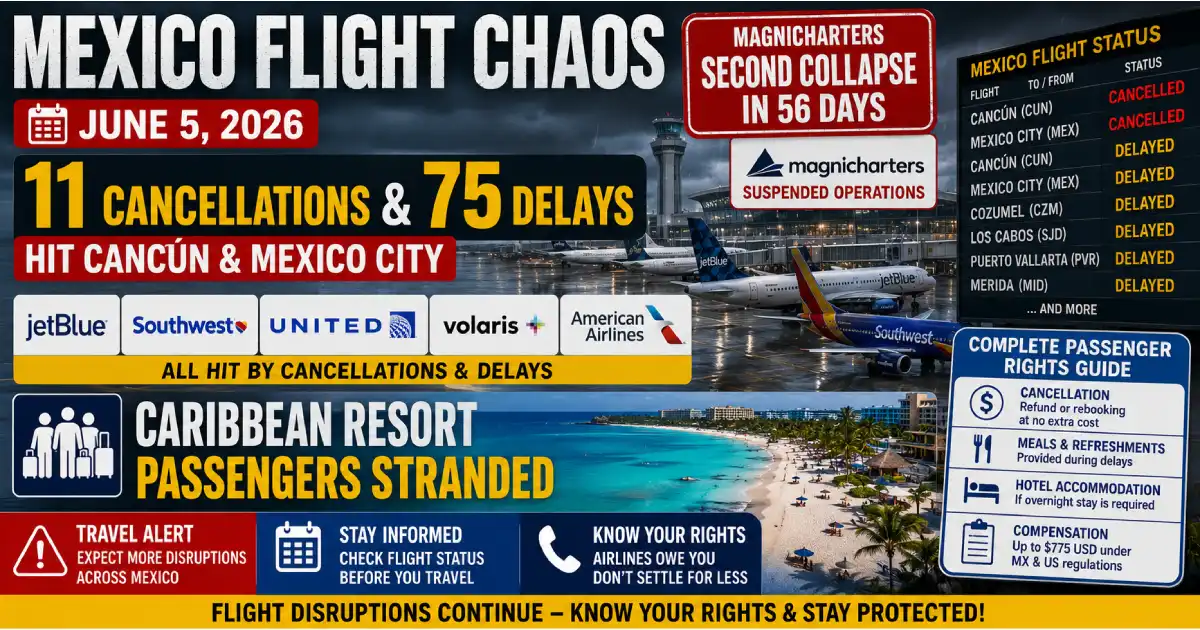
Breaking — June 5, 2026: Mexico’s two busiest aviation gateways — Cancún International Airport (CUN) and Lic. Benito Juárez International Airport (MEX) in Mexico City — have recorded a combined 11 cancellations and 75 delays today, stranding hundreds of leisure travellers at Caribbean resorts and business passengers in Mexico City in what aviation analysts are now describing as a systemic failure of Mexico’s aviation operational resilience. The headline — and the story no competitor is framing correctly — is Magnicharters: the 30-year-old Mexican charter specialist that suspended all flights for two weeks on April 11, citing “logistical problems”, has today recorded a 100% cancellation rate at both CUN and MEX for the second time in 56 days. This is not a teething problem. This is a carrier in structural distress — and today’s Reddit thread from the Cancún departures terminal says everything: “Just got cancelled at CUN. No explanation, massive line at the desk. They’re offering nothing.” Beyond Magnicharters, JetBlue, Southwest, United, Volaris, VivaAerobus, and American Airlines are recording a combined 31 additional delays at CUN and MEX, with gate conflicts, inbound aircraft delays, and crew positioning issues following the pattern of cascading disruption that has defined Mexico’s peak-season aviation picture throughout 2026. Cancún International alone recorded 6 cancellations and 35 delays. Mexico City MEX recorded 5 cancellations and 40 delays. Here is every confirmed number, the full Magnicharters collapse history, every affected airline, every broken route, and every Mexican and international passenger right you hold today.
Published: June 5, 2026 — Friday Airports disrupted: Cancún International (CUN) + Lic. Benito Juárez International (MEX) Total cancellations: 11 (CUN: 6 · MEX: 5) Total delays: 75 (CUN: 35 · MEX: 40) Total disruptions: 86 Magnicharters status: 🔴 100% cancellation rate at both CUN and MEX — complete operational failure This is Magnicharters’: Second operational collapse in 56 days (previous: April 11, 2026) Other carriers disrupted: JetBlue · Southwest Airlines · United Airlines · Volaris · VivaAerobus · American Airlines · Aeromexico Combined non-Magnicharters delays: 31 CUN breakdown: 6 cancellations · 35 delays · Magnicharters dominant in cancellations · VivaAerobus/Volaris/JetBlue/Southwest/United in delays MEX breakdown: 5 cancellations · 40 delays · Magnicharters dominant in cancellations · Aeromexico/United/American in delays Primary audience impact: US tourists at Caribbean all-inclusive resorts · US–Mexico business travellers · UK & European charter passengers Season context: Peak Caribbean resort season — June is second-highest occupancy month · Cancún handles 12M+ tourists annually Mexican passenger rights: PROFECO (consumer protection) · AFAC (aviation regulator) · SICT emergency coordination International passenger rights (US): DOT regulations — full cash refund for cancellations International passenger rights (UK/EU): EU261/UK261 — up to €600/£520 for qualifying disruptions at EU/UK airports Reddit passenger reports: “Just got cancelled at CUN. No explanation, massive line at the desk. They’re offering nothing.” Government response: SICT/AFAC emergency coordination — Aeromexico, VivaAerobus and Volaris activated to rebook passengers (as in April 11 collapse) Magnicharters hotline: Available — passengers directed to rebook via hotline or major carrier desks
On June 5, 2026, Mexico’s aviation system buckled under pressure. Across Cancún International Airport (CUN) and Lic. Benito Juárez International Airport (MEX) in Mexico City, a perfect storm of operational failures left hundreds of travelers stranded, frustrated, and scrambling for alternatives. The numbers tell a grim story: 11 flight cancellations and 75 delays rippled across Mexico’s two busiest airports in a single day. What should have been routine journeys became logistical nightmares for both leisure travelers heading to Caribbean resorts and business professionals missing critical meetings.
Cancún International Airport is not merely a regional hub. It is the primary entry point for millions of tourists heading to Mexico’s Caribbean coast — the gateway to the Riviera Maya, Tulum, Playa del Carmen, Isla Mujeres, and the all-inclusive resort corridor that generates approximately 30% of Mexico’s entire tourism revenue. On a peak-season June Friday, Cancún typically processes tens of thousands of inbound and outbound passengers — families arriving for summer holidays, Americans returning from resort breaks, Europeans on charter packages, and Mexicans travelling domestically to the Yucatán. Today, six of those flights cancelled and 35 more delayed, creating the bottleneck that is currently playing out at CUN’s departure gates.
Mexico City Benito Juárez is a different profile — primarily a business and government travel hub, with heavy domestic connectivity to all Mexican states and significant international traffic to the US, Europe, and Latin America. Today’s 5 cancellations and 40 delays at MEX are hitting a different passenger demographic: business travellers, government officials, families on domestic routes, and international passengers transiting through Mexico City to South American or Caribbean connections.
What the two airports share today: Magnicharters. And understanding Magnicharters is the key to understanding the full picture.
Magnicharters is not a name most international passengers know. It is a 30-year-old Mexican charter airline specialising in tourism routes — the “tourist airline of Mexico,” as it describes itself — connecting Mexican domestic holiday destinations with the major source markets of Mexico City, Monterrey, Guadalajara, and Tijuana. Its routes serve the resort cities: Cancún, Huatulco, Mérida, Los Cabos, Puerto Vallarta. Its passengers are overwhelmingly domestic Mexican holidaymakers on charter packages — the Mexican equivalent of a British Thomson or TUI package flight.
The first Magnicharters catastrophe struck on April 11, 2026 — a Sunday during Holy Week, one of Mexico’s highest-demand domestic travel periods. Magnicharters, Mexico’s leading tourist airline, informed the public that due to logistical problems, flights scheduled for the next two weeks would not be able to operate. The official statement offered minimal detail: “We want to assure our customers that we are addressing this situation with due diligence to resolve it.”
The practical reality was more severe. Hundreds of Magnicharters travelers trying to return home through Cancún found themselves without a flight. No Magnicharters staff showed up to assist stranded passengers. The Governor of Quintana Roo, Mara Lezama, personally attended Cancún International Airport on Sunday afternoon to coordinate with other airlines to get stranded vacationers home — because Magnicharters’ own employees were not present to help.
Three Magnicharters flights were scheduled to depart Cancún that Sunday. None left. Passengers were redirected to Terminal 2 and told to seek reassignment from other airlines.
The Mexican Secretariat of Infrastructure, Communications and Transport (SICT), acting through the Federal Aviation Agency (AFAC), swiftly activated an emergency assistance plan, coordinating with Aeromexico, VivaAerobus, and Volaris to rebook passengers and providing a special evacuation flight from Cancún. Cancún, Huatulco, and Mérida bore the brunt — over 200 passengers immediately affected, with tourism revenue losses estimated in the millions across the Riviera Maya corridor.
The shutdown impacted tourism severely by stranding domestic and international visitors during Holy Week holidays, delaying returns and inflating costs for hotels, taxis, and alternative tickets.
Industry observers and Mexican aviation analysts have identified the likely causes of Magnicharters’ repeated collapses, which fit the profile of a structurally distressed small carrier operating at the margins of Mexican aviation regulation:
Fleet availability crisis: Magnicharters operates a small fleet — approximately 6–8 aircraft — giving it virtually no redundancy when an aircraft requires unscheduled maintenance. A single AOG (Aircraft on Ground) event removes 12–25% of operational capacity immediately. Multiple concurrent AOG events produce the kind of complete schedule collapse seen on April 11 and again today.
Crew scheduling fragility: Small carriers with limited crew pools have no reserve capacity to cover sick calls, duty-hour exhaustion, or the scheduling disruptions that follow any operational delay. When Magnicharters’ operations began fragmenting in early April, the crew scheduling system — already running with minimal slack — could not absorb the compounding failures.
Financial stress: Larger airlines such as Aeromexico, VivaAerobus, and Volaris dominate Mexican aviation, but smaller airlines like Magnicharters exist to serve more specialised tourist markets. The Mexico beach airline crisis 2026 points to the need for stronger consumer mandates in Mexican aviation oversight. The collapse of operations without prior notice, twice in 56 days, suggests a carrier that is unable to maintain the operational prerequisites — maintenance contracts, fuel payments, crew agreements — for reliable schedule performance.
Regulatory gap: Mexico’s aviation consumer protection framework is less robust than the US DOT or EU261 system. The AFAC can coordinate emergency rebooking assistance, but there is no mandatory cash compensation framework equivalent to EU261 for domestic Mexican air travel disruptions. Passengers are protected by general consumer protection law (PROFECO) but lack the specific, actionable compensation rights that US and European passengers hold.
Today’s Magnicharters 100% cancellation rate at both CUN and MEX is structurally identical to the April 11 event. The most shocking development came from Magnicharters, which reported a catastrophic 100% cancellation rate on select flights at both airports. This wasn’t a minor hiccup — it was a complete operational failure for the carrier. Industry observers are questioning whether scheduling conflicts or fleet availability triggered this unprecedented shutdown.
The airline’s meltdown raises serious questions about operational resilience and passenger protection standards across Mexican aviation hubs. The fact that Magnicharters has now recorded two complete operational collapses in 56 days — both at peak travel periods, both without adequate prior notice, both requiring government emergency coordination — suggests the April 11 “logistical problems” were not resolved. They were deferred.
Cancún is the most commercially significant of today’s two disrupted airports for TravelTourister’s US and UK audience. It is the primary gateway for American and British tourists on Caribbean holidays — the #1 international destination for Americans on beach resort packages in 2026, and a top-5 destination for UK charter passengers.
Today, Cancún explicitly recorded 6 complete cancellations and 35 severe delays. The absolute brunt of this disaster fell upon Magnicharters, which suffered a 100% cancellation rate on all its scheduled flights at the airport, completely stranding domestic holidaymakers.
Beyond Magnicharters: vital low-cost and legacy carriers including VivaAerobus, Volaris, JetBlue, Southwest, United, and American Airlines reported a combined 31 delays, physically preventing inbound aircraft from securing gates and trapping thousands inside the terminal. This is particularly damaging during peak season when resort occupancy rates are at or near 100% — passengers who cannot check out because their flight is cancelled are adding unexpected room nights at their own expense in one of the most expensive hotel markets in Mexico.
This is particularly damaging during peak season when resort occupancy rates are at their highest. A cancelled return flight from Cancún is not a minor inconvenience — it is an unexpected night (or two) in a resort hotel at rack rates, unplanned childcare, missed work commitments, and the specific frustration of being stranded in a destination that is simultaneously beautiful and operationally impossible to leave on the day you planned to leave.
JetBlue at Cancún: JetBlue operates multiple daily services between Cancún and its northeastern US hubs — New York JFK, Boston Logan, and Fort Lauderdale primarily. JetBlue’s Cancún operation is its largest Latin American destination and carries heavy leisure traffic from the Northeast US corridor. Today’s JetBlue delays at CUN are affecting passengers on the last day of half-term and extended Memorial Day holidays — a demographic with rigid return-date commitments.
Southwest Airlines at Cancún: Southwest launched Cancún services in 2025 and has rapidly grown its Caribbean presence. Southwest’s Cancún services connect primarily to Dallas Love Field, Houston Hobby, Baltimore, and Chicago Midway — all major Southwest hubs. Southwest’s zero-interline policy applies here as everywhere: if Southwest cannot rebook you on an alternative Southwest service, the only other option is a full cash refund.
United Airlines at Cancún: United’s Cancún operation connects to Houston Intercontinental (IAH), Chicago O’Hare (ORD), Newark (EWR), and Washington Dulles (IAD). United is today simultaneously managing its own national disruptions — Day 66 of the US aviation crisis — and dealing with a Cancún delay that may cascade back into the US network as aircraft arrive late at Houston and Chicago.
American Airlines at Cancún: American’s Cancún services connect primarily to Dallas–Fort Worth (DFW), Miami (MIA), and Charlotte (CLT). With DFW still in post-tornado recovery mode (May 26 was DFW’s worst post-tornado day with 477 disruptions), American is operating Cancún services in a network that has no spare capacity anywhere. A Cancún delay feeding back into DFW or MIA today compounds already-elevated disruption at those hubs.
VivaAerobus and Volaris at Cancún: Mexico’s two major low-cost carriers are also recording delays. Both are absorbing displaced Magnicharters passengers — at government direction, as in the April 11 emergency — while simultaneously running their own disrupted schedules. VivaAerobus cancelled 4 flights and delayed 12 services during the similar May 22 event at Cancún, establishing the pattern being repeated today.
The same chaos unfolded at Mexico City’s MEX terminal. Mexico City’s Benito Juárez airport recorded 5 cancellations and 40 delays, with Magnicharters again recording the dominant share of cancellations.
MEX is a different passenger profile from Cancún. Its disrupted passengers today include:
Business travellers on US–Mexico City routes: United, American, and Aeromexico all operate high-frequency MEX services for the US–Mexico business corridor. A delayed departure from MEX on a Friday — when US executives are trying to return home for the weekend — produces the specific frustration of a missed weekend flight with no Monday replacement acceptable.
Domestic Mexican travellers: MEX serves as the primary hub for domestic Mexican routes — connecting the capital to Monterrey, Guadalajara, Tijuana, Mérida, and dozens of secondary cities. Magnicharters’ MEX cancellations are stranding domestic passengers who have no international passenger rights framework to fall back on.
Aeromexico network passengers: Aeromexico operates MEX as its primary hub, connecting Mexican domestic routes to its transatlantic and transpacific network. Today’s MEX delays are affecting Aeromexico’s connecting passengers to European and US destinations.
A critically important piece of information for American passengers stranded in Mexico today: US DOT passenger rights apply to US carriers operating from Mexico to the United States. JetBlue, Southwest, United, and American are all subject to DOT regulations for their CUN and MEX services to the US.
If JetBlue, Southwest, United, or American cancels your CUN or MEX flight today, you are entitled to a full cash refund of your unused ticket within 7 business days under the DOT’s May 2024 refund rule. This applies regardless of whether you are in Mexico or in the US. The airline cannot force you to accept a voucher or a future credit instead of cash.
How to claim on a US carrier from Mexico: ✅ JetBlue: jetblue.com → Manage Trips | 1-800-538-2583 — or the JetBlue app from your phone ✅ Southwest: southwest.com → Manage Reservations | 1-800-435-9792 ✅ United: united.com → My Trips | 1-800-864-8331 ✅ American Airlines: aa.com → My Trips | 1-800-433-7300
US carriers must rebook you to your final US destination — not just back to the US. If United cancels your CUN–Houston flight and you are connecting to a domestic US city, United must rebook the entire journey.
When a US carrier’s delay of 3+ hours is caused by operational factors within the airline’s control (not Magnicharters’ collapse — that is an extraordinary circumstance for US carriers), DOT Customer Service Dashboard commitments require meal vouchers. The VivaAerobus, Volaris, and Magnicharters-caused gate conflicts at CUN are an external cause; however, any delay where the US carrier’s own operation (late inbound aircraft, crew positioning) contributed is within airline control.
For US carrier cancellations where the airline-operational component is primary, the DOT Customer Service Dashboard commitments require hotel accommodation and ground transport for overnight stays. Mexico City and Cancún hotels at peak season are expensive — document all receipts.
All fees paid for checked bags, seat upgrades, or priority boarding on any cancelled flight must be refunded in full.
DOT complaint filing: airconsumer.dot.gov — file if any US carrier fails to honour rights at CUN or MEX today.
Magnicharters is a Mexican carrier operating under Mexican aviation law. Unlike US or European passengers, Magnicharters passengers do not have access to the EU261 compensation framework or the DOT’s specific refund rules. However, Mexican law provides the following:
PROFECO is Mexico’s federal consumer protection agency. Passengers stranded by Magnicharters cancellations can file a complaint with PROFECO at profeco.gob.mx. PROFECO can compel Magnicharters to provide:
The AFAC — Mexico’s civil aviation regulator — has the authority to intervene when a carrier repeatedly fails to meet its operational obligations. The April 11 collapse produced AFAC emergency coordination with Aeromexico, VivaAerobus, and Volaris to rebook passengers. The same emergency coordination is expected today — passengers should actively seek out the Aeromexico, VivaAerobus, and Volaris desks for rebooking assistance.
Under Mexican consumer law, Magnicharters is required to offer either:
Magnicharters contact: The airline’s passenger hotline — contact details are available at the Magnicharters desk at CUN Terminal 2 or MEX. Passengers are directed to the hotline for rebooking. Governor Lezama’s intervention at CUN in April suggests Quintana Roo state authorities may again be present at the airport to assist.
If you booked a package holiday that includes a Magnicharters flight — whether through a Mexican tour operator, a UK travel agent, or an online platform — your rights depend on how the package was sold:
Package booked through a UK ATOL-protected tour operator: The tour operator is responsible for getting you home, regardless of which carrier cancels. Contact your UK tour operator immediately. ATOL protection covers financial failure of the operator and practical assistance when flights fail.
Package booked through a US travel agent or OTA: Contact the OTA (Expedia, Booking.com, etc.) immediately. Under US consumer protection principles, if the product you purchased (a flight) has not been provided, you are entitled to a refund of that component.
Package booked directly from Mexico: Your contract is with the Mexican tour operator. File via PROFECO if the operator fails to assist.
Cancún is not just Mexico’s most popular tourist destination. It is the United States’ most popular international beach resort destination — receiving more American tourists than any Caribbean or Latin American country except Mexico as a whole. In 2025, approximately 8 million Americans visited Cancún and the Riviera Maya. In peak summer 2026, daily passenger throughput at CUN runs into the tens of thousands.
For the US market, a Cancún disruption carries specific emotional and financial weight that exceeds comparable disruptions at, say, European business hubs. Cancún passengers are:
For the UK market, Cancún is one of the top 10 long-haul holiday destinations. UK charter operators including TUI and Jet2 run Cancún services from Manchester, Birmingham, and London Gatwick. While today’s disruption primarily affects US-operated services (JetBlue, Southwest, United, American) and Mexican carriers (Magnicharters, Volaris, VivaAerobus), UK passengers on connecting itineraries through US hubs or on charter services that route through Cancún are also exposed.
Today’s June 5 collapse is Magnicharters’ third operational disruption event in 2026 — and the second complete operational failure. The pattern is now unmistakable:
| Date | Event | Airports | Passengers Affected |
|---|---|---|---|
| April 11, 2026 | Complete 2-week suspension | CUN · HUX · MID | 200+ immediately · thousands over 2 weeks |
| May 21–22, 2026 | 100% cancellation rate at CUN | CUN | Domestic passengers — peak weekend |
| June 5, 2026 | 100% cancellation rate at CUN + MEX | CUN · MEX | Hundreds — peak summer season |
The escalating frequency and geographic scope — April was primarily CUN and beach resorts; June 5 is simultaneously CUN and MEX — suggests that Magnicharters’ operational fragility is systemic rather than situational. A carrier that cannot maintain reliable operations at its two most important airports in consecutive months, during Mexico’s two highest-demand travel periods (Holy Week, summer), is a carrier whose operational foundation is structurally compromised.
For any passenger with a future Magnicharters booking: this pattern is a clear signal to contact your tour operator or booking platform today and request rebooking to an alternative carrier before your travel date. Do not wait for the next collapse to act.
The Mexico beach airline crisis 2026 has become a cautionary signal for travellers who rely on smaller niche carriers for holiday flights to coastal resorts.
Today’s Cancún and Mexico City disruptions are not happening in a vacuum. They are part of a broader pattern of Mexican aviation stress that has been building through 2026:
Structural context: Mexico’s aviation market is dominated by Aeromexico, VivaAerobus, and Volaris — three carriers that together account for the overwhelming majority of domestic capacity. Below them sits a tier of smaller carriers — Magnicharters, Interjet (which failed in 2020–2021), Novair, and others — that operate with minimal regulatory oversight and financial buffers. When demand spikes in peak season and operational margins tighten, this tier is the first to fail.
Regulatory gap: Mexico lacks an EU261-equivalent mandatory compensation framework. AFAC can coordinate emergency assistance, but there is no automatic €250–€600 payment that activates when a Mexican carrier cancels a domestic flight. This leaves domestic Magnicharters passengers in a significantly weaker position than US-carrier passengers at the same airport on the same day.
Peak season timing: June is the beginning of Mexico’s peak summer tourism season. The Caribbean resort corridor enters its highest-occupancy months — June, July, August — with hotels, tour operators, and airlines all running at or near maximum capacity. A carrier failure in this environment has cascading consequences throughout the supply chain. Every hotel room occupied by a stranded passenger is a hotel room unavailable for an arriving guest. Every gate blocked by a Magnicharters aircraft waiting for crew is a gate that another carrier’s on-time departure cannot use.
Posted By : Vinay
This article is provided for general informational purposes only and is based on information available at the time of publication. Travel advisories, airline schedules, airport operations, visa requirements, government regulations, and other travel-related information are subject to change without prior notice. While Travel Tourister makes reasonable efforts to verify information using official announcements, government publications, airline and airport communications, and other reliable sources, we cannot guarantee that all information remains complete, accurate, or up to date at all times. Readers should independently verify any information that may affect their travel plans with the relevant airline, airport authority, government agency, embassy, or other official source before making travel, financial, or other decisions. Travel Tourister shall not be liable for any direct or indirect loss, inconvenience, or damages arising from the use of or reliance on the information contained in this article. Nothing in this publication constitutes legal, immigration, financial, or professional travel advice. If you believe any information in this article is inaccurate or outdated, please contact our editorial team. We review all credible correction requests promptly and update our content whenever appropriate.
Lastest News
2nd Floor, 39, Above Kirti Club, DLF Industrial Area, Kirti Nagar, New Delhi, Delhi 110015



Travel Tourister is a leading Travel portal where we introduce travellers to trusted travel agents to make their journey hasselfree, memorable And happy. Travel Tourister is a platform where travellers get Tour packages ,Hotel packages deals through trusted travel companies And hoteliers who are working with us across the world. We always try to find new and more travel agents and hoteliers from every nook and corners across the world so that you could compare the deals with different travel agents and hoteliers and book your tour or hotel with the one you have chosen according to your taste and budget.
Copyright © Travel Tourister, India. All Rights Reserved

 Call
Call Enquiry