Published on : 11 Jun 2026
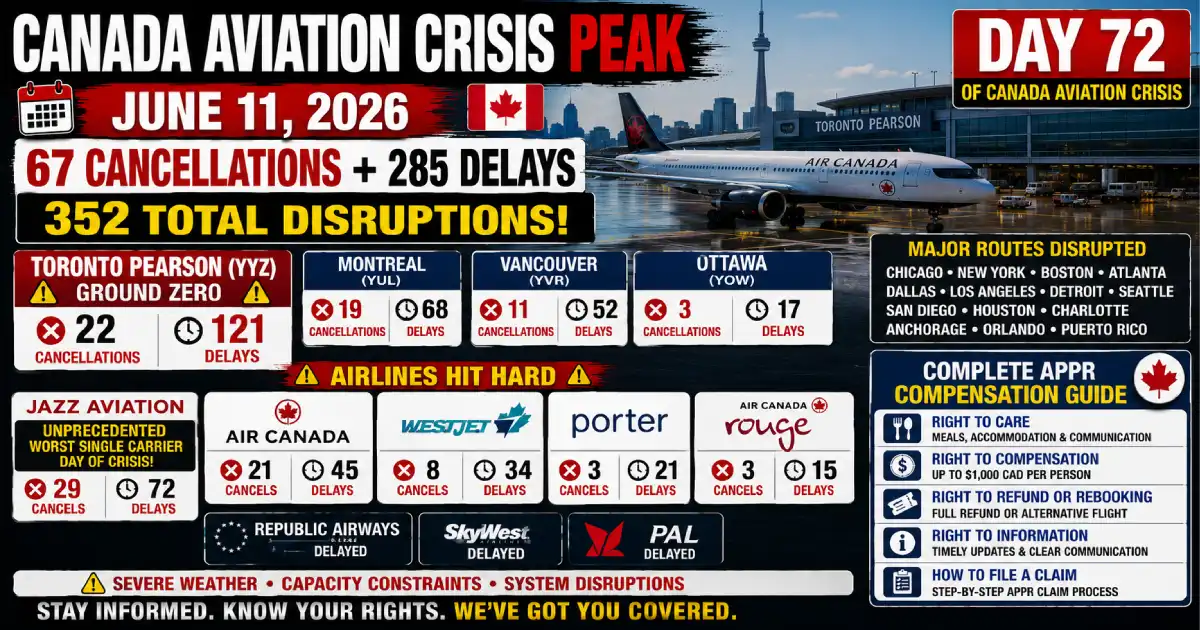
Day 72. The numbers that define Canada’s aviation crisis have been getting steadily worse all week — 59 cancellations on June 7, 79 cancellations on June 10, and now, on June 11, a total that marks the worst single-carrier performance in the entire 72-day crisis: Jazz Aviation has cancelled 29 flights in a single day. Twenty-nine. A regional carrier that serves 50-to-75-seat aircraft on connections that smaller Canadian cities depend on as their sole link to the national network has grounded more than a quarter of its daily schedule.
Thousands of passengers were left grounded across Canada on June 11, 2026, with Toronto Pearson, Montreal-Trudeau, Ottawa, Vancouver, Toronto City Centre, and Winnipeg recording 285 delays and 67 cancellations — 352 flights disrupted in total. Toronto Pearson International saw the highest disruption levels with 121 delays and 22 cancellations. Montreal-Trudeau recorded 66 delays and 19 cancellations. Ottawa Macdonald-Cartier reported 29 delays and 3 cancellations. Vancouver International recorded 29 delays and 11 cancellations. Toronto City Centre recorded 26 delays and 6 cancellations. Winnipeg International reported 14 delays and 6 cancellations.
Among airlines, Jazz recorded 72 delays and 29 cancellations, and Air Canada suffered 45 delays and 21 cancellations — the two carriers accounting for the vast majority of today’s disruption. Porter Airlines recorded 26 delays, Air Canada Rouge 14 delays and 4 cancellations, Republic 14 delays, and SkyWest 7 delays and 3 cancellations. Other disrupted carriers included PAL Airlines, Endeavor Air, Pacific Coastal Airlines, Calm Air, and Air Inuit.
Jazz’s 29 cancellations today is not just a number. It is the structural expression of what happens when a regional carrier operating a tight, crew-dependent schedule runs 72 consecutive days of disruption without a single full recovery period. The positioning debt that has accumulated since April 1 has now reached the point where Jazz cannot fill its rostered service on a standard Thursday in June. That is the crisis in its most concrete form.
Published: June 11, 2026 — Thursday (Day 72 · Canada Aviation Crisis · Summer Peak Week 2) Canada national total: 67 cancellations + 285 delays = 352 disruptions Toronto Pearson (YYZ): 22 cancellations + 121 delays = 143 disruptions — worst Canadian airport Montreal-Trudeau (YUL): 19 cancellations + 66 delays = 85 disruptions Vancouver International (YVR): 11 cancellations + 29 delays = 40 disruptions Toronto City Centre (YTZ — Billy Bishop): 6 cancellations + 26 delays = 32 disruptions Ottawa Macdonald-Cartier (YOW): 3 cancellations + 29 delays = 32 disruptions Winnipeg James Armstrong Richardson (YWG): 6 cancellations + 14 delays = 20 disruptions Jazz Aviation (Air Canada Express): 29 cancellations + 72 delays = 101 disruptions — unprecedented worst carrier day of entire 72-day crisis Air Canada mainline: 21 cancellations + 45 delays = 66 disruptions Porter Airlines: 26 delays Air Canada Rouge: 4 cancellations + 14 delays Republic Airways: 14 delays SkyWest Airlines: 3 cancellations + 7 delays Also disrupted: PAL Airlines · Endeavor Air · Pacific Coastal Airlines · Calm Air · Air Inuit Crisis trajectory: June 7: 64 cancels · June 8: 133 cancels · June 9: 69 cancels · June 10: 79 cancels · June 11: 67 cancels APPR compensation: ✅ Up to CAD $1,000 large carrier controllable delays 9+ hours Full refund: ✅ Unconditional within 30 days all cancellations APPR filing: otc-cta.gc.ca | AirHelp: airhelp.com/en-ca
The Canada aviation crisis began on April 1, 2026. Today is June 11. That is 72 consecutive days — ten weeks and two days — without a single clean national recovery. To put that in perspective: no previous sustained aviation disruption in Canadian history has run this long without the system returning to baseline operations for at least a week of normal performance.
The Day 72 numbers sit within a week that has been the worst of the entire crisis:
| Date | National cancellations | National delays | Worst airport |
|---|---|---|---|
| Day 68 — June 7 | 64 | 400 | Toronto Pearson 17 cancels |
| Day 69 — June 8 | 133 | 400+ | Montreal, Edmonton, Vancouver |
| Day 70 — June 9 | 69 | 142 | Montreal 13 cancels |
| Day 71 — June 10 | 79 | 299 | Toronto 25 cancels |
| Day 72 — June 11 | 67 | 285 | Toronto 22 cancels · Jazz 29 cancels |
Five consecutive days of elevated crisis, all in the first two weeks of summer peak season. The system was supposed to be recovering by now. Instead it is recording its worst Jazz Aviation single-day cancellation total of the entire crisis.
The cause is structural and compound: 72 days of accumulated positioning debt that has never been cleared, a Jazz crew rostering system that has been running at capacity utilisation rates not designed to absorb this level of sustained disruption, a summer demand peak that adds flight volume on top of an already-stressed network, and — this week — the specific compound pressure of the June 10 Canada disruption (79 cancellations, the worst day of the week) feeding into today’s positioning picture through an overnight recovery window that was insufficient to clear the debt.
Jazz Aviation’s 29 cancellations on Day 72 represent a threshold event in the Canadian crisis. This is not simply a bad day for a regional carrier. It is the evidence that Jazz’s crew and aircraft positioning system has exceeded its recovery capacity at a fundamental level.
Jazz operates as Air Canada Express under a capacity purchase agreement with Air Canada. It flies Bombardier Q400 turboprop and CRJ regional jet aircraft on 50-to-75-seat routes connecting smaller Canadian cities to Air Canada’s mainline hubs. Its crew model is built around the assumption that disruptions will be isolated events — a weather system here, a mechanical issue there — that the system can absorb through overtime and voluntary re-rostering without structural breakdown.
Jazz recorded 29 cancellations and 72 delays today — with Jazz and Air Canada together bearing the absolute brunt of the nationwide schedule destruction. Jazz’s operational collapse meant domestic passengers faced the worst disruptions of the crisis.
What 72 days of continuous elevated disruption has done to Jazz’s crew positioning: every crew member who has worked overtime to cover a Day 61 disruption has used a recovery day that was supposed to protect a Day 72 scheduled service. Every aircraft that was repositioned to cover a Day 68 cancellation is now in the wrong place for its Day 72 rotation. The 29 cancellations today are the accumulated debt of those 72 days of decisions — individually rational, cumulatively catastrophic.
The regional communities most affected by Jazz’s 29 cancellations today:
Jazz serves over 50 Canadian communities — many of them cities of 10,000 to 50,000 people where the twice-daily Jazz turboprop connection to Toronto Pearson or Montreal-Trudeau is the community’s only year-round air link to the national network. When Jazz cancels 29 flights on a single day, the communities affected include:
Toronto Pearson International became the epicentre of today’s travel chaos, suffering 121 delays and 22 cancellations.
Toronto Pearson’s 143-disruption Day 72 is its third consecutive disruption day above 100 total disruptions — Days 70 (June 9), 71 (June 10), and 72 (June 11) have all produced a combined 370+ Pearson disruptions in three days. The airport has not had a sub-50 disruption day since before June 6.
Pearson’s 22 cancellations today span all three operational layers of the hub:
Jazz feeder cancellations: The largest portion of Pearson’s 22 cancellations today are Jazz Express services to and from smaller Ontario, Atlantic, and Quebec communities — the same regional feeder chain that was severed on Day 65, 66, 67, and now Day 72.
Air Canada mainline cancellations: Air Canada’s 21 cancellations nationally are concentrated at its two primary hubs — Pearson and Montreal. Pearson’s share includes both domestic trunk cancellations (Toronto–Vancouver, Toronto–Calgary) and transborder US cancellations (Toronto–Chicago, Toronto–New York, Toronto–San Francisco).
International disruptions: The 121 Pearson delays include disrupted services on Air Canada’s transatlantic (London, Frankfurt, Paris) and transpacific (Tokyo, Seoul, Sydney) networks — late arriving international services that cannot turn around on schedule for their outbound departures.
Montreal-Trudeau’s 85-disruption Day 72 continues the pattern from Day 66 (June 5) when Montreal was designated ground zero with 9 cancellations and 92 delays. Today’s 19 cancellations at YUL are the highest of any Canadian airport for cancellations, just ahead of Pearson’s 22 when weighted by the airport’s total daily flight volume.
Montreal’s 19 cancellations today particularly affect:
Transatlantic departures: Air Canada’s morning Paris CDG, London Heathrow, and Casablanca departures from Trudeau depend on aircraft arriving overnight from European hubs. Those overnight arrivals are themselves running late due to the European aviation crisis — the SNCF strike aftermath, the June 9 2,002-delay European collapse, and the Amsterdam Schiphol 275-disruption day on June 10 are all feeding into Air Canada’s Montreal transatlantic positioning picture.
Jazz Quebec regional network: Montreal is Jazz’s primary Quebec hub. Its 19 Trudeau cancellations include routes to Quebec City, Saguenay, Sept-Îles, Baie-Comeau, Gaspé, Bonaventure, and other Quebec regional communities. When Jazz cancels at Montreal, Quebec loses its feeder network.
Vancouver International recorded 11 cancellations and 29 delays today.
Vancouver’s 40-disruption Day 72 includes Air Canada’s transpacific network pressure — the carrier’s Tokyo, Seoul, Sydney, and Shanghai departures from YVR are all running late on an 11-cancellation day. Pacific Coastal Airlines, which serves British Columbia’s coastal and island communities, is confirmed disrupted — cutting off remote BC communities including Campbell River, Comox, and Bella Bella from their Vancouver connections.
Billy Bishop Toronto City Airport’s 32-disruption Day 72 is particularly notable because YTZ is supposed to be the disruption relief valve for Toronto Pearson passengers — the airport where Porter Airlines’ independent operation provides an alternative when Pearson is congested.
Toronto City Centre recorded 26 delays and 6 cancellations today.
With YTZ itself recording 6 cancellations and 26 delays today, the relief valve is broken. Pearson passengers who would normally rebook onto Porter’s Toronto–Ottawa, Toronto–Montreal, Toronto–Halifax, or Toronto–New York routes are finding that Porter’s Billy Bishop operation is itself disrupted.
Ottawa’s 32-disruption Day 72 affects Canada’s capital city — the hub through which government officials, lobbyists, legal professionals, and public servants route their Toronto–Ottawa–Montreal corridor travel. Jazz’s feeder cancellations at Ottawa today sever the direct Air Canada Express connections to Toronto and Montreal that the Ottawa professional community depends on for same-day return travel.
The chaos at Winnipeg stems from a lethal combination of severe weather — heavy storms and catastrophic flooding across Manitoba — colliding with logistical gridlock at major airport terminals.
Winnipeg’s 20-disruption Day 72 is partly weather-driven — Manitoba is experiencing a severe flooding event this week that has separately grounded some services. However, the positioning debt carried into Winnipeg from the national Day 71 crisis means the weather-caused disruptions are being amplified by an airline system with no spare capacity to absorb them.
Jazz’s Day 72 performance represents the worst single-carrier day of the entire 72-day Canadian crisis by cancellation count. The carrier has now recorded four consecutive days of 20+ cancellations — Days 69, 70, 71, and now 72.
The compound risk: Canada’s Air Passenger Protection Regulations classify Jazz cancellations differently depending on whether the booking was made as part of a through-itinerary with Air Canada or as a standalone Jazz ticket:
Single Air Canada itinerary (one booking reference): Air Canada is fully responsible for rerouting you to your final destination when Jazz cancels. This includes rebooking on the next available Jazz service, on Air Canada mainline where capacity exists, or on a competing carrier (WestJet, Porter) if Air Canada’s own next available service is more than 9 hours away. APPR large-carrier compensation scale applies — up to CAD $1,000.
Standalone Jazz ticket (separate booking): Jazz bears responsibility for its own leg only. Jazz is classified as a large carrier under APPR (it operates more than 60 aircraft). Full APPR compensation scale applies: up to CAD $1,000 for controllable cancellations on large carriers.
Call before going to the airport. Jazz’s gate desks during a 29-cancellation day are processing hundreds of affected passengers simultaneously — the phone queue is significantly shorter than the terminal queue.
Contact: aircanada.com → My Bookings | Air Canada/Jazz: 1-888-247-2262
Air Canada’s 21 mainline cancellations today represent the carrier’s worst single-day cancellation performance of the current week. These are not regional feeder failures — these are mainline cancellations on Air Canada’s full-size Airbus and Boeing aircraft on trunk domestic, transborder US, and transatlantic services.
The transatlantic element is the most commercially sensitive: Air Canada and Jazz together bore the absolute brunt of today’s nationwide schedule destruction, with Air Canada’s mainline cancellations affecting connections that cannot be simply rebooked onto the next available domestic service — a cancelled Toronto–London or Montreal–Paris involves a 24-hour minimum rebooking window, not a 4-hour wait.
APPR for Air Canada passengers: Full large-carrier APPR scale applies.
| Disruption | Delay | APPR compensation |
|---|---|---|
| Controllable cancellation | Any | CAD $1,000 |
| Controllable delay | 3–6 hours | CAD $400 |
| Controllable delay | 6–9 hours | CAD $700 |
| Controllable delay | 9+ hours | CAD $1,000 |
Contact: aircanada.com → My Bookings | 1-888-247-2262
Porter’s 26-delay Day 72 at Billy Bishop is notable because the carrier has generally been one of Canada’s more operationally resilient performers during the crisis — its De Havilland Dash 8 fleet and Billy Bishop hub have insulated it from some of Pearson’s worst congestion events.
Today’s 26 delays at YTZ suggest Porter is absorbing second-order effects from the national crisis — late inbound aircraft from connecting points, crews running behind schedule from yesterday’s 79-cancellation Day 71.
Contact: flyporter.com → Manage | 1-888-619-8622
Air Canada Rouge’s 4 cancellations today affect its leisure route network — Caribbean, Mexico, and European vacation markets departing from Toronto and Montreal. For passengers on prepaid package holidays whose Air Canada Rouge service has been cancelled today: the APPR unconditional refund right applies, and Air Canada is responsible for rerouting to the final destination (typically a resort or hotel) at no additional cost.
Contact: aircanada.com → My Bookings | 1-888-247-2262
Republic’s 14 delays at Toronto Pearson today reflect its US-carrier cross-border exposure — Republic operates as United Express and American Eagle on the Toronto-to-US transborder routes, and the Day 72 US crisis (3,895 delays and 91 cancellations nationally) is feeding late aircraft north of the border.
SkyWest’s 3 Canadian cancellations today break the US-Canada transborder feeder connections — the routes feeding Canadian passengers south to United’s and American’s US network.
Day 72 disruptions are primarily attributable to accumulated positioning failures — 72 days of compounding operational debt that has never been cleared. Positioning failures are controllable. Airlines schedule their own operations. When those operations break because of internal scheduling, crew management, or aircraft positioning failures that predate any specific weather event — that is controllable.
The Manitoba flooding element at Winnipeg introduces a genuine weather component — but only for disruptions specifically caused by that weather at Winnipeg. A Jazz cancellation at Toronto or Montreal today has no weather excuse.
Large carriers (Air Canada, Jazz, Air Canada Rouge, Porter, WestJet):
| Disruption | Delay | Compensation |
|---|---|---|
| Controllable cancellation | Any | CAD $1,000 |
| 3–6 hour controllable delay | — | CAD $400 |
| 6–9 hour controllable delay | — | CAD $700 |
| 9+ hour controllable delay | — | CAD $1,000 |
Small carriers (PAL Airlines, Pacific Coastal, Calm Air, Air Inuit):
| Disruption | Delay | Compensation |
|---|---|---|
| Controllable cancellation | Any | CAD $500 |
| 3–6 hour controllable delay | — | CAD $125 |
| 6–9 hour controllable delay | — | CAD $250 |
| 9+ hour controllable delay | — | CAD $500 |
Full cash refund within 30 days for any cancelled flight regardless of cause. Airlines cannot substitute a voucher without your explicit consent.
Say: “My flight has been cancelled. I am invoking my APPR right to a full cash refund under Section 17.”
For large carrier controllable disruptions where the airline’s next available service is more than 9 hours away — Air Canada, WestJet, and Porter must offer rebooking on a competing carrier. Ask specifically: “Under APPR Section 19, are you offering rebooking on an alternative carrier?”
Alternative carrier options today:
2+ hour delay: Meal vouchers — CAD $10 after 2 hours, CAD $15 after 4 hours. Request at the Air Canada, Jazz, or Porter service desk. Do not wait to be offered them — ask immediately upon reaching 2 hours.
Overnight cancellation: Hotel accommodation + ground transport + rebooking onto the next available service. If the airline cannot arrange accommodation directly — book independently at a reasonable standard and submit for reimbursement with receipts.
VIA Rail as Montreal–Toronto alternative: If your Jazz or Air Canada Toronto–Montreal or Montreal–Toronto connection is cancelled today, VIA Rail’s corridor service (5.5 hours, multiple departures daily from Montreal Central Station and Toronto Union Station) is a practical same-day alternative. Book at viarail.ca.
Step 1: Ask for the stated cause of your disruption in writing at the gate desk. Photograph the departures board showing your cancelled or delayed flight.
Step 2: File directly with the airline within 30 days:
Step 3: If unresolved within 30 days — escalate to the Canadian Transportation Agency at otc-cta.gc.ca → File a Complaint.
Step 4: Assisted no-win-no-fee claims: AirHelp (airhelp.com/en-ca).
Time limit: 1 year from disruption date to file with the CTA.
At Toronto Pearson: Open the Air Canada app immediately — do not join the terminal desk queue on a 143-disruption day. Air Canada app → My Trips → select your disrupted flight → rebook or request refund. The app queue is 45–60 minutes shorter than the Pearson Terminal 1 or 3 service desk queues during a major disruption event.
If your Jazz feeder was cancelled and you have a mainline connection: Call 1-888-247-2262 immediately. State that your Jazz Air Canada Express flight was cancelled and you need Air Canada to protect your mainline connection under your single itinerary booking. Do not let the cancellation be processed as a standalone Jazz event.
At Montreal-Trudeau: The transatlantic check-in zone (Terminal 1, international departures) is under the highest pressure today. If your Air Canada transatlantic departure is delayed by 2+ hours — go to the Air Canada Maple Leaf Lounge service desk (open to non-members during disruption events) for rebooking assistance ahead of the main terminal desk queue.
At Billy Bishop (YTZ): Porter’s service desk in the ferry terminal is accessible without clearing security. If your Porter service has been cancelled — the desk agents can rebook you onto the next available Porter service or direct you to the Union-Pearson Express (UP Express) for Pearson rebooking options.
Manitoba flooding passengers (Winnipeg): If your Winnipeg disruption was caused by the Manitoba flooding — check weather.gc.ca for Environment Canada’s flooding bulletin. Weather-caused disruptions do not trigger APPR cash compensation but full refund and rebooking rights still apply.
| Airline | Website | Phone |
|---|---|---|
| Air Canada / Jazz | aircanada.com → My Bookings | 1-888-247-2262 |
| Air Canada Rouge | aircanada.com → My Bookings | 1-888-247-2262 |
| Porter Airlines | flyporter.com → Manage | 1-888-619-8622 |
| WestJet | westjet.com → Manage | 1-888-937-8538 |
| PAL Airlines | palairlines.ca | 1-800-563-2800 |
| Air Inuit | airinuit.com | +1 819 964 2222 |
| Pacific Coastal | pacificcoastal.com | 1-800-663-2872 |
| Calm Air | calmair.com | 1-800-839-2256 |
Toronto Pearson live: torontopearson.com → Flight Info Montreal-Trudeau live: admtl.com → Flights Vancouver live: yvr.ca → Flights Ottawa live: yow.ca → Flights Winnipeg live: waa.ca → Flights Billy Bishop live: billybishopairport.com → Flights APPR complaints: otc-cta.gc.ca → File a Complaint AirHelp Canada: airhelp.com/en-ca VIA Rail: viarail.ca → Trains and Stations
Related Articles:
Posted By : Vinay
This article is provided for general informational purposes only and is based on information available at the time of publication. Travel advisories, airline schedules, airport operations, visa requirements, government regulations, and other travel-related information are subject to change without prior notice. While Travel Tourister makes reasonable efforts to verify information using official announcements, government publications, airline and airport communications, and other reliable sources, we cannot guarantee that all information remains complete, accurate, or up to date at all times. Readers should independently verify any information that may affect their travel plans with the relevant airline, airport authority, government agency, embassy, or other official source before making travel, financial, or other decisions. Travel Tourister shall not be liable for any direct or indirect loss, inconvenience, or damages arising from the use of or reliance on the information contained in this article. Nothing in this publication constitutes legal, immigration, financial, or professional travel advice. If you believe any information in this article is inaccurate or outdated, please contact our editorial team. We review all credible correction requests promptly and update our content whenever appropriate.
Lastest News
2nd Floor, 39, Above Kirti Club, DLF Industrial Area, Kirti Nagar, New Delhi, Delhi 110015



Travel Tourister is a leading Travel portal where we introduce travellers to trusted travel agents to make their journey hasselfree, memorable And happy. Travel Tourister is a platform where travellers get Tour packages ,Hotel packages deals through trusted travel companies And hoteliers who are working with us across the world. We always try to find new and more travel agents and hoteliers from every nook and corners across the world so that you could compare the deals with different travel agents and hoteliers and book your tour or hotel with the one you have chosen according to your taste and budget.
Copyright © Travel Tourister, India. All Rights Reserved

 Call
Call Enquiry