Published on : 07 Jul 2026
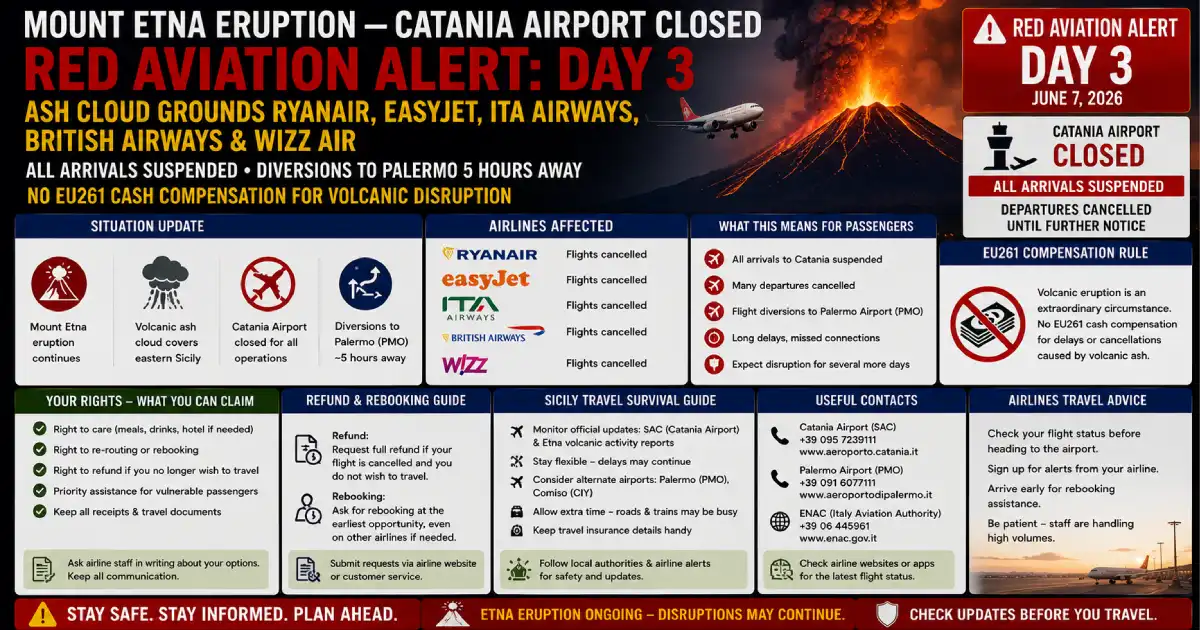
The volcano has been erupting for ten consecutive days. Catania Airport has been closed since Sunday night. And as of this morning, the restrictions remain in place.
Mount Etna — Europe’s tallest and most active volcano, rising to 3,329 metres above the eastern coast of Sicily — entered a phase of intensified eruption overnight on Sunday, July 5, 2026, triggering a red aviation alert that has now grounded flights at Catania-Fontanarossa Airport (CTA) for a third consecutive disruption day. The Voragine crater at the summit of Etna opened a fissure on June 26, which triggered intense ash emissions the next day. Volcanic activity at the site remains ongoing.Mount Etna initiated intense Strombolian activity and ash emissions at approximately 7:45 am on Sunday.
The operator said all incoming flights had been halted and no departures were permitted. The restrictions are expected to remain in place until 10 am (0800 GMT) on Tuesday That is this morning, July 7 — making today the critical status day for tens of thousands of passengers who have been stranded, diverted, or have upcoming Sicily bookings and need to know whether Catania is reopening.
Nearby communities surrounding Etna reported volcanic ash falling over residential areas as the eruption continued. The ash cloud has been tracked drifting south and south-southeast from the summit craters, directly across the approach paths used by aircraft arriving at Catania from the UK, northern Europe, and the Mediterranean. Italy’s national airline, ITA Airways, has confirmed that all departing and arriving flights at Catania Airport will either be cancelled, rescheduled, or rerouted. Ryanair, easyJet, British Airways, and Wizz Air have all cancelled or diverted dozens of services.
If you have a Sicily flight this week — or if you were already there when this began — this is your complete guide to what is happening, what Catania’s reopening status means for you, where your diverted flight actually landed, how to get from Palermo to Catania, and exactly what the law says you are owed when a volcano grounds your plane.
Published: July 7, 2026 — Tuesday (Day 3 of Catania Airport Closure · Mount Etna Eruption Day 10+) Volcano: Mount Etna — Voragine crater — Strombolian activity + dense ash emissions Eruption started (current episode): June 26, 2026 (fissure opening) — Intensified July 5 overnight Aviation alert level: 🔴 RED — VONA (Volcano Observatory Notice for Aviation) — highest level Ground alert level: 🟡 YELLOW — no civilian evacuations ordered — ground communities not in danger Catania Airport (CTA) status: Closed — all arrivals suspended, all departures blocked Potential partial reopening: 10:00 am local time (08:00 GMT) July 7 — conditional on ash clearance Runway status: Ash and volcanic sand covering runways — active clearing operations ongoing by SAC Ash cloud height: 4,500 metres above summit craters — drifting south/south-southeast Airport authority: SAC (Società Aeroporto Catania) Diversion airport: Palermo Airport (PMO) — 33 additional flights landed there on July 5 alone — approximately 5 hours by bus from Catania Secondary diversion: Comiso Airport (CIY) — smaller regional airport in southwestern Sicily Airlines cancelled: Ryanair · easyJet · ITA Airways · British Airways · Wizz Air · Vueling · Blue Air + regional operators Traffic cap (partial ops if reopened): 5 aircraft movements per hour — down from typical peak throughput EU261/UK261 cash compensation: ❌ NOT payable — volcanic eruption = extraordinary circumstances Refund right: ✅ Unconditional — full cash refund for all cancellations Rebooking right: ✅ Next available flight at no charge Duty of care: ✅ Meals + hotel for overnight stranded passengers — unconditional Bus transfers: Airlines arranging coach connections from Palermo to Catania — 5-hour journey INGV monitoring: ingv.it → Etna Observatory → Live activity updates
Mount Etna is not a dormant volcano that surprised everyone. Etna, located on the island of Sicily, is the highest active volcano in continental Europe. It erupts multiple times a year in smaller episodes, and has a well-established history of disrupting Catania Airport during its larger events. Eruptions in 2024 forced the airport to close on separate occasions in July and August, while a June 2025 eruption triggered a red aviation alert after an ash column rose several kilometres into the atmosphere.
The current episode began with a fissure opening at the Voragine crater on June 26. The Italian National Institute of Geophysics and Volcanology (INGV), through its Etna Observatory, said the volcano is exhibiting “Stromboli activity,” a type of moderate, intermittent and rhythmic volcanic eruption typical of the mountain. Strombolian activity — named after the nearby island of Stromboli — involves rhythmic explosions of gas-rich lava from a single vent, producing ash columns, lava bombs, and ash fall in surrounding areas without the catastrophic flows associated with more explosive eruption types.
The critical distinction for aviation: the physical danger to communities on the ground and the danger to aircraft in the sky are classified separately by Italian authorities. Italy’s Civil Protection Department has explicitly maintained a general Yellow Alert for local population centers, even as the aviation alert remains strictly at Red Alert due to intense airborne ash. The twin alert system separates the physical danger on the ground from the risks in the sky.
Why volcanic ash is uniquely dangerous to aircraft: Volcanic ash is not like ordinary particulate smoke. It consists of tiny, jagged glass and rock fragments. When these particles enter a jet engine — even in relatively small concentrations — they can melt onto turbine blades, fuse into glass-like deposits, and cause engine flameout or severe damage. Unlike weather-related turbulence or lightning, there is no way to fly through volcanic ash safely with a commercial airliner. Aviation safety authorities respond by closing airspace until ash concentrations fall below measurable levels and winds shift the plume away from approach corridors.
Prevailing winds are pushing the dense ash cloud toward the southern and south-southeast sectors of the island, keeping the aviation hazard active. Catania Airport sits on the eastern coast of Sicily, directly south of Etna’s summit. Ash drifting south from the Voragine crater moves directly over the airport’s approach paths — the instrument landing system corridors that aircraft use to descend safely from altitude to runway. Until the wind shifts or activity reduces ash concentrations below safe thresholds, these approach paths cannot be used.
SAC has restricted traffic to just five flights per hour until 9:00 PM local time, airlines are diverting regional and international traffic to avoid severe airborne holding patterns.
The restrictions are expected to remain in place until 10 am (0800 GMT) on Tuesday.This is today. However, the word “expected” is doing significant work in that sentence — airport reopening after volcanic activity is conditional entirely on what the volcano does overnight and whether wind shifts have moved the ash plume clear of approach corridors by morning. SAC’s statement makes the 10am figure a target, not a guarantee.
If Catania reopens partially this morning, the initial operation is likely to be heavily constrained. Airport management has restricted traffic to just five flights per hour. In normal peak summer operations, Catania processes many times that volume. A five-per-hour cap means airlines will have to queue departures and arrivals — some services scheduled in the morning will slip into afternoon even if the airport formally reopens on time.
What to do today if you are flying to or from Catania: Passengers are kindly requested not to travel to the airport unless they have first checked the status of their flight with their airline. This instruction — issued by SAC itself and repeated by every carrier currently operating to Sicily — is the most important piece of advice in this article. Do not go to Catania Airport this morning without confirming, on your airline’s app or website, that your specific flight is operating. The airport’s potential 10am reopening does not mean your specific flight is operating — airlines need runway availability, slots, positioning aircraft, and operational crews before any individual service can restart.
Real-time Catania status: aeroporto.catania.it → Flight Information → Arrivals / Departures
Airport workers have begun the labour-intensive process of sweeping ash from the runways and taxiways. Volcanic ash removal at Catania is not a rapid procedure — it requires specialised sweeping equipment that collects and removes the abrasive material without distributing it further. The ash must be fully cleared from the runway surface and markings before aircraft can safely operate.
Some flights are being diverted to Palermo Airport, with some 33 additional flights landing there on July 5. The airport has shared a list of the two dozen flights set to land there today on its Facebook page. Airlines are arranging transport by bus to take holidaymakers to their original destination.
Incoming flights scheduled to land at Catania-Fontanarossa Airport are being systematically rerouted across Sicily due to the closure of airspace sector B2.
Palermo is approximately 220 kilometres from Catania — a journey that takes approximately 5 hours by road under normal conditions. Airlines including Ryanair and easyJet have been arranging coach transfers for passengers diverted to Palermo, transporting them to Catania city centre so they can reach their hotels, resort bookings, and onwards transport connections.
Airlines are organising bus transfers to transport passengers from Palermo Airport to Catania, though travellers should expect additional ground travel times of around five hours.
If your flight was diverted to Palermo and you were not placed on a bus:
Self-transfer from Palermo to Catania:
A smaller number of flights have been diverted to Comiso Airport in southwestern Sicily — a smaller regional airport approximately 80km from Catania city (1 hour 30 minutes by road). If your flight was diverted to CIY, car hire is the most practical onward option — public transport connections from Comiso are limited.
Ryanair operates one of the largest Sicily route networks of any carrier — connecting Catania to London Stansted, Liverpool, Manchester, Dublin, Brussels, Berlin, Warsaw, and dozens of other European cities. Major carriers including Ryanair, EasyJet, and Wizz Air have cancelled or diverted dozens of flights.
Ryanair’s standard procedure for volcanic disruption events is to cancel flights to affected airports and offer affected passengers the choice of a free date change or a full cash refund, without applying any change fee. Check ryanair.com → My Bookings for the current waiver status on your booking. Sicily travellers must verify the active status of carrier waivers, as most airlines are offering free date changes or full refunds for flights scheduled on July 5 and July 6, 2026. Confirm whether your July 7 flight is included in the extended waiver period — as volcanic activity is ongoing, most airlines have extended coverage beyond the initial closure dates.
easyJet serves Catania from London Gatwick, London Luton, Manchester, Bristol, Edinburgh, and other UK bases. The carrier has cancelled multiple services and issued a disruption advisory covering July 5 and 6, which is likely extended to July 7 given the ongoing closure.
Check easyjet.com → Manage Bookings → Disruptions for your specific flight status and to access the self-service rebooking tool.
Italy’s national airline, ITA Airways, has confirmed that all departing and arriving flights at Catania Airport will either be cancelled, rescheduled, or rerouted. ITA serves Catania on domestic Italian routes — particularly the Rome Fiumicino–Catania and Milan Linate–Catania corridors. Passengers booked on ITA Catania services should check itaairways.com → My Flights for rebooking options.
Airlines including Ryanair, EasyJet, British Airways, and ITA Airways have grounded services, with many incoming flights diverted to other Sicilian hubs like Palermo and Comiso. BA operates services between London Heathrow and Catania and is among the carriers with diverted and cancelled services.
British Airways passengers: check ba.com → Manage My Booking. For UK261 claims related to rebooking: the volcanic eruption is extraordinary circumstances — BA is not required to pay cash compensation but is required to rebook or refund, and to provide duty of care.
Wizz Air operates London Luton–Catania and other European routes into Sicily. Its disruption handling follows the same extraordinary circumstances framework — free rebooking or full refund, no cash compensation. Check wizzair.com → Manage Booking.
Vueling operates Catania–Barcelona and other Spanish connections. Blue Air and regional Italian carriers are also affected. All carriers operating to/from Catania are subject to the same airport closure regardless of their own operational status — no carrier can operate if SAC has blocked runway access.
This is the most important section for every passenger affected by the Etna closure. The rights picture for volcanic disruptions is clear, consistent, and different from strike disruptions in one crucial way.
Volcanic eruptions are classified as extraordinary circumstances under EU Regulation 261/2004 and its UK equivalent UK261. This classification is not contested, ambiguous, or negotiable — it is established law confirmed by multiple European Court of Justice rulings. As volcanic activity qualifies as an “extraordinary circumstance” (force majeure), airlines are not legally required to pay cash compensation for delays.
Volcanic eruptions are classified as extraordinary circumstances under European passenger rights laws, meaning airlines are not legally required to provide monetary compensation.
This means: if your Ryanair Catania–London service was cancelled because Catania Airport was closed by Mount Etna’s ash cloud, you cannot claim the standard EU261/UK261 cash compensation of €250 per passenger (the amount applicable to routes under 1,500km). The airline is legally protected from cash compensation liability because the cause is genuinely beyond its control.
Contrast with the Italy July 5 strike: Yesterday’s easyJet crew strike allowed UK passengers to claim €250 per person because that disruption was caused by easyJet’s own employees — within the carrier’s control. Volcanic eruptions are not within any airline’s control. The distinction is absolute.
For every cancellation caused by the Etna closure, you have an unconditional right to a full cash refund of your fare to your original payment method within 7 days. The extraordinary circumstances classification does not remove this right. Airlines are generally required to offer passengers an alternative flight or a refund when a flight is delayed by more than three hours or cancelled.
Say at the airline desk: “I am requesting a full cash refund under EU Regulation 261/2004 Article 8. I understand cash compensation does not apply to volcanic disruption. I am requesting the refund of my fare to my original payment method.”
Alternatively to a refund, you are entitled to free rebooking on the next available flight to your destination once Catania reopens — or, if you prefer, to a different Sicilian airport (Palermo or Comiso) at no additional charge.
Under UK and EU aviation laws, your airline must provide a duty of care, which includes free meals, refreshments, and hotel accommodation if you are stranded overnight, or offer a full ticket refund.
This is the right that is most commonly not exercised by passengers who assume that “extraordinary circumstances” means their airline owes them nothing. The extraordinary circumstances classification removes cash compensation liability — it does not remove duty of care. From a 2-hour delay, airlines must provide meals. For overnight stranding caused by the Catania closure, airlines must provide hotel accommodation and transfers.
How to claim duty of care at Palermo or Comiso (diversion airports): Go to the airline’s ground desk at the diversion airport. Say: “My flight was diverted here from Catania due to the Etna eruption. I am requesting hotel accommodation for tonight and meal vouchers under EU Regulation 261/2004 Article 9 duty of care. This right applies regardless of extraordinary circumstances.”
If the airline cannot arrange hotel accommodation, book independently at a reasonable standard and keep every receipt — you can claim reimbursement post-travel. “Reasonable standard” in practice means a 3-4 star hotel at standard room rate, not a suite.
Unlike EU261 compensation — which does not apply for volcanic disruptions — travel insurance policies that specifically cover natural disasters, force majeure, or volcanic activity may cover your consequential losses. These losses can include:
Sicily travellers must verify the active status of carrier waivers, as most airlines are offering free date changes or full refunds for flights scheduled during the disruption. If your airline has cancelled your flight and issued a full refund, the flight cost itself is covered — but your hotel and excursion losses are where insurance becomes critical.
Call your insurer today. Ask specifically whether volcanic eruption is covered under your policy’s “natural disaster” or “force majeure” clause, and whether the fact that this eruption was pre-existing (Etna has been active since June 26) affects your coverage. Policies purchased before June 26 are more likely to provide full coverage than policies purchased after the eruption began.
The single most common mistake passengers make during extended airport closures is staying at the airport waiting for updates. Catania Airport’s terminal will be increasingly uncomfortable, crowded, and poorly resourced over an extended closure. If you are scheduled to fly into or out of Sicily today, do not head to the airport without confirming your flight status first.
If you are already at the airport — leave once you have spoken to the airline desk and received confirmation of your rebooking or refund. Go to your hotel or a hotel near the airport and monitor status from there with your airline’s app.
You may actually be in a better position than you think. Sicily is a beautiful, historically extraordinary island, and the volcanic disruption that has closed Catania Airport has not affected:
If your airline is offering rebooking for 1–3 days from now and your hotel is still available, extending your Sicily stay may be a more enjoyable outcome than rushing to the diversion airport for a coach journey to Palermo and a 5-hour bus back.
If your flight home has been cancelled indefinitely and you need to leave Sicily:
Fly from Palermo (PMO): Palermo Airport is not affected by Etna’s ash cloud and is operating normally. It has direct connections to multiple UK airports (Ryanair Stansted, easyJet Gatwick/Luton, Vueling Barcelona connecting UK) and to Rome Fiumicino and Milan Malpensa for onward connections. Getting to Palermo from Catania: 5 hours by coach (Interbus or Flixbus, approximately €15–25), or 3 hours by train (€20–30, Catania Centrale to Palermo Centrale via Messina — change at Messina or take the direct ferry-connected service).
Ferry from Catania to Malta or mainland Italy: Virtu Ferries operates the Catania–Malta service (approximately 3 hours). GNV and Grimaldi Lines operate Sicily–mainland Italy overnight ferry services from Palermo or Messina to Naples, Salerno, or Civitavecchia (Rome). The ferry routes are entirely unaffected by volcanic ash. From Naples or Rome, all major carriers operate flights to UK and international destinations.
Train north to mainland Italy: The coastal rail line north from Catania via Messina, crossing to mainland Italy by ferry at the Strait of Messina, connects to Reggio Calabria and the national Trenitalia network — including high-speed services to Naples (connection to AV trains) and eventually Rome (Termini). Total journey: approximately 8–10 hours to Rome by rail. From Rome Fiumicino, all transatlantic and UK carriers operate normally.
The volcano has a long record of disrupting air travel at Catania. Eruptions in 2024 forced the airport to close on separate occasions in July and August, while a June 2025 eruption triggered a red aviation alert after an ash column rose several kilometres into the atmosphere.
Etna’s eruption episodes typically follow one of two patterns:
Short intense episodes (24–72 hours): The most common pattern — intense activity over 1–3 days, generating a significant ash column that closes Catania for a day or two, followed by a reduction in ash emissions and a wind-driven clearing of the approach corridors. The July 2024 and August 2024 closures both fell into this category.
Extended activity (1–3 weeks): Less common but well-documented — Etna sustains Strombolian activity for an extended period, with intermittent ash emission producing multiple shorter closure events over several weeks. The current episode — which began June 26, ten-plus days ago — has characteristics of a sustained episode rather than a single short burst.
Despite the frequency of such disruptions, tourism to Sicily has continued to grow in recent years. The Catania aviation community has developed established procedures for managing Etna disruptions — the diversion infrastructure to Palermo and Comiso, the bus transfer network, the ground-clearing procedures — all refined over decades of experience. This is not a novel crisis management challenge for the airport or the Italian authorities. It is an expected and managed risk.
July 7 (today): Potential partial reopening at 10am local time (08:00 GMT) — conditional on ash clearance and wind direction. The operator said all incoming flights had been halted and no departures were permitted. The restrictions are expected to remain in place until 10 am (0800 GMT) on Tuesday. Monitor SAC’s website (aeroporto.catania.it) and your airline’s app from early this morning.
July 8–10: If ash activity reduces and wind patterns shift, Catania is likely to resume partial operations with the five-aircraft-per-hour cap before moving toward full operations. Airlines will reintroduce cancelled services progressively — not all on the same day. Expect your specific rebooked flight to be 2–5 days from original cancellation in most cases.
Italy July 21 — Malpensa Ground Handling Strike: Independent of Etna — Milan Malpensa faces a 24-hour ground-handling strike on July 21. Passengers with Italian airport bookings should monitor both the Catania volcanic situation and the Malpensa July 21 confirmed strike action simultaneously.
Posted By : Vinay
This article is provided for general informational purposes only and is based on information available at the time of publication. Travel advisories, airline schedules, airport operations, visa requirements, government regulations, and other travel-related information are subject to change without prior notice. While Travel Tourister makes reasonable efforts to verify information using official announcements, government publications, airline and airport communications, and other reliable sources, we cannot guarantee that all information remains complete, accurate, or up to date at all times. Readers should independently verify any information that may affect their travel plans with the relevant airline, airport authority, government agency, embassy, or other official source before making travel, financial, or other decisions. Travel Tourister shall not be liable for any direct or indirect loss, inconvenience, or damages arising from the use of or reliance on the information contained in this article. Nothing in this publication constitutes legal, immigration, financial, or professional travel advice. If you believe any information in this article is inaccurate or outdated, please contact our editorial team. We review all credible correction requests promptly and update our content whenever appropriate.
Lastest News
2nd Floor, 39, Above Kirti Club, DLF Industrial Area, Kirti Nagar, New Delhi, Delhi 110015



Travel Tourister is a leading Travel portal where we introduce travellers to trusted travel agents to make their journey hasselfree, memorable And happy. Travel Tourister is a platform where travellers get Tour packages ,Hotel packages deals through trusted travel companies And hoteliers who are working with us across the world. We always try to find new and more travel agents and hoteliers from every nook and corners across the world so that you could compare the deals with different travel agents and hoteliers and book your tour or hotel with the one you have chosen according to your taste and budget.
Copyright © Travel Tourister, India. All Rights Reserved

 Call
Call Enquiry