Published on : 20 Jun 2026
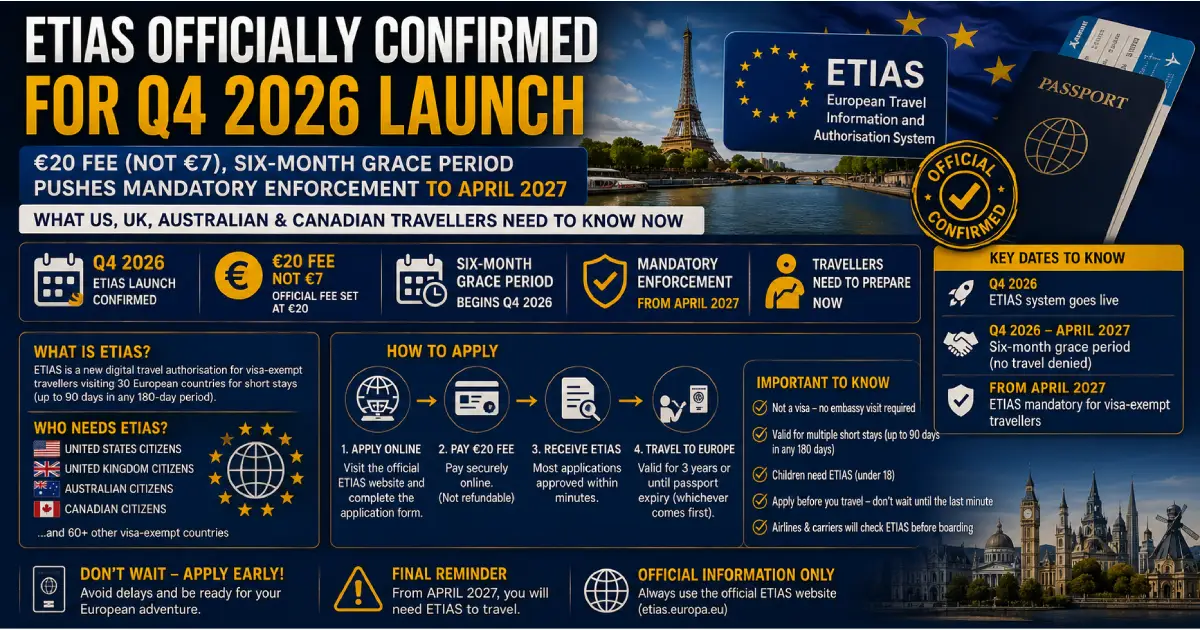
Europe’s new entry authorisation system finally has a settled set of facts. The launch quarter is confirmed. The grace period is confirmed. And the fee that many travellers still think is €7 has actually been €20 since July 2025.
The European Travel Information and Authorisation System — ETIAS — is now in its most stable, citable state since the scheme was first proposed. The European Commission has confirmed a Q4 2026 launch, most likely in October or November, for the system that will require visa-exempt travellers from the United States, United Kingdom, Australia, Canada, and roughly 56 other countries to obtain pre-travel authorisation before entering the Schengen Area. A six-month transitional grace period follows the launch, meaning mandatory enforcement will not take effect until approximately April 2027, giving travellers and airlines time to adapt before non-compliance becomes a hard barrier to travel.
Here is the detail that catches even well-informed travellers out: the €7 fee that circulated in early coverage of ETIAS — and that still appears on some outdated travel blogs and forum posts — was revised upward by the European Commission more than a year ago. On July 17, 2025, the Commission formally confirmed the ETIAS application fee at €20, not €7, citing inflation since the original 2018 figure was set, rising operational and cybersecurity costs, and a deliberate alignment with comparable systems internationally, including the US ESTA and UK ETA. If you have seen “€7” mentioned anywhere recently, including in some otherwise well-meaning travel content, that figure is over a year out of date.
This article lays out the complete, current, accurately-sourced picture: what ETIAS actually is, when it launches, what it costs, who needs it, and exactly what US, UK, Australian, and Canadian travellers should and should not do right now.
Published: June 20, 2026 — Saturday System: ETIAS — European Travel Information and Authorisation System Launch window: Confirmed Q4 2026 (October–December) — exact date not yet announced Advance notice commitment: EU has committed to providing at least 6 months’ advance notice of the precise launch date Application fee: €20 per person (confirmed by European Commission, July 17, 2025 — NOT €7, which was the original 2018 proposal) Fee exemptions: Travellers under 18 and over 70 — exempt from the fee entirely, but must still apply Grace/transitional period: Approximately 6 months after launch — mandatory enforcement begins around April 2027 Full strict enforcement: Expected after an additional 6-month grace period, around October 2027 Validity once approved: 3 years, or until passport expires, whichever comes first Countries requiring ETIAS: US, UK, Canada, Australia, New Zealand, Japan, South Korea, UAE, Brazil, Ireland (UK only, as Ireland is not Schengen), and 50+ other visa-exempt nationalities Covers: 30 European countries (29 Schengen states plus Cyprus) Related system already live: EU Entry/Exit System (EES) — biometric border tracking, live since April 10, 2026 Action required right now: None — applications are not yet open Official application portal (when live): travel-europe.europa.eu/etias — NO other website is authorised to process ETIAS applications Fee comparison: US ESTA $40 (raised from $21, September 2025) · UK ETA £20 (raised from £16, April 2026) · Canada eTA CAD $7 · Australia ETA AUD $20
ETIAS is not a visa. It is a pre-travel electronic authorisation — the European equivalent of the US ESTA, the UK’s ETA, or Canada’s eTA — designed to pre-screen visa-exempt travellers before they arrive in Europe, cross-referencing applicant information against security and migration databases. The system does not change the underlying entry rules for visa-exempt travellers: the standard 90-days-in-any-180-day rule for short stays in the Schengen Area remains exactly as it is today. ETIAS adds a pre-screening layer on top of that existing framework; it does not replace or extend it.
For US, UK, Australian, and Canadian passport holders, who currently enter the Schengen Area visa-free for tourism, business meetings, and short stays, ETIAS will not require an embassy visit, an interview, or biometric data collection at application stage. The application is entirely online, typically takes a few minutes to complete, and the vast majority of applications are auto-approved within minutes by the system’s automated screening, cross-referenced against security and migration databases. Manual review — which can extend processing to several days or, in flagged cases, up to 30 days — applies to a small minority of applications.
What ETIAS is not:
This is worth explaining properly, because the confusion is genuinely understandable and widespread. When ETIAS was first conceived as part of the EU’s border digitisation programme (the regulation establishing the framework dates to 2018), the planned fee was set at €7 — a figure that was widely reported at the time and that has persisted in outdated articles, forum threads, and even some still-uncorrected travel guides circulating online.
On July 17, 2025, the European Commission formally announced and confirmed a revised fee of €20, replacing the original €7 figure. The European Commission’s stated justification cited three factors: inflation accumulated since the €7 figure was set in 2018, higher-than-originally-projected operational and cybersecurity costs associated with running the system at scale, and a deliberate decision to align ETIAS pricing with comparable electronic travel authorisation schemes operated by other major destinations.
That alignment context is genuinely useful for understanding where €20 sits internationally. The US ESTA, for comparison, was itself raised from $21 to $40 on September 30, 2025. The UK’s own ETA was raised from £16 to £20 on April 8, 2026. Canada’s eTA remains comparatively inexpensive at CAD $7, and Australia’s ETA sits at AUD $20. The European Commission’s own framing positioned the €20 ETIAS fee as bringing the EU broadly into line with the US and UK figures, rather than being an outlier on the high end.
What this means practically for a family or group booking: Each traveller — including children, though under-18s and over-70s are fee-exempt while still needing to apply — requires an individual ETIAS authorisation. For a family of four with two adults and two children under 18, the total cost at launch would be €40 (two adult fees; the two children’s applications are free but still mandatory). The fee is non-refundable even if an application is denied, and a corrected resubmission after a denial or an error requires paying the fee again.
Understanding ETIAS as a single hard cutover date is the most common misconception, and it’s worth correcting clearly, because the actual rollout is structured in three distinct phases.
Phase 1 — Q4 2026 Launch (most likely October or November): ETIAS becomes operational and the application portal goes live at travel-europe.europa.eu/etias. From this point, visa-exempt travellers can begin applying. The exact date has not yet been announced — the EU has committed to providing at least six months’ advance public notice before the system goes live, so once that announcement comes, travellers planning trips for the following months will have a clear runway.
Phase 2 — Six-Month Transitional/Grace Period (Q4 2026 through approximately April 2027): This is the detail that matters most for anyone planning travel between the launch and mid-2027. During this transitional window, ETIAS applications will be accepted and recommended from day one, but enforcement during the transition phase is flexible — meaning travellers who arrive without an ETIAS authorisation during this period will generally still be permitted entry under the existing visa-exempt rules, rather than being turned away. This transitional period means travellers can enter without ETIAS for at least six months after launch, as long as they meet all other existing entry requirements.
Phase 3 — Mandatory Enforcement (from approximately April 2027): ETIAS becomes mandatory for most travellers from around April 2027 — approximately six months after the Q4 2026 launch. From this point, visa-exempt travellers arriving without a valid ETIAS authorisation can expect to be denied boarding by airlines or refused entry at the Schengen border.
Phase 4 — Full Strict Enforcement (from approximately October 2027): A further six-month period follows mandatory enforcement before the system reaches what is described as full strict enforcement — providing an additional buffer for edge cases, system reliability bedding-in, and traveller awareness to fully catch up before the rules are applied with zero tolerance.
The important caveat on enforcement during the grace period: Even though enforcement is described as “flexible” during the transitional phase, airlines may already refuse boarding to passengers without approval once the system is live and the expectation to apply is publicly established — airline compliance behaviour does not always track government enforcement leniency exactly. The safest practical approach for any traveller flying after the Q4 2026 launch date is to apply for ETIAS regardless of the grace period’s technical leniency, simply to avoid any risk of an individual airline staff member or gate agent applying the rule more strictly than the official transitional guidance technically requires.
American passport holders currently enjoy visa-free entry to the Schengen Area for stays of up to 90 days in any 180-day period. ETIAS does not change this fundamental allowance — it adds the pre-screening authorisation layer on top of it. From the Q4 2026 launch, with the grace period extending real enforcement out to around April 2027, US travellers have a comfortable runway to incorporate the ETIAS application into their pre-trip routine, much as many already do with the ESTA for US-bound international visitors.
Practical guidance for Americans: No action is needed right now — applications are not yet open as of this writing. Once the system launches, budget €20 per traveller, apply via the official portal only (travel-europe.europa.eu/etias), and build in a buffer of at least a few days before departure even though most approvals are issued within minutes, simply to allow time to address any manual review flag without disrupting travel plans.
UK passport holders are subject to the same Q4 2026 timeline as other visa-exempt nationalities, despite Brexit having ended the UK’s EU membership and automatic free movement. UK citizens visiting any of the 30 ETIAS-covered countries — the 29 Schengen states plus Cyprus — will need ETIAS authorisation from launch onward. ETIAS is required only when travelling to Europe; UK domestic travel is entirely unaffected.
This adds a layer of complexity to UK-Europe travel that pre-Brexit travellers did not face, sitting alongside the now-live EU Entry/Exit System (EES), which has been operational since April 10, 2026 and handles biometric tracking of entries and exits at the border itself — a separate system from ETIAS that requires no action from travellers beyond the standard biometric capture at the border.
Practical guidance for UK travellers: The combination of EES (already live, no traveller action required) and ETIAS (not yet live, application required from Q4 2026) means UK travellers heading to Europe for the rest of 2026 should expect biometric processing at the border now, and should plan to add the ETIAS application step to their pre-trip checklist once the system goes live later this year.
Australian passport holders are among the roughly 60 visa-exempt nationalities subject to ETIAS from its Q4 2026 launch. For Australians whose European travel typically involves long-haul, carefully planned trips — often combining multiple Schengen countries in a single itinerary given the distance and cost of travelling from Australia — the three-year validity period of an approved ETIAS authorisation is a particularly relevant detail. A single ETIAS approval, once granted, covers unlimited entries to any of the 30 ETIAS countries for three years (or until passport expiry, whichever comes first) — meaning an Australian traveller who applies before their first post-launch European trip will not need to reapply for subsequent trips within that three-year window, provided their passport remains valid.
Practical guidance for Australians: Given the cost and complexity already involved in long-haul travel from Australia to Europe, the ETIAS application is a comparatively minor addition to trip planning — but the AUD-equivalent cost (€20, translating to roughly AUD $33–35 depending on exchange rates) is worth budgeting per traveller, including children, even though under-18s are fee-exempt.
Canadian passport holders fall under the same Q4 2026 launch and April 2027 mandatory enforcement timeline as other visa-exempt nationalities. For context, Canada’s own eTA system — required for visa-exempt foreign nationals flying into Canada — costs a comparatively modest CAD $7, which may partly explain why some Canadian travellers have anchored on the outdated €7 ETIAS figure, assuming a similar low-cost parity between the two systems. That assumption is incorrect: at €20, the ETIAS fee for Canadians (roughly CAD $30 depending on exchange rates) is notably higher than Canada’s own reciprocal eTA charge.
Practical guidance for Canadians: Budget accordingly — at €20 per adult traveller, a Canadian family planning a European trip after the Q4 2026 launch should factor this into trip costs at a materially higher rate than Canada’s own eTA might suggest as a reference point.
This warning deserves explicit emphasis because it has already become a real problem. Multiple third-party websites have already appeared online using official EU logos, claiming to accept ETIAS applications, with some reportedly collecting personal data and payment details from travellers who believed they were applying through an authorised channel — despite the fact that ETIAS is not yet even operational.
The only official ETIAS application portal, once live, will be: travel-europe.europa.eu/etias
Any other website — regardless of how official it looks, regardless of EU branding or logos displayed, regardless of search engine ranking position — is not an authorised government channel. Some of these sites are outright scams collecting payment and personal data fraudulently. Others are legitimate-seeming third-party “visa service” companies that will process your application for a significantly inflated fee on top of the actual €20 government charge — not illegal, but an unnecessary additional cost for a process the European Commission has explicitly designed to be simple enough for travellers to complete themselves directly.
Bookmark only: travel-europe.europa.eu — and be skeptical of any ETIAS-related search ad, social media post, or third-party site requesting payment before the system has officially launched.
Given everything above, here is the practical, no-nonsense action list for any US, UK, Australian, or Canadian traveller reading this in June 2026:
Right now, before the Q4 2026 launch: Nothing. Applications are not open. Continue travelling to Europe exactly as you do today — no ETIAS authorisation exists yet to apply for, and no current entry requirement has changed. Be wary of any website currently claiming to process ETIAS applications; if it’s accepting payment today, it is not legitimate.
When the launch date is announced (expected several months before the actual Q4 2026 go-live): Note the specific date. The EU’s six-month advance notice commitment means you should have ample warning.
Once ETIAS launches in Q4 2026: If you’re travelling to Europe after the launch date, apply via travel-europe.europa.eu/etias before your trip. Budget €20 per adult traveller (free for under-18s and over-70s, though they still need to apply). Apply at least a few days before departure even though most approvals come through within minutes, to leave room for the rare manual review case.
Between launch and approximately April 2027 (the grace period): Technically, enforcement remains flexible and you can likely still enter without ETIAS if you somehow haven’t applied — but given that airlines may enforce more strictly than the letter of the transitional guidance, the safest approach is simply to apply regardless of the grace period’s technical leniency.
From approximately April 2027 onward: ETIAS becomes mandatory. An authorisation will be a hard requirement for boarding and entry, not just a recommended precaution.
Posted By : Vinay
This article is provided for general informational purposes only and is based on information available at the time of publication. Travel advisories, airline schedules, airport operations, visa requirements, government regulations, and other travel-related information are subject to change without prior notice. While Travel Tourister makes reasonable efforts to verify information using official announcements, government publications, airline and airport communications, and other reliable sources, we cannot guarantee that all information remains complete, accurate, or up to date at all times. Readers should independently verify any information that may affect their travel plans with the relevant airline, airport authority, government agency, embassy, or other official source before making travel, financial, or other decisions. Travel Tourister shall not be liable for any direct or indirect loss, inconvenience, or damages arising from the use of or reliance on the information contained in this article. Nothing in this publication constitutes legal, immigration, financial, or professional travel advice. If you believe any information in this article is inaccurate or outdated, please contact our editorial team. We review all credible correction requests promptly and update our content whenever appropriate.
Lastest News
2nd Floor, 39, Above Kirti Club, DLF Industrial Area, Kirti Nagar, New Delhi, Delhi 110015



Travel Tourister is a leading Travel portal where we introduce travellers to trusted travel agents to make their journey hasselfree, memorable And happy. Travel Tourister is a platform where travellers get Tour packages ,Hotel packages deals through trusted travel companies And hoteliers who are working with us across the world. We always try to find new and more travel agents and hoteliers from every nook and corners across the world so that you could compare the deals with different travel agents and hoteliers and book your tour or hotel with the one you have chosen according to your taste and budget.
Copyright © Travel Tourister, India. All Rights Reserved

 Call
Call Enquiry