Published on : 29 Aug 2026
By Travel Tourister | Updated Aug 2026
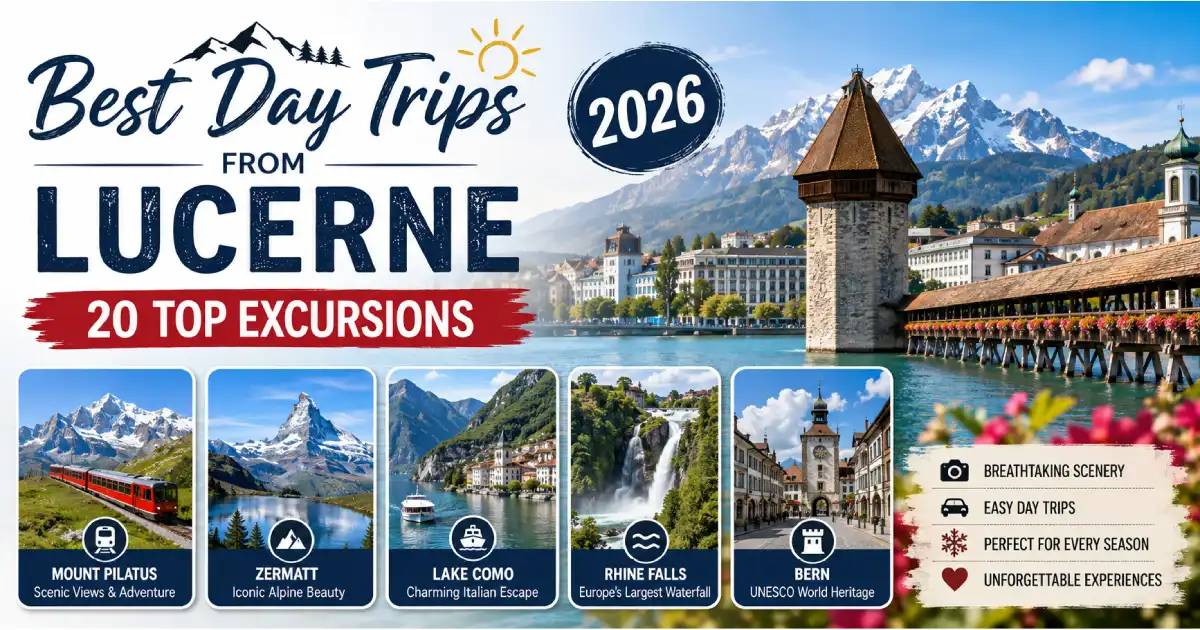
Lucerne sits at the geographic heart of Switzerland — a railway junction and lake hub whose central position makes it the single most efficient base from which to explore the country’s most celebrated destinations. Within 2 hours of Lucerne by train or boat, visitors can reach Zurich (Switzerland’s largest city, 48 minutes), Bern (the medieval federal capital, 70 minutes), Interlaken (the Bernese Oberland gateway, 2 hours), the Jungfraujoch (the “Top of Europe” at 3,454 meters, 3 hours including the mountain railway sequence), and Zermatt (the Matterhorn’s car-free village, 2.5 hours). The Swiss Travel Pass transforms this geographic centrality into practical day-trip efficiency — every destination in this guide is covered (fully or with mountain railway discounts) by the Swiss Travel Pass, eliminating the individual ticket purchasing that makes Swiss travel expensive when managed without a pass.
What distinguishes Lucerne’s day-trip landscape from other Swiss base cities is the combination of Alpine summit access, UNESCO World Heritage destinations, and historically significant natural sites all within a single day’s reach — the Rütli meadow (Switzerland’s founding site, accessible only by lake steamer), the Jungfraujoch (Europe’s highest railway station), Bern’s UNESCO Old Town, the Rhine Falls (Europe’s largest waterfall by volume), and Basel’s Foundation Beyeler (one of Europe’s finest private art museums) are all logistically achievable as Lucerne day trips while remaining genuinely distinct from what Lucerne itself provides. This guide covers the 20 best day trips from Lucerne organized by journey time and destination category — mountain summits, cultural cities, natural wonders, and historic sites — with practical transport details, cost information, and timing guidance for 2026 visitors.
For complete guides to Lucerne itself, see our Best Places to Visit in Lucerne 2026, Things to Do in Lucerne 2026, and Best Time to Visit Lucerne guides.
| Destination | Journey Time | Transport | Cost (Swiss Travel Pass) | Best For | Best Season |
|---|---|---|---|---|---|
| Mount Pilatus | 40 min (boat) + 30 min (rail) | SGV boat + rack railway | 50% discount on rack railway | World’s steepest rack railway, panorama | May–November |
| Mount Rigi | 40 min (boat) + 30 min (rail) | SGV boat + rack railway | Included + rack railway discount | “Queen of Mountains,” sunrise | Year-round |
| Stanserhorn | 30 min boat/train + cable car | Train + CabriO cable car | Discount applies | Open-top cable car, panorama | May–October |
| Bürgenstock | 30 min (boat + funicular) | SGV boat + funicular | Partially included | Clifftop resort, dramatic lake views | May–October |
| Rütli Meadow | 2 hrs (boat) | SGV boat | Included | Swiss Confederation founding site | May–October |
| Engelberg & Titlis | 45 min (train) | SBB train | Included (Titlis: 50% discount) | Glacier, rotating cable car | Year-round |
| Zurich | 48 min (train) | SBB IC | Included | Art museums, lake, Old Town | Year-round |
| Bern | 70 min (train) | SBB IC | Included | UNESCO Old Town, Federal Parliament | Year-round |
| Interlaken | 2 hrs (train) | SBB IC | Included | Bernese Oberland gateway | Year-round |
| Jungfraujoch | 3 hrs (train + mountain rail) | SBB + Jungfrau Railway | 50% discount on Jungfraujoch | “Top of Europe,” highest station in Alps | Year-round |
| Rhine Falls + Schaffhausen | 2 hrs (train) | SBB IC | Included | Europe’s largest waterfall | Spring–Autumn |
| Basel | 70 min (train) | SBB IC | Included | Art Basel, Rhine, museums | Year-round |
| Stein am Rhein | 2 hrs (train + regional) | SBB + regional | Included | Painted medieval village | April–October |
| Grindelwald | 2 hrs (train) | SBB IC + BOB | Included | Eiger views, Bernese Oberland village | Year-round |
| Zermatt | 2.5 hrs (train) | SBB IC + MGB | Included | Matterhorn, car-free village | Year-round |
| Gruyères | 1.5 hrs (train) | SBB + MOB | Included (castle CHF 12) | Cheese, medieval town, HR Giger | Year-round |
| Lucerne to Lausanne | 1.5 hrs (train) | SBB IC | Included | Olympic Museum, Gothic cathedral | Year-round |
| Lauterbrunnen Valley | 2 hrs (train) | SBB IC + BOB | Included | 72 waterfalls, cliff villages | May–October |
| Andermatt | 1 hr (train) | MGB | Included | Alpine village, Furka Pass, history | Year-round |
| Tell’s Chapel | 1.5 hrs (boat) | SGV steamer | Included | William Tell legend, lake scenery | May–October |
Journey: SGV boat Lucerne → Alpnachstad (40 min, included Swiss Travel Pass) + Pilatus-Bahn rack railway → summit (30 min, 50% discount Swiss Travel Pass) | Return: Aerial cable car + gondola → Kriens + bus → Lucerne | Total cost with Swiss Travel Pass: Approximately CHF 45–55 | Season: May–November (rack railway); year-round (aerial gondola) | Duration: Half day
The Pilatus Golden Round Trip — combining four different transport modes (SGV lake steamer, rack railway, aerial cable car, gondola) in a circuit that begins and ends in Lucerne — is the quintessential Lucerne day excursion and the one most consistently recommended by visitors who’ve done it. The specific elements that make it extraordinary: the world’s steepest rack railway (Pilatus-Bahn, maximum gradient 48%, ascending the mountain’s eastern face through progressively dramatic terrain in 30 minutes), the summit complex at 2,132 meters (the Dragon Path ridge walk, the two summit hotels visible from below during the ascent, the 360-degree panorama encompassing Lake Lucerne below and the Bernese Alps on the southern horizon), and the descent by aerial cable car and gondola (a completely different visual experience from the ascent, covering the mountain’s northern face rather than the eastern) create the most varied single-day mountain experience available from any Swiss city.
Practical planning: The conventional direction (boat to Alpnachstad for the rack railway ascent, aerial gondola descent to Kriens, bus back to Lucerne) allows the rack railway experience at the body’s most receptive point (ascending when fresh rather than descending when tired) and saves the longer transport mode (the aerial gondola) for the return. The early morning boat from Lucerne’s Bahnhofquai (checking current SGV timetable for the first departure) delivers visitors to Alpnachstad for the first rack railway ascent — arriving at the summit before the mid-morning tour group volumes and maximizing the probability of pre-cloud-build-up visibility.
Insider tips: The Pilatus “Good Morning Ticket” (a discounted first-ascent offer — check pilatus.ch for current 2026 pricing and availability) rewards early-morning departures with both cost savings and the summit at its least crowded and most clearly visible. Mountain weather at 2,132 meters is genuinely variable — checking the Pilatus summit webcam (pilatus.ch/en/planning/webcams) the evening before allows realistic visibility assessment before committing to the specific departure.
Journey: SGV boat Lucerne → Vitznau (40 min, included Swiss Travel Pass) + Rigi Vitznau rack railway → Rigi Kulm summit (30 min, 50% discount) | Alternative: SGV boat → Weggis + Rigi Kaltbad aerial gondola | Total cost with Swiss Travel Pass: Approximately CHF 35–45 | Season: Year-round | Duration: Half day (or overnight for sunrise)
Mount Rigi (1,797 meters, the “Queen of the Mountains” that Mark Twain famously visited and whose summit railway — Europe’s first mountain railway, opened 1871 — made it one of the earliest Alpine tourism destinations in the world) provides Lucerne’s most historically resonant mountain day trip. The 360-degree summit panorama (Lake Lucerne, Lake Zug, Lake Lauerz, and on clear days the Bernese Alps — Eiger, Mönch, and Jungfrau identifiable on the southern horizon) and the specific historical tradition of Rigi sunrise viewing (practiced since the early 19th century, when writers and European royalty made specific pilgrimage visits) give the mountain a depth of cultural resonance beyond its physical dimensions.
The Rigi circuit can be varied by ascent route: from Vitznau (the original 1871 rack railway, the most historically significant ascent) or from Weggis (the aerial gondola to Rigi Kaltbad, then rack railway or hiking to the summit) — the Vitznau rack railway specifically provides the most historically complete Rigi experience. A descent from the Rigi Scheidegg station (the secondary summit area, with different views and less visitor concentration than the Kulm) to Goldau by rack railway and return to Lucerne via Arth-Goldau provides a complete circuit using three different transport modes.
Insider tips: The Rigi Kulm Hotel’s sunrise tradition (staying overnight at the summit hotel to watch the pre-dawn Alpine colour transition) requires booking 3–6 months ahead for summer season and 1–2 months ahead for autumn and winter. Visitors specifically targeting the sunrise experience (the primary historical reason for Rigi visits) and unwilling or unable to overnight should take the very first morning train from Vitznau (departing approximately 7 AM in summer, check current timetable), arriving at the summit for breakfast and the best daily visibility window before afternoon cloud build-up.
Journey: SBB train Lucerne → Engelberg (45 min, included Swiss Travel Pass) + cable car sequence → Titlis summit (50% discount Swiss Travel Pass) | Total cost with Swiss Travel Pass: Approximately CHF 55–70 (Titlis cable car with 50% discount) | Season: Year-round | Duration: Full day
Engelberg (the “Angel Mountain” town at the base of Mount Titlis, 45 minutes by direct train from Lucerne’s main station) provides the most accessible genuine glacier experience from Lucerne — the Titlis cable car sequence (gondola from Engelberg to Stand, then the Rotair — the world’s first revolving aerial cable car, completing a 360-degree rotation during its 5-minute ascent to allow continuous panoramic viewing — to the 3,238-meter summit) delivers visitors to year-round glacier terrain, the Titlis Cliff Walk (Europe’s highest suspension bridge, 100 meters long at 3,041 meters altitude, spanning a cliff gap in the open air), and ice cave carved within the actual glacier.
Engelberg additionally offers the Benedictine Kloster Engelberg (one of Switzerland’s most significant active Baroque monasteries, with guided tours covering the library containing medieval manuscripts, the Baroque church completed 1730, and the economic operations including cheese and chocolate production that maintain the monastery’s financial independence) — combining a morning Kloster visit with an afternoon Titlis excursion creates the most complete Engelberg day trip structure.
Practical planning: The Titlis cable car sequence takes approximately 45 minutes ascending from Engelberg — departing Lucerne by 8:30–9 AM and arriving in Engelberg by 9:15–9:45 AM provides adequate time for both the Kloster visit (1–1.5 hours) and the full Titlis excursion (2.5–3 hours including summit time) before the last cable car descent in the early evening.
Insider tips: The Rotair’s revolving cabin (the world’s first rotating aerial cable car, completed 1992 — the cabin rotates 360 degrees during the 5-minute ascent, ensuring every passenger sees the complete panorama regardless of where they stand) is most effectively experienced by facing outward during the rotation — standing close to the windows rather than toward the center maximizes the panoramic viewing that the rotation design provides.
Journey: SGV boat Lucerne → Stansstad (20 min, included Swiss Travel Pass) + bus/walk → Stans + cable car sequence → Stanserhorn summit | Alternative: SBB train Lucerne → Stans (regional connection) | Season: May–October | Duration: Half day
The Stanserhorn (1,898 meters, accessible by a combination of a historic funicular — operating since 1893 — and the world’s first open-top double-decker aerial cable car, the CabriO, introduced 2012) provides Lucerne’s most specifically unusual mountain experience. The CabriO’s open upper deck (standing passengers exposed to wind, sky, and the surrounding Alpine landscape in 360-degree open air rather than enclosed gondola viewing) creates an aerial experience that no enclosed cable car can replicate — the physical sensation of standing exposed at altitude during the ascent, with the lake visible below and the surrounding peaks approaching from all directions, is precisely what the CabriO was designed to provide and what photographs fail to communicate.
The Stanserhorn summit provides panoramic views comparable to Pilatus (including Lake Lucerne directly below, the Bernese Alps to the south, and the broader Central Swiss landscape northward) with significantly fewer visitors than the more internationally-marketed Pilatus excursion — one of the best “quality-to-crowd” value ratios in the Lucerne day-trip landscape.
Insider tips: The CabriO’s open upper deck is weather-dependent — calm, clear days provide the intended exhilarating experience while rain or strong wind close the upper deck and reduce the experience to a standard enclosed gondola. Checking the Stanserhorn weather camera (stanserhorn.ch) before departing from Lucerne allows the specific CabriO open-deck experience to be confirmed rather than hoped for.
Journey: SBB train Lucerne → Interlaken Ost (2 hrs, included Swiss Travel Pass) + BOB → Grindelwald or Lauterbrunnen + Wengernalpbahn → Kleine Scheidegg + Jungfrau Railway → Jungfraujoch (50% discount Swiss Travel Pass on Jungfrau Railway) | Total cost with Swiss Travel Pass: Approximately CHF 90–110 (Jungfraujoch portion) | Season: Year-round | Duration: Full day (depart Lucerne by 7 AM)
The Jungfraujoch day trip from Lucerne — ascending to Europe’s highest railway station at 3,454 meters — requires the most logistically demanding planning of any Lucerne day excursion but delivers the most extraordinary single destination. Departing Lucerne by 7–7:30 AM (the first intercity trains toward Interlaken depart approximately this time — check current 2026 SBB timetable), arriving at Interlaken Ost by approximately 9 AM, then following the Bernese Oberland mountain railway sequence (BOB to Grindelwald or Lauterbrunnen, Wengernalpbahn to Kleine Scheidegg, Jungfrau Railway to the summit) — arriving at the Jungfraujoch approximately 11–11:30 AM after the 2-hour mountain railway ascent.
The Jungfraujoch experience (the Aletsch Glacier viewing terrace — the longest glacier in the Alps visible from the summit station, the Ice Palace carved within the glacier itself, and the specific disorientation of standing at 3,454 meters in an enclosed summit station accessible without mountaineering) constitutes Switzerland’s single most celebrated visitor experience, and the day-trip from Lucerne achieves it in approximately 12 hours total (7 AM departure, 7 PM return).
Practical planning: The Good Morning Ticket for the Jungfrau Railway (check jungfrau.ch for current 2026 pricing and availability — a discounted first-ascent ticket for the earliest departures from Kleine Scheidegg) saves approximately CHF 20–30 on the already-discounted (with Swiss Travel Pass) Jungfraujoch ticket. The weather caveat is critical: checking the Jungfraujoch summit webcam (jungfrau.ch/en-gb/planning/webcams) the evening before and morning of the planned visit allows realistic visibility assessment — a cloudy summit produces a very expensive cloud experience rather than the glacier panorama.
Insider tips: The Lucerne-to-Jungfraujoch day trip requires approximately 12 hours total (7 AM departure from Lucerne, 7 PM return) — building in flexibility for the return journey (the last trains from Interlaken to Lucerne running into the evening allows a relaxed descent without last-minute rushing) produces a more enjoyable experience than tight scheduling that requires hurrying at the summit.
Journey: SBB IC train Lucerne → Zurich Hauptbahnhof (48 min, multiple departures hourly, included Swiss Travel Pass) | Duration: Full day | Best For: Kunsthaus Zürich, lake swimming, Old Town | Season: Year-round
Zurich (48 minutes from Lucerne by direct InterCity train) provides Lucerne-based visitors with access to Switzerland’s largest city, most significant art museum (Kunsthaus Zürich — see our Best Places to Visit in Zurich 2026 guide), and most sophisticated restaurant and cultural scene. The specific Lucerne-to-Zurich day trip value: combining Lucerne’s specific medieval and lake character with Zurich’s urban density and cultural sophistication creates a Switzerland visit that covers both ends of the country’s urban experience spectrum within the same accommodation base.
A productive Zurich day trip: Arrive Zurich HB by 9 AM → Kunsthaus Zürich (2–3 hours, including the new Chipperfield building and the Giacometti collection) → Old Town walk (Grossmünster, Fraumünster Chagall windows, Lindenhügel viewpoint) → lunch at Hiltl or Kronenhalle → lake swimming at Seebad Utoquai or Flussbad Oberer Letten (summer) or Rietberg Museum (year-round) → return to Lucerne by early evening.
Insider tips: The Zurich Card (CHF 29 for 24 hours, covering all Zurich public transport and free entry to 43 Zurich museums) is worth purchasing on arrival at Zurich Hauptbahnhof for day-trip visitors who plan museum visits and tram use — the Kunsthaus alone (CHF 26 entry) combined with one tram journey covers most of the card’s cost, making it the most efficient access tool for Zurich day visitors.
Journey: SBB IC train Lucerne → Bern (70 min, direct, included Swiss Travel Pass) | Duration: Full day | Best For: UNESCO Old Town, Bundeshaus, Bear Park, Rose Garden view | Season: Year-round
Bern (70 minutes from Lucerne by direct InterCity) provides the most historically complete single-city Swiss cultural experience available as a Lucerne day trip — the UNESCO World Heritage Old Town (6 kilometers of arcaded sandstone walkways covering every main commercial street, providing covered pedestrian access regardless of weather), the Bundeshaus (the Federal Parliament building, guided tours available in multiple languages), the BärenPark (Bern’s bear park — live bears maintained since 1513 as the city’s heraldic symbol), and the Rosengarten overlook (the most reproduced elevated view of Bern — the Old Town on its Aare river peninsula, the Federal Parliament building visible, and the Bernese Alps forming the southern horizon on clear days) constitute a complete cultural day.
Practical Bern itinerary: Arrive Bern by 9 AM → Old Town walk starting from the Zytglogge (the animated astronomical clock tower, performing 4 minutes before each hour) → Kramgasse and Gerechtigkeitsgasse (the main Old Town arcaded axes) → Münster Cathedral (tower climb for city views) → Bundeshaus (free guided tour, check tour availability on bundeshaus.ch) → BärenPark → Rosengarten overlook → return to Lucerne by early evening.
Insider tips: The Rosengarten overlook (a 10-minute uphill walk from the BärenPark, a public rose garden on the hill above the Aare, free access) provides the most reproduced single Bern photograph — the Old Town on its river peninsula, the Parliament building visible, and the Alps behind. This view rewards the specific effort of the uphill walk in a way that no other Bern viewpoint replicates.
Journey: SBB IC train Lucerne → Basel SBB (70 min, direct, included Swiss Travel Pass) | Duration: Full day | Best For: Foundation Beyeler (Riehen), Rhine swimming, Art Basel (June) | Season: Year-round
Basel (70 minutes from Lucerne, the same travel time as Bern but in a different direction — northwest rather than west) provides access to Europe’s finest private art museum (the Foundation Beyeler in Riehen — 15 minutes further by tram from Basel SBB, included in Swiss Travel Pass — housing Picasso, Mondrian, Rothko, Bacon, and Monet in a Renzo Piano-designed building of extraordinary refinement), the Rhine swimming (Basel’s unique urban outdoor activity — floating downstream in the Rhine River carried by current, using the traditional Wickelfisch waterproof bag for clothes) in summer, and the historic Rhine Ferrys (the cable-propelled Fähren crossing the Rhine using only the river current’s force, CHF 1.60 per crossing).
Practical Basel itinerary: Arrive Basel SBB by 9 AM → tram to Riehen (15 min) → Foundation Beyeler (2–3 hours — one of Europe’s finest museum experiences, book timed entry online) → tram back to Basel → Old Town walk (Münsterplatz, the Kunstmuseum Basel’s free public areas) → Rhine Fähre crossing (CHF 1.60, the unique cable ferry experience) → Rhine swimming in summer (Wickelfisch bag available from tourist shops) or Kunstmuseum Basel afternoon visit → return to Lucerne.
Insider tips: The Foundation Beyeler’s temporary exhibitions (check fondationbeyeler.ch for current 2026 programming) often justify a Basel day trip independently — the Foundation’s major retrospectives attract European art visitors specifically, and combining a Beyeler visit with the Rhine’s summer swimming creates an eclectic but specifically Basel day that no other Swiss city can replicate.
Journey: SBB train Lucerne → Bern (70 min) + Bern → Fribourg (27 min) + Fribourg → Bulle (27 min) + regional to Gruyères (10 min) | Total: Approximately 1.5 hours | Duration: Full day | Season: Year-round
Gruyères (approximately 1.5 hours from Lucerne by train via Bern and Fribourg, with Swiss Travel Pass covering all connections) provides the most varied single-destination day trip from Lucerne — combining the medieval hilltop village and castle (Château de Gruyères, CHF 12, with period furnishings and a comprehensive history of the counts of Gruyères), La Maison du Gruyère cheese dairy (in the village below, CHF 10–12, with live morning production visible), the HR Giger Museum (the Alien artist’s collection in medieval stone rooms — Switzerland’s most unexpected cultural juxtaposition), and the HR Giger Bar (decorated entirely in the surrealist artist’s biomechanical aesthetic) within a single compact destination.
Practical Gruyères itinerary: Arrive Gruyères by 10 AM → La Maison du Gruyère cheese dairy (visit before 11 AM for the best chance of seeing active morning production) → Gruyères village walk and castle → lunch (the village has several restaurants serving Gruyère-specific dishes, raclette, and fondue) → HR Giger Museum → HR Giger Bar (one of Switzerland’s most atmospheric bar environments regardless of HR Giger interest) → return to Lucerne by late afternoon or early evening.
Insider tips: The Gruyères cheese dairy morning production (milk arriving from surrounding farms, the curd-cutting and pressing visible through gallery windows above the production floor) occurs during the first hours of the day — arriving before 11 AM maximizes the probability of seeing active production rather than an empty production floor between batches.
Journey: SBB IC train Lucerne → Lausanne (approximately 1.5 hours, change at Bern or direct, included Swiss Travel Pass) | Duration: Full day | Best For: Olympic Museum, Notre-Dame Cathedral, lake steamer to Montreux | Season: Year-round
Lausanne (approximately 1.5 hours from Lucerne by direct or single-change train, the journey passing through Bern on most services) provides access to the International Olympic Museum (CHF 20, on the Ouchy lakefront, the most comprehensive Olympic history exhibition globally — a destination worth the trip independently), the Gothic Cathedral of Notre-Dame (the most historically significant Gothic cathedral in Switzerland, with a fully functioning nightwatch tradition maintained since 1405 — the watchman calling the hours from 10 PM to 2 AM nightly), and the Ouchy lakefront (the lower lakeside district of Lausanne, with Lake Geneva steamers and the lakeside promenade providing a taste of the Léman region’s specific character).
Combining Lausanne with a Lavaux vineyard walk (the UNESCO vineyard terraces between Lausanne and Montreux accessible by regional train from Lausanne — Cully or Rivaz stations providing trail access) creates the most complete Lake Geneva cultural and natural day trip available from Lucerne.
Insider tips: The Lausanne Cathedral’s nightwatch tradition (the watchman calling from the cathedral tower at 10 PM, 11 PM, midnight, 1 AM, and 2 AM — an uninterrupted tradition since 1405, one of Europe’s most quietly extraordinary living historical practices) is only accessible to visitors who are in Lausanne at 10 PM or later — the Lucerne-to-Lausanne day trip that specifically includes an evening concert or dinner in Lausanne and returns by late train allows hearing the nightwatch if timing aligns.
Journey: SBB train Lucerne → Schaffhausen (approximately 1.5–2 hours, change at Zurich or Winterthur, included Swiss Travel Pass) + regional to Neuhausen am Rheinfall (5 min) | Duration: Full day | Best For: Europe’s largest waterfall, medieval Schaffhausen Old Town, Stein am Rhein | Season: Spring–Autumn (maximum flow May–July)
The Rhine Falls (Rheinfall) — Europe’s largest waterfall by volume (23 meters high, 150 meters wide, up to 600 cubic meters of water per second at peak May–July snowmelt flow) — combined with Schaffhausen’s well-preserved medieval Old Town (the Munot fortress, the painted guild house facades comparable to Lucerne’s own, and the specific Rhine city character that Schaffhausen maintains as the only Swiss canton on the Rhine’s north bank) creates Lucerne’s finest northern Switzerland day trip.
The optional Stein am Rhein extension (20 minutes by regional train from Schaffhausen) adds Switzerland’s most completely frescoed medieval village — the Rathausplatz and Unterstadt’s painted facades covering the entire main street’s buildings in 16th–17th century frescoes of extraordinary quality and preservation, constituting the finest historic painted streetscape in German-speaking Switzerland.
Practical itinerary: Arrive Rhine Falls 10 AM → Schloss Laufen descending viewing platform (CHF 5, the closest Rhine-edge position) → boat to the rock island mid-falls (seasonal, CHF 5) → Schaffhausen Old Town lunch → Munot fortress (free, castle walk with Rhine city views) → Stein am Rhein (20 min, afternoon frescoed village walk) → return to Lucerne by early evening.
Insider tips: The Rhine Falls’ spring snowmelt peak (May–June) produces the most dramatic waterfall — the difference between peak flow (600 m³/second, spray reaching viewing platforms, genuinely thundering) and late-summer reduced flow (200 m³/second, impressive but notably less dramatic) is significant enough to make the spring visit specifically more worthwhile if timing flexibility exists.
Journey: SGV steamer Lucerne → Rütli (approximately 2 hours, included Swiss Travel Pass) + short hop to Tell’s Chapel | Duration: Full day | Season: May–October | Note: Rütli has no road access — boat only, by design
The combination of the Rütli meadow (the hillside above Lake Lucerne’s southwestern shore where the original Swiss Confederation founding oath was sworn in 1291 — accessible exclusively by boat, the road access deliberately absent to preserve the site’s isolation and historical atmosphere) and Tell’s Chapel (the lakeside chapel marking the traditional location of William Tell’s legendary leap from Gessler’s boat, a few minutes by steamer from Rütli) creates the most historically concentrated single day trip from Lucerne.
Neither site is physically impressive in the conventional tourism sense — the Rütli is a sloping Alpine meadow with a monument and flag, Tell’s Chapel is a small lakeside building. Their significance is historical and mythological: these are the landscape settings of Switzerland’s national founding narrative, experienced from the same lake that the participants in these events crossed, accessed by the same transport mode (water) as the original participants. For visitors interested in Swiss national identity and history, this excursion carries specific resonance unavailable at any other Swiss destination.
Practical itinerary: Morning SGV steamer from Lucerne’s Bahnhofquai pier → 2-hour lake journey (the most scenic section of Lake Lucerne — the lake’s narrowing toward the Urner See arm, the Rigi visible to the right, the Pilatus to the left as the steamer heads south) → Rütli landing (30–45 minutes ashore) → steamer to Tell’s Chapel (15 minutes) → Flüelen (the lake’s southeastern terminus, 1 hour further — full lake traverse option) → return by steamer or train from Flüelen (train to Lucerne 45 minutes, much faster than the steamer return).
Insider tips: The SGV steamer to Rütli frequently carries Swiss school groups (the Rütli is a standard Swiss civic education destination for schoolchildren from all German-speaking cantons — hearing Swiss children learn about the founding oath at its actual location creates a specifically moving encounter with living civic tradition) — sharing the deck with school groups on the approach adds rather than detracts from the historical atmosphere.
Journey: SBB train Lucerne → Interlaken Ost (2 hours, included Swiss Travel Pass) + BOB narrow-gauge → Lauterbrunnen (22 min, included) | Duration: Full day | Season: May–October | Best For: Staubbachfall, Trümmelbach Falls, cliff villages, UNESCO waterfall valley
Lauterbrunnen Valley (approximately 2.5 hours total travel from Lucerne) provides access to Switzerland’s most dramatically beautiful valley — a glacier-carved U-shaped gorge with vertical cliff walls rising 300 meters on both sides, hosting 72 named waterfalls (including the Staubbachfall — a 297-meter free-falling waterfall visible directly from the valley floor, the third highest in Switzerland), the car-free cliff villages of Mürren (on the western wall, accessible by cable car) and Wengen (on the eastern slope, accessible by cog railway), and the Trümmelbach Falls (ten glacial meltwater waterfalls inside the mountain, accessible by tunnel and elevator, CHF 13).
A complete Lauterbrunnen Valley day from Lucerne: Train to Lauterbrunnen by 11 AM → Trümmelbach Falls (1 hour, inside the mountain, genuinely extraordinary) → valley floor walk toward Stechelberg (the Staubbachfall visible overhead throughout) → cable car to Mürren (the car-free cliff village with the most dramatic Bernese Alps view available from any inhabited terrain, CHF 8–12 one-way) → return by cable car to Grütschalp and rack railway to Lauterbrunnen → return to Lucerne.
Insider tips: The Lauterbrunnen day trip is most rewarding when specifically timed to include the Trümmelbach Falls (their underground glacial waterfall character is unique in Switzerland and unavailable at any other single destination — not visiting them during a Lauterbrunnen day trip is the trip’s most consistent regret reported by visitors who skipped them for time reasons).
Journey: SBB train Lucerne → Interlaken Ost (2 hrs) + BOB → Grindelwald (35 min, included Swiss Travel Pass) | Duration: Full day | Best For: Eiger north face views, First Cliff Walk, Eiger Express gondola | Season: Year-round
Grindelwald (accessible from Lucerne in approximately 2.5 hours total, entirely by Swiss Travel Pass-covered trains) provides access to the Bernese Oberland’s most famous Alpine village — the community directly below the Eiger’s north face, with the Eiger-Mönch-Jungfrau trio dominating the southern skyline from the village center and every point on the surrounding trail network. The Eiger Express gondola (the newest and fastest uplift to the Eiger Glacier station at 2,320 meters, connecting to the Jungfraujoch railway sequence) and the First Cliff Walk (a metal walkway bolted to the cliff face at the First gondola top station, providing exposure and views that distinctly startle visitors accustomed to conventional mountain viewpoints) constitute Grindelwald’s two most specific experiences.
Insider tips: The Grindelwald First Cliff Walk (accessible via the First gondola, CHF 36–42 one-way) represents the most distinctive single Grindelwald activity — the glass-floored walkway sections and cliff-edge exposure at 2,168 meters create a specific visceral experience of Alpine heights unavailable at conventional mountain viewpoints. The 30-minute walk from the gondola station to the cliff walk itself is required before reaching the main attraction.
Journey: Matterhorn Gotthard Bahn train Lucerne → Andermatt (approximately 1 hour, included Swiss Travel Pass) | Duration: Half to full day | Season: Year-round | Best For: Alpine village, military history, Furka Pass road, year-round skiing
Andermatt (approximately 1 hour from Lucerne by the Matterhorn Gotthard Bahn narrow-gauge railway, included in Swiss Travel Pass) is one of Switzerland’s most historically significant Alpine villages — sitting at the intersection of the Gotthard Pass (north-south, the primary Alpine crossing between Northern Europe and Italy, the route Hannibal’s elephants and Napoleon’s armies both used), the Furka Pass (east-west, the road that connects Valais and Graubünden through extraordinary mountain terrain), and the Oberalp Pass (the route the Glacier Express uses, connecting Graubünden to the Valais). This triple-pass intersection makes Andermatt the most strategically significant Alpine settlement in Switzerland, with a military fortification history that extends from the Napoleonic era through the Cold War.
The Andermatt-Reuss valley’s specific character (the traditional Ursern Valley Alpine village maintained within the broader SkiArena Andermatt ski area, which has seen major investment and resort development since 2013) creates a specifically transitional destination — a traditional Alpine community integrating with luxury resort development in a process visible in real time.
Insider tips: The Schöllenen Gorge (the dramatically narrow ravine carved by the Reuss River between Andermatt and Göschenen, accessible by a short walk or the Schöllenen Bahn funicular — CHF 8, included with Swiss Travel Pass discount — providing the most dramatic geological formation in Central Switzerland) is Andermatt’s single most visually extraordinary specific element, and one that most visitors don’t discover independently. Descending into the gorge on the funicular and walking the medieval Devil’s Bridge provides the most geologically and historically concentrated 30-minute experience available in the Andermatt area.
About Travel Tourister Travel Tourister’s destination specialists have completed Lucerne’s full day-trip circuit — from Pilatus Golden Round Trip mornings and Jungfraujoch full-day alpine ascents through Rütli founding-site boat journeys and Gruyères cheese-and-castle afternoons to Basel Foundation Beyeler museum days and Rhine Falls spring snowmelt visits — to deliver the most practical and honest excursion guide for 2026 Lucerne visitors.
Posted By : Vinay
Latest Article
2nd Floor, 39, Above Kirti Club, DLF Industrial Area, Kirti Nagar, New Delhi, Delhi 110015



Travel Tourister is a leading Travel portal where we introduce travellers to trusted travel agents to make their journey hasselfree, memorable And happy. Travel Tourister is a platform where travellers get Tour packages ,Hotel packages deals through trusted travel companies And hoteliers who are working with us across the world. We always try to find new and more travel agents and hoteliers from every nook and corners across the world so that you could compare the deals with different travel agents and hoteliers and book your tour or hotel with the one you have chosen according to your taste and budget.
Copyright © Travel Tourister, India. All Rights Reserved

 Call
Call Enquiry