Published on : 02 Sep 2026
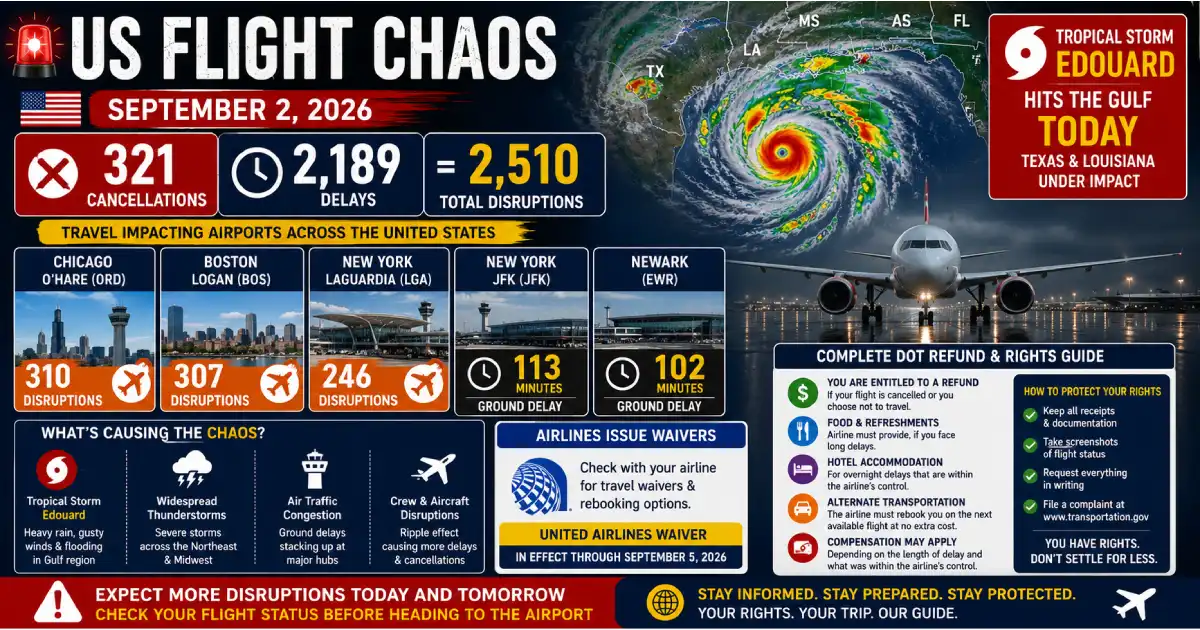
Breaking: The United States aviation network is recording its most severe double-storm disruption of the 2026 autumn travel season on Wednesday September 2. A total of 321 cancellations and 2,189 delays — 2,510 total disruptions — struck the national aviation system on Tuesday September 1, centred on Chicago O’Hare, Boston Logan, and New York’s three major airports, as thunderstorms and unsettled weather battered the Northeast and Midwest corridors simultaneously. Today, September 2, those disruptions are compounding rather than clearing. Chicago O’Hare has recorded 262 delays and 48 cancellations, making it one of the most affected airports in the US. Boston Logan has recorded 247 delays and 60 cancellations. New York LaGuardia has recorded 148 delays and 98 cancellations. JFK is operating under a ground-delay program linked to thunderstorms, with an average delay of 113 minutes. Newark is also facing a ground delay linked to thunderstorms, with an average delay of 102 minutes. San Francisco has a ground delay averaging 50 minutes because of low ceilings. Boston Logan is also operating with a ground delay averaging 97 minutes because of runway construction. And today, a second front is opening: Tropical Storm Edouard made official landfall on September 1 near Johnson Bayou, Louisiana, and its aftermath is now pushing flooding rain and wind across the Gulf Coast, putting Houston George Bush Intercontinental, Houston Hobby, New Orleans Louis Armstrong, Baton Rouge, and Lake Charles under active disruption pressure. The one-two punch of a Northeast thunderstorm system and a Gulf Coast tropical storm hitting the national aviation network simultaneously is producing cascading delays that are spreading well beyond the directly affected airports — touching Denver, Dallas-Fort Worth, Miami, Atlanta, and every domestic connection in between. United Airlines has issued travel waivers for Gulf Coast airports through September 5. American Airlines waivers are active for Northeast disruption. If you are flying anywhere in the United States today, here is every airport, every ground stop, and exactly what you are owed.
Published: September 2, 2026 — Wednesday National Disruptions (September 1): 321 cancellations + 2,189 delays = 2,510 total Today’s Active Ground Programs:
The latest disruption reflects how quickly conditions can deteriorate across the Northeast and Midwest air corridors, where dense traffic and tightly scheduled operations leave limited room to absorb weather shocks. The thunderstorm system that triggered yesterday’s 2,510-disruption total has not cleared — it is producing additional rounds of showers and severe cells today across the tri-state New York region and into southern New England. JFK’s 113-minute average ground delay and Newark’s 102-minute average are being driven by active thunderstorm cells over the approach corridors. LaGuardia’s departure delays — averaging 30 minutes and increasing through the morning — confirm that New York’s three airports are all simultaneously constrained.
This matters for the entire national network because New York is the single most important aviation nexus in the United States. When JFK, EWR, and LGA are all simultaneously running 30–113 minute delays, the cascade radiates outward. Every United flight from Newark to Chicago, Denver, or Los Angeles that departs late arrives late — and that aircraft’s next scheduled rotation departs late. Every American flight from JFK to Miami or Dallas that runs behind puts the aircraft’s next duty crew into rest time calculations. The ripple from three congested New York airports touches hundreds of downstream flights within four to six hours.
Tropical Storm Edouard made landfall at 2:20 PM CDT on September 1 near Johnson Bayou, Louisiana, with sustained winds of 60 mph. Today its remnants are pushing flooding rainfall inland across eastern Texas and western Louisiana — an area that is home to some of the United States’ most important aviation hubs. George Bush Intercontinental Airport (IAH) has issued an active departure delay today. Houston Hobby (HOU), New Orleans Louis Armstrong (MSY), Baton Rouge (BTR), Lake Charles (LCH), and Beaumont/Port Arthur (BPT) are all affected.
Houston Bush Intercontinental is United Airlines’ primary hub for Latin American and Gulf Coast connections — and one of the most important connecting airports in the US for passengers flying from New York, Chicago, Boston, and the Northeast to the Caribbean, Mexico, Colombia, Brazil, and beyond. An active departure delay at IAH today does not just strand Houston passengers — it breaks connections for thousands of passengers who were planning to transit through Houston onto onward flights south.
| Airport | Code | Delays | Cancellations | Total | Ground Program |
|---|---|---|---|---|---|
| Chicago O’Hare | ORD | 262 | 48 | 310 | — |
| Boston Logan | BOS | 247 | 60 | 307 | Ground delay 97 min (runway construction + weather) |
| New York LaGuardia | LGA | 148 | 98 | 246 | Departure delays — avg 30 min, increasing |
| New York JFK | JFK | Multiple | Multiple | Elevated | Ground delay — thunderstorms — avg 113 min |
| Newark Liberty | EWR | Multiple | Multiple | Elevated | Ground delay — thunderstorms — avg 102 min |
| San Francisco | SFO | Multiple | Multiple | Elevated | Ground delay — low ceilings — avg 50 min |
| Houston Bush | IAH | Active today | Active today | 🔴 Growing | Departure delay — Edouard aftermath |
| Houston Hobby | HOU | Active today | Active today | 🔴 Growing | Edouard — active |
| New Orleans | MSY | Active today | Active today | 🔴 Growing | Edouard — active |
| Baton Rouge | BTR | Active today | Active today | 🔴 Growing | Edouard — active |
| Lake Charles | LCH | Active today | Active today | 🔴 Growing | United waiver active |
| 🇺🇸 NATIONAL TOTAL (Sept 1) | — | 2,189 | 321 | 2,510 |
Chicago O’Hare has recorded 262 delays and 48 cancellations — making it the worst single airport by total disruptions in the United States today. O’Hare is simultaneously United Airlines’ largest domestic hub and American Airlines’ second-largest, meaning that 310 disruptions at ORD have an outsized national impact. Every United bank that runs late at O’Hare cascades through the entire Star Alliance connecting network. Every American delay at ORD ripples into the AAdvantage network from coast to coast.
The Chicago disruption is being driven by the Midwest thunderstorm system — the same weather pattern that is hitting the Northeast, but arriving from the west and sweeping through the Great Lakes region. Chicago’s flat geography and position at the intersection of major US weather corridors makes it structurally vulnerable to every major storm system that crosses the continent. September thunderstorms are a recurring feature of Chicago aviation — but the combination of post-summer peak traffic and the simultaneous Northeast + Gulf Coast storms means there is no easy recovery routing today.
United Airlines at O’Hare today:
American Airlines at O’Hare today:
SkyWest at O’Hare:
Boston Logan has recorded 247 delays and 60 cancellations. The airport is also operating with a ground delay averaging 97 minutes because of runway construction.
Boston is today’s second-worst airport and its disruption has an unusual compounding factor: the 97-minute ground delay is not caused by weather alone. Logan is simultaneously conducting active runway construction — a scheduled infrastructure project that is reducing available runway capacity during peak hours. When thunderstorms then layer on top of reduced runway capacity, the effect on average delay times is disproportionately severe. A single runway delay that might average 40 minutes under normal capacity conditions averages 97 minutes under reduced runway availability.
JetBlue, which operates its largest East Coast presence at Boston, is the most exposed carrier to Logan’s extended delays today. JetBlue’s point-to-point model — which relies on precise scheduling with limited buffer — is structurally vulnerable to extended ground delays at hub airports. Delta, American, and United are also significantly affected at Logan.
Boston Logan passengers today: ✅ JetBlue: jetblue.com/travel-info | 1-800-538-2583 ✅ Delta: delta.com/disruptions | 1-800-221-1212 ✅ American: aa.com/travelalerts | 1-800-433-7300 ✅ Allow minimum 3 hours for any Logan connection today — the runway construction + weather combination makes standard connection times non-viable
New York’s three airports are the epicentre of today’s Northeast storm disruption and collectively represent the single most important aviation node in the United States.
JFK is operating under a ground-delay program linked to thunderstorms, with an average delay of 113 minutes.
A 113-minute average ground delay is among the most severe FAA ground delay programs recorded at JFK this year. Every transatlantic arrival and departure at JFK — British Airways, American Airlines, Delta, Virgin Atlantic, Aer Lingus, Lufthansa, Air France, and dozens of others — is being subjected to extended arrival sequencing and departure sequencing delays. Passengers connecting at JFK from international flights onto domestic services — or vice versa — face the highest risk of missed connections of any US airport today.
What JFK passengers must do right now: ✅ 113-minute average means your flight is very likely delayed — check your specific flight number on the FAA system status page at fly.faa.gov ✅ If connecting internationally through JFK today: give yourself minimum 3.5 hours buffer — the 113-minute average means individual delays are ranging from 45 minutes to 3+ hours ✅ Contact your airline proactively if your connection is under 3 hours — they can reroute you before you miss the connection rather than after
Newark is also facing a ground delay linked to thunderstorms, with an average delay of 102 minutes.
Newark is United Airlines’ East Coast hub and one of the busiest airports in the country. A 102-minute average ground delay at EWR affects every United transcontinental, transborder, and international departure from the airport. United’s Newark–Houston flights are subject to both the EWR ground delay and the Houston departure delay from Edouard — creating a total double-disruption on one of the most important domestic US routes.
The United travel waiver for JFK/EWR covers September 1 travel with rebooking on flights departing before September 4 — check united.com/travel-alerts for current Newark-specific waiver status.
New York LaGuardia has recorded 148 delays and 98 cancellations. LGA is experiencing departure delays averaging 30 minutes, with delays increasing.
LaGuardia’s 98 cancellations give it the highest cancellation count of any single airport in today’s data — more than Chicago, more than Boston, more than JFK. This reflects LaGuardia’s particular vulnerability to weather: the airport is physically constrained, has no spare capacity buffer, and serves primarily short-haul domestic routes where cancellation is often the airline’s preferred tool for recovering aircraft positioning rather than waiting out multi-hour delays.
Delta, American, and Southwest are the dominant carriers at LaGuardia. Delta’s extensive LaGuardia network — serving most major East Coast and Southeast US cities — is particularly affected by the 98-cancellation figure.
Tropical Storm Edouard’s aftermath is generating flooding conditions and turbulent approaches across the Gulf Coast corridor. IAH has an active departure delay today — a formal FAA Traffic Management Initiative affecting all outbound flights until conditions improve. United Airlines’ waiver for Houston covers September 1 and 2 — rebook onto any United flight departing through September 5.
All three airports remain directly affected by Edouard’s inland flooding rainfall. New Orleans Louis Armstrong serves as a key connecting point for Gulf Coast and Caribbean leisure travel. Baton Rouge and Lake Charles serve essential regional communities with limited alternative transport options.
Critical for Gulf Coast passengers: Edouard’s remnants could produce 3–5 inches of additional rainfall today over eastern Texas and western Louisiana, with isolated spots receiving up to 10 inches. Flood warnings issued by the National Weather Service remain active across the region. Do not attempt to drive to these airports in flood conditions — contact your airline and rebook remotely.
| Carrier | Primary Hub Affected | Notes |
|---|---|---|
| United Airlines | ORD (262 delays), EWR (102-min delay), IAH (Edouard) | Worst carrier by combined impact — three major hubs hit simultaneously |
| American Airlines | ORD, LGA (98 cancellations), JFK | 48 ORD cancellations + LaGuardia 98-cancel hub exposure |
| JetBlue | BOS (247 delays, 97-min ground delay) | Highest BOS exposure — Boston is JetBlue’s largest base |
| Delta Air Lines | LGA (dominant carrier), BOS | LaGuardia 98 cancellations — Delta is primary LGA carrier |
| Southwest Airlines | LGA, ORD (secondary) | LaGuardia presence + Chicago exposure |
| SkyWest | ORD (feeder for United + American) | Regional feeders grounding cascade connections |
| Spirit Airlines | LGA, EWR (secondary) | Elevated cancellations — no interline agreements |
This is the single most important passenger protection in US aviation and one that airlines routinely fail to communicate clearly:
The combination of weather-related restrictions, airport operating conditions, traffic-management measures, and normal airline operational requirements is contributing to changing schedules across major US travel hubs. Regardless of which of these causes applies to your specific cancelled flight, your refund right is the same.
| Situation | Your Right |
|---|---|
| Flight cancelled — ANY cause including weather | Full cash refund to original payment — mandatory and automatic |
| Domestic flight delayed 3+ hours | You may choose a full cash refund instead of traveling |
| International flight delayed 6+ hours | You may choose a full cash refund instead of traveling |
| Significant departure airport change | Full cash refund right activated |
| Extra connection added to itinerary | Full cash refund right activated |
The most important phrase to know: “Under the DOT’s April 2024 Automatic Refund Rule, I am requesting a full cash refund to my original payment method for this cancelled flight. I do not accept a travel credit.” Airlines cannot force a voucher on you for a cancelled flight. This right is unconditional.
United Airlines Active Waivers:
Other Major Carriers: At the time of United’s alert, Delta, American, Southwest, and JetBlue had not yet updated their travel alerts page with rebooking options for travelers out of New York, New Jersey and Philadelphia. Check each carrier’s alerts page directly — waivers are typically issued 12–24 hours into a disruption event and may now be live.
Even when weather exempts airlines from compensation, their Customer Service Plans (contractually binding) require:
| Carrier | Meals/Vouchers | Hotel (weather) | Hotel (controllable) |
|---|---|---|---|
| United | ✅ Yes | ⚠️ Discretionary | ✅ Required |
| American | ✅ Yes | ⚠️ Discretionary | ✅ Required |
| Delta | ✅ Yes | ⚠️ Discretionary | ✅ Required |
| Southwest | ✅ Yes | ✅ Provides hotels even for weather | ✅ Required |
| JetBlue | ✅ Yes | ✅ Provides hotels even for weather | ✅ Required |
Southwest and JetBlue are significantly more generous on weather-related hotel accommodation. If you are stranded overnight and flying Southwest or JetBlue, ask explicitly for hotel accommodation — they will typically provide it.
With cascading cancellations forcing passengers onto fewer available flights, overbooking situations become more common during multi-day disruption events. If you are denied boarding involuntarily at any point:
| Delay to Destination | DOT-Mandated Cash Compensation |
|---|---|
| 1–2 hours domestic | $775 minimum |
| 2+ hours domestic / 1–4 hours international | $1,550 minimum |
This is separate from any refund — you receive both.
Step 1 — Check your inbound aircraft on FlightAware BEFORE leaving home Go to flightaware.com. Enter your specific flight number. Find the current location of the actual aircraft scheduled for your rotation. If it is sitting at a storm-hit airport — Chicago, Boston, New York, or any Gulf Coast city — your departure will be late regardless of what the airline’s departure board shows. This single check is the most time-saving action any US traveller can take today.
Step 2 — Know your ground delay status at fly.faa.gov The FAA’s official National Airspace System status page (fly.faa.gov) shows every active ground delay program and ground stop in real time. Before heading to any of today’s affected airports, check whether your specific airport has an active FAA program. A 113-minute average delay at JFK means individual delays range from 45 minutes to over 3 hours — your specific flight could be at either end of that range.
Step 3 — Rebook via app, not by phone Phone queues at United, American, Delta, and Southwest during major disruption events run 45–120 minutes. Airline apps process rebooking in 3–5 minutes. Use the app first. If the app cannot handle your itinerary (multi-city, complex routing, international), then call.
Step 4 — Northeast connections: 3-hour minimum buffer today Do not attempt a connection under 3 hours at JFK, EWR, LGA, or BOS today. The 113-minute average at JFK and 102-minute average at EWR mean a standard 90-minute connection has a very high probability of failure. If you have a tight connection today, call your airline right now and ask them to note your booking and discuss alternative routings.
Step 5 — Gulf Coast passengers: do not drive to flood-warning airports If you are near Houston, New Orleans, or Baton Rouge and have an active flood warning in your area, do not drive to the airport. Contact your airline by phone or app and rebook remotely. Flood conditions near airport access roads can trap you in transit with no ability to reach your gate.
Step 6 — If cancelled: cash refund, not voucher At any airline counter or on any phone call: “My flight has been cancelled. I am requesting a full cash refund to my original payment method under the DOT’s April 2024 Automatic Refund Rule.” Keep the conversation on this point — airline agents are trained to offer travel credits first. You are not required to accept a credit.
Step 7 — Labor Day weekend is 5 days away — act fast Labor Day (September 7) is one of the three highest-traffic travel weekends in the US. Recovery seats are filling rapidly. Rebook into the September 3–6 window today. By Thursday, the best recovery options will be gone.
| Resource | Contact / Link |
|---|---|
| FAA National Airspace Status | fly.faa.gov |
| FlightAware Live Tracking | flightaware.com |
| United Airlines Travel Alerts + Waiver | united.com/travel-alerts |
| United Phone | 1-800-864-8331 |
| American Airlines Travel Alerts | aa.com/travelalerts |
| American Phone | 1-800-433-7300 |
| Delta Travel Disruptions | delta.com/us/en/travel-disruptions |
| Delta Phone | 1-800-221-1212 |
| Southwest Travel Disruptions | southwest.com/travel-disruptions |
| Southwest Phone | 1-800-435-9792 |
| JetBlue Travel Info | jetblue.com/travel-info |
| JetBlue Phone | 1-800-538-2583 |
| Spirit Airlines | spirit.com |
| Houston IAH Status | fly2houston.com |
| New Orleans MSY Status | flymsy.com |
| National Hurricane Center | nhc.noaa.gov |
| DOT Consumer Protection | airconsumer.dot.gov |
| DOT Phone | 1-202-366-2220 |
Wednesday September 2, 2026 is the most disrupted day in US aviation since the summer season began, with a double-storm system producing simultaneous chaos across the Northeast and Gulf Coast. Travelers moving through some of the United States’ busiest air hubs faced a difficult day as a mix of severe weather and operational constraints contributed to 321 cancellations and 2,189 delays centered on Boston, New York and Chicago. Today those numbers are compounding rather than clearing: Chicago O’Hare has recorded 262 delays and 48 cancellations. Boston Logan has recorded 247 delays and 60 cancellations. New York LaGuardia has recorded 148 delays and 98 cancellations. JFK is operating under a ground-delay program with an average delay of 113 minutes. EWR is facing a ground delay with an average delay of 102 minutes. And Houston, New Orleans, and the entire Gulf Coast are absorbing Tropical Storm Edouard’s flooding aftermath simultaneously.
The six things every US passenger must do right now:
For More Resources:
Related Articles:
Posted By : Vinay
This article is provided for general informational purposes only and is based on information available at the time of publication. Travel advisories, airline schedules, airport operations, visa requirements, government regulations, and other travel-related information are subject to change without prior notice. While Travel Tourister makes reasonable efforts to verify information using official announcements, government publications, airline and airport communications, and other reliable sources, we cannot guarantee that all information remains complete, accurate, or up to date at all times. Readers should independently verify any information that may affect their travel plans with the relevant airline, airport authority, government agency, embassy, or other official source before making travel, financial, or other decisions. Travel Tourister shall not be liable for any direct or indirect loss, inconvenience, or damages arising from the use of or reliance on the information contained in this article. Nothing in this publication constitutes legal, immigration, financial, or professional travel advice. If you believe any information in this article is inaccurate or outdated, please contact our editorial team. We review all credible correction requests promptly and update our content whenever appropriate.
Lastest News
2nd Floor, 39, Above Kirti Club, DLF Industrial Area, Kirti Nagar, New Delhi, Delhi 110015



Travel Tourister is a leading Travel portal where we introduce travellers to trusted travel agents to make their journey hasselfree, memorable And happy. Travel Tourister is a platform where travellers get Tour packages ,Hotel packages deals through trusted travel companies And hoteliers who are working with us across the world. We always try to find new and more travel agents and hoteliers from every nook and corners across the world so that you could compare the deals with different travel agents and hoteliers and book your tour or hotel with the one you have chosen according to your taste and budget.
Copyright © Travel Tourister, India. All Rights Reserved

 Call
Call Enquiry