Published on : 17 Sep 2026
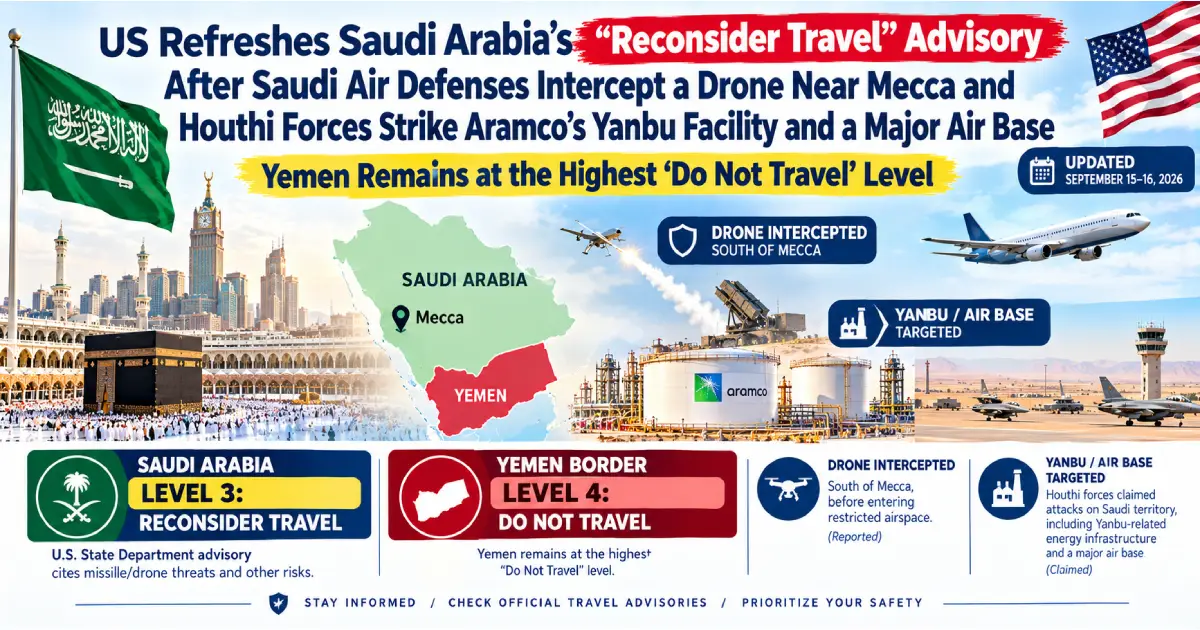
A drone intercepted before it could reach one of Islam’s holiest cities is the kind of incident that reshapes a travel advisory’s tone, even when the official risk category doesn’t change.
The US State Department updated its Saudi Arabia travel advisory summary on September 15, 2026, maintaining the country at “Level 3: Reconsider Travel” — a level Saudi Arabia has held continuously since March 8, 2026, when the department first ordered non-emergency US government employees and their families to leave the country. The department’s own advisory page is explicit that this update changed no risk indicators or levels; it simply refreshed the advisory’s language. But the specific incidents behind that refresh are what make it newsworthy: published reporting dated September 16 describes Saudi air defenses intercepting a drone south of Mecca before it could enter restricted airspace, with the alleged launch tied to Yemen’s Houthi movement. Separately, Houthi spokesman Yahya Saree said a fresh wave of missile and drone attacks targeted Saudi Aramco’s oil facilities in the Red Sea port city of Yanbu and King Khalid Air Base in Khamis Mushait.
The advisory continues to draw a sharp distinction between most of Saudi Arabia and the country’s border region with Yemen, which remains at “Level 4: Do Not Travel” — the State Department’s highest alert category. That border designation isn’t new either, but the department’s Saudi Arabia guidance now specifies that US government employees are barred from travelling within 20 miles of the Yemen border entirely, underscoring how seriously Washington is treating the ongoing cross-border threat.
Published: September 17, 2026 — Thursday Advisory status: Level 3 “Reconsider Travel” — unchanged since March 8, 2026; summary refreshed September 15, 2026 Yemen border region: Level 4 “Do Not Travel” — the highest advisory category US government employee restriction: No travel within 20 miles of the Yemen border Trigger incidents cited in recent reporting:
It would be easy to read “no changes to the advisory level” and conclude nothing has really happened here. That would miss the point. Advisory levels are broad, static categories — Level 3 covers everything from a persistently elevated terrorism risk to an active shooting conflict, and a country can sit at that same level for months while the specific situation on the ground shifts considerably underneath it. What actually moves the needle for travelers is the summary language and the specific incidents the State Department chooses to cite when it refreshes that summary — and a drone intercepted near Mecca, one of the most significant religious sites in the world and a destination for millions of annual pilgrims and visitors, is a materially different kind of incident than the advisory’s earlier language reflected.
This pattern connects directly to what this site has tracked since July, when a Houthi missile and drone attack struck Abha International Airport in Saudi Arabia’s southern Asir province, and more recently this week’s broader look at escalating regional security conditions affecting Gulf aviation. The through-line across all of this coverage is the same southern border region and the same Houthi-Saudi dynamic — this week’s Mecca drone intercept and the Yanbu/Khamis Mushait attacks are best understood as the latest entries in an ongoing pattern rather than an isolated new development.
Level 3, “Reconsider Travel,” is not a travel ban, and it is not the same as Yemen’s Level 4 “Do Not Travel” designation. In practical terms, it signals that the US government believes the general risk environment warrants genuine reconsideration of non-essential travel, while stopping short of advising against all travel to the country. Many of the specific concerns cited — armed conflict risk, terrorism, and drone/missile activity — are heavily concentrated toward the country’s southern and border regions rather than evenly distributed nationwide. Riyadh, Jeddah, and destinations like AlUla continue to operate as functioning tourism and business destinations, even as the overall country-level advisory sits above the more common Level 2 rating most destinations carry.
If your Saudi Arabia itinerary includes any proximity to the southern border region — road trips, tours through southern provinces, or business travel near Khamis Mushait or Abha — this is the part of the advisory that carries the most direct, specific risk. The State Department’s own guidance for its employees, barring travel within 20 miles of the Yemen border entirely, is a useful benchmark for civilian travelers assessing their own risk tolerance in that specific area, even though the same formal restriction doesn’t legally apply to private citizens.
✅ Read the full State Department advisory text at travel.state.gov and compare it against your specific itinerary — cities, day trips, and any road routes ✅ Treat the southern border region as materially higher risk than the rest of the country, consistent with the government’s own 20-mile employee restriction ✅ Build extra time into your itinerary for airport processing, potential last-minute schedule changes, and contingency lodging, given the broader aviation disruption this site has tracked across the region this week ✅ Ensure your passport has at least six months of validity beyond your planned departure date, standard practice for Saudi entry regardless of the current advisory ✅ If your plans have flexibility, consider postponing non-essential travel until the situation stabilizes further; if travel is necessary, register with your embassy and monitor advisory updates closely
US State Department Saudi Arabia advisory: travel.state.gov US State Department Yemen advisory: travel.state.gov UK FCDO travel advice: gov.uk/foreign-travel-advice/saudi-arabia
Related Articles:
Posted By : Vinay
This article is provided for general informational purposes only and is based on information available at the time of publication. Travel advisories, airline schedules, airport operations, visa requirements, government regulations, and other travel-related information are subject to change without prior notice. While Travel Tourister makes reasonable efforts to verify information using official announcements, government publications, airline and airport communications, and other reliable sources, we cannot guarantee that all information remains complete, accurate, or up to date at all times. Readers should independently verify any information that may affect their travel plans with the relevant airline, airport authority, government agency, embassy, or other official source before making travel, financial, or other decisions. Travel Tourister shall not be liable for any direct or indirect loss, inconvenience, or damages arising from the use of or reliance on the information contained in this article. Nothing in this publication constitutes legal, immigration, financial, or professional travel advice. If you believe any information in this article is inaccurate or outdated, please contact our editorial team. We review all credible correction requests promptly and update our content whenever appropriate.
Lastest News
2nd Floor, 39, Above Kirti Club, DLF Industrial Area, Kirti Nagar, New Delhi, Delhi 110015



Travel Tourister is a leading Travel portal where we introduce travellers to trusted travel agents to make their journey hasselfree, memorable And happy. Travel Tourister is a platform where travellers get Tour packages ,Hotel packages deals through trusted travel companies And hoteliers who are working with us across the world. We always try to find new and more travel agents and hoteliers from every nook and corners across the world so that you could compare the deals with different travel agents and hoteliers and book your tour or hotel with the one you have chosen according to your taste and budget.
Copyright © Travel Tourister, India. All Rights Reserved

 Call
Call Enquiry