Published on : 17 Sep 2026
By Travel Tourister | Updated Sep 2026
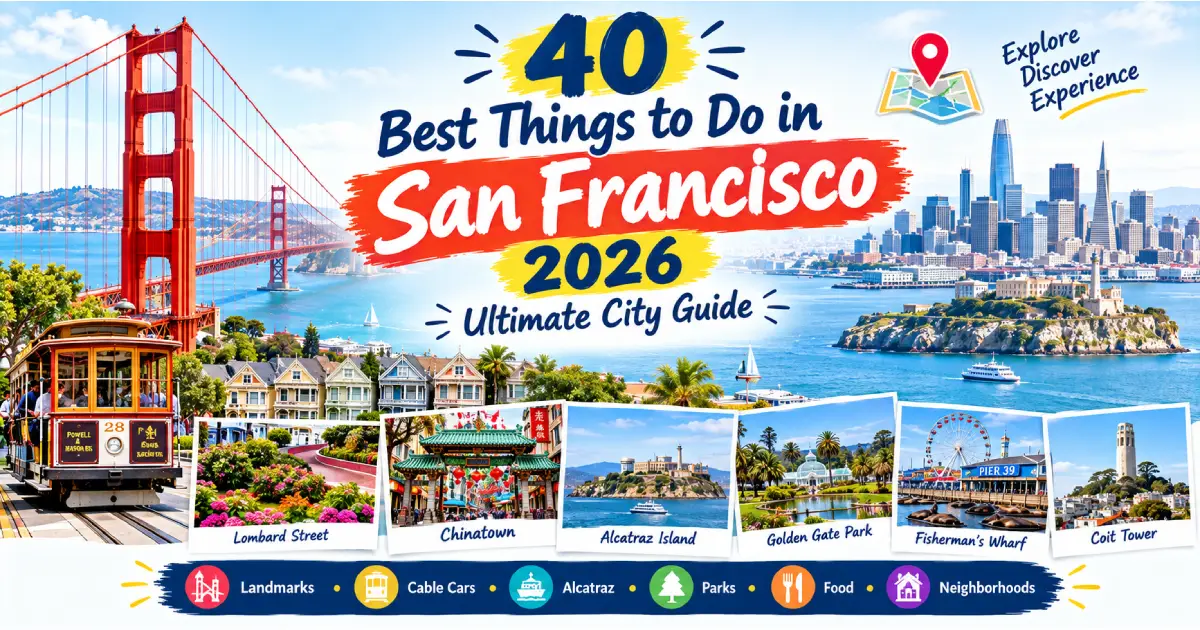
San Francisco is the American city that most consistently produces the specific emotion of arrival — the moment the Golden Gate Bridge appears through the morning fog, or the first view of the city’s hills rising from the bay, or the specific quality of the fog-cooled air on a July afternoon when the rest of California is baking at 100°F, that distinctive San Francisco-ness that residents describe as the reason they stay and visitors describe as the reason they return. The best things to do in San Francisco in 2026 span the internationally celebrated (the Golden Gate Bridge walk, the Alcatraz night tour, the cable car ride up Powell Street) through the specifically local (the Mission District’s burrito culture, the morning fog watching from Twin Peaks, the Sunday morning Ferry Building Farmers Market with its Acme Bread and Cowgirl Creamery cheese) to the genuinely extraordinary (the de Young Museum’s collection, the day trip to Muir Woods’ cathedral redwood groves, and the 49-Mile Scenic Drive that connects the city’s most dramatic viewpoints).
What makes San Francisco specifically different from America’s other major cities is the combination of the natural dramatic geography (the seven-by-seven mile peninsula city surrounded by water on three sides, the hills rising to 285 meters within the city limits, the Pacific Ocean 30 minutes from downtown, and the bay providing the specific maritime character that the coastal geography generates) with the cultural density that a city of 870,000 manages to maintain (the concentration of technology wealth alongside the specific bohemian and countercultural traditions that the Beats, the Haight-Ashbury, the Castro, and the Mission District each represent in succession — the specific San Francisco cultural sequence from the 1950s Beats through the 1960s Summer of Love through the 1970s gay rights movement through the tech boom and its social disruptions all visible in the city’s physical and cultural fabric simultaneously). This guide covers the 40 best things to do in San Francisco for every type of 2026 visitor.
For related guides, see our San Francisco Travel Guide 2026, Best Restaurants in San Francisco 2026, Best Time to Visit San Francisco 2026, and Day Trips from San Francisco 2026.
| # | Activity | Category | Cost | Duration | Book Ahead? |
|---|---|---|---|---|---|
| 1 | Walk the Golden Gate Bridge | Landmark | Free | 2–3 hrs | No |
| 2 | Alcatraz Island Tour | Historic Site | $44–$57 | 3–4 hrs | Yes (weeks) |
| 3 | Cable Car Ride (Powell-Hyde) | Transport/Iconic | $8 | 30 min | No |
| 4 | Fisherman’s Wharf | Waterfront | Free to walk | 2 hrs | No |
| 5 | Ferry Building Farmers Market | Food/Market | Free entry | 2 hrs | No (Sat AM) |
| 6 | Chinatown Walk | Culture | Free | 1.5 hrs | No |
| 7 | Golden Gate Park | Park | Free | Half–full day | No |
| 8 | de Young Museum | Museum | $25 | 2–3 hrs | No |
| 9 | Mission Dolores and the Murals | Culture | $7 (museum) | 1.5–2 hrs | No |
| 10 | Twin Peaks Viewpoint | Viewpoint | Free | 45 min | No |
| 11 | Lombard Street | Sightseeing | Free | 20 min | No |
| 12 | Muir Woods Day Trip | Nature | $18 (entry) | Half day | Yes (shuttle) |
| 13 | Napa Valley Day Trip | Wine/Food | $50–$200+ | Full day | Yes (wineries) |
| 14 | Haight-Ashbury Walk | Culture | Free | 1.5 hrs | No |
| 15 | The Castro | Culture/LGBTQ+ | Free | 1.5 hrs | No |
| 16 | SFMOMA | Museum | $25 | 2–3 hrs | No |
| 17 | Ghirardelli Square | Shopping/Chocolate | Free to enter | 1 hr | No |
| 18 | Coit Tower and Telegraph Hill | Viewpoint | $15 (elevator) | 1.5 hrs | No |
| 19 | Sausalito Ferry Day Trip | Day Trip | $14–$16 (ferry) | Half day | No |
| 20 | Angel Island Ferry | Nature/History | $18 (ferry) | Half day | No |
| 21 | Palace of Fine Arts | Architecture | Free | 30–45 min | No |
| 22 | Painted Ladies (Alamo Square) | Photography | Free | 30 min | No |
| 23 | Lands End Trail and Sutro Baths | Hiking | Free | 2 hrs | No |
| 24 | The Embarcadero Walk | Waterfront | Free | 1–2 hrs | No |
| 25 | Exploratorium | Museum | $30 | 2–3 hrs | No |
| 26 | California Academy of Sciences | Museum | $35 | 2–3 hrs | No |
| 27 | Ocean Beach at Sunset | Beach/Nature | Free | 1 hr | No |
| 28 | Mission Burrito Lunch | Food | $12–$18 | 45 min | No |
| 29 | North Beach and City Lights Bookstore | Culture | Free | 1.5 hrs | No |
| 30 | Tartine Bakery Morning Pastry | Food | $5–$12 | 30 min | No (line) |
| 31 | Dolores Park | Park/Social | Free | 1–2 hrs | No |
| 32 | Fort Point Under the Bridge | History | Free | 45 min | No |
| 33 | Baker Beach | Beach | Free | 1–2 hrs | No |
| 34 | Sunset District Dim Sum | Food | $15–$25 | 1.5 hrs | No |
| 35 | SoMa and South Beach Walk | Culture | Free | 1 hr | No |
| 36 | Japantown | Culture | Free | 1 hr | No |
| 37 | Filbert Street Steps | Viewpoint/Walk | Free | 45 min | No |
| 38 | Point Reyes National Seashore | Nature | Free (parking $30) | Full day | No |
| 39 | Comedy Shows at Cobb’s or Punch Line | Entertainment | $20–$40 | 2 hrs | Yes |
| 40 | Sunday Brunch in the Mission | Food | $25–$45 | 1.5 hrs | Yes |
Cost: Free (pedestrian access) | Location: Golden Gate Bridge, connecting San Francisco to Marin County | Best time: Early morning (7–9 AM) for clearest fog conditions | Duration: 2–3 hours (walk + viewpoints) | Parking: Vista Point parking lots (arrive early — fills by 9 AM on weekends)
The Golden Gate Bridge (the 1937 International Orange suspension bridge connecting San Francisco’s northern tip with the Marin Headlands, the 2.7-kilometer main span suspended from two 227-meter towers — the most photographed bridge in the world and the defining single element of San Francisco’s visual identity) is the starting point for every San Francisco visit and the most genuinely awe-inspiring free experience available in any American city. The pedestrian walkway (the eastern sidewalk open to pedestrians and cyclists from 5 AM to 9 PM daily, the west sidewalk reserved for cyclists) allows the full 2.7-kilometer crossing from the San Francisco anchorage to Vista Point in Marin — the specific mid-span views (the San Francisco skyline visible to the southeast, Alcatraz Island in the bay, and the Pacific Ocean visible to the northwest through the Golden Gate itself) constituting the most complete single visual engagement with San Francisco’s geography available at any accessible point.
The fog strategy: San Francisco’s famous summer fog (the specific Pacific marine layer that rolls through the Golden Gate during the summer months — June through August most specifically) creates two dramatically different Golden Gate Bridge experiences. The fog-shrouded bridge (the towers disappearing into the grey bank above while the main span remains visible) is the most specifically atmospheric and most photographically distinctive version — the specific image that makes San Francisco’s summer fog visually famous. The fog-clear bridge (most reliably clear in September and October, and on winter days following rain) provides the most complete architectural and geographic view. Both are specifically worthwhile — the visitor who sees only one is missing half the story.
The best viewpoints:
Battery Spencer (Marin Headlands): The most dramatically elevated single Golden Gate viewpoint — the former military battery 90 meters above the water level on the Marin side, the full bridge visible in its entirety with the San Francisco skyline directly behind it and the Pacific in the foreground. Access by car from the Sausalito side (take the first exit after crossing the bridge) or by ferry to Sausalito + taxi/Uber to the Headlands.
Fort Point (San Francisco side): At water level directly beneath the San Francisco anchorage — the view looking straight up at the bridge’s underside from 27 meters below, the specific engineering visible in extreme close-up. Free access, the most dramatically unusual single Golden Gate viewpoint available.
Baker Beach: The most accessible in-city beach viewpoint — the bridge visible to the north from the beach level, the Marin Headlands behind it, and the specific west-facing orientation providing the most dramatically lit late-afternoon version of the bridge visible from San Francisco proper.
Insider tips: The Golden Gate Bridge on foot in the early morning (7–8 AM on weekdays) provides the crossing with minimum pedestrian traffic — the afternoon weekend crossings can be congested enough to slow the walk significantly. The specific morning quality of light (the low-angle sun from the east illuminating the International Orange paint at its most saturated, the bay in the shadow of the bridge creating a specific two-tone water color) is the most photographically rewarding single Golden Gate condition.
Cost: $44.25 (day tour, adult); $57 (evening tour, adult) | Access: Ferries depart from Pier 33, The Embarcadero | Duration: 2.5 hours minimum on island; 3.5 hours for the evening tour | Book: Yes — weeks to months ahead at alcatrazcruises.com | Hours: Day tours multiple times daily; evening tours Thursday–Monday
Alcatraz (the 22-acre island in San Francisco Bay that housed the United States’ most notorious federal penitentiary from 1934 to 1963 — the island whose isolation, surrounded by the bay’s strong currents and frigid water, made it the preferred location for the country’s most escape-resistant federal prison) is simultaneously the most historically significant and the most experientially gripping single San Francisco attraction: the audio tour (narrated by former Alcatraz guards and inmates, the specific personal accounts of prison life, escape attempts, and the 1962 escape by Frank Morris and the Anglin Brothers [the three men who disappeared from the island and whose fate remains officially unknown] creating the most vivid historical encounter available at any National Park Service site in California).
The cellhouse audio tour: The defining Alcatraz experience — the National Park Service’s multi-award-winning audio tour (available in multiple languages, included in the ferry ticket price) allows self-paced exploration of the main cellhouse, the exercise yard, the solitary confinement block (D Block), and the hospital, with the specific audio accounts (former inmates describing their cells, former guards describing the security procedures, and the specific audio reconstruction of the 1946 “Battle of Alcatraz” [the failed escape attempt that resulted in the deaths of two guards and three inmates]) creating the most immediately immersive single US penitentiary experience.
Day tour vs. evening tour:
Practical tips: Book Alcatraz tickets 2–4 weeks ahead for weekday visits in the off-season; 4–8 weeks ahead for summer weekends. Sold-out dates are genuinely common from May through September. Wear layers — the island is consistently 10–15°F cooler than the city center.
Cost: $8 per single ride; $24 day pass (Muni Passport covers cable cars) | Routes: Powell-Hyde (most scenic), Powell-Mason, California Street | Best time: Early morning (before 9 AM) to avoid lines | Duration: 30–45 minutes one-way | Year-round
The San Francisco cable cars (the three surviving routes from the original 1873 cable car system — the only National Historic Landmark that moves, the specific mechanical system [the underground cable running at constant speed beneath the street, the gripman operating the car by gripping and releasing the moving cable] unchanged in fundamental principle since Andrew Hallidie introduced it to conquer San Francisco’s hills in 1873) provide the most specifically San Francisco single transport experience: the Powell-Hyde line (the most scenic route — climbing from Powell and Market through the Russian Hill residential streets, over the Russian Hill summit with the bay view, and descending to the Hyde Street Pier at Fisherman’s Wharf) covering the most dramatically varied urban topography of any American public transit route in 30 minutes.
The Powell-Hyde line: The most recommended cable car route for visitors — the ascent through the Union Square area and the Nob Hill commercial zone, the summit of Russian Hill with the first bay view appearing suddenly at the crest, the descent through the residential Russian Hill streets (the specific gravity-assisted momentum of the car descending the steep grade, the gripman calling out the approaching turns), and the Fisherman’s Wharf terminus at the Hyde Street cable car barn (the historic car barn visible from the terminus, a free walk-through exhibition of the mechanical system’s history and current operation).
The cable car lines strategy: Avoiding the Powell Street turnaround queue (the specific 45-minute-to-2-hour wait at the Powell/Market starting point, where passengers board in sequence — the most painful single San Francisco tourist experience in peak summer) by boarding at intermediate stops (California and Powell for the Powell-Hyde/Powell-Mason, the mid-route stops providing wait times of 5–15 minutes rather than the turnaround’s 45–120) is the single most practically useful San Francisco visitor tip for the cable car experience.
Cost: Free to walk | Location: The northern waterfront, Pier 39 through Pier 45 | Best time: Morning (before tourist crowds peak) | Duration: 1.5–2 hours | Season: Year-round
Fisherman’s Wharf (the northern San Francisco waterfront from Pier 33 [the Alcatraz ferry terminal] through Pier 45 [the historic USS Pampanito submarine and the World War II Liberty Ship SS Jeremiah O’Brien], centered on Pier 39 [the commercial complex with the sea lion colony] and the Ghirardelli Square historic chocolate factory) is the single most visited San Francisco destination and the one most frequently described by San Francisco residents as the least specifically authentic experience of the city. Both assessments are correct simultaneously — Fisherman’s Wharf is heavily tourist-facing in its commercial character, and it also provides genuinely worthwhile experiences that the resident-dismissal obscures.
The genuinely worthwhile Fisherman’s Wharf experiences:
The sea lions at Pier 39: The California sea lion colony that spontaneously colonized the K-Dock boat slips in January 1990 (following the Loma Prieta earthquake, the sea lions arriving and remaining on the dock despite the boat owners’ initial displeasure, the city eventually designating the dock as a marine mammal area and allowing the colony to remain) now numbers 300–1,500 individuals depending on season. The free public viewing (from the dock perimeter) provides the most accessible close-range marine mammal encounter in any American urban setting — the sea lions’ specific sounds (the barking, the social jostling for position on the floating docks), smells, and general physical presence creating a genuinely wildlife-encounter experience in the middle of a tourist commercial complex.
The Dungeness crab in season (November–June): The sidewalk crab stands (the cracked fresh-cooked Dungeness crab, served in the traditional San Francisco sidewalk format from the stands along Jefferson Street) represent the most specifically authentic Fisherman’s Wharf food tradition — the Dungeness crab (native to the Pacific Northwest and Northern California, its specific sweet and briny flavor the most specifically San Francisco Bay seafood experience available at any outdoor vendor).
USS Pampanito (Pier 45): The preserved WWII fleet submarine (CHF 20 — the self-guided tour of the actual working submarine, the crew’s quarters visible in close-up and the torpedo room accessible, providing the most physically immediate WWII naval experience available at any Northern California attraction).
Cost: Free entry | Location: The Embarcadero at Market Street | Hours: Saturdays 8 AM–2 PM; Tuesdays and Thursdays 10 AM–2 PM | Best time: Saturday morning, arriving before 9:30 AM
The Ferry Building Farmers Market (the Saturday morning market behind and beside the historic Ferry Building on the Embarcadero — the most celebrated urban farmers market in California, drawing the finest artisan food producers from throughout Northern California to a setting that is simultaneously a working commercial food hall and the city’s most specifically food-culture-defining public space) provides the most specifically San Francisco single food experience available without a restaurant reservation: Acme Bread Company’s sourdough (the specific bacterial culture of Acme’s starter, the San Francisco Bay Area’s distinctive sourdough character arising from the specific Lactobacillus sanfranciscensis that the local environment sustains), Cowgirl Creamery’s Mt. Tam triple-cream (the most celebrated Northern California artisan cheese, available for tasting at the Ferry Building’s Cowgirl Creamery shop), Blue Bottle Coffee (the Bay Area artisan coffee roaster whose Ferry Building location provides the most quality-controlled single-cup coffee available in San Francisco at a stand-service format), and the various other artisan producers (the ranchers, the farmers, the olive oil producers, the jam makers, and the vegetable growers from Point Reyes to Watsonville) creating the most specifically farm-to-table-origin food market experience in any American city.
What to eat at the Ferry Building market:
Cost: Free (most park areas); paid attractions within the park | Size: 1,017 acres (larger than New York’s Central Park) | Location: Western San Francisco | Duration: Half day to full day | Season: Year-round
Golden Gate Park (the 1,017-acre public park that occupies the western half of San Francisco from Stanyan Street to the Pacific Ocean — larger than Central Park, created from sand dunes through the extraordinary 19th-century horticultural engineering of John McLaren [the park’s superintendent for 55 years] who transformed the shifting dune landscape into one of the most botanically diverse urban parks in North America) contains within its boundaries a remarkable concentration of San Francisco’s finest cultural institutions and natural spaces: the de Young Museum, the California Academy of Sciences, the Japanese Tea Garden (the oldest public Japanese garden in the United States, established 1894 as part of the California Midwinter International Exposition and maintained in continuous operation since), the Conservatory of Flowers (the Victorian glass greenhouse from 1878, the oldest remaining municipal conservatory in North America), the Buffalo Paddock (where a herd of American bison has been maintained since 1891), and the Dutch Windmills (the two working windmills at the park’s western ocean end that historically pumped the fresh water for the park’s irrigation).
Golden Gate Park priorities:
The de Young Museum (CHF 25): The finest single art museum in San Francisco — the collection ranging from American painting from the 17th century through contemporary to the African, Oceanic, and Americas collections that form the de Young’s most internationally significant single holding. The Hamon observation tower (free to access within the museum — the glass-enclosed upper tower providing 360-degree Golden Gate Park and city views) is the museum’s most specifically photographic single element.
California Academy of Sciences ($35): The natural history museum, aquarium, and planetarium combined — the living roof (a 2.5-acre roof planted with California native species visible from the building’s exterior and from an accessible roof terrace) and the Claude the albino alligator (the resident albino American alligator in the Swamp exhibit, the single most specifically sought-after California Academy wildlife encounter) providing the most child-accessible single Golden Gate Park institutional experience.
Japanese Tea Garden (entry $13): The oldest public Japanese garden in the United States — the 5.5-acre garden with its pagodas, koi ponds, and the specific horticultural patience of 130 years of maintenance creating the most complete Japanese garden atmosphere available in an American urban park.
Cost: Free | Location: Northwestern San Francisco (Outer Richmond) | Access: 38 Geary Muni bus to Point Lobos Avenue, then walk | Duration: 2 hours | Best time: Morning for coastal clarity
The Lands End Trail (the 3.5-mile trail along San Francisco’s northwestern coastal bluff — the trail running from the USS San Francisco Memorial (above Land’s End) through the native coastal scrub vegetation to the Sutro Baths ruins and the Cliff House, the Pacific Ocean visible below throughout) is the single most dramatically beautiful urban trail in San Francisco: the specific combination of the Golden Gate Bridge visible to the north (the approach view of the bridge from the Lands End bluffs is the most naturally staged single Golden Gate viewpoint in the city, the bridge framed by the coastal vegetation and the Pacific below), the coastal geology (the exposed rock formations of the Point Lobos headland visible from the trail), and the Sutro Baths ruins (the remains of the 1896 Adolph Sutro saltwater swimming complex — the largest indoor swimming establishment in the world when built, now a National Park Service Historic Site with the tidal pools occupying the former pool basins and the ruins’ concrete walls creating the most dramatically atmospheric single San Francisco historic ruin).
The Sutro Baths at sunset: The Sutro Baths ruins (the concrete pool basins filling with Pacific Ocean water through a sea cave connection, the ruins’ walls reflecting in the standing water) at sunset create the most dramatically atmospheric single photography location in San Francisco — the low-angle Pacific sunset light on the ruins, the ocean below, and the Golden Gate Bridge visible in the distance to the north providing the most complete single San Francisco landscape composition.
Cost: Free | Access: Twin Peaks Boulevard (car recommended; Muni 37 Corbett bus serves the area) | Altitude: 281 meters (Corona Heights) / 277 meters (Eureka Peak) | Best time: Clear days; September and October most reliable
Twin Peaks (the two conical hills at San Francisco’s geographic center, with the Twin Peaks Boulevard summit providing 360-degree unobstructed city panoramas) is the single most comprehensive San Francisco viewpoint: the entire city visible simultaneously — the Financial District skyline to the northeast, the Bay Bridge and the East Bay hills beyond, the Golden Gate Bridge and Marin Headlands to the north, the Pacific Ocean to the west, the San Francisco International Airport (on clear days) to the south, and the entire Golden Gate Park greenbelt visible as a west-east band of green across the city’s middle section. The specific urban geography of San Francisco (the peninsula’s relationship with the bay and the ocean, the hills’ distribution pattern, and the specific concentrated urban density) is most completely comprehensible from Twin Peaks’ elevated position.
Fog watching from Twin Peaks: San Francisco’s summer fog (the marine layer that rolls in from the Pacific, the specific westward fog bank visible from Twin Peaks as it approaches from the direction of the Ocean Beach and the western neighborhoods before reaching and enveloping the Financial District and the bay) provides a specifically dramatic Twin Peaks spectacle from above — watching the fog advance across the city from an elevated position above the fog bank’s initial height is one of the most specifically San Francisco single natural experiences available at no cost.
Cost: $25 (adults); free (children under 12) | Location: 151 Third Street, SoMa | Hours: Thursday–Tuesday 10 AM–5 PM (Thursday until 9 PM) | Duration: 2–3 hours
SFMOMA (the San Francisco Museum of Modern Art, expanded in 2016 with the Snohetta-designed addition that tripled the exhibition space — the new building’s distinctive wavy white fiberglass facade a significant architecture statement in the SoMa neighborhood) is the largest modern art museum in the western United States: the permanent collection (the Matisse painting collection — the most significant single artist holding, including “Femme au Chapeau” from 1905, one of the most iconic Fauvist paintings; the Frida Kahlo holdings; the photography collection; and the design and architecture collection) and the temporary exhibition program (consistently ambitious and internationally significant in scale and quality) creating the most comprehensive single modern and contemporary art museum experience on the West Coast.
The free permanent collection access: SFMOMA offers free access to selected floors of the permanent collection for all visitors (the first three floors free without admission, the complete museum requiring the $25 ticket) — making the museum one of the most specifically accessible large modern art institutions in California for budget-conscious visitors who want partial engagement with the collection.
Cost: Free (murals); $12–$18 (burritos) | Location: Mission District | Best time: Daytime for the murals; any time for food | Duration: 2–3 hours
The Mission District (the historically Latino neighborhood between 14th and 24th Streets, the most specifically culturally complex single neighborhood in San Francisco — the layers of the Ohlone Indigenous culture, the Spanish Mission period, the 19th-century German and Irish working-class immigrant community, the 20th-century Mexican and Central American community, and the 21st-century tech-boom gentrification all visible simultaneously in the neighborhood’s streetscapes, food culture, and specific social tensions) provides the most specifically complex single San Francisco neighborhood walk.
The Mission murals: The most concentrated public mural program in the United States — the Mission District’s walls (the Balmy Alley mural corridor, the Clarion Alley mural program, and the various individually commissioned and spontaneous murals throughout the neighborhood’s walls) create an outdoor public art gallery of extraordinary political, historical, and aesthetic richness. The Balmy Alley (between 24th and 25th Streets, Treat Avenue and Harrison Street) is the most celebrated single mural corridor — the alley’s full block of continuous murals (approximately 30 distinct works addressing Central American political history, immigrant rights, and the Mission’s community identity) providing the most formally organized single mural encounter.
The Mission burrito: The most specifically celebrated single food in San Francisco — the Mission-style burrito (the large flour tortilla [steamed to pliability before assembly], rice, beans, protein [carnitas, al pastor, chicken, or carne asada], pico de gallo, sour cream, guacamole, and cheese assembled in the specific cylindrical Mission format wrapped in foil) is a San Francisco culinary invention whose specific architecture (the rice addition distinguishing the Mission burrito from the simple California burrito or the New Mexican burrito format) is specific to the Mission District’s taqueria tradition. The three most cited sources: Taqueria El Farolito (2779 Mission Street — the most specifically cited single Mission burrito by the SF food community), La Taqueria (2889 Mission — the James Beard Award winner, the beans-rice-less configuration that purists prefer), and Taqueria Cancun (various locations).
Cost: Free | Location: Between Columbus Avenue and Kearny Street, Grant Avenue north of Bush Street | Duration: 1.5 hours | Best time: Morning (before noon) for the produce markets
San Francisco’s Chinatown (the 24-block neighborhood bounded by Broadway, Bush Street, Kearny Street, and Powell Street — the oldest Chinatown in North America, established 1848 when Chinese immigrants arrived during the California Gold Rush, and the most densely populated single neighborhood in San Francisco) is the most specifically authentic remaining Chinatown in any American city: the working produce and live-seafood markets of Stockton Street (the actual grocery shopping street of the resident Chinese-American community, parallel to and far less tourist-facing than the Grant Avenue commercial corridor), the dim sum restaurants (the early-morning Cantonese breakfast tradition of small plates — har gow, siu mai, cheong fun, and egg tarts served from rolling carts), and the specific architectural character of the Chinatown buildings (the green-tiled pagoda roofs added to the original Victorian buildings after the 1906 earthquake as a deliberate statement of cultural identity) creating the most complete single American Chinatown experience.
Dim sum in Chinatown: The early-morning dim sum (the traditional Cantonese breakfast/brunch service, available 7 AM–2 PM at the major Chinatown dim sum restaurants) represents the most specifically San Francisco Chinatown food experience. The Gold Mountain Restaurant, the City View Restaurant, and the Yank Sing (in the Financial District, slightly outside Chinatown but serving the finest dim sum in the city) all provide the classic cart-service format.
Cost: Free | Location: Columbus Avenue and surrounding streets | Duration: 1.5 hours | Character: Literary history, Italian-American culture, Beat Generation
North Beach (the San Francisco neighborhood centered on Columbus Avenue between the Financial District and Fisherman’s Wharf — the historically Italian-American neighborhood [the Little Italy of the West Coast, the bocce ball games and the Italian restaurants of the 1940s and 1950s giving way to the Beat Generation cultural explosion of the mid-1950s] whose specific role in American literary and countercultural history makes it the most intellectually significant single San Francisco neighborhood) provides the most specifically literary San Francisco walking experience.
City Lights Bookstore (261 Columbus Avenue): The most specifically historically significant single San Francisco address in American literary history — the bookstore founded by Lawrence Ferlinghetti in 1953 (the first paperback-only bookstore in the United States, a specific democratization of book pricing that the hardcover-dominated market at the time didn’t attempt) that subsequently became the publisher of Allen Ginsberg’s “Howl” (1956, the publication of which resulted in an obscenity trial that City Lights and Ferlinghetti won, establishing a precedent for literary freedom in American publishing). The bookstore (still operating in 2026 in the same Columbus Avenue location, three floors of new and used books with specific strength in poetry, political literature, and the Beat tradition) is a pilgrimage destination for anyone with any interest in American literary history — browsing the shelves is free, the specific atmosphere (the creaking floors, the hand-lettered section signs, and the specific selection philosophy) is irreplaceable.
Vesuvio Café (255 Columbus Avenue): Directly adjacent to City Lights — the bar where the Beat Generation gathered, where Jack Kerouac famously stood up Dylan Thomas and went drinking instead of meeting him at the airport, and where the specific San Francisco bohemian bar tradition from the 1950s has been maintained with deliberate historical consciousness. The upstairs sitting area’s specific character (the vintage political posters, the mismatched furniture, and the afternoon light through the Columbus Avenue windows) provides the most specifically Beat-era San Francisco single bar atmosphere.
Cost: $18 (entry reservation, mandatory); $3.75 (Muir Woods Shuttle, recommended) | Location: 17 miles north of San Francisco, Marin County | Access: Shuttle from Sausalito Ferry Terminal OR drive (parking reservation required) | Duration: Half day | Book: Both entry and parking/shuttle must be reserved in advance at recreation.gov
Muir Woods National Monument (the old-growth coast redwood forest in the Redwood Creek watershed of the Marin County hills — the 554-acre grove whose trees reach heights of 78+ meters and ages of 800+ years, protected as a National Monument since 1908 when William Kent donated the land to prevent its logging and President Theodore Roosevelt designated it in honor of John Muir) is the most immediately humbling natural experience accessible within a half-day trip from San Francisco: the specific quality of the light in an old-growth redwood grove (the filtered canopy light, the specific green luminescence of the grove floor, and the sound-dampening effect of the massive trunks creating an acoustic environment of extraordinary quietude), the Cathedral Grove (the specific section of Muir Woods whose tree density and height creates the most church-like single natural environment in the monument), and the specific smell (the specific terpene compounds of the redwood bark creating the most distinctly Northern California forest smell — earthy, slightly sweet, and impossible to adequately describe to anyone who hasn’t experienced it).
Practical planning: The mandatory online reservation system (recreation.gov — both entry and parking/shuttle must be reserved separately, the parking filling first and the shuttle providing a better experience anyway) requires specific advance planning. Book 2–4 weeks ahead for weekdays; 4–8 weeks ahead for summer weekends. The Muir Woods Shuttle from the Sausalito Ferry Terminal (reachable by ferry from the Ferry Building, covered by the Golden Gate Ferry day pass) is the most environmentally appropriate and most logistically straightforward access.
Cost: $50–$200+/person (depending on wineries visited) | Distance: 55 miles north of San Francisco | Access: Car rental ($60–$100/day); wine country tours from $120/person | Duration: Full day | Book: Yes — most Napa wineries require reservations
Napa Valley (the 35-mile agricultural valley north of San Francisco — the most internationally celebrated single American wine region, the Cabernet Sauvignon and Chardonnay productions from the Oakville, Rutherford, and Stags Leap District appellations constituting some of the world’s finest examples of both varietals) is the most specifically California-distinct day trip available from San Francisco: the organized winery-visit experience (the vineyard setting, the cave tastings in the carved-out hillside caves that the valley’s major properties maintain, and the specific food and wine pairing programs that Napa’s culinary culture has developed around the wine tourism model) creating a specifically American luxury-agricultural tourism day of specific character.
Essential Napa Valley stops:
Cost: $14–$16 (Golden Gate Ferry round-trip from Ferry Building, covered by Clipper Card) | Duration: Half day | Access: Golden Gate Ferry from the Ferry Building
Sausalito (the affluent waterfront town directly across the Golden Gate from San Francisco — 15 minutes by ferry, the specific Mediterranean character of the hillside houses, the yacht harbor, and the Sausalito main street creating the most immediately beautiful single Bay Area community accessible by public ferry) provides the most dramatically scenically-staged single San Francisco day trip: the ferry departure from the Ferry Building (the Bay Bridge and the Embarcadero skyline visible as the boat pulls away), the Golden Gate Bridge approaching from the east as the ferry rounds the Marin Headlands (the bridge visible in profile for the first time in the trip), and the Sausalito harbor arrival (the town’s hillside setting visible from the ferry approaching the dock).
What to do in Sausalito: The Sausalito main street walk (the waterfront restaurants, the art galleries, and the specific Sausalito gift shops constituting a thoroughly tourist-facing but genuinely pleasant commercial street), the Bay Model Visitor Center (the scale model of the San Francisco Bay and Delta that the US Army Corps of Engineers built in 1957 to study bay hydraulics — a 1.5-acre working hydraulic model of the entire bay, free admission, genuinely interesting), and the houseboat community (the specific floating residential community north of the main Sausalito harbor — the houseboats ranging from converted barges to custom-built floating homes, visible from the waterfront path north of the ferry terminal, the most specifically eccentric single Bay Area residential community available as a walking view).
Cost: Free | Location: Steiner Street at Hayes Street, Alamo Square | Best time: Morning (before noon); post-rain days for clearest skyline backdrop | Duration: 30–45 minutes
The Painted Ladies (the six Victorian houses at 710–720 Steiner Street, photographed against the San Francisco skyline from the Alamo Square Park hillside — the image most reproduced in San Francisco tourism media after the Golden Gate Bridge, the specific “Postcard Row” composition [the Victorian facades in the foreground, the downtown Financial District skyscrapers in the background, with the specific San Francisco morning light creating the color contrast]) provide the most photographically iconic single residential San Francisco image.
The photography reality: The Painted Ladies as a photographic subject are best experienced early in the morning (the eastern sun illuminating the Victorian facades while the skyline remains in slight shadow, creating the specific tonal contrast that the postcard image requires) and on clear days following rain (when the skyline’s visibility is at its maximum). The Alamo Square Park hill provides the specific elevated position (approximately 15 meters above street level) that the composition requires.
Cost: Free (to walk or drive) | Location: Russian Hill, between Hyde and Leavenworth Streets | Best time: Early morning to avoid crowds | Duration: 20 minutes
Lombard Street (the one-block section of Lombard Street between Hyde and Leavenworth Streets on Russian Hill — the eight hairpin turns on the 27% grade hill, the brick paving, and the hydrangea-planted switchback garden creating the “crookedest street in the world” that appears on approximately 40% of all San Francisco visitor photographs) provides the most self-consciously theatrical single San Francisco street experience: the slow vehicular descent (the switchback turns requiring constant steering input, the specific geometry of the eight bends visible from above as the car approaches from the Hyde Street Crest), the pedestrian stairs (running on both sides of the switchback roadway, the stairs providing a faster descent than the cars’ required slow speed), and the view from the base (the Bay Bridge visible at the bottom of the Russian Hill descent, the specific urban canyon of Leavenworth Street framing the view eastward).
The resident reality: Lombard Street’s residents (the houses on the switchback section are private residences) have become increasingly frustrated with the tourist volume — the city has periodically discussed implementing a fee or reservation system for the vehicular descent. Check the current 2026 access status before specifically planning a car descent — walking the stairs remains free and unrestricted.
Cost: $5–$12 (individual pastries) | Location: 600 Guerrero Street, Mission District | Hours: Varies; check tartinebakery.com | Line: Significant — arrive 30 minutes before opening or at 5 PM (when the afternoon bread bake sells out) | Season: Year-round
Tartine Bakery (the Mission District bakery of Chad Robertson whose specific sourdough bread — the country sourdough loaf, baked once daily in the late afternoon, available to the line that forms from approximately 4 PM — is consistently cited by food critics as the finest regularly available sourdough bread in the United States) provides the most specifically celebrated single San Francisco food purchase: the morning croissant (the most technically accomplished croissant outside of the best Paris bakeries, the lamination visible in the specific honeycomb interior and the specific shattering crust), the croque monsieur (the most celebrated breakfast savory item on the morning menu), and the afternoon bread (the country loaf — the specific dark crust, the open irregular crumb structure of properly fermented sourdough, and the specific wheaten acidity that Robertson’s formula produces — available for purchase from the 5 PM bake-sell-out in approximately 30 minutes).
Cost: $15–$28/person | Best locations: Yank Sing (Rincon Center, Financial District), City View Restaurant (Chinatown), Good Mong Kok (Richmond District) | Best time: Weekend morning, arrive before 10 AM | Season: Year-round
San Francisco’s dim sum tradition (the Chinese Cantonese breakfast-and-brunch service of small plates — the dumplings, the rice noodle rolls, the sticky rice parcels, and the various other preparations that the dim sum kitchen’s specific specialized cooking produces) is the most specifically Bay Area food culture expression of the Chinese-American community that the Gold Rush and the railroad construction brought to Northern California in the 1850s–1880s.
The cart service tradition: The traditional dim sum service (rolling carts carrying freshly-made preparations through the dining room, servers calling the item names as they pass, diners selecting from the passing carts rather than ordering from a menu) is increasingly replaced by iPad or paper menu ordering at higher-end establishments — the cart service (still maintained at City View, Good Mong Kok, and various other traditional houses) provides the more chaotic and more specifically traditional experience that the menu format streamlines out of existence.
About Travel Tourister Travel Tourister’s destination specialists have explored San Francisco across all seasons and all neighborhoods — from Golden Gate Bridge dawn fog walks and Alcatraz evening tour cellhouse atmospheric encounters through Ferry Building Saturday market Acme sourdough mornings and Mission burrito Taqueria El Farolito lunches to Lands End Trail Sutro Baths sunset sessions, Tartine Bakery afternoon bread-line waits, Muir Woods Cathedral Grove early-morning quietude, and Napa Valley Stag’s Leap tasting room visits — to deliver the most complete and practically honest guide to the best things to do in San Francisco for 2026 visitors.
Posted By : Vinay
Latest Article
2nd Floor, 39, Above Kirti Club, DLF Industrial Area, Kirti Nagar, New Delhi, Delhi 110015



Travel Tourister is a leading Travel portal where we introduce travellers to trusted travel agents to make their journey hasselfree, memorable And happy. Travel Tourister is a platform where travellers get Tour packages ,Hotel packages deals through trusted travel companies And hoteliers who are working with us across the world. We always try to find new and more travel agents and hoteliers from every nook and corners across the world so that you could compare the deals with different travel agents and hoteliers and book your tour or hotel with the one you have chosen according to your taste and budget.
Copyright © Travel Tourister, India. All Rights Reserved

 Call
Call Enquiry