Published on : 25 Sep 2026
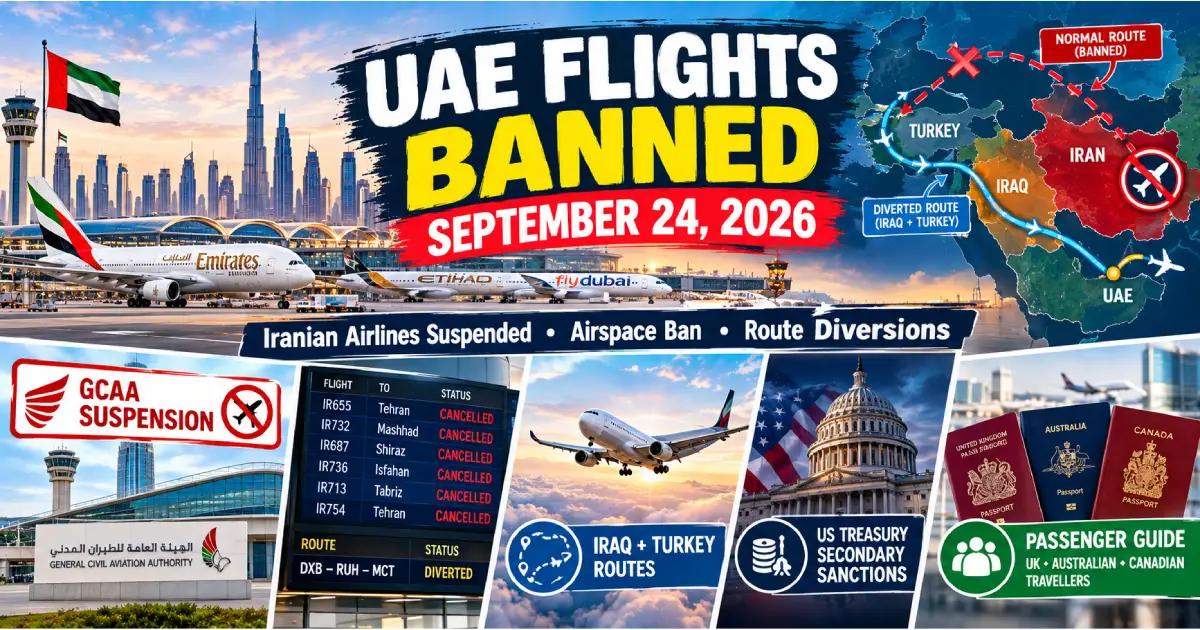
In a single 24-hour period, the Gulf aviation crisis escalated dramatically. The UAE banned Iranian airlines. Iran retaliated by banning UAE aircraft from its airspace. FlydubAI flights to Russia were diverted in real time. And the reason it all happened overnight traces to a US Treasury decision made more than two weeks earlier — one whose consequences have now arrived on runways across the Gulf.
The United Arab Emirates has officially suspended all flights operated by Iranian airlines until further notice. The General Civil Aviation Authority announced the ban on Thursday September 24, with it taking effect immediately.
Iranian-based airlines, such as Iran Air, Mahan Air, Iran Airtour, and Qeshm Air, are unable to fly in and out of Dubai International Airport and Abu Dhabi Zayed International Airport until further notice as a result of the decision.
In response, Iran decided to shut off its airspace to all UAE-registered aircraft — including those registered to Emirates, Etihad Airways, and flydubai. Data from FlightRadar24 showed flydubai flights being diverted over Iraq and Turkey within hours of the retaliatory ban taking effect.
The GCAA confirmed in a statement to Emirates News Agency WAM: “The General Civil Aviation Authority announced the suspension of flights operated by Iranian airlines to and from the UAE, effective today, Thursday, 24th September, until further notice. The GCAA confirmed that the decision was made in light of the US ban imposed on Iranian airlines from using airports in various countries around the world.”
This is not simply another chapter in the ongoing Gulf airspace crisis. It is a structural escalation — a US-driven sanctions mechanism extending far beyond the conflict zone to affect the global financial infrastructure of aviation, pulling the UAE into compliance through the threat of exclusion from the US dollar system, and producing immediate retaliatory consequences that are now reshaping flight paths across the Gulf, Caucasus, and Central Asia.
Published: September 25, 2026 Ban effective date: Thursday, September 24, 2026 — immediate Announced by: UAE General Civil Aviation Authority (GCAA) via Emirates News Agency WAM Reason: US ban imposed on Iranian airlines from using airports around the world; secondary sanctions threat against service providers Iranian airlines affected: Iran Air · Mahan Air · Iran Airtour · Qeshm Air · all other Iranian carriers UAE airports affected: Dubai International (DXB) · Abu Dhabi Zayed International (AUH) · Sharjah (SHJ) and all UAE airports Iran retaliation: Immediate airspace ban on all UAE-registered aircraft — Emirates, Etihad, flydubai FlydubAI impact: Russia routes (Baku, Moscow, St Petersburg) now diverted over Iraq + Turkey — confirmed FlightRadar24 Duration: Until further notice — no end date specified Iranian passengers stranded: Iranian diaspora community in UAE with cancelled return flights Primary confirmed sources: Gulf News · Arab News · The National · Time Out Dubai · AGBI · InsideFlyer · WAM · Paddle Your Own Kanoo EASA context: Conflict zone information bulletin expires September 30 — 5 days away US Treasury context: September 8, 2026 — 27 Iranian airlines + 36 entities sanctioned
To understand why the UAE acted on September 24, the story must begin with the US Treasury’s September 8, 2026 announcement.
The US Treasury Department on September 8 imposed sanctions on 27 Iranian airlines as part of a wider package targeting 36 entities and individuals linked to the country’s aviation sector. The target list included Iran Air (Iran’s state carrier), Mahan Air (Iran’s largest private carrier, long-sanctioned for alleged IRGC links), Iran Airtour, Qeshm Air, and dozens of smaller carriers and aviation support companies.
Critically, the September 8 sanctions package went beyond targeting Iranian airlines themselves. Treasury Secretary Scott Bessent confirmed that airports and companies providing services to Iranian-operated aircraft — including fuel, landing facilities, and ticket sales — could face secondary sanctions. Any country that is found to be allowing business to continue with Iranian airlines has been threatened with exclusion from the US dollar system.
This secondary sanctions threat is the key mechanism. The US dollar system underpins UAE trade and finance — the UAE dirham is pegged to the US dollar, and virtually all UAE international trade, banking, and finance is conducted in or through the US dollar system. Exclusion from that system would be, as multiple analysts cited this week described it, disastrous for the UAE.
For sixteen days after the September 8 Treasury announcement, the UAE allowed Iranian airline operations to continue. The Iranian diaspora in the UAE — one of the largest in the world, with an estimated 300,000+ Iranian nationals living and working in the country — continued to use Iranian carriers for visits home. The commercial relationship between the two neighbouring countries remained officially operational.
Then, on September 24, the UAE Central Bank announced that Bank Melli Iran — Iran’s largest lender — had been barred from conducting any financial transactions between its UAE branches and Iran, after investigations found the bank had failed to comply with anti-money laundering regulations. The aviation ban followed within hours — the UAE acting comprehensively to bring its aviation and financial sectors into full US sanctions compliance simultaneously.
The General Civil Aviation Authority announced the suspension of flights operated by Iranian airlines to and from the UAE, effective today, Thursday, September 24, until further notice.
Three words in this announcement carry the most operational weight: until further notice. This is not a temporary suspension with a review date. It is an open-ended ban with no stated end condition. The GCAA added that the public and all relevant authorities will be informed ahead of time if normal air traffic resumes between the two countries — an implicit acknowledgement that resumption is not expected any time soon.
The GCAA urged passengers and members of the public to rely on official and authorised sources for information — a standard cautionary statement, but one that reflects awareness that the ban will generate significant passenger confusion, particularly among the large Iranian diaspora community in the UAE.
Which airlines are affected: All Iranian carriers operating to UAE airports are suspended. The primary airlines that operated UAE routes prior to September 24 include:
Iranian state media, citing ISNA (Iranian Students News Agency), reported that flights operated by Iranian airlines to the UAE had been cancelled from midnight on September 24.
Iran’s response came within hours. Iran responded by blocking UAE-registered aircraft from its airspace, targeting Emirates, Etihad, and flydubai.
This retaliatory airspace ban covers all aircraft registered in the UAE — meaning that Emirates (the world’s largest international airline by passenger traffic), Etihad Airways (Abu Dhabi’s national carrier), and flydubai (Dubai’s state-owned budget carrier) are now prohibited from transiting Iranian airspace.
The practical consequences:
Most Emirates and Etihad long-haul routes had already been rerouted around Iran since February 2026, when US and Israeli joint military operations against Iran began and Iranian airspace became operationally hazardous. So for Emirates’ major transatlantic routes to New York, London, Sydney, and Melbourne — which fly west, north, or east of Iran — the retaliatory airspace ban changes little operationally.
The airline most directly affected is flydubai.
FlydubAI Russia routes — immediate diversion confirmed:
FlydubAI had only recently returned to flying over Iran on its flights to and from Baku in Azerbaijan. Data from flight-tracking website Flightradar24 showed flights being diverted over Iraq and Turkey within hours of Iran’s retaliatory ban. Flydubai’s recently resumed direct paths to Russian cities — including Baku, Moscow, and St Petersburg — are now extended.
The Baku route (Dubai–Baku) normally transits Iranian airspace as the geographically direct path over northern Iran. The diversion over Iraq and Turkey adds approximately 30–45 minutes to the sector time and increases fuel consumption. For Moscow and St Petersburg services, the diversion is more significant — adding potentially 60–90 minutes each way and requiring schedule adjustments to maintain crew duty hour compliance.
Travellers on flydubai Russia routes should expect:
While much of the aviation coverage focuses on the geopolitical and operational dimensions, the immediate human consequence of the ban is felt most acutely by the Iranian diaspora community in the UAE.
Dubai and Abu Dhabi together are home to an estimated 300,000+ Iranian nationals — the largest Iranian community outside of Iran in the world. These are business owners, professionals, students, and workers who maintain regular connections to family in Iran. Iranian airlines served their home community — typically cheaper and more directly routed than alternatives via Istanbul or other transit hubs.
The ban effective from midnight on September 24 means that Iranian community members who had booked Iranian airline tickets to visit family in Iran — for the upcoming Mehregan festival (mid-October), or for medical appointments, or for ordinary family visits — have had their flights cancelled without advance warning.
Options for Iranian nationals in the UAE whose Iranian airline flights are cancelled:
The UAE ban on Iranian airlines does not directly affect flights operated by British, Australian, or Canadian carriers. However, its indirect consequences matter to Tier 1 country travellers:
1 — The EASA September 30 deadline is now even more significant
The EASA Conflict Zone Information Bulletin covering Bahrain, Kuwait, Qatar, and the UAE expires on September 30 — five days from today. The UAE’s comprehensive escalation of sanctions compliance on September 24 — both the aviation ban and the Bank Melli financial freeze — will almost certainly factor into EASA’s assessment of whether to extend the bulletin.
If EASA extends the bulletin beyond September 30 (as now seems more likely given yesterday’s escalation), the flight suspensions by British Airways, Lufthansa Group, Singapore Airlines, and Cathay Pacific — which have been structured around the EASA framework — are more likely to be extended as well.
2 — FlydubAI Russia route disruption affects UK and Australian connecting passengers
FlydubAI operates significant connections from Dubai to destinations in Eastern Europe, the Caucasus, and Central Asia that serve as onward connections for UK and Australian passengers. Longer flydubai journey times on Russia-region routes compound the disruption that connecting passengers already face.
3 — The dollar system mechanism reveals the crisis is no longer primarily military
The UAE ban was not triggered by a new missile attack, a drone strike, or an airspace closure over a conflict zone. It was triggered by a financial compliance mechanism — the threat of exclusion from the US dollar system. This is a new dimension to the Gulf aviation crisis that this publication has not previously covered: the role of US financial sanctions architecture in reshaping civil aviation independently of the physical conflict.
Emirates: Emirates’ core long-haul network — to London Heathrow, Sydney, New York, Los Angeles, Tokyo, Nairobi, and dozens of other destinations — was already routing around Iranian airspace and is unaffected by Iran’s retaliatory airspace ban. Emirates had earlier in 2026 been routing around the conflict zone. No Emirates routes are newly disrupted by today’s ban.
Etihad Airways: Similarly, Etihad’s primary long-haul network was already rerouted around Iranian airspace from February 2026 onwards. The retaliatory ban creates minimal new operational impact for Etihad’s main network.
FlyDubai: Most directly affected. FlydubAI’s recently resumed Iranian overflights on Russia-region routes are now suspended. Flights to Baku (Azerbaijan), Moscow, and St Petersburg are being diverted over Iraq and Turkey as confirmed by FlightRadar24. Passengers on these routes should check flight status directly.
British Airways at Dubai: British Airways had already suspended Dubai services through late October 2026 (November return confirmed, as this publication reported on September 21). Today’s escalation does not change BA’s return timeline but reinforces the complexity of the environment it will be returning to.
International airlines restoring some UAE service: Some international carriers have been cautiously restoring Dubai services in recent weeks. Today’s escalation may pause or reverse some of those decisions as airlines reassess the risk environment.
| Date | Event |
|---|---|
| September 8 | US Treasury sanctions 27 Iranian airlines + 36 entities; secondary sanctions threat issued |
| September 8 | NATS UK software failure — 2,000+ flights cancelled (separate event, same day) |
| September 15 | This publication covers Gulf airspace crisis comprehensively for first time |
| September 19 | Houthi missile near Riyadh airport — FlightRadar24 maximum disruption 5.0 |
| September 21 | Gulf airports recording 1,585 delays + 40 cancellations |
| September 24 | UAE Central Bank freezes Bank Melli Iran UAE branches |
| September 24 | GCAA bans all Iranian airline flights — effective immediately |
| September 24 | Iran retaliates — bans UAE aircraft from Iranian airspace |
| September 24 | FlydubAI Russia routes diverted over Iraq + Turkey — confirmed FlightRadar24 |
| September 25 (today) | UAE + Dubai airports reporting ongoing delays |
| September 30 | EASA Conflict Zone Information Bulletin expires |
Iranian airlines are required to refund cancelled flights under their applicable passenger rights obligations. Contact your carrier directly:
Your direct flight rights are not affected by today’s ban — your carrier (Emirates, Etihad, British Airways, Qantas, etc.) continues to operate your specific sectors. However:
| Contact | Details |
|---|---|
| UAE GCAA | gcaa.gov.ae |
| Dubai Airport live status | dubaiairports.ae → Flight Status |
| Abu Dhabi Airport | abudhabiairport.ae → Flight Status |
| Emirates | 600 555 555 (UAE) · emirates.com → Manage Booking |
| Etihad Airways | 600 555 0600 (UAE) · etihad.com → Manage My Booking |
| FlyDubai | +971 4 232 2232 · flydubai.com → Manage Booking |
| British Airways | 0800 727 800 (UK) · ba.com → Manage My Booking |
| Iran Air (for affected passengers) | iranair.com |
| Mahan Air (for affected passengers) | mahanair.com |
| FlightRadar24 live tracking | flightradar24.com |
| EASA conflict zone bulletin | easa.europa.eu |
| Metric | Detail |
|---|---|
| Decision | UAE GCAA suspends all Iranian airline flights — effective September 24, until further notice |
| Reason | US Treasury September 8 sanctions on 27 Iranian airlines; secondary sanctions threat |
| Financial mechanism | Dollar system exclusion threat — US ban forces UAE compliance |
| Carriers banned | Iran Air · Mahan Air · Iran Airtour · Qeshm Air · all Iranian carriers |
| Airports affected | Dubai (DXB) · Abu Dhabi (AUH) · all UAE airports |
| Iran retaliation | Airspace ban on UAE-registered aircraft — Emirates, Etihad, flydubai |
| FlydubAI impact | Russia routes (Baku, Moscow, St Petersburg) diverted over Iraq + Turkey |
| Confirmed sources | Gulf News · Arab News · The National · AGBI · InsideFlyer · WAM · 5 more |
| Iranian diaspora | 300,000+ Iranian nationals in UAE — flights cancelled without advance warning |
| EASA context | Conflict Zone Bulletin expires September 30 — 5 days — extension now more likely |
| BA Dubai return | November 2026 (unchanged) — but environment is more complex |
| Passenger rights | Iranian airline passengers: refund via carrier or card chargeback |
Related Articles:
Posted By : Vinay
This article is provided for general informational purposes only and is based on information available at the time of publication. Travel advisories, airline schedules, airport operations, visa requirements, government regulations, and other travel-related information are subject to change without prior notice. While Travel Tourister makes reasonable efforts to verify information using official announcements, government publications, airline and airport communications, and other reliable sources, we cannot guarantee that all information remains complete, accurate, or up to date at all times. Readers should independently verify any information that may affect their travel plans with the relevant airline, airport authority, government agency, embassy, or other official source before making travel, financial, or other decisions. Travel Tourister shall not be liable for any direct or indirect loss, inconvenience, or damages arising from the use of or reliance on the information contained in this article. Nothing in this publication constitutes legal, immigration, financial, or professional travel advice. If you believe any information in this article is inaccurate or outdated, please contact our editorial team. We review all credible correction requests promptly and update our content whenever appropriate.
Lastest News
2nd Floor, 39, Above Kirti Club, DLF Industrial Area, Kirti Nagar, New Delhi, Delhi 110015



Travel Tourister is a leading Travel portal where we introduce travellers to trusted travel agents to make their journey hasselfree, memorable And happy. Travel Tourister is a platform where travellers get Tour packages ,Hotel packages deals through trusted travel companies And hoteliers who are working with us across the world. We always try to find new and more travel agents and hoteliers from every nook and corners across the world so that you could compare the deals with different travel agents and hoteliers and book your tour or hotel with the one you have chosen according to your taste and budget.
Copyright © Travel Tourister, India. All Rights Reserved

 Call
Call Enquiry