Published on : 21 Sep 2026
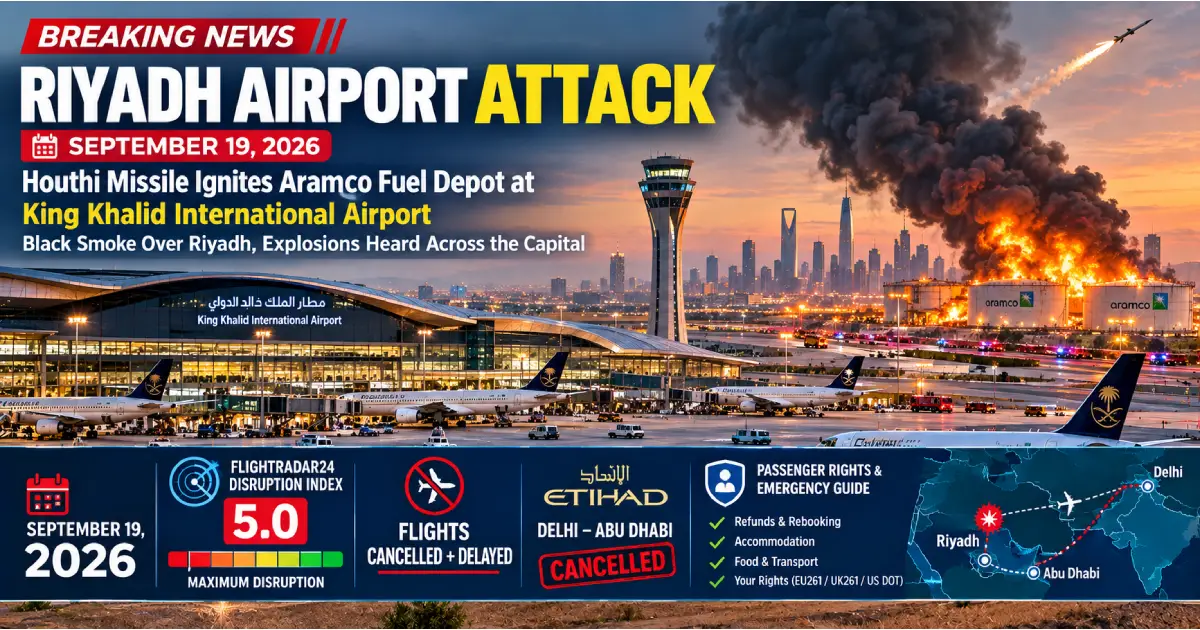
Riyadh woke up to fire, smoke, and the sound of explosions on the morning of September 19, 2026. A Houthi ballistic missile, launched toward Saudi Arabia’s capital in a coordinated strike, was intercepted by Saudi air defences — but not before setting an Aramco fuel depot ablaze near the runway perimeter of King Khalid International Airport. What followed was one of the most serious aviation security incidents at a major international airport in 2026.
Yemen’s Houthis struck Riyadh for the first time in this conflict cycle on the night of September 18–19, setting an Aramco fuel depot ablaze near King Khalid International Airport and triggering major flight disruptions. Yemen’s Ansarallah movement claimed responsibility for two simultaneous strikes: an attack on what Houthi military spokesman Yahya Saree described as “sensitive sites” in the Saudi capital using a large number of ballistic and cruise missiles and drones, and a separate operation targeting Saudi Aramco facilities in the Red Sea port of Yanbu.
In Riyadh, the strikes set a fuel depot near King Khalid International Airport ablaze, with photographers on the ground documenting firefighters battling a burning tank embossed with the Aramco logo. Saudi authorities issued an overnight air raid alert for Riyadh and the nearby city of Al-Kharj. Residents across the city reported hearing explosions and watching black smoke rise over the horizon. Flight tracking service FlightRadar24 listed King Khalid International Airport under its maximum disruption index of 5.0 — meaning the airport was experiencing “major problems with long delays and several cancelled flights.”
This was not a routine disruption. It was not a thunderstorm, an ATC system failure, or a strike action. It was a missile attack on the fuel supply infrastructure of one of the world’s most internationally connected airports — an event without precedent in the 2026 aviation crisis and with direct consequences for tens of thousands of passengers whose journeys pass through Riyadh.
Published: September 21, 2026 Event date: September 19, 2026 (overnight into Saturday morning, Riyadh local time) Airport: King Khalid International Airport (RUH), Riyadh, Saudi Arabia Disruption classification: FlightRadar24 maximum index 5.0 — “major problems with long delays and several cancelled flights” Cause: Houthi ballistic missile intercepted near RUH — Aramco fuel depot blaze adjacent to airport Confirmed by: AFP · France24 · Eastern Herald · The Traveler · Nomad Lawyer · Malay Mail · Outlook India · FlightRadar24 Saudi coalition response: Ballistic missile intercepted; Houthi drones toward Bish, Farasan, Taif, Yanbu also foiled Houthi claim: Two simultaneous strikes — Riyadh “sensitive sites” + Aramco Yanbu facilities Saudi wounded (all locations): 73 (unverified independently) Significance: First Houthi strike reaching Riyadh in this conflict cycle Simultaneous incident: Etihad Airways cancels Delhi–Abu Dhabi (technical issue same day) Airport current status: Operations resumed trending toward normal by Saturday evening Ongoing context: Part of the wider Gulf airspace crisis — EASA conflict zone bulletin extended to September 30
Night of September 18–19 (approximately 02:00–04:00 local Riyadh time): Saudi civil defence issued an overnight alert warning of a possible aerial threat. The alert covered Riyadh and the nearby city of Al-Kharj. Saudi residents received phone notifications. Some residents described hearing what sounded like explosions through the night.
Early morning September 19: The Saudi-led coalition confirmed in a statement carried by Al Jazeera that Saudi air forces had successfully intercepted and destroyed a ballistic missile launched by the Houthi terrorist militia towards the city of Riyadh at dawn. The missile was intercepted — but not before a blaze ignited on a fuel tank at the Aramco-owned depot near the airport’s edge.
Morning September 19: Two residents told AFP, speaking on condition of anonymity, that they saw black smoke and fire in the direction of the airport. AFP journalists subsequently heard two additional explosions before the Saudi civil defence agency lifted the alert. A column of black smoke rose from the Aramco fuel depot near the airport perimeter, visible from apartment windows across Riyadh. Firefighters arrived on scene and began combating the blaze at the burning Aramco-branded fuel tank.
Saturday morning through afternoon: FlightRadar24 listed King Khalid International Airport under its maximum disruption index of 5.0. This is the highest possible disruption classification on FlightRadar24 — defined as major problems with long delays and several cancelled flights. Flight tracking data showed widespread delays and cancellations spreading through morning and afternoon schedules.
Saturday afternoon through evening: Firefighters extinguished the blaze. Saudi civil defence lifted the initial alert. Later coverage indicated flight operations began trending back toward normal as the day progressed, though disruption continued into the afternoon as the knock-on effects of cancelled and delayed services compounded through the schedule.
Every disruption this publication has covered this year — from JFK’s five June chaos days, to the NATS millisecond software failure, to the Mount Etna ash cloud, to the ongoing Gulf airspace carrier suspensions — has had a civilian or operational cause. Weather. ATC. Software. Staffing.
September 19 at Riyadh is different. It is the first time in 2026 that a major international airport’s operations have been disrupted by an act of armed conflict — specifically, a ballistic missile strike resulting in a fuel depot fire adjacent to an active runway.
Striking the capital, home to more than seven million people and the seat of the Al Saud family, moves this conflict into political and psychological territory that infrastructure damage alone cannot reach. Riyadh has not been attacked like this in this conflict cycle. The fact that Saudi air defences successfully intercepted the missile does not alter the operational consequence for the airport — the fire, the alert, the black smoke visible across the city, and the immediate cessation of normal flight operations.
For international passengers, the significance is straightforward: Riyadh’s King Khalid International Airport is not a secondary regional gateway. It is one of the Gulf’s busiest international hubs, handling routes to Europe, Asia, North America, Africa, and beyond. A disruption here affects a global network.
King Khalid International Airport (RUH) is the primary international gateway for Saudi Arabia’s capital and its surrounding region of 7+ million people. It serves as the primary hub for Saudia (Saudi Airlines) and Flynas, and as a major transit point for international carriers serving the Kingdom.
Key route connections from RUH:
The international reach of King Khalid International Airport means that Saturday’s maximum-disruption event did not only affect passengers travelling to and from Riyadh. It affected transit passengers connecting through RUH to onward destinations across three continents — passengers whose first or last awareness of the disruption may have been a delay notification on a flight sector that had nothing to do with Saudi Arabia.
On the same day as the Riyadh attack, a separate disruption compounded the regional picture. Etihad Airways cancelled its New Delhi to Abu Dhabi service after a technical issue, stranding travellers and forcing rebookings.
While entirely unrelated to the Riyadh missile strike, the timing created a double-disruption across two of the Gulf’s major aviation hubs on the same day — RUH under fire-driven maximum disruption, and Abu Dhabi dealing with a cancelled Etihad service from one of its most important feeder markets (India).
For passengers on the Delhi–Abu Dhabi Etihad route:
Saturday’s attack did not occur in isolation. It is the most dramatic aviation-consequence event yet in a broader pattern of Gulf instability that has driven the region’s largest aviation disruption since the outbreak of the Israel-Hamas conflict in 2023.
Since March 2026, escalating conflict involving US-Israeli strikes on Iran and Iranian counterstrikes against Gulf infrastructure has created an unprecedented aviation security environment in the region. Kuwait International Airport was struck by drone attacks in March 2026 and remained closed for weeks. Iranian forces launched attacks on US facilities in Saudi Arabia. Saudi air defences intercepted multiple Houthi attacks in preceding weeks.
The EASA conflict zone information bulletin covering Bahrain, Kuwait, Qatar, and the UAE — which has driven the flight suspensions by British Airways, Lufthansa Group, Singapore Airlines, Cathay Pacific, and Air Canada since mid-2026 — is still in force. It was extended on August 31 to September 30, 2026. That deadline is nine days away from today.
The September 19 Riyadh attack is likely to be cited in any further EASA assessment of Gulf airspace risk. It demonstrates that the threat is not confined to the lower Gulf or to Iranian proxies operating over shipping lanes — it reaches directly into the Saudi capital, adjacent to an airport runway, in daylight hours.
Passengers arriving into RUH on September 19: Inbound flights faced delays and diversions as the airport operated in reduced capacity mode throughout the morning and early afternoon. Passengers connecting onward through Riyadh for second legs were particularly exposed — a missed Riyadh connection due to a delayed inbound flight on a day of maximum disruption means the connecting airline is responsible for rebooking.
Passengers departing from RUH on September 19: Multiple departures were cancelled and delayed throughout the morning. Saudia, Flynas, and international carriers operating from RUH all faced schedule disruption.
Transit passengers routing through RUH: Passengers routing via Riyadh to onward destinations — particularly on Saudia’s international network to Europe, Asia, and Africa — faced cascading connection failures when their inbound connecting legs arrived late or were cancelled.
Passengers already in Riyadh on holidays, business, or in transit: Passengers who were in Saudi Arabia during the overnight alert faced a more personal dimension of this disruption — an air raid alert, the sound of explosions, and uncertainty about when the airport would return to normal operations.
Saturday’s disruption has two potential cause classifications:
“Extraordinary circumstances”: If the airline attributes your specific cancellation or delay directly to the missile strike and fuel depot fire — a genuine security emergency beyond the airline’s control — this may be classified as extraordinary circumstances under applicable regulations. In this case, fixed cash compensation may not be payable. However, duty of care (meals, hotel, rebooking) ALWAYS applies regardless of cause.
“Operational delay”: If your specific delay or cancellation was a knock-on consequence — your aircraft was not in the right position because an earlier flight was disrupted by the emergency — and the airline cannot directly attribute your specific disruption to the extraordinary circumstance, you may have a stronger claim for compensation.
Ask your airline in writing: “What specific cause is being recorded for my flight’s cancellation/delay on September 19 at RUH? Is it being classified as extraordinary circumstances?”
Screenshot every cancellation notification. Save every rebooking confirmation. Keep all receipts for meals, accommodation, and transport incurred because of the disruption. These are the foundation of any duty of care claim or subsequent compensation application.
Under international aviation regulations, regardless of whether your specific disruption is classified as extraordinary circumstances, airlines must provide:
These duty of care obligations apply even when fixed cash compensation does not.
| Your situation | Regulation | Compensation potential |
|---|---|---|
| Saudia/Flynas flight — Saudi-origin or Saudi regulation | GACAR passenger rights | Saudi GACA complaint process |
| European carrier departing from RUH | EU261 | Disputed — may be extraordinary circumstances |
| UK carrier departing from RUH | UK261 | Disputed — may be extraordinary circumstances |
| Any carrier — duty of care | All frameworks | ✅ Always applies |
Saturday’s Riyadh attack echoes a precedent that Saudi aviation has experienced before. On 25 March 2022, the Houthi movement conducted drone and missile attacks on an Aramco oil storage facility at Saudi Aramco’s North Jeddah Bulk Plant, triggering a large fire. That attack occurred approximately 11 kilometres from the Jeddah Corniche Circuit during the 2022 Formula One Saudi Arabian Grand Prix — black smoke was visible from the circuit during practice sessions, with some drivers remarking on a burning smell from their cockpits.
The 2022 Jeddah attack ultimately did not close the airport. The 2026 Riyadh attack reached directly to the airport’s fuel supply infrastructure — a qualitatively more severe location. In 2022, the airport remained open but disrupted. In 2026, RUH reached FlightRadar24’s maximum disruption index.
| Carrier | Contact | Online |
|---|---|---|
| Saudia (Saudi Airlines) | +966 920 022 222 | saudia.com → Manage Booking |
| Flynas | +966 920 010 105 | flynas.com → Manage Booking |
| Etihad Airways | +971 2 599 0000 | etihad.com → Manage My Booking |
| Emirates | +971 600 555 555 | emirates.com → Manage Booking |
| flydubai | +971 4 232 2232 | flydubai.com → Manage Booking |
| British Airways (Gulf context) | 0800 727 800 (UK) | ba.com → Manage My Booking |
| Lufthansa (Gulf context) | 0371 945 9747 (UK) | lufthansa.com → My Bookings |
| Air India | +91 11 2462 0566 | airindia.com → Manage Booking |
| Saudi GACA complaints | — | gaca.gov.sa |
| EASA Gulf bulletin info | — | easa.europa.eu |
| FlightRadar24 live tracking | — | flightradar24.com |
| Metric | Detail |
|---|---|
| Airport | King Khalid International Airport (RUH), Riyadh |
| Event | Houthi ballistic missile intercepted; Aramco fuel depot ablaze near runway |
| Confirmed by | AFP · France24 · Eastern Herald · FlightRadar24 · The Traveler · Nomad Lawyer |
| Disruption level | FlightRadar24 maximum index 5.0 — highest possible classification |
| Significance | First Houthi strike reaching Riyadh in 2026 conflict cycle |
| Saudi coalition | Confirmed interception; Houthi attacks on Bish, Farasan, Taif, Yanbu also foiled |
| Houthi claim | Ballistic missiles + drones targeting Riyadh “sensitive sites” + Yanbu Aramco |
| Airport status | Operations gradually resumed Saturday evening |
| Simultaneous incident | Etihad cancels Delhi–Abu Dhabi (technical issue, same day) |
| Gulf context | Part of wider Gulf airspace crisis — EASA bulletin expires September 30 |
| Duty of care right | ✅ Always applies regardless of extraordinary circumstances classification |
| Cash compensation | Disputed — extraordinary circumstances likely to be claimed by airlines |
| Historical parallel | 2022 Jeddah Aramco attack — first airport infrastructure strike since |
Related Articles:
Posted By : Vinay
This article is provided for general informational purposes only and is based on information available at the time of publication. Travel advisories, airline schedules, airport operations, visa requirements, government regulations, and other travel-related information are subject to change without prior notice. While Travel Tourister makes reasonable efforts to verify information using official announcements, government publications, airline and airport communications, and other reliable sources, we cannot guarantee that all information remains complete, accurate, or up to date at all times. Readers should independently verify any information that may affect their travel plans with the relevant airline, airport authority, government agency, embassy, or other official source before making travel, financial, or other decisions. Travel Tourister shall not be liable for any direct or indirect loss, inconvenience, or damages arising from the use of or reliance on the information contained in this article. Nothing in this publication constitutes legal, immigration, financial, or professional travel advice. If you believe any information in this article is inaccurate or outdated, please contact our editorial team. We review all credible correction requests promptly and update our content whenever appropriate.
Lastest News
2nd Floor, 39, Above Kirti Club, DLF Industrial Area, Kirti Nagar, New Delhi, Delhi 110015



Travel Tourister is a leading Travel portal where we introduce travellers to trusted travel agents to make their journey hasselfree, memorable And happy. Travel Tourister is a platform where travellers get Tour packages ,Hotel packages deals through trusted travel companies And hoteliers who are working with us across the world. We always try to find new and more travel agents and hoteliers from every nook and corners across the world so that you could compare the deals with different travel agents and hoteliers and book your tour or hotel with the one you have chosen according to your taste and budget.
Copyright © Travel Tourister, India. All Rights Reserved

 Call
Call Enquiry