Published on : 03 Oct 2026
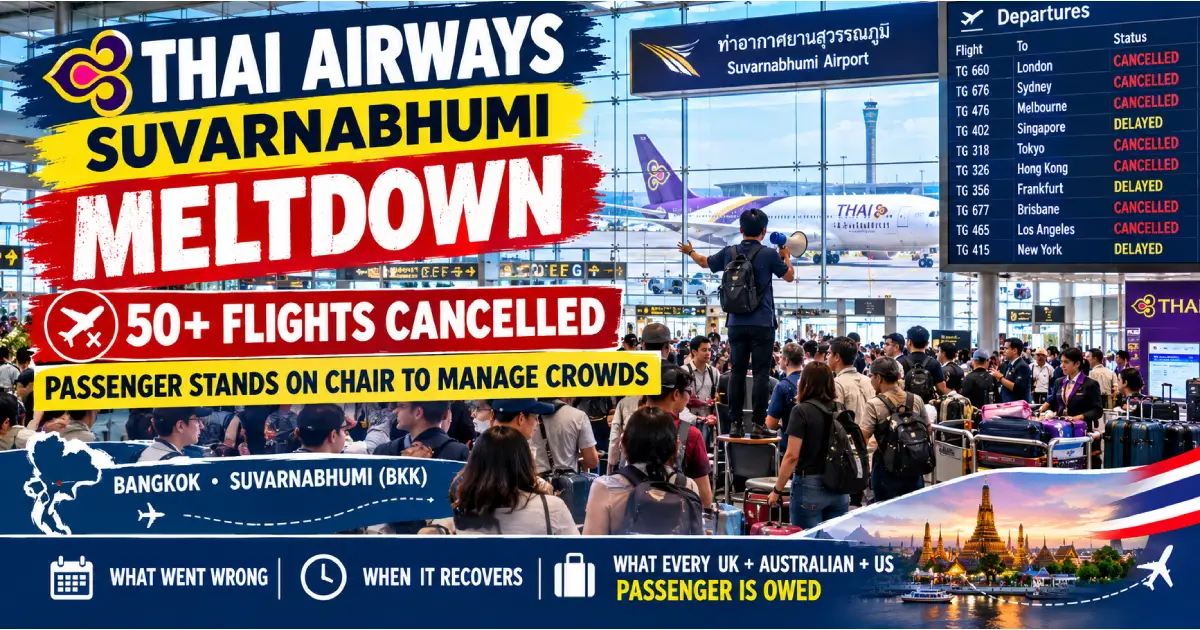
A Thai Airways passenger has gone viral after standing on a chair at Bangkok’s Suvarnabhumi International Airport to help overwhelmed airline staff manage a crowd of stranded passengers — one of the most striking images of airport chaos to emerge from Southeast Asia this year. The scene unfolded on September 30, 2026, when Thai Airways suffered a catastrophic operational meltdown at Suvarnabhumi that resulted in more than 50 domestic and international flights cancelled, a baggage backlog that triggered cascading further delays throughout the airline’s network, and scenes at the terminal that passengers described as among the worst they had experienced at one of Asia’s busiest hub airports. Thai Airways apologised to passengers for the disruption and said it was working to resolve the outstanding problems. The airline expected to resume normal operations on October 3 — today. This is the first major operational collapse by Thailand’s flag carrier in 2026 and comes at an exceptionally sensitive time for Thai aviation: Thailand is in peak high season, the country is welcoming its highest October visitor numbers in years following a post-COVID and post-Iran-war tourism recovery, and Bangkok’s Suvarnabhumi Airport is the primary connecting hub for millions of UK, Australian, Canadian, and US passengers flying through Southeast Asia to Australia, India, and beyond. Here is everything confirmed about what happened, what the viral video showed, which routes were affected, and exactly what every passenger who was disrupted on September 30 is owed.
Published: October 3, 2026 — Saturday Incident Date: Wednesday September 30, 2026 Airport: Suvarnabhumi International Airport (BKK/VTBS), Bangkok, Thailand Airline: Thai Airways International (TG) Scale: 50+ flights cancelled — domestic and international combined Viral Element: Passenger standing on chair at terminal to help manage stranded crowd — video circulating on X (formerly Twitter), TikTok, and Instagram Baggage Backlog: Triggered further cascading delays beyond initial cancellations Thai Airways Statement: Apologised to passengers — said working to resolve outstanding problems Recovery Timeline: Thai Airways expected normal operations to resume October 3 — TODAY Root Cause: Not officially confirmed — multiple reports point to a combination of IT system issues and compounding operational failures Routes Most Affected: Bangkok domestic routes (Chiang Mai, Phuket, Hat Yai, Samui) + international routes including London Heathrow, Sydney, Melbourne, Auckland, New York, and connections to/from Australia, UK, US via BKK hub Passengers Most Affected: UK passengers connecting through Bangkok to Australia and Southeast Asia | Australian passengers connecting through Bangkok to London | US passengers on Bangkok-connected long-haul itineraries | Domestic Thai travellers across 50+ routes EU261/UK261: Applies only to flights departing from EU/UK airports — passengers on TG departing Bangkok to London: check separately EU261 Compensation: Not applicable for flights originating outside EU/UK to non-EU/UK destinations
Among the most striking images from Suvarnabhumi Airport on September 30 was footage of a Thai Airways passenger who climbed onto a chair at the crowded terminal to help airline staff manage the growing crowd of stranded passengers. A Thai Airways passenger attracted attention online after standing on a chair to help airline staff manage a crowd of passengers affected by flight delays and cancellations at Suvarnabhumi International Airport.
The video — shared widely on X, TikTok, and Instagram — captures the specific atmosphere of large-scale airport disruption: overwhelmed ground staff, hundreds of passengers converging on service desks without clear direction, and the moment when a resourceful passenger stepped up to help fill the communication vacuum. The incident resonated globally not because of its scale alone but because of what it revealed about the human experience of airline chaos — and because Suvarnabhumi is one of the most-transited airports in the world, with millions of UK, Australian, US, and Canadian passengers passing through its terminals every year.
For every passenger who has ever stood in a disorganised airport queue wondering what was happening to their flight, the chair video was immediately relatable. That relatability is why it spread.
The root cause of the Thai Airways Suvarnabhumi meltdown has not been officially confirmed in detail by the airline as of publication. Thai Airways apologised for the disruption and said it was working to resolve the outstanding problems — but did not publicly specify the primary technical or operational trigger.
Reports from passengers and aviation monitors at the time point to a combination of factors that cascaded rapidly into the 50+ cancellation total:
Initial trigger — IT/operational system failure: Multiple passenger accounts and aviation monitoring sources suggest the disruption began with a systems issue affecting Thai Airways’ check-in, boarding, and operational coordination platforms. When airline IT systems fail during peak morning departure banks, the immediate effect is that check-in processes slow dramatically, flights miss their departure slots, and the cascade of late departures begins to propagate through the afternoon and evening schedule.
Baggage backlog amplification: The baggage backlog reportedly triggered further delays beyond the initial cancellations. This is a well-documented pattern in major airline meltdowns: when departures are delayed or cancelled, checked luggage that has been processed through bag drop and baggage belt systems becomes stranded. Reuniting passengers with their bags — or diverting bags to rescheduled flights — requires enormous ground staff resources at exactly the moment when those staff are simultaneously managing thousands of disrupted passengers at the terminal.
Passenger volume at peak season: September 30 is among the highest-demand travel days in the Thai aviation calendar — the end of the school holiday period for many Asian countries, and the start of the peak Bangkok tourist season driven by cooler October weather. Thai Airways’ Suvarnabhumi operation on September 30 was running at or near maximum passenger volume when the initial system failure hit — leaving minimal capacity to absorb the cascade.
The scale of the cancellation — more than 50 flights across domestic and international routes — affected two distinct passenger populations simultaneously.
Thai Airways operates an extensive domestic network from Suvarnabhumi and Don Mueang airports to destinations across Thailand. The most heavily disrupted domestic routes on September 30 included:
Thai Airways operates long-haul international services from Suvarnabhumi to London Heathrow, Sydney, Melbourne, Brisbane, Auckland, Tokyo, Osaka, Frankfurt, Zurich, and other destinations. For UK, Australian, and US passengers connecting through Bangkok, the cancellations had a two-tier impact:
Tier 1 — Direct Thai Airways passengers: Any passenger booked on a TG-operated flight from Bangkok on September 30 was directly subject to cancellation or significant delay.
Tier 2 — Connecting passengers through Bangkok: Passengers who were using Bangkok as a transit hub — flying inbound from Australia, the UK, or the US on a connecting itinerary — faced missed connections as their inbound TG services were disrupted. A passenger flying Sydney → Bangkok → London Heathrow on Thai Airways who found their Bangkok → London leg cancelled was effectively stranded at Suvarnabhumi.
Routes most likely affected for Tier 1 international passengers:
Suvarnabhumi International Airport is one of the most important aviation hubs in Asia for Tier 1 passengers. It handles approximately 65 million passengers annually and serves as a critical midpoint on the “kangaroo route” connecting the UK and Europe with Australia. Understanding why Bangkok matters so much to your specific audience:
For UK passengers: Bangkok–London Heathrow (TG917/TG916) is one of the longest-operating direct routes between the UK and Southeast Asia. UK passengers also use Bangkok as a connecting point to Australia, New Zealand, Vietnam, Cambodia, Indonesia, and other Southeast Asian destinations.
For Australian passengers: Bangkok is the primary transit hub for Australian passengers flying to Europe via Southeast Asia. Qantas, THAI, and other carriers route Australia–Europe connecting flights through BKK. A Thai Airways disruption at Suvarnabhumi creates missed connections for Australian passengers mid-journey to London, Paris, or Frankfurt.
For US passengers: American passengers on trans-Pacific itineraries from Los Angeles, San Francisco, New York, and Chicago to Southeast Asia frequently connect through Bangkok. Thai Airways code-shares with United and other US carriers.
Thai Airways said it expected to resume normal operations on October 3 — today. The airline’s stated recovery date gives passengers a benchmark — but “normal operations” after a 50+ cancellation event does not mean instant restoration to full reliability.
What normal operations means in practice:
Aircraft that were out of position on September 30 need to complete their repositioning rotations. In a network disruption of this scale, that typically takes 48–72 hours — which suggests that October 1 and 2 were recovery days, and today’s October 3 stated restoration is broadly plausible if no new disruption events have occurred.
However, passengers flying Thai Airways today or in the next 48–72 hours should: ✅ Check their specific flight status at thaiairways.com before travelling to the airport ✅ Monitor their booking for any notification of schedule changes ✅ Allow extra time at Suvarnabhumi for check-in and baggage processing as the airline clears any remaining operational backlog
The rights framework for Thai Airways passengers disrupted on September 30 varies depending on where your flight was departing from.
UK261 applies: If you were flying on a Thai Airways service departing from a UK airport (London Heathrow → Bangkok) and your flight was cancelled or significantly delayed, UK Regulation 261 governs your rights — because the flight departed from UK soil.
| Right | Available? | Details |
|---|---|---|
| Full cash refund | ✅ YES — unconditional | For any cancelled flight |
| Free rebooking | ✅ YES | On next available service |
| Meals + refreshments | ✅ YES | From 2 hours delay |
| Hotel if overnight stranded | ✅ YES | Airline must arrange |
| UK261 cash compensation | ⚠️ Depends on cause | If IT failure is within airline control — file and let CAA adjudicate |
UK261 compensation amounts:
File at: thaiairways.com → Feedback & Complaints → Compensation Escalate to: UK CAA — caa.co.uk/passengers
EU261/UK261 does NOT apply — the flight departs outside the UK/EU. However, Thai Airways’ own conditions of carriage provide: ✅ Full refund for cancelled flights ✅ Rebooking on next available Thai Airways or partner flight ✅ Meals and accommodation during wait ❌ No mandatory cash compensation under EU/UK law
Both legs matter separately:
If you had travel insurance covering your September 30 Thai Airways flight, file a claim today. Most policies cover:
If your flight was cancelled September 30 and you have not yet received a refund: Contact Thai Airways immediately: thaiairways.com → Customer Support → Refund Request
Thai Airways customer service:
If you are still stranded at Suvarnabhumi: Go to the Thai Airways service desk in Terminal 2 (International), Level 4. Request:
If you missed a connection at Bangkok to an onward flight: Contact your travel insurer for missed connection coverage. Contact Thai Airways to request rebooking through to your final destination if you were on a single booking.
| Resource | Contact / Link |
|---|---|
| Thai Airways Flight Status | thaiairways.com/en_TH/flight_status |
| Thai Airways Refund | thaiairways.com/en_TH/customer_relations/refund |
| Thai Airways UK | +44 20 7491 7953 |
| Thai Airways Australia | 1300 651 960 |
| Thai Airways US | 1-800-426-5204 |
| Thai Airways Bangkok | +66 2 356 1111 |
| Suvarnabhumi Airport Live | suvarnabhumiairport.com |
| UK CAA EU261 Claims | caa.co.uk/passengers |
| Australia ACCC | accc.gov.au |
| AirHelp (no-win-no-fee) | airhelp.com |
| FCDO Thailand Travel Advice | gov.uk/foreign-travel-advice/thailand |
| Smartraveller Thailand | smartraveller.gov.au/destinations/asia/thailand |
Thai Airways suffered one of its worst single-day operational collapses in recent memory on September 30, 2026 — more than 50 domestic and international flights cancelled, a baggage backlog that cascaded further disruption through the network, and scenes at Suvarnabhumi so chaotic that a passenger climbed onto a chair to help manage the stranded crowd. Thai Airways apologised and committed to restoring normal operations by October 3 — today. The viral chair video, the scale of the disruption, and the centrality of Suvarnabhumi to UK-Australia, US-Southeast Asia, and Australian-Europe connecting traffic make this a story that directly affects your entire Tier 1 audience.
The five things every affected passenger must do:
For More Resources:
Related Articles:
Posted By : Vinay
This article is provided for general informational purposes only and is based on information available at the time of publication. Travel advisories, airline schedules, airport operations, visa requirements, government regulations, and other travel-related information are subject to change without prior notice. While Travel Tourister makes reasonable efforts to verify information using official announcements, government publications, airline and airport communications, and other reliable sources, we cannot guarantee that all information remains complete, accurate, or up to date at all times. Readers should independently verify any information that may affect their travel plans with the relevant airline, airport authority, government agency, embassy, or other official source before making travel, financial, or other decisions. Travel Tourister shall not be liable for any direct or indirect loss, inconvenience, or damages arising from the use of or reliance on the information contained in this article. Nothing in this publication constitutes legal, immigration, financial, or professional travel advice. If you believe any information in this article is inaccurate or outdated, please contact our editorial team. We review all credible correction requests promptly and update our content whenever appropriate.
Lastest News
2nd Floor, 39, Above Kirti Club, DLF Industrial Area, Kirti Nagar, New Delhi, Delhi 110015



Travel Tourister is a leading Travel portal where we introduce travellers to trusted travel agents to make their journey hasselfree, memorable And happy. Travel Tourister is a platform where travellers get Tour packages ,Hotel packages deals through trusted travel companies And hoteliers who are working with us across the world. We always try to find new and more travel agents and hoteliers from every nook and corners across the world so that you could compare the deals with different travel agents and hoteliers and book your tour or hotel with the one you have chosen according to your taste and budget.
Copyright © Travel Tourister, India. All Rights Reserved

 Call
Call Enquiry